
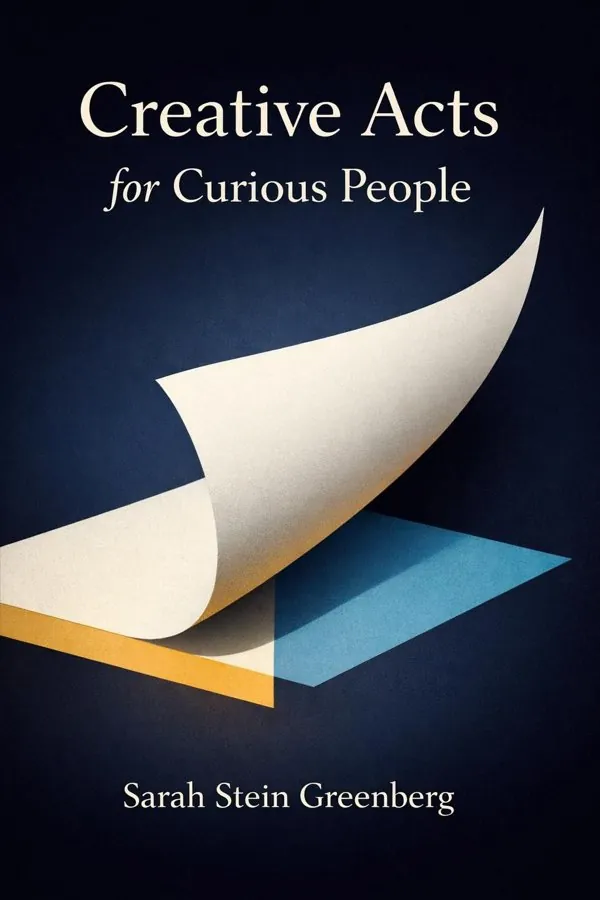
Creative Acts for Curious People: How to Think, Create, and Lead in Unconventional Ways: Summary & Key Insights
 10 min5 chaptersAudio available
What Is Creative Acts for Curious People: How to Think, Create, and Lead in Unconventional Ways About?
Creative Acts for Curious People: How to Think, Create, and Lead in Unconventional Ways by Sarah Stein Greenberg is a creativity book spanning 5 pages. This book, written by Sarah Stein Greenberg, the executive director of Stanford University's d.school, offers a collection of creative exercises and insights designed to help readers cultivate curiosity, innovation, and leadership through design thinking. It provides practical methods for approaching challenges with creativity and empathy, encouraging readers to experiment and embrace unconventional problem-solving.
This FizzRead summary covers all 5 key chapters of Creative Acts for Curious People: How to Think, Create, and Lead in Unconventional Ways in approximately 10 minutes, distilling the most important ideas, arguments, and takeaways from Sarah Stein Greenberg's work. Also available as an audio summary and Key Quotes Podcast.
Creative Acts for Curious People: How to Think, Create, and Lead in Unconventional Ways
This book, written by Sarah Stein Greenberg, the executive director of Stanford University's d.school, offers a collection of creative exercises and insights designed to help readers cultivate curiosity, innovation, and leadership through design thinking. It provides practical methods for approaching challenges with creativity and empathy, encouraging readers to experiment and embrace unconventional problem-solving.
Who Should Read Creative Acts for Curious People: How to Think, Create, and Lead in Unconventional Ways?
This book is perfect for anyone interested in creativity and looking to gain actionable insights in a short read. Whether you're a student, professional, or lifelong learner, the key ideas from Creative Acts for Curious People: How to Think, Create, and Lead in Unconventional Ways by Sarah Stein Greenberg will help you think differently.
- ✓Readers who enjoy creativity and want practical takeaways
- ✓Professionals looking to apply new ideas to their work and life
- ✓Anyone who wants the core insights of Creative Acts for Curious People: How to Think, Create, and Lead in Unconventional Ways in just 10 minutes
Want the full summary?
Get instant access to this book summary and 100K+ more with Fizz Moment.
Get Free SummaryAvailable on App Store • Free to download
Key Chapters
Design thinking begins with empathy. It teaches us to look at the world not through our own assumptions, but through the experiences of others. As I guide you through these pages, I want you to see that designing is not limited to designing objects—it’s about designing ways forward. Every problem we face, from how we craft meaningful work to how we address complex social systems, is ultimately a design challenge. And design thinking gives us the framework to tackle these challenges with heart and rigor.
The first move of design thinking is to understand, not to solve. That means engaging actively with people’s stories, observing their environments, and listening deeply before acting. Some of the most impactful innovations have arisen not from clever ideas alone, but from a profound understanding of human need. Once we develop empathy, we reframe the challenge: instead of asking, “How do we fix this?” we ask, “What are people really seeking?” That shift opens creative space.
After understanding comes ideation—the generation of possibilities without judgment. In our d.school workshops, we’ve seen how radical openness can transform individuals who claim they are 'not creative.' When freed from the constraints of needing a perfect answer, they begin to imagine boldly. That imagination is then channeled into prototyping—bringing ideas into physical or visible form quickly, cheaply, and playfully. Prototyping is the act of thinking through making. Each prototype generates learning; each failure is not a verdict but an invitation to refine.
Finally, design thinking insists on iteration. We return again and again to test, learn, and improve. The process honors uncertainty and imperfection, recognizing that discovery happens in motion. This human-centered approach is as much about cultivating empathy and curiosity as it is about developing better products or strategies. When you begin to see design as an act of care and curiosity, creativity becomes a way of being rather than a task to complete.
Curiosity is where all creative acts begin. It is the energy that fuels exploration and the spark that draws us toward insight. In an increasingly hurried, outcome-driven world, curiosity can feel like a luxury we can’t afford. But it is, in truth, the foundation we cannot live without. In the book, I encourage you to practice curiosity deliberately, through observation exercises, inquiry, and reframing challenges.
When we practice deep observation, we learn to notice more—to see patterns, contradictions, or small details that others overlook. I’ve watched innovators transform projects simply by sitting quietly in a space and paying attention to how people move, talk, or struggle. Curiosity helps us defer judgment long enough to ask better questions. Rather than assuming we understand a problem, we can test our assumptions and discover what’s truly at play.
One of the exercises we do at the d.school is called 'Curiosity Conversations'—structured dialogues where the goal is not to make a point but to uncover what you don’t yet know. This simple shift turns ordinary conversations into creative encounters. Another technique is 'reframing,' where we practice asking questions differently: not 'How can we sell this thing?' but 'What if selling weren’t the goal?' or 'What need hasn’t been expressed yet?'
By sustaining curiosity, we resist premature closure in our thinking. That openness fosters empathy, creativity, and resilience. Curiosity is a discipline—a choice to stay in wonder even when certainty would be easier. As a creative leader, retaining your curiosity keeps your team exploring rather than defending existing ideas. It turns every moment into a possibility rather than a finish line.
+ 3 more chapters — available in the FizzRead app
All Chapters in Creative Acts for Curious People: How to Think, Create, and Lead in Unconventional Ways
About the Author
Sarah Stein Greenberg is the executive director of the Stanford d.school (Hasso Plattner Institute of Design). She leads programs that foster creativity and innovation across disciplines, helping students and professionals develop design thinking skills to tackle complex global challenges.
Get This Summary in Your Preferred Format
Read or listen to the Creative Acts for Curious People: How to Think, Create, and Lead in Unconventional Ways summary by Sarah Stein Greenberg anytime, anywhere. FizzRead offers multiple formats so you can learn on your terms — all free.
Available formats: App · Audio · PDF · EPUB — All included free with FizzRead
Download Creative Acts for Curious People: How to Think, Create, and Lead in Unconventional Ways PDF and EPUB Summary
Key Quotes from Creative Acts for Curious People: How to Think, Create, and Lead in Unconventional Ways
“It teaches us to look at the world not through our own assumptions, but through the experiences of others.”
“Curiosity is where all creative acts begin.”
Frequently Asked Questions about Creative Acts for Curious People: How to Think, Create, and Lead in Unconventional Ways
Creative Acts for Curious People: How to Think, Create, and Lead in Unconventional Ways by Sarah Stein Greenberg is a creativity book that explores key ideas across 5 chapters. This book, written by Sarah Stein Greenberg, the executive director of Stanford University's d.school, offers a collection of creative exercises and insights designed to help readers cultivate curiosity, innovation, and leadership through design thinking. It provides practical methods for approaching challenges with creativity and empathy, encouraging readers to experiment and embrace unconventional problem-solving.
You Might Also Like
Dimensions Of Creativity
Margaret A. Boden
10 min
How to Fly a Horse: The Secret History of Creation, Invention, and Discovery
Kevin Ashton
10 min
Imagine: How Creativity Works
Jonah Lehrer
10 min
The Accidental Creative: How to Be Brilliant at a Moment's Notice
Todd Henry
10 min
The Origins of Creativity
Edward O. Wilson
10 min
Wired to Create: Unraveling the Mysteries of the Creative Mind
Scott Barry Kaufman, Carolyn Gregoire
10 minFeatured In
Browse by Category
Ready to read Creative Acts for Curious People: How to Think, Create, and Lead in Unconventional Ways?
Get the full summary and 100K+ more books with Fizz Moment.