
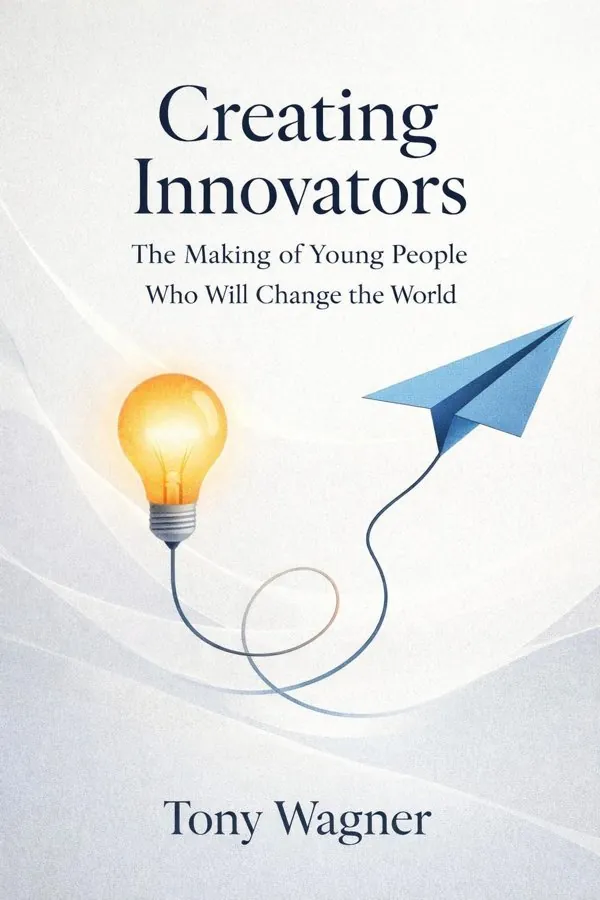
Creating Innovators: The Making of Young People Who Will Change the World: Summary & Key Insights
by Tony Wagner
 10 min9 chaptersAudio available
Key Takeaways from Creating Innovators: The Making of Young People Who Will Change the World
The most dangerous mistake in education is assuming that yesterday’s model of success will still work tomorrow.
Long before children learn formal theory, they learn through tinkering, pretending, building, and testing.
The surest way to kill innovation is to separate learning from personal meaning.
Passion may start the journey, but purpose gives it direction.
No innovator develops in isolation.
What Is Creating Innovators: The Making of Young People Who Will Change the World About?
Creating Innovators: The Making of Young People Who Will Change the World by Tony Wagner is a education book spanning 11 pages. In Creating Innovators, education expert Tony Wagner asks a question that feels more urgent every year: how do young people learn to create, not just consume, the future? Drawing on interviews with entrepreneurs, designers, engineers, artists, and the parents and teachers who shaped them, Wagner argues that innovation is not a mysterious gift reserved for a few prodigies. It is a set of habits, motivations, and experiences that can be cultivated. The book challenges the traditional education model built around compliance, test scores, and risk avoidance, showing how these norms often suppress curiosity and initiative just when the world needs them most. In an economy defined by rapid change, automation, and global competition, success depends less on memorizing information and more on learning how to ask good questions, solve meaningful problems, collaborate, and persist through failure. Wagner writes with the authority of a leading education thinker and researcher, but his message is practical: if parents, schools, colleges, and employers want more innovators, they must create environments where play, passion, purpose, and perseverance can thrive.
This FizzRead summary covers all 9 key chapters of Creating Innovators: The Making of Young People Who Will Change the World in approximately 10 minutes, distilling the most important ideas, arguments, and takeaways from Tony Wagner's work. Also available as an audio summary and Key Quotes Podcast.
Creating Innovators: The Making of Young People Who Will Change the World
In Creating Innovators, education expert Tony Wagner asks a question that feels more urgent every year: how do young people learn to create, not just consume, the future? Drawing on interviews with entrepreneurs, designers, engineers, artists, and the parents and teachers who shaped them, Wagner argues that innovation is not a mysterious gift reserved for a few prodigies. It is a set of habits, motivations, and experiences that can be cultivated. The book challenges the traditional education model built around compliance, test scores, and risk avoidance, showing how these norms often suppress curiosity and initiative just when the world needs them most. In an economy defined by rapid change, automation, and global competition, success depends less on memorizing information and more on learning how to ask good questions, solve meaningful problems, collaborate, and persist through failure. Wagner writes with the authority of a leading education thinker and researcher, but his message is practical: if parents, schools, colleges, and employers want more innovators, they must create environments where play, passion, purpose, and perseverance can thrive.
Who Should Read Creating Innovators: The Making of Young People Who Will Change the World?
This book is perfect for anyone interested in education and looking to gain actionable insights in a short read. Whether you're a student, professional, or lifelong learner, the key ideas from Creating Innovators: The Making of Young People Who Will Change the World by Tony Wagner will help you think differently.
- ✓Readers who enjoy education and want practical takeaways
- ✓Professionals looking to apply new ideas to their work and life
- ✓Anyone who wants the core insights of Creating Innovators: The Making of Young People Who Will Change the World in just 10 minutes
Want the full summary?
Get instant access to this book summary and 100K+ more with Fizz Moment.
Get Free SummaryAvailable on App Store • Free to download
Key Chapters
The most dangerous mistake in education is assuming that yesterday’s model of success will still work tomorrow. Wagner begins with the reality that the modern economy is shaped by constant disruption: new technologies overturn industries, global competition raises the bar, and social and environmental problems demand original solutions. In this world, routine work is increasingly automated or outsourced, while the greatest value comes from people who can see opportunities, connect ideas, and build something new.
This shifts the goal of education. Schools have traditionally rewarded accuracy, obedience, and individual performance on predetermined tasks. But innovators must do something different: identify problems worth solving, work across disciplines, experiment without guaranteed outcomes, and learn continuously. Wagner’s point is not that foundational knowledge no longer matters. Rather, knowledge is only the starting point. What matters is what students can do with what they know.
Consider the difference between a student who memorizes scientific facts for an exam and one who uses scientific thinking to design a low-cost water filter or test an environmental solution in the community. The second student is building the mindset of an innovator: curiosity, initiative, collaboration, and practical problem-solving.
For parents, teachers, and leaders, this means rethinking what counts as achievement. High grades may reflect diligence, but they do not automatically signal creativity or courage. If we want young people who can change the world, we must reward original thinking, resilience, and meaningful contribution alongside academic mastery.
Actionable takeaway: Audit one learning or work environment you influence and ask, “Are we mostly training compliance, or are we developing creativity, initiative, and problem-solving?” Then make one change that favors innovation over routine performance.
Long before children learn formal theory, they learn through tinkering, pretending, building, and testing. Wagner highlights play as the starting point in many innovators’ stories because unstructured exploration teaches lessons that worksheets cannot. Through play, children discover cause and effect, experiment with materials, imagine alternatives, and develop the confidence to try, fail, and try again.
Play matters because innovation begins in freedom, not in excessive control. A child building a fort, modifying a toy, filming a homemade video, or inventing rules for a game is practicing the fundamentals of design thinking. They are asking, “What happens if I do this?” and “How else might this work?” These are the same questions entrepreneurs, scientists, and artists ask later in life.
Wagner suggests that adults often undervalue play because it looks unproductive. Yet many structured educational environments leave too little room for open-ended experimentation. When every activity has a correct answer and a strict rubric, students may become efficient at compliance but weak at imagination. By contrast, playful learning encourages resourcefulness and intrinsic motivation.
Practical applications are simple but powerful. Parents can provide materials rather than instructions: cardboard, tools, art supplies, basic coding kits, old electronics to take apart. Teachers can incorporate maker activities, simulations, or project time where students define the problem as well as the solution. Employers can remember that creativity in adults often grows from environments that preserve room for curiosity and experimentation.
Actionable takeaway: Create one recurring block of unstructured creative time each week, with minimal instructions and no pressure for a polished result. Let the goal be exploration, not evaluation.
The surest way to kill innovation is to separate learning from personal meaning. Wagner shows that many young innovators became exceptional not because adults pushed them harder, but because they discovered something they genuinely cared about. Passion gives young people the stamina to practice, the willingness to go beyond assigned requirements, and the energy to persist through setbacks.
This does not mean waiting passively for a single grand passion to appear. More often, passion develops through exposure, experimentation, and encouragement. A student may begin with casual interest in robotics, music production, sustainability, fashion, or storytelling. With time, access, and support, that interest deepens into commitment. The key is that the learning becomes self-propelled. Instead of asking, “Will this be on the test?” the student begins asking, “How can I get better?”
Traditional schooling often treats passion as a distraction from the official curriculum. Wagner argues the opposite: passion is a gateway to rigorous learning. A teenager obsessed with game design may willingly learn coding, physics, narrative structure, user psychology, and visual design. A young person interested in social justice may pursue history, economics, policy, writing, and community organizing with unusual depth. Interest becomes the engine that pulls serious effort.
Adults play a crucial role here. They do not need to script a child’s future, but they can notice sparks of enthusiasm, offer resources, and avoid prematurely narrowing options. Instead of asking only what career is practical, they can ask what problems or fields make the young person feel most alive.
Actionable takeaway: Identify one area of genuine interest in a young person’s life and help expand it with a mentor, course, tool, book, or real-world project that invites deeper commitment.
Passion may start the journey, but purpose gives it direction. Wagner distinguishes between being excited by an activity and understanding why it matters. The most compelling innovators are not driven only by self-expression or achievement; they are motivated by the desire to improve something beyond themselves. Purpose connects personal talent to social value.
This is especially important in a culture that often defines success narrowly as status, income, or credentials. Young people may work hard to gain admission, collect awards, or impress others without ever asking what they want their work to contribute. Wagner’s interviews suggest that durable motivation grows when individuals see a meaningful problem they want to solve, whether in health care, education, design, technology, the environment, or the arts.
Purpose also strengthens resilience. When obstacles arise, a person working only for external rewards may quit. But someone who feels responsible to a cause is more likely to continue. A student developing an app to help visually impaired users, for example, is not just practicing coding skills; they are working toward a human outcome. A young filmmaker documenting community issues is not just learning technique; they are using storytelling in service of awareness and change.
Schools and families can nurture purpose by asking better questions: What problems do you care about? Who benefits from your work? How could your interests serve others? Service learning, community-based projects, internships, and entrepreneurial challenges can all help young people connect ability with impact.
Actionable takeaway: Pair one area of skill or interest with one real-world need. Ask, “How could this ability help someone else?” and turn the answer into a small project with visible impact.
No innovator develops in isolation. Wagner repeatedly shows that behind young creators and entrepreneurs there are adults who notice potential, offer feedback, open doors, and model a different way of learning. Mentorship matters not because mentors provide all the answers, but because they validate exploration and help young people imagine larger possibilities for themselves.
A strong mentor does several things at once. They challenge without controlling, encourage without rescuing, and guide without demanding conformity. They may be a parent who respects a child’s unusual interests, a teacher who lets students pursue ambitious projects, a coach who emphasizes reflection, or a professional who provides exposure to authentic work. What matters most is not prestige but quality of relationship.
Mentors are especially powerful when they help young people navigate uncertainty. Innovation involves ambiguity, rejection, and unfinished ideas. A mentor can normalize struggle, offer practical critique, and teach that setbacks are part of mastery rather than evidence of failure. For instance, a student starting a social enterprise might need help refining the mission, speaking to users, managing time, and staying realistic without losing ambition.
Wagner also implies that mentorship should not be reserved for elite students or formal programs. Informal networks often matter just as much. A local designer, engineer, librarian, nonprofit founder, or artist can transform a young person’s sense of what is possible simply by taking their ideas seriously.
Actionable takeaway: Help every young person build a “mentor map” of two or three adults beyond immediate family who can offer encouragement, expertise, and honest feedback in an area they care about.
One of Wagner’s boldest claims is that many educational practices do not merely fail to produce innovators; they actively discourage innovative behavior. Systems built on standardization, seat time, narrow testing, and fear of mistakes send a powerful message: do what you are told, avoid risk, and aim for the approved answer. These habits may produce orderly classrooms, but they rarely produce original thinkers.
Innovation requires exactly the opposite conditions. Young people need room to ask their own questions, pursue complex problems, revise their work, and learn from failed attempts. Yet students are often rewarded for speed over depth, certainty over inquiry, and individual competition over collaboration. Even high achievers may become dependent on external validation, reluctant to try anything they cannot already do well.
Wagner is not dismissing accountability or structure. Rather, he is criticizing a version of schooling that confuses measurable outputs with meaningful learning. A student can excel at test preparation and still be weak at initiative, creativity, communication, or problem framing. In fact, some of the very students most successful in conventional systems may find open-ended work uncomfortable because they have had little practice with ambiguity.
Schools that want different outcomes must rethink assessment, classroom culture, and curriculum design. Project-based learning, public exhibitions of work, interdisciplinary challenges, portfolios, and iterative feedback all better reflect how innovation happens in real life. Teachers become facilitators of inquiry rather than distributors of fixed answers.
Actionable takeaway: Replace one assignment based on memorization or formula with a problem-based task that requires students to define questions, create something original, and revise after feedback.
If innovation cannot be lectured into existence, what kind of environment helps it grow? Wagner points to learning settings that combine challenge, autonomy, collaboration, and relevance. These environments do not abandon rigor; they redefine it. Real rigor means grappling with uncertainty, producing work for authentic audiences, and integrating knowledge across disciplines.
In practice, this can look like students designing products, launching campaigns, building prototypes, conducting community research, creating performances, or solving local problems. The important shift is from passive consumption to active production. Instead of merely studying entrepreneurship, students might create and test a small venture. Instead of only reading about environmental issues, they might gather data, propose interventions, and present recommendations to local stakeholders.
Such environments also treat collaboration as essential rather than optional. Innovation today rarely comes from solitary genius alone. It emerges through teams that combine different strengths and perspectives. Young people therefore need repeated practice in listening, negotiating, giving feedback, managing conflict, and co-creating solutions.
Another feature of innovative environments is psychological safety. Students must know they can experiment without humiliation. When adults model curiosity, admit uncertainty, and praise thoughtful risk-taking, learners become more willing to stretch. Over time, they develop agency: the belief that they can shape outcomes rather than merely respond to instructions.
Actionable takeaway: Design one learning experience around a real audience and real problem. Ask learners to produce something useful outside the classroom, then include reflection on what they would improve in the next iteration.
It is impossible to create innovators if the institutions beyond school continue to reward conventional credentials above real capability. Wagner argues that colleges and employers are part of the same ecosystem. When universities prioritize admission metrics and employers rely heavily on prestige signals, they reinforce the behaviors schools teach: resume building, risk avoidance, and performance for approval.
But the innovation economy needs something different. Higher education should become a place where students experiment, collaborate across disciplines, and connect ideas to practice. Employers, meanwhile, should look beyond grades and pedigree to evidence of initiative, creativity, communication, and problem-solving. A candidate who has built something, led a project, learned from failure, or created value in an uncertain context may be better prepared than someone with flawless academic credentials alone.
Wagner’s message is particularly relevant for internships, hiring, and early-career development. Young adults need opportunities to do meaningful work, receive feedback, and understand how ideas become products, services, or social change. Colleges can support this through project-based courses, partnerships with organizations, incubators, and experiential learning. Employers can contribute by recruiting for potential, not just polish, and by building cultures where new ideas from younger staff are welcomed rather than ignored.
This broader perspective matters because innovation is not produced by schools alone. It depends on whether the next stages of life continue to nurture curiosity and courage or push people back into conformity.
Actionable takeaway: When evaluating students or job candidates, add one criterion that captures real-world initiative, such as projects completed, problems solved, or evidence of learning from failure.
Perhaps Wagner’s most important insight is that innovation is not created by a single course, workshop, or inspirational speech. It emerges from an ecosystem: families that allow exploration, schools that value inquiry, mentors who guide, colleges that encourage experimentation, employers that reward initiative, and communities that connect learning to real needs. When these elements align, young people are far more likely to become creative contributors.
This ecosystem view helps explain why isolated reforms often disappoint. Adding a makerspace means little if students are still punished for mistakes. Teaching entrepreneurship has limited effect if college admissions reward only traditional achievements. Encouraging creativity in theory is not enough if schedules, assessments, and organizational cultures leave no room for it in practice.
Wagner therefore calls for systemic change. Policy matters, but so do cultural assumptions. Adults must stop equating success with compliance and begin valuing exploration, persistence, and contribution. This includes rethinking how time is used, how achievement is measured, and how young people are trusted. Innovation grows where people are expected to take ownership, engage with complexity, and create value for others.
The implication is hopeful as well as demanding. Because innovation is ecological, many actors can help build it. Parents can protect play and passion. Teachers can design richer tasks. school leaders can support experimentation. Colleges can expand experiential learning. Employers can hire for capability. Communities can offer real problems and real audiences.
Actionable takeaway: Identify one part of the innovation ecosystem you can influence directly, then strengthen the connection between learning and real-world contribution through a partnership, project, or policy change.
All Chapters in Creating Innovators: The Making of Young People Who Will Change the World
About the Author
Tony Wagner is an American author, education expert, and researcher best known for his work on preparing young people for a world shaped by rapid technological, economic, and social change. He has served as a Senior Research Fellow at the Learning Policy Institute and was an Innovation Education Fellow at Harvard University’s Technology & Entrepreneurship Center. Across his career, Wagner has focused on the gap between traditional schooling and the skills most needed today, including creativity, critical thinking, collaboration, and initiative. His writing challenges narrow, test-driven definitions of achievement and advocates for education that develops adaptable, purposeful problem-solvers. Through books, speaking, and research, he has become a leading voice in conversations about reimagining learning for the twenty-first century.
Get This Summary in Your Preferred Format
Read or listen to the Creating Innovators: The Making of Young People Who Will Change the World summary by Tony Wagner anytime, anywhere. FizzRead offers multiple formats so you can learn on your terms — all free.
Available formats: App · Audio · PDF · EPUB — All included free with FizzRead
Download Creating Innovators: The Making of Young People Who Will Change the World PDF and EPUB Summary
Key Quotes from Creating Innovators: The Making of Young People Who Will Change the World
“The most dangerous mistake in education is assuming that yesterday’s model of success will still work tomorrow.”
“Long before children learn formal theory, they learn through tinkering, pretending, building, and testing.”
“The surest way to kill innovation is to separate learning from personal meaning.”
“Passion may start the journey, but purpose gives it direction.”
“Wagner repeatedly shows that behind young creators and entrepreneurs there are adults who notice potential, offer feedback, open doors, and model a different way of learning.”
Frequently Asked Questions about Creating Innovators: The Making of Young People Who Will Change the World
Creating Innovators: The Making of Young People Who Will Change the World by Tony Wagner is a education book that explores key ideas across 9 chapters. In Creating Innovators, education expert Tony Wagner asks a question that feels more urgent every year: how do young people learn to create, not just consume, the future? Drawing on interviews with entrepreneurs, designers, engineers, artists, and the parents and teachers who shaped them, Wagner argues that innovation is not a mysterious gift reserved for a few prodigies. It is a set of habits, motivations, and experiences that can be cultivated. The book challenges the traditional education model built around compliance, test scores, and risk avoidance, showing how these norms often suppress curiosity and initiative just when the world needs them most. In an economy defined by rapid change, automation, and global competition, success depends less on memorizing information and more on learning how to ask good questions, solve meaningful problems, collaborate, and persist through failure. Wagner writes with the authority of a leading education thinker and researcher, but his message is practical: if parents, schools, colleges, and employers want more innovators, they must create environments where play, passion, purpose, and perseverance can thrive.
You Might Also Like

Bedtime Biography: Florence Nightingale
Isabel Thomas
10 min
Introduction To Museum Studies
Howard H. Hoyt
10 min
A Mind for Numbers: How to Excel at Math and Science (Even If You Flunked Algebra)
Barbara Oakley
10 min
AI for Educators: Learning Strategies, Teacher Empowerment, and the Future of Education
Matt Miller
10 min
Animation For Beginners
Morr Meroz
10 min
Artificial Intelligence for Learning
Donald Clark
10 minBrowse by Category
Ready to read Creating Innovators: The Making of Young People Who Will Change the World?
Get the full summary and 100K+ more books with Fizz Moment.