
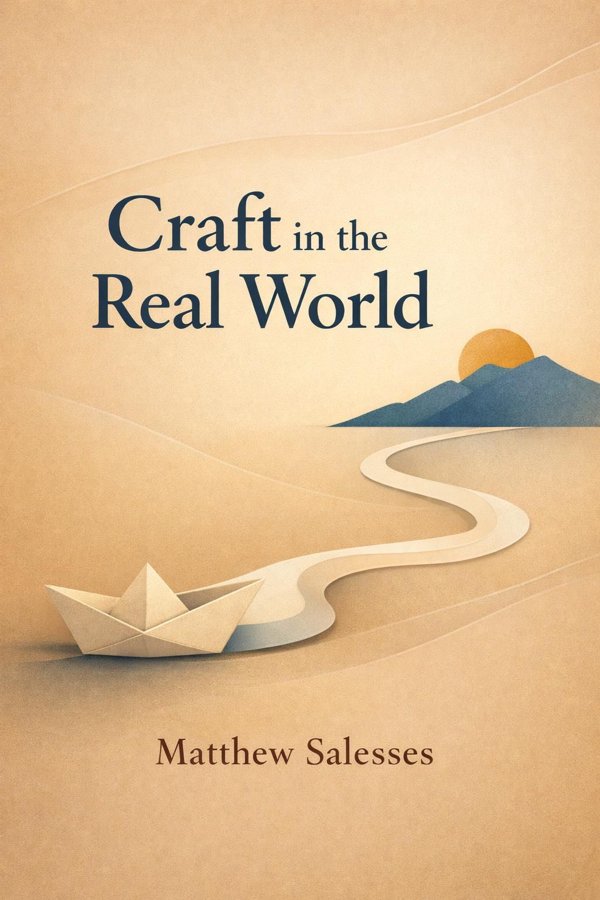
Craft in the Real World: Rethinking Fiction Writing and Workshopping: Summary & Key Insights
 10 min12 chaptersAudio available
What Is Craft in the Real World: Rethinking Fiction Writing and Workshopping About?
Craft in the Real World: Rethinking Fiction Writing and Workshopping by Matthew Salesses is a writing book spanning 12 pages. In this groundbreaking book, Matthew Salesses challenges traditional Western notions of creative writing workshops and craft. He explores how cultural expectations, power dynamics, and biases shape the way fiction is taught and evaluated. Drawing from his own experiences as a writer and teacher, Salesses offers alternative frameworks for understanding narrative, character, and storytelling that embrace diversity and inclusivity. The book invites writers and educators to rethink what makes writing 'good' and to create more equitable spaces for creative expression.
This FizzRead summary covers all 12 key chapters of Craft in the Real World: Rethinking Fiction Writing and Workshopping in approximately 10 minutes, distilling the most important ideas, arguments, and takeaways from Matthew Salesses's work. Also available as an audio summary and Key Quotes Podcast.
Craft in the Real World: Rethinking Fiction Writing and Workshopping
In this groundbreaking book, Matthew Salesses challenges traditional Western notions of creative writing workshops and craft. He explores how cultural expectations, power dynamics, and biases shape the way fiction is taught and evaluated. Drawing from his own experiences as a writer and teacher, Salesses offers alternative frameworks for understanding narrative, character, and storytelling that embrace diversity and inclusivity. The book invites writers and educators to rethink what makes writing 'good' and to create more equitable spaces for creative expression.
Who Should Read Craft in the Real World: Rethinking Fiction Writing and Workshopping?
This book is perfect for anyone interested in writing and looking to gain actionable insights in a short read. Whether you're a student, professional, or lifelong learner, the key ideas from Craft in the Real World: Rethinking Fiction Writing and Workshopping by Matthew Salesses will help you think differently.
- ✓Readers who enjoy writing and want practical takeaways
- ✓Professionals looking to apply new ideas to their work and life
- ✓Anyone who wants the core insights of Craft in the Real World: Rethinking Fiction Writing and Workshopping in just 10 minutes
Want the full summary?
Get instant access to this book summary and 100K+ more with Fizz Moment.
Get Free SummaryAvailable on App Store • Free to download
Key Chapters
When I talk about 'craft,' I’m not referring to an eternal checklist of elements every good story must have. Craft, as it’s typically defined in the West—character, conflict, plot, showing versus telling—is a cultural system, not a natural law. These conventions emerged from specific traditions, like the Aristotelian arc or modern realism, which privilege certain emotional rhythms and moral arcs. Yet we often teach these techniques as if they were universal, and in doing so, we encode an implicit hierarchy of expression.
I encourage writers to see craft as relative. A pause, an omission, a communal voice—these might carry as much narrative meaning in one tradition as tension or plot reversal does in another. What we call 'good writing' is a negotiation between writer and reader, shaped by shared expectations. Once you realize that, craft becomes larger, more democratic. It’s not an abstract system hovering above culture; it’s culture itself, in motion.
In the classroom, this means teaching students to articulate what aesthetic choices serve which effects, in which contexts. Craft is what a story does, not what a story should be. Its value is relational, not absolute.
Every culture tells stories differently because every culture has different ideas about what stories are for. Western pedagogy may teach that a story must have an individual hero who undergoes change, but many other traditions value continuity, collectivity, or cyclical time. A story that resists climax, that ends in ambiguity, or that centers the communal rather than the individual might be misunderstood in a typical workshop, not because it fails but because its goals differ.
In my experience, this misunderstanding can silence or distort marginalized voices. When writers are told their stories lack 'arc' or 'stakes,' they are really being told their ways of seeing the world don’t align with dominant expectations. That tension reveals how deeply our notions of craft are intertwined with ideology. Once we recognize this, we can open up new ways to read and write. A workshop can become a place of translation rather than correction, where writers explain the logic of their cultural forms and readers learn new kinds of pleasure. Storytelling is not one-size-fits-all. It is a dialogue between histories.
+ 10 more chapters — available in the FizzRead app
All Chapters in Craft in the Real World: Rethinking Fiction Writing and Workshopping
About the Author
Matthew Salesses is a Korean American author and professor of creative writing. He has written several acclaimed works of fiction and nonfiction, including 'Disappear Doppelgänger Disappear' and 'The Hundred-Year Flood'. His writing often explores identity, race, and the politics of storytelling. Salesses teaches at Columbia University and is recognized for his contributions to reimagining the creative writing workshop model.
Get This Summary in Your Preferred Format
Read or listen to the Craft in the Real World: Rethinking Fiction Writing and Workshopping summary by Matthew Salesses anytime, anywhere. FizzRead offers multiple formats so you can learn on your terms — all free.
Available formats: App · Audio · PDF · EPUB — All included free with FizzRead
Download Craft in the Real World: Rethinking Fiction Writing and Workshopping PDF and EPUB Summary
Key Quotes from Craft in the Real World: Rethinking Fiction Writing and Workshopping
“When I talk about 'craft,' I’m not referring to an eternal checklist of elements every good story must have.”
“Every culture tells stories differently because every culture has different ideas about what stories are for.”
Frequently Asked Questions about Craft in the Real World: Rethinking Fiction Writing and Workshopping
Craft in the Real World: Rethinking Fiction Writing and Workshopping by Matthew Salesses is a writing book that explores key ideas across 12 chapters. In this groundbreaking book, Matthew Salesses challenges traditional Western notions of creative writing workshops and craft. He explores how cultural expectations, power dynamics, and biases shape the way fiction is taught and evaluated. Drawing from his own experiences as a writer and teacher, Salesses offers alternative frameworks for understanding narrative, character, and storytelling that embrace diversity and inclusivity. The book invites writers and educators to rethink what makes writing 'good' and to create more equitable spaces for creative expression.
You Might Also Like
The Art of Perspective
Christopher Castellani
10 min
Making a Point: The Persnickety Story of English Punctuation
David Crystal
10 min
The Elements Of Eloquence: How To Turn The Perfect English Phrase
Mark Forsyth
10 min
The Pocket Muse: Ideas and Inspirations for Writing
Monica Wood
10 min
A Little Book on Form: An Exploration into the Formal Imagination of Poetry
Robert Hass
10 min
Adventures In The Screen Trade: A Personal View Of Hollywood And Screenwriting
William Goldman
10 minBrowse by Category
Ready to read Craft in the Real World: Rethinking Fiction Writing and Workshopping?
Get the full summary and 100K+ more books with Fizz Moment.