
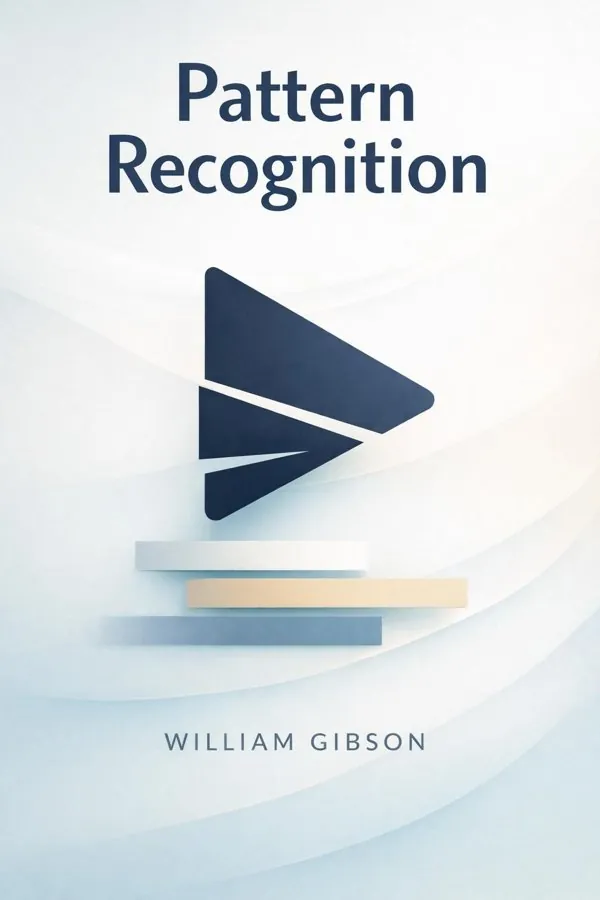
Pattern Recognition: Summary & Key Insights
 10 min9 chaptersAudio available
Key Takeaways from Pattern Recognition
What if the symbols designed to guide consumers felt physically invasive to you?
Cities do not just contain commerce; they teach people how to read power.
Some works of art become powerful precisely because they refuse to explain themselves.
The modern marketer does not merely sell products; he hunts for emerging desire.
Long before social platforms became dominant, people were already forming intense relationships through shared digital obsessions.
What Is Pattern Recognition About?
Pattern Recognition by William Gibson is a bestsellers book spanning 5 pages. William Gibson’s Pattern Recognition is a literary thriller about branding, grief, digital culture, and the search for meaning in a world saturated with signals. Set in the uneasy aftermath of 9/11, the novel follows Cayce Pollard, a highly paid marketing consultant whose unusual sensitivity to logos and brand imagery makes her both valuable and vulnerable. While in London for a corporate assignment, she becomes obsessed with a series of anonymous video fragments circulating online—enigmatic pieces of “the footage” that captivate a global community of viewers. Her search for the creator leads her across London, Tokyo, and Moscow, into a web of money, power, art, and hidden motives. What makes Pattern Recognition enduring is that it captures the texture of modern life before most novels knew how to describe it: internet fandoms, viral media, outsourced identity, and the way corporations shape desire. Gibson, already famous for redefining science fiction with Neuromancer, turns here from futuristic speculation to the uncanny strangeness of the present. The result is a novel that feels less like prediction than diagnosis—an elegant, unsettling portrait of how people seek authenticity in a world built from brands, images, and data.
This FizzRead summary covers all 9 key chapters of Pattern Recognition in approximately 10 minutes, distilling the most important ideas, arguments, and takeaways from William Gibson's work. Also available as an audio summary and Key Quotes Podcast.
Pattern Recognition
William Gibson’s Pattern Recognition is a literary thriller about branding, grief, digital culture, and the search for meaning in a world saturated with signals. Set in the uneasy aftermath of 9/11, the novel follows Cayce Pollard, a highly paid marketing consultant whose unusual sensitivity to logos and brand imagery makes her both valuable and vulnerable. While in London for a corporate assignment, she becomes obsessed with a series of anonymous video fragments circulating online—enigmatic pieces of “the footage” that captivate a global community of viewers. Her search for the creator leads her across London, Tokyo, and Moscow, into a web of money, power, art, and hidden motives.
What makes Pattern Recognition enduring is that it captures the texture of modern life before most novels knew how to describe it: internet fandoms, viral media, outsourced identity, and the way corporations shape desire. Gibson, already famous for redefining science fiction with Neuromancer, turns here from futuristic speculation to the uncanny strangeness of the present. The result is a novel that feels less like prediction than diagnosis—an elegant, unsettling portrait of how people seek authenticity in a world built from brands, images, and data.
Who Should Read Pattern Recognition?
This book is perfect for anyone interested in bestsellers and looking to gain actionable insights in a short read. Whether you're a student, professional, or lifelong learner, the key ideas from Pattern Recognition by William Gibson will help you think differently.
- ✓Readers who enjoy bestsellers and want practical takeaways
- ✓Professionals looking to apply new ideas to their work and life
- ✓Anyone who wants the core insights of Pattern Recognition in just 10 minutes
Want the full summary?
Get instant access to this book summary and 100K+ more with Fizz Moment.
Get Free SummaryAvailable on App Store • Free to download
Key Chapters
What if the symbols designed to guide consumers felt physically invasive to you? Cayce Pollard lives with exactly that condition. She is unusually sensitive to branding, logos, and commercial design, reacting viscerally to certain trademarks and marketing cues. This makes her a prized consultant in the corporate world: if a logo disturbs or rings false to Cayce, companies take that reaction seriously. Yet the same gift also exposes the cost of living inside a culture where identity is constantly packaged, sold, and manipulated.
Gibson uses Cayce’s sensitivity as more than an eccentric trait. It becomes a way of dramatizing how deeply brands penetrate modern consciousness. Most people absorb logos unconsciously, but Cayce experiences branding as a direct assault on her nervous system. Through her, the novel asks a difficult question: when every object, image, and lifestyle choice arrives preloaded with market meaning, how much space is left for an unmanufactured self?
The concept remains strikingly relevant. Today, people navigate personal branding on social media, aesthetic trends driven by algorithms, and products designed as identity statements. Cayce’s discomfort mirrors the fatigue many feel when taste itself becomes monetized. In practical terms, the novel invites readers to notice how often they respond not to the thing itself, but to the story wrapped around it.
Actionable takeaway: audit the symbols you live with. Identify a few brands, platforms, or visual cues that strongly influence your mood or choices, and ask whether they reflect your values or merely shape them.
Cities do not just contain commerce; they teach people how to read power. In Pattern Recognition, London is not merely the opening setting but a central metaphor for the novel’s world: layered, cosmopolitan, commodified, and buzzing with information. Cayce arrives there to evaluate a new corporate logo for advertising magnate Hubertus Bigend, a man who understands that influence now travels through style, trend, and narrative as much as through products.
London embodies the fusion of culture and capital. It is where fashion, media, corporate strategy, and subcultural cool intersect. Gibson presents it as a place where people are always scanning surfaces for meaning, whether in clothing, architecture, speech, or brand presentation. The city becomes a live network of signs, a place where authenticity and performance are difficult to separate.
This matters because modern urban life often works the same way. Professionals in creative industries, finance, technology, and media are constantly interpreting subtle signals: who has access, what is emerging, which aesthetic codes matter, and where value is being created. London in the novel teaches us that success in such environments depends on pattern recognition—seeing connections before they become obvious.
Readers can apply this idea by paying attention to environments rather than isolated events. Whether you are evaluating a business opportunity, a cultural trend, or a workplace dynamic, context matters. Patterns emerge from clusters of details: language, timing, alliances, style, and omission.
Actionable takeaway: when entering a new environment, do not focus only on what people say. Observe the signals around them—design choices, habits, networks, and status markers—to understand the deeper pattern at work.
Some works of art become powerful precisely because they refuse to explain themselves. The mysterious video fragments known as “the footage” are the emotional and intellectual center of Pattern Recognition. Released anonymously online, these short, exquisitely composed clips inspire fascination across a dispersed internet subculture. No one knows who made them, how they are distributed, or whether they form a coherent narrative. That uncertainty is exactly what makes them irresistible.
For Cayce, the footage represents the opposite of branding. It is not optimized, focus-grouped, or tied to a product campaign. It circulates without a clear commercial motive, drawing viewers into a community built on interpretation rather than consumption. People gather in online forums to analyze textures, transitions, costumes, and possible storylines. Their discussions turn viewing into collective meaning-making.
Gibson anticipated a world in which anonymous digital artifacts could generate intense global obsession. Today we see similar phenomena in viral videos, cryptic online creators, alternate reality storytelling, and fandom cultures built around fragments and clues. The footage shows how mystery can create deeper engagement than explanation. People do not simply want content; they want participation, discovery, and the feeling of proximity to something real.
There is also a warning here. Communities formed around mystery can produce insight, but they can also invite projection. People often see their own desires in incomplete works. Cayce’s attachment to the footage is personal, even spiritual, because it offers order and beauty amid emotional dislocation.
Actionable takeaway: when something grips your attention, ask whether you value it for what it is or for the meaning you are adding to it. That distinction reveals both your desires and your blind spots.
The modern marketer does not merely sell products; he hunts for emerging desire. Hubertus Bigend, one of Gibson’s most memorable characters, understands this better than anyone. Charismatic, manipulative, and intellectually agile, Bigend recognizes that the footage is culturally potent before most people would know how to classify it. He hires Cayce not out of artistic devotion, but because he suspects that identifying its source could provide immense strategic value.
Bigend represents a new kind of power: the ability to convert subculture into leverage. He sees that anything capable of attracting authentic attention can eventually be translated into marketing intelligence, influence, or capital. His genius lies not in creating meaning, but in detecting where meaning is already condensing and moving quickly to occupy that space.
This idea is central to understanding contemporary business and media. Viral trends, niche communities, aesthetic microcultures, and creator-driven platforms are constantly mined by brands seeking relevance. A meme, a visual style, or a grassroots movement can be commercialized almost instantly. Gibson shows how institutions track authenticity not to preserve it, but to absorb it.
For readers, Bigend offers both a lesson and a caution. It is useful to learn how attention works, because markets increasingly reward those who detect shifts early. But it is equally important to ask what is lost when every genuine signal becomes an exploitable asset.
Actionable takeaway: if you work in business, media, or design, study emerging communities with respect rather than extraction in mind. Ask not only “How can this be monetized?” but also “What makes this meaningful before money enters the frame?”
In a world flooded with signals, style becomes a form of knowledge. Cayce’s journey to Tokyo expands the novel’s exploration of how information is embedded in surfaces, rituals, and design. Tokyo appears as a place where branding, fashion, technology, and cultural codes move with extraordinary speed and precision. It is both hypermodern and deeply coded, a city where appearance is not superficial but communicative.
Gibson uses Tokyo to show that information is not only spoken or written; it is worn, displayed, arranged, and performed. The city’s retail spaces, consumer objects, and subcultural aesthetics all function like interfaces. To outsiders, they may seem dazzling or opaque. To insiders, they reveal affiliation, aspiration, and sensitivity to change. Cayce, whose instincts are tuned to subtle signals, moves through this environment as both analyst and pilgrim.
This section of the novel also sharpens its global perspective. Meaning no longer travels from one cultural center outward in a simple line. Trends circulate transnationally, mutating as they move. Tokyo is not derivative of the West; it is one of the engines producing the future of taste. That insight was prescient, and it remains essential in a world where influence comes from many nodes at once.
For readers, Tokyo illustrates the value of cultural literacy. If you want to understand markets, communities, or innovation, pay attention to aesthetics. Visual choices often reveal emotional and social priorities before formal analysis catches up.
Actionable takeaway: treat design and style as data. The next time you encounter a new product, brand, or subculture, ask what its aesthetics communicate about belonging, aspiration, and power.
The deeper a mystery goes, the more it draws hidden histories to the surface. Cayce’s movement toward Moscow shifts Pattern Recognition from cultural investigation to emotional reckoning. Here the search for the source of the footage intersects with older forms of power—wealth, security networks, post-Soviet influence, and the residues of violence. The glossy surfaces of global culture give way to more dangerous structures beneath them.
Moscow matters because it reminds readers that digital circulation does not erase geography or history. Behind anonymous online artifacts are real bodies, family loyalties, traumatic pasts, and political conditions. The footage feels weightless when encountered online, but its origins are entangled with injury, surveillance, and privilege. Gibson refuses to let the internet remain abstract; he reconnects virtual fascination to material reality.
For Cayce, this stage also reopens personal grief, especially around her father’s disappearance. The hunt for the footage becomes entangled with her need to make sense of absence. The novel suggests that people are often drawn to puzzles not only because they want answers, but because mystery provides a structure for mourning. Solving one hidden pattern can feel like approaching another loss that cannot be solved.
In real life, we often forget that every digital phenomenon has infrastructure and consequence behind it: labor, politics, class, logistics, trauma, ownership. Moscow restores that depth.
Actionable takeaway: whenever something online appears detached, frictionless, or purely aesthetic, ask what histories and power structures made it possible. Looking behind the surface is one of the most important forms of pattern recognition.
People do not seek patterns only to understand the world; they seek them to survive uncertainty. Beneath its plot mechanics and cultural analysis, Pattern Recognition is a novel about grief. Cayce is haunted by the unresolved loss of her father, who disappeared on September 11. That wound shapes how she moves through the world: alert, detached, searching, unable to fully settle into the present.
Pattern-seeking becomes, for her, both profession and coping mechanism. If the world can be read, perhaps it can be endured. If fragments can be assembled into a form, perhaps absence can become legible. The footage exerts such a strong pull because it offers aesthetic coherence without false reassurance. It is broken into pieces, but those pieces feel deliberate. In a life shattered by arbitrary loss, that matters.
Gibson is especially subtle here. He does not reduce trauma to psychology alone. He shows how historical events alter atmosphere itself. The post-9/11 setting is not just background; it infuses the novel with unease, vigilance, and dislocation. Personal grief and collective trauma overlap, making the search for meaning feel urgent and fragile.
This idea has broad relevance. After disruption—bereavement, crisis, job loss, social upheaval—people often become hyperattentive to signs, routines, and narratives. That can help restore agency, but it can also create false certainty. The challenge is to find forms of meaning that support healing without collapsing into illusion.
Actionable takeaway: when you feel compelled to impose order on uncertainty, pause and ask whether the pattern you see is clarifying reality or shielding you from pain. Both are human responses, but they lead to different outcomes.
The more manufactured the world becomes, the more valuable the authentic appears—and the harder it is to define. One of Pattern Recognition’s most enduring concerns is the tension between authentic expression and the systems that package, circulate, and exploit it. Cayce is drawn to the footage because it feels untouched by the usual machinery of promotion. It seems to exist for itself rather than for market conversion.
Yet Gibson complicates any easy idea of purity. Authenticity is not simply the absence of commerce. It can be stylized, projected, misread, or strategically performed. Brands often imitate the visual language of sincerity. Communities can canonize obscure works into status symbols. Even genuine art, once recognized, becomes vulnerable to appropriation. The novel shows that authenticity is less a stable category than a relationship of trust between creator, artifact, and audience.
This is highly practical for contemporary readers. Whether you are choosing media, building a brand, creating art, or curating your online presence, the question is not just “Is this authentic?” but “What makes this feel trustworthy, and to whom?” A handcrafted product can be fake in spirit; a polished work can still be honest. Authenticity lies in coherence, intention, and the absence of manipulative excess.
Gibson does not offer a simple escape from simulation. Instead, he suggests that authenticity survives in fleeting moments of unforced connection: an artwork that resists reduction, a relationship not mediated by status, an experience not optimized for display.
Actionable takeaway: look for coherence over image. In people, brands, and creative work, trust what remains consistent across contexts rather than what is most loudly presented as “real.”
All Chapters in Pattern Recognition
About the Author
William Gibson is an American-born Canadian writer born in 1948 and widely regarded as one of the most influential voices in modern speculative fiction. He rose to prominence with Neuromancer, the 1984 novel that helped define cyberpunk and reshaped how literature imagined computers, networks, and digital life. Gibson’s fiction explores the intersection of technology, design, media, capital, and human identity, often focusing less on machines themselves than on their cultural consequences. Over time, his work evolved from near-future science fiction into sharp examinations of the contemporary world, where the present often feels stranger than any forecast. Pattern Recognition is a key example of that shift, showing his gift for identifying emerging realities before they become ordinary. His influence extends far beyond literature into film, technology culture, fashion, and media theory.
Get This Summary in Your Preferred Format
Read or listen to the Pattern Recognition summary by William Gibson anytime, anywhere. FizzRead offers multiple formats so you can learn on your terms — all free.
Available formats: App · Audio · PDF · EPUB — All included free with FizzRead
Download Pattern Recognition PDF and EPUB Summary
Key Quotes from Pattern Recognition
“What if the symbols designed to guide consumers felt physically invasive to you?”
“Cities do not just contain commerce; they teach people how to read power.”
“Some works of art become powerful precisely because they refuse to explain themselves.”
“The modern marketer does not merely sell products; he hunts for emerging desire.”
“Long before social platforms became dominant, people were already forming intense relationships through shared digital obsessions.”
Frequently Asked Questions about Pattern Recognition
Pattern Recognition by William Gibson is a bestsellers book that explores key ideas across 9 chapters. William Gibson’s Pattern Recognition is a literary thriller about branding, grief, digital culture, and the search for meaning in a world saturated with signals. Set in the uneasy aftermath of 9/11, the novel follows Cayce Pollard, a highly paid marketing consultant whose unusual sensitivity to logos and brand imagery makes her both valuable and vulnerable. While in London for a corporate assignment, she becomes obsessed with a series of anonymous video fragments circulating online—enigmatic pieces of “the footage” that captivate a global community of viewers. Her search for the creator leads her across London, Tokyo, and Moscow, into a web of money, power, art, and hidden motives. What makes Pattern Recognition enduring is that it captures the texture of modern life before most novels knew how to describe it: internet fandoms, viral media, outsourced identity, and the way corporations shape desire. Gibson, already famous for redefining science fiction with Neuromancer, turns here from futuristic speculation to the uncanny strangeness of the present. The result is a novel that feels less like prediction than diagnosis—an elegant, unsettling portrait of how people seek authenticity in a world built from brands, images, and data.
More by William Gibson
You Might Also Like
The Godfather
Mario Puzo
10 min
The Handmaid's Tale
Margaret Atwood
10 min
The Hunger Games
Suzanne Collins
10 min
The Nightingale
Kristin Hannah
10 min
The Seven Husbands of Evelyn Hugo
Taylor Jenkins Reid
10 min
Backwater Justice
Fern Michaels
10 minBrowse by Category
Ready to read Pattern Recognition?
Get the full summary and 100K+ more books with Fizz Moment.