
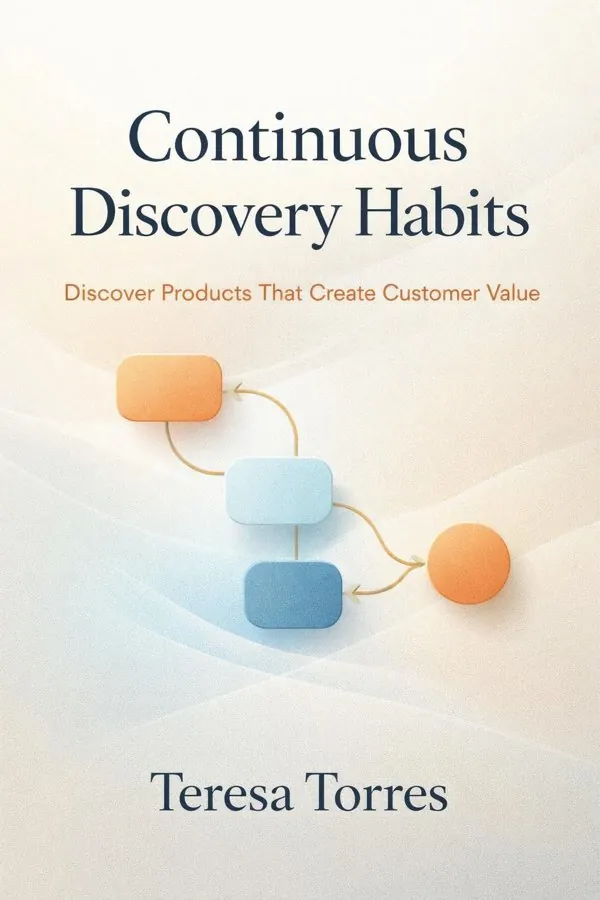
Continuous Discovery Habits: Discover Products That Create Customer Value: Summary & Key Insights
 10 min9 chaptersAudio available
Key Takeaways from Continuous Discovery Habits: Discover Products That Create Customer Value
A product can be perfectly built and still completely miss the mark.
The best product decisions rarely come from one smart person.
One customer conversation can be interesting; a weekly cadence of conversations becomes transformational.
Teams often jump from a goal to a feature idea without carefully examining the problem space.
Shipping more features is not the same as creating more value.
What Is Continuous Discovery Habits: Discover Products That Create Customer Value About?
Continuous Discovery Habits: Discover Products That Create Customer Value by Teresa Torres is a productivity book spanning 9 pages. Most product teams do not fail because they lack effort. They fail because they spend too much time building and too little time learning. In Continuous Discovery Habits, Teresa Torres argues that great products emerge when teams stop treating customer research as a one-time phase and instead make discovery a regular, repeatable habit. Rather than relying on assumptions, internal opinions, or outdated plans, teams learn directly from customers every week and use those insights to guide decisions. The book offers a practical system for integrating discovery into everyday product work. Torres introduces tools such as weekly customer interviews, product trio collaboration, opportunity solution trees, and assumption testing to help teams identify the most valuable problems to solve before investing heavily in solutions. Her approach is hands-on, structured, and designed for real-world product environments where time is limited and uncertainty is constant. Teresa Torres is one of the leading voices in modern product discovery, known for coaching teams at startups and large organizations alike. Her work matters because it bridges the gap between theory and execution, showing how teams can build products that create genuine customer value while also delivering meaningful business results.
This FizzRead summary covers all 9 key chapters of Continuous Discovery Habits: Discover Products That Create Customer Value in approximately 10 minutes, distilling the most important ideas, arguments, and takeaways from Teresa Torres's work. Also available as an audio summary and Key Quotes Podcast.
Continuous Discovery Habits: Discover Products That Create Customer Value
Most product teams do not fail because they lack effort. They fail because they spend too much time building and too little time learning. In Continuous Discovery Habits, Teresa Torres argues that great products emerge when teams stop treating customer research as a one-time phase and instead make discovery a regular, repeatable habit. Rather than relying on assumptions, internal opinions, or outdated plans, teams learn directly from customers every week and use those insights to guide decisions.
The book offers a practical system for integrating discovery into everyday product work. Torres introduces tools such as weekly customer interviews, product trio collaboration, opportunity solution trees, and assumption testing to help teams identify the most valuable problems to solve before investing heavily in solutions. Her approach is hands-on, structured, and designed for real-world product environments where time is limited and uncertainty is constant.
Teresa Torres is one of the leading voices in modern product discovery, known for coaching teams at startups and large organizations alike. Her work matters because it bridges the gap between theory and execution, showing how teams can build products that create genuine customer value while also delivering meaningful business results.
Who Should Read Continuous Discovery Habits: Discover Products That Create Customer Value?
This book is perfect for anyone interested in productivity and looking to gain actionable insights in a short read. Whether you're a student, professional, or lifelong learner, the key ideas from Continuous Discovery Habits: Discover Products That Create Customer Value by Teresa Torres will help you think differently.
- ✓Readers who enjoy productivity and want practical takeaways
- ✓Professionals looking to apply new ideas to their work and life
- ✓Anyone who wants the core insights of Continuous Discovery Habits: Discover Products That Create Customer Value in just 10 minutes
Want the full summary?
Get instant access to this book summary and 100K+ more with Fizz Moment.
Get Free SummaryAvailable on App Store • Free to download
Key Chapters
A product can be perfectly built and still completely miss the mark. That is the central problem Teresa Torres wants teams to confront: building efficiently does not guarantee building something valuable. Many organizations approach discovery as a front-end activity. They do some research, define requirements, commit to a roadmap, and then move into delivery mode. But customer needs shift, markets evolve, and assumptions break down. By the time the product is launched, the team may be solving yesterday’s problem.
Torres proposes replacing episodic discovery with continuous discovery, a habit of ongoing learning woven directly into product development. Instead of trying to predict everything upfront, teams stay close to customers as they build. They regularly gather feedback, observe behaviors, and refine their understanding of what matters. This shortens the distance between decisions and evidence.
For example, a team working on a budgeting app might initially believe users need more charts and forecasting tools. Through ongoing customer conversations, they may discover that what users actually want is easier categorization of spending and fewer manual steps. Without continuous discovery, the team could waste months polishing advanced features nobody uses.
This mindset changes how product work is organized. Plans become more flexible, decisions become more evidence-based, and success depends less on guesswork. Continuous discovery does not slow teams down; it helps them avoid expensive detours.
Actionable takeaway: Stop treating discovery as a phase. Build a weekly habit of learning from customers so decisions evolve with real evidence, not stale assumptions.
The best product decisions rarely come from one smart person. They come from multiple perspectives working together before solutions are locked in. Torres introduces the concept of the product trio: a product manager, a designer, and an engineer collaborating continuously in discovery. Each role sees risk differently. Product managers focus on value and outcomes, designers on usability and desirability, and engineers on feasibility and technical trade-offs.
When discovery is owned by only one function, blind spots multiply. A product manager may understand the business opportunity but overlook interaction friction. A designer may spot user pain points but miss technical constraints. An engineer may foresee implementation complexity that changes which solution is viable. The product trio combines these perspectives early, when ideas are still cheap to change.
Imagine a team considering a new onboarding flow for a SaaS platform. The product manager sees activation metrics dropping, the designer notices that users feel overwhelmed by too many choices, and the engineer suggests using progressive disclosure instead of rebuilding the entire interface. Working together, they avoid both a shallow fix and an overengineered response.
This model also strengthens team ownership. Instead of tossing work from research to design to engineering, the trio shares responsibility for understanding customer problems and shaping solutions. That leads to faster learning, better prioritization, and fewer handoff failures.
Actionable takeaway: Form a consistent product trio and involve all three roles in customer interviews, synthesis, and solution decisions to improve the quality of every product choice.
One customer conversation can be interesting; a weekly cadence of conversations becomes transformational. Torres argues that the most important discovery habit is maintaining weekly customer touchpoints. The goal is not occasional validation when a launch is near. It is a steady rhythm of learning that helps teams detect patterns, update assumptions, and stay grounded in customer reality.
Weekly touchpoints reduce the risk of designing from internal opinions. They also make research more manageable. Instead of planning a giant study every quarter, teams learn in small, continuous increments. Over time, those conversations create a rich body of insight. Teams hear the language customers use, understand workarounds, identify friction points, and uncover unmet needs that metrics alone cannot reveal.
A team improving an e-commerce checkout might review analytics and notice high cart abandonment on mobile. Data shows where users drop off, but not why. In weekly interviews, customers reveal that shipping costs appear too late, coupon fields create anxiety, and payment options feel limited. These insights help the team prioritize the right opportunities instead of guessing.
The key is consistency and focus. Interviews should be lightweight, frequent, and tied to current product decisions. Teams do not need perfect scripts or research labs. They need access to customers and a discipline of listening.
Over time, weekly touchpoints make discovery part of the team’s operating system. Customer understanding no longer depends on memory, isolated reports, or a dedicated researcher. It becomes a shared, living asset.
Actionable takeaway: Schedule at least one customer touchpoint every week and treat it as non-negotiable, just like sprint planning or product review.
Teams often jump from a goal to a feature idea without carefully examining the problem space. That shortcut feels productive, but it hides weak assumptions and narrows thinking too early. Torres introduces the Opportunity Solution Tree as a visual framework that helps teams connect outcomes, customer opportunities, and solution ideas in a structured way.
At the top of the tree is the outcome the team wants to influence, such as increasing retention, improving activation, or reducing support volume. Beneath that are opportunities: customer needs, pain points, desires, and obstacles that, if addressed, could move the outcome. Only after identifying opportunities do teams brainstorm potential solutions. This sequence matters because it shifts attention from features to the underlying value they create.
Suppose a language learning app wants to improve user retention. A team might instinctively propose gamification features. But when they map the opportunity space, they discover several possibilities: users forget to return after missing a day, lessons feel too repetitive, and progress feels invisible. Each opportunity suggests very different solutions, from smarter reminders to more varied content to clearer milestone tracking.
The tree helps teams avoid becoming attached to a single idea too soon. It also creates transparency. Stakeholders can see how a feature proposal links to a customer opportunity and a business outcome, making prioritization more rigorous.
Most importantly, the Opportunity Solution Tree keeps discovery dynamic. Teams can add new opportunities as they learn, prune weak solution ideas, and focus on the branches with the strongest evidence.
Actionable takeaway: Use an Opportunity Solution Tree for every significant product goal so your team explores the right problems before committing to solutions.
Shipping more features is not the same as creating more value. One of the book’s strongest arguments is that teams should organize around outcomes rather than outputs. Outputs are the things teams build: dashboards, buttons, workflows, integrations. Outcomes are the changes those things produce: more engagement, faster onboarding, lower churn, higher trust, better task completion.
Many organizations reward output because it is visible and easy to count. Roadmaps fill up, launches are announced, and progress appears tangible. But if those features do not improve customer behavior or business performance, the team has only increased activity, not impact. Torres pushes teams to ask a more demanding question: what result are we trying to create, and how will we know if we are succeeding?
For instance, a team might be assigned to build a help center redesign. That is an output. But the real outcome might be reducing support tickets, improving self-service resolution, or increasing customer confidence during setup. Once the outcome is clear, the team gains freedom to consider alternatives. Maybe a redesign is not the best answer. Maybe contextual guidance, better search, or proactive onboarding messages would deliver stronger results.
This approach changes planning and accountability. Teams are no longer measured only by whether they delivered on time. They are judged by whether they moved meaningful metrics. That makes discovery essential, because teams need evidence to understand which customer opportunities are most likely to influence outcomes.
Actionable takeaway: Rewrite feature requests as desired outcomes, then evaluate every idea by its likely impact on customer behavior and business performance.
Every product idea contains hidden bets. Some are about customer desirability, some about technical feasibility, and others about business viability. The problem is that teams often discover these risks too late, after they have already invested heavily in development. Torres advocates for assumption testing and lightweight experimentation as a way to learn faster and reduce waste.
Instead of asking whether an idea sounds good in a meeting, teams should identify the assumptions that must be true for it to succeed. Will customers understand the concept? Will they change behavior? Can the team deliver the experience reliably? Will it create enough value to justify the cost? Once these assumptions are explicit, they can be tested with prototypes, interviews, concierge experiments, fake-door tests, usability sessions, or small pilot releases.
Consider a team exploring AI-generated meeting summaries. The concept sounds compelling, but several assumptions need testing: users trust the summaries, accuracy is high enough to save time, privacy concerns are manageable, and customers will actually pay for the feature. A clickable prototype can test usefulness, a concierge version can test workflow value, and a limited pilot can reveal adoption patterns before full rollout.
This disciplined approach turns experimentation into decision support. The purpose is not to prove the team is right. It is to reduce uncertainty and improve learning. Good experiments are focused, affordable, and tied to specific assumptions.
By testing before scaling, teams spend less time building features that fail and more time refining the ideas with the greatest evidence behind them.
Actionable takeaway: Before committing to any major solution, list its critical assumptions and design the smallest possible experiment to test the riskiest one first.
Metrics tell you what is happening, but customers tell you why. Torres emphasizes that strong product decisions require both quantitative data and qualitative insight. Teams that rely only on dashboards may optimize the wrong behavior. Teams that rely only on interviews may overreact to anecdotal stories. The power comes from combining the two.
Quantitative data helps teams identify patterns at scale. It shows trends in retention, conversion, usage frequency, feature adoption, or funnel drop-off. Qualitative feedback adds context. It reveals motivations, frustrations, expectations, and the meaning behind user behavior. When these sources are paired, teams can make better judgments about where to focus and what to test.
Imagine a streaming app notices that users frequently start but do not finish the onboarding process. Analytics highlight the drop-off point. Interviews reveal that people feel forced to choose too many preferences before seeing value. Without the data, the team might not see the pattern clearly. Without the interviews, they might redesign the wrong screen or add unnecessary guidance.
Torres encourages teams to synthesize evidence continuously rather than waiting for formal reports. Customer conversations, behavioral metrics, support tickets, sales calls, and usability observations can all contribute to a fuller picture. The goal is not perfection. It is triangulation.
This integrated view also protects teams from bias. If the data and interviews point in different directions, that tension is useful. It signals that more learning is needed before acting.
Actionable takeaway: Pair every major metric you track with direct customer evidence, and use both together when deciding what problem to solve next.
Good intentions are not enough to make discovery stick. Many teams try customer research for a few weeks, then abandon it when deadlines increase, calendars fill up, or leadership demands delivery. Torres argues that continuous discovery succeeds only when teams design habits that are realistic, repeatable, and resilient under pressure.
This means reducing friction. Recruiting customers should be systematized. Interview notes should be easy to capture and share. Meetings should be structured around evidence, not opinions. Discovery should fit the team’s cadence rather than feel like extra work piled on top of delivery. The easier the process, the more likely it will endure.
For example, a B2B team might create a rolling panel of customers willing to participate in 20-minute monthly interviews. They may dedicate one afternoon each week to customer conversations, reserve 30 minutes afterward for synthesis, and update a shared opportunity map. None of these actions are dramatic, but together they create a stable system for ongoing learning.
Leadership support also matters. If managers praise shipping speed while ignoring product learning, teams will naturally deprioritize discovery. Sustainable habits require explicit permission to investigate, test, and adapt. Over time, discovery becomes less of an initiative and more of a default way of working.
Torres reminds readers that consistency beats intensity. A small habit done every week can reshape product quality more than a large research effort done once or twice a year.
Actionable takeaway: Build discovery into existing team routines with simple systems for recruiting, interviewing, synthesizing, and sharing so learning can survive busy delivery cycles.
Discovery is not only for the beginning of a project. One of Torres’s most practical contributions is showing that discovery belongs in every stage of the product lifecycle. Teams need discovery when identifying opportunities, exploring solutions, validating assumptions, refining designs, monitoring launches, and learning from outcomes after release.
Too often, organizations divide work into a discovery phase and a delivery phase, as if learning ends once development begins. But products continue to generate new questions throughout implementation. A prototype may test well but reveal usability issues in real conditions. A successful launch may expose unexpected edge cases or create demand from a new segment. Continuous discovery helps teams respond to these evolving realities instead of sticking rigidly to outdated plans.
Consider a team launching a new scheduling feature. Early discovery identifies a pain point around coordinating availability. During design, usability tests reveal confusion about time zones. During rollout, usage data shows that teams adopt the feature, but individuals do not. Follow-up interviews uncover that solo users want a simpler version for personal planning. At every stage, discovery informs the next move.
Embedding discovery in the lifecycle creates tighter feedback loops. Teams stop seeing launch as the finish line and start seeing it as another learning milestone. This leads to more adaptation, smarter iteration, and stronger long-term product outcomes.
The implication is clear: discovery is not something to complete. It is something to maintain.
Actionable takeaway: Treat every stage of product work as an opportunity to learn, and define what evidence you need before, during, and after delivery.
All Chapters in Continuous Discovery Habits: Discover Products That Create Customer Value
About the Author
Teresa Torres is a product discovery coach, consultant, and author best known for helping teams build products that deliver genuine customer value. Drawing on experience across product management, design, and user research, she has advised startups, scale-ups, and established companies on how to improve decision-making through continuous learning. Torres is widely recognized for translating product discovery from a vague concept into a practical set of habits teams can use every week, including customer interviews, assumption testing, and opportunity mapping. Her work has influenced modern product practice by emphasizing cross-functional collaboration and evidence-based choices over feature-driven roadmaps. Through her coaching, writing, and workshops, she has become one of the most respected voices in customer-centered product development.
Get This Summary in Your Preferred Format
Read or listen to the Continuous Discovery Habits: Discover Products That Create Customer Value summary by Teresa Torres anytime, anywhere. FizzRead offers multiple formats so you can learn on your terms — all free.
Available formats: App · Audio · PDF · EPUB — All included free with FizzRead
Download Continuous Discovery Habits: Discover Products That Create Customer Value PDF and EPUB Summary
Key Quotes from Continuous Discovery Habits: Discover Products That Create Customer Value
“A product can be perfectly built and still completely miss the mark.”
“The best product decisions rarely come from one smart person.”
“One customer conversation can be interesting; a weekly cadence of conversations becomes transformational.”
“Teams often jump from a goal to a feature idea without carefully examining the problem space.”
“Shipping more features is not the same as creating more value.”
Frequently Asked Questions about Continuous Discovery Habits: Discover Products That Create Customer Value
Continuous Discovery Habits: Discover Products That Create Customer Value by Teresa Torres is a productivity book that explores key ideas across 9 chapters. Most product teams do not fail because they lack effort. They fail because they spend too much time building and too little time learning. In Continuous Discovery Habits, Teresa Torres argues that great products emerge when teams stop treating customer research as a one-time phase and instead make discovery a regular, repeatable habit. Rather than relying on assumptions, internal opinions, or outdated plans, teams learn directly from customers every week and use those insights to guide decisions. The book offers a practical system for integrating discovery into everyday product work. Torres introduces tools such as weekly customer interviews, product trio collaboration, opportunity solution trees, and assumption testing to help teams identify the most valuable problems to solve before investing heavily in solutions. Her approach is hands-on, structured, and designed for real-world product environments where time is limited and uncertainty is constant. Teresa Torres is one of the leading voices in modern product discovery, known for coaching teams at startups and large organizations alike. Her work matters because it bridges the gap between theory and execution, showing how teams can build products that create genuine customer value while also delivering meaningful business results.
You Might Also Like



Browse by Category
Ready to read Continuous Discovery Habits: Discover Products That Create Customer Value?
Get the full summary and 100K+ more books with Fizz Moment.