
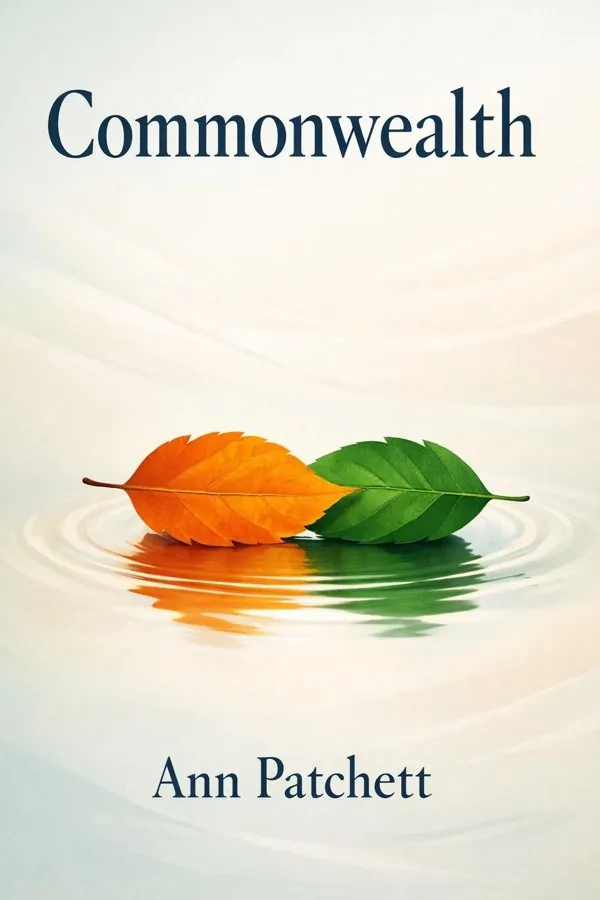
Commonwealth: Summary & Key Insights
by Ann Patchett
 10 min9 chaptersAudio available
Key Takeaways from Commonwealth
A family can be changed forever in a single unguarded moment.
Divorce may separate spouses, but it does not end the family story.
Children often make meaning out of chaos faster than adults do.
The past does not stay behind us; it keeps negotiating with the present.
Avoided truths do not disappear; they wait for the moment when they must be faced.
What Is Commonwealth About?
Commonwealth by Ann Patchett is a bestsellers book spanning 4 pages. What if the defining event of your family history began with a moment so small it could almost be missed? In Commonwealth, Ann Patchett turns one impulsive kiss at a christening party into the spark that reshapes two families over the next fifty years. From that opening disruption, the novel follows the Keatings and the Cousinses through divorce, remarriage, shared summers, old resentments, grief, betrayal, and the strange endurance of love. The result is not simply a family saga, but a deeply human study of how people live inside the consequences of one another’s choices. What makes Commonwealth so powerful is Patchett’s ability to treat ordinary domestic life as epic terrain. She shows how children inherit stories they did not choose, how memory distorts the past, and how forgiveness often arrives unevenly, if at all. Her authority as a novelist lies in her precision: she captures the emotional logic of families with remarkable clarity, making each character flawed, recognizable, and alive. For readers interested in literary fiction that explores marriage, blended families, and the long afterlife of decisions, Commonwealth offers an intelligent, compassionate, and emotionally resonant reading experience.
This FizzRead summary covers all 9 key chapters of Commonwealth in approximately 10 minutes, distilling the most important ideas, arguments, and takeaways from Ann Patchett's work. Also available as an audio summary and Key Quotes Podcast.
Commonwealth
What if the defining event of your family history began with a moment so small it could almost be missed? In Commonwealth, Ann Patchett turns one impulsive kiss at a christening party into the spark that reshapes two families over the next fifty years. From that opening disruption, the novel follows the Keatings and the Cousinses through divorce, remarriage, shared summers, old resentments, grief, betrayal, and the strange endurance of love. The result is not simply a family saga, but a deeply human study of how people live inside the consequences of one another’s choices.
What makes Commonwealth so powerful is Patchett’s ability to treat ordinary domestic life as epic terrain. She shows how children inherit stories they did not choose, how memory distorts the past, and how forgiveness often arrives unevenly, if at all. Her authority as a novelist lies in her precision: she captures the emotional logic of families with remarkable clarity, making each character flawed, recognizable, and alive. For readers interested in literary fiction that explores marriage, blended families, and the long afterlife of decisions, Commonwealth offers an intelligent, compassionate, and emotionally resonant reading experience.
Who Should Read Commonwealth?
This book is perfect for anyone interested in bestsellers and looking to gain actionable insights in a short read. Whether you're a student, professional, or lifelong learner, the key ideas from Commonwealth by Ann Patchett will help you think differently.
- ✓Readers who enjoy bestsellers and want practical takeaways
- ✓Professionals looking to apply new ideas to their work and life
- ✓Anyone who wants the core insights of Commonwealth in just 10 minutes
Want the full summary?
Get instant access to this book summary and 100K+ more with Fizz Moment.
Get Free SummaryAvailable on App Store • Free to download
Key Chapters
A family can be changed forever in a single unguarded moment. Commonwealth begins at a christening party in Southern California, where Bert Cousins arrives uninvited, carrying a bottle of gin and a restless dissatisfaction he barely understands. Fix Keating, a police officer, is celebrating the baptism of his youngest daughter, Franny, while his wife Beverly hosts with the polished energy expected of her. In the middle of the heat, noise, and chatter, Bert kisses Beverly. That act feels impulsive, even reckless, but Patchett uses it to show how life-altering events often emerge from situations that seem ordinary.
The kiss does not matter because it is romantic in a sweeping sense. It matters because it exposes what is already fragile in both marriages. Bert is worn down by the demands of his life with Teresa and their children. Beverly feels constrained by the version of herself she performs inside her marriage. The kiss becomes less a beginning than a revelation: two people suddenly recognize a way out, and everyone around them must live with the consequences.
Patchett’s great insight is that major turning points rarely arrive with moral clarity. No one at the party can fully grasp what has happened, yet the course of multiple lives has shifted. Readers can apply this idea beyond the novel by paying closer attention to moments that reveal underlying truths rather than just dramatic surface action. Small choices, emotional honesty, and lapses in self-control can redirect entire relationships.
Actionable takeaway: Reflect on one “small” moment in your own life that changed a relationship, and ask what it revealed about needs or tensions already present beneath the surface.
Divorce may separate spouses, but it does not end the family story. After Bert leaves Teresa and Beverly leaves Fix, a new household is formed from the wreckage of two old ones. What follows is not a clean break but a complicated merging. The children from both marriages become bound together, not by choice, but by circumstance. Patchett captures the difficult truth that adults can redraw legal and romantic lines, yet children continue carrying the emotional debris.
The new blended family is neither sentimental nor entirely tragic. It is crowded, confusing, and often practical. The children shuttle between homes, absorb adult tensions, and create private codes of survival. Beverly and Bert build a life together, but the previous marriages remain active forces in memory and personality. Teresa’s grief and bitterness do not disappear simply because the divorce papers are signed. Fix’s restraint does not shield him from pain. Every adult adapts differently, and every child interprets the transition in personal terms.
One of the novel’s strengths is its refusal to simplify divorce into liberation or failure. Instead, it shows family as an ongoing network of obligations, injuries, habits, and loyalties. Anyone from a blended family will recognize how relationships can be simultaneously intimate and unresolved. In modern life, this feels especially relevant: family structures shift, but emotional entanglements remain.
The practical lesson is that families need stories broad enough to include contradiction. People can love new partners and still mourn what was lost. Children can belong in more than one home and still feel displaced in all of them.
Actionable takeaway: If you are navigating a blended family, focus less on creating a “perfect” new unit and more on making room for mixed loyalties, uneven grief, and honest communication.
Children often make meaning out of chaos faster than adults do. In Commonwealth, the shared summers in Virginia become the emotional center of the younger generation’s lives. Cal, Caroline, Holly, Jeanette, Albie, and Franny are thrown together by their parents’ choices, but over time they develop a collective identity that exists apart from the adults who created the arrangement. These summers are full of freedom, tension, competition, and intimacy. The children become a tribe, united by boredom, adventure, rivalry, and the strange solidarity that forms when no one else fully understands your circumstances.
Patchett portrays childhood not as innocence, but as a period of intense observation. The children notice what the adults say, what they avoid saying, and how power moves through the household. They form alliances, tease one another, and absorb emotional patterns that will follow them into adulthood. The rural Virginia setting, with its relative lack of supervision, allows them to become both playful and feral. Their bond feels real because it is built from repetition—shared meals, private jokes, summers that seem endless until they are over.
At the same time, these scenes contain danger. Childhood communities can protect, but they can also hide pain and normalize neglect. The children’s independence is partly a strength and partly a sign that adults are not fully attending to them. This duality is essential to the novel’s realism.
For readers, the broader application is clear: shared experiences in youth shape identity in ways formal family definitions cannot. Cousins, step-siblings, and near-strangers can become lifelong emotional landmarks simply by surviving the same seasons together.
Actionable takeaway: Revisit one formative childhood group or setting in your memory and identify what habits, fears, or strengths it quietly taught you.
The past does not stay behind us; it keeps negotiating with the present. One of Commonwealth’s central achievements is showing how family history accumulates weight over time. Early events do not fade so much as change shape. A divorce becomes a story told differently by each participant. A childhood accident becomes a wound carried in silence. A parent’s perceived failure grows larger or smaller depending on who remembers it. Patchett is especially interested in how memory is not fixed evidence, but a living force that influences later choices.
The characters are repeatedly confronted by versions of the past they cannot fully control. Some want to forget, others want to assign blame, and still others try to convert pain into narrative. Franny, in particular, becomes a key figure in understanding this process. As an adult, she sees that the stories we inherit are often incomplete and that family myths can conceal as much as they explain. What one person calls sacrifice, another remembers as abandonment. What one person considers survival, another experiences as damage.
This idea matters because many people imagine healing as a clean separation from history. Patchett suggests something more difficult and more honest: we live by revising our relationship to the past, not by escaping it. In practical life, this means that unresolved experiences often return through patterns—through whom we trust, what we fear, and how we interpret love.
The novel invites readers to treat memory with humility. We may feel certain of our family stories, but certainty can flatten other people’s realities. Growth begins when we accept that our version is only one among several.
Actionable takeaway: Choose one family story you have long treated as settled, and ask how another person involved might tell it differently.
Avoided truths do not disappear; they wait for the moment when they must be faced. As Commonwealth moves across decades, the characters are forced into forms of reckoning with one another and themselves. These confrontations are not always dramatic arguments. Often they take the shape of awkward conversations, withheld apologies, accidental revelations, or moments when someone finally understands what an earlier event cost another person. Patchett’s realism lies in showing that reckoning is usually imperfect. People rarely confess everything, and closure seldom arrives in one clean scene.
Franny’s adult life brings several of these tensions into focus, especially when family experiences are transformed into material for art. The issue is no longer only what happened, but who has the right to tell it. Betrayal enters in a new form: private pain becomes public story. This development deepens the novel’s moral complexity. It asks whether telling the truth can become another kind of violation, especially when the truth belongs to more than one person.
Confrontation in the novel is valuable not because it resolves every wound, but because it interrupts denial. It forces characters to see that silence has consequences too. In families, people often protect themselves by pretending that enough time has passed to make discussion unnecessary. Patchett argues the opposite. Time may soften emotion, but it can also harden misunderstanding if no one speaks.
In everyday life, reckoning may mean clarifying an old misunderstanding, setting a boundary, or acknowledging a harm you once minimized. It does not require perfect language. It requires willingness to stop hiding behind habit.
Actionable takeaway: Identify one unresolved relationship in your life and take one concrete step toward clarity—ask a direct question, state a truth calmly, or acknowledge your part in the tension.
Adults make choices for adult reasons, but children often pay the emotional price. Throughout Commonwealth, Patchett demonstrates that the younger generation is shaped not just by what their parents decide, but by how those decisions are explained, concealed, or ignored. Bert and Beverly pursue a life together that feels necessary to them, yet their children are left to absorb instability, divided loyalties, and the burden of adapting before they are ready. The children are not passive victims, but neither are they untouched.
What makes the novel compelling is the way these effects appear gradually. Patchett does not reduce childhood harm to a single speech or diagnosis. Instead, she shows how it appears in temperament, attachment, resentment, and memory. Some children become watchful. Some become reckless. Some tell stories to organize what happened to them. Others avoid looking too closely. This is true to life: the consequences of family upheaval often show up years later, in forms that seem unrelated until someone traces the line backward.
The broader insight applies well beyond divorce. Parents, teachers, and leaders often assume that if children are not protesting, they are coping. Commonwealth quietly dismantles that illusion. Children notice more than adults think, and they draw conclusions even when no one offers explanations. A chaotic environment teaches lessons whether or not those lessons are intended.
The practical application is to treat children as meaning-making people. They need age-appropriate truth, emotional consistency, and permission to feel conflicted. Shielding them from every fact is less useful than helping them interpret what is happening.
Actionable takeaway: When a major change affects a child, explain it plainly, revisit the conversation over time, and invite questions instead of assuming silence means understanding.
The stories we tell about our lives can save us, but they can also betray us. One of Commonwealth’s most fascinating layers involves the transformation of family experience into narrative. Franny’s relationship with a famous writer introduces a question that runs beneath the whole novel: what happens when private history becomes public art? Patchett explores the allure of storytelling—the way it creates order from confusion and gives meaning to suffering—but she also examines its ethical cost.
In the novel, lived experience is never neutral material. It belongs emotionally to multiple people. A writer may see a powerful plot, while family members see exposure, theft, or distortion. This tension reflects a broader reality in memoir, fiction, and even ordinary conversation. Every time we tell a story about a shared past, we make choices about emphasis, sympathy, blame, and omission. We are not just remembering; we are shaping reality.
Patchett does not condemn storytelling. In fact, she honors its necessity. Stories help people survive. They preserve memory, reveal hidden patterns, and make loneliness feel less absolute. But she insists that storytelling requires responsibility. Turning pain into art does not erase the obligations owed to the people whose lives supplied the material.
For readers, this idea is highly practical. We all narrate our lives—at dinner tables, in therapy, online, in journals. The question is whether we do so with humility. Are we using narrative to understand, or to control? Are we making room for complexity, or flattening people into supporting characters in our personal mythology?
Actionable takeaway: Before telling a story that involves others, pause to consider what you may be leaving out, whose dignity is at stake, and whether your version is fair as well as compelling.
Forgiveness is rarely a single decision; more often, it is an ongoing adjustment to what cannot be undone. Commonwealth resists the comforting idea that family pain can be neatly resolved. Instead, Patchett presents forgiveness as partial, delayed, inconsistent, and deeply human. Some characters move toward acceptance. Others remain attached to grievance. Some forgive in one context and withhold it in another. This messiness is precisely what makes the novel emotionally convincing.
The book’s mature wisdom lies in separating forgiveness from forgetting or excusing. To forgive does not mean declaring that the hurt was minor. It means loosening the past’s control over the present, even if the memory remains sharp. In family life, this is especially difficult because the people who wound us are often the same people we continue to love, depend on, or resemble. Patchett understands that forgiveness in such settings can never be purely moral; it is also practical, relational, and psychological.
This perspective offers relief to readers who have struggled with simplistic advice about healing. You do not have to produce instant peace to be moving forward. Sometimes growth looks like setting a boundary. Sometimes it looks like understanding a parent’s limitations without denying your own pain. Sometimes it is simply refusing to rehearse an old injury every day.
Commonwealth suggests that compassion becomes possible when people recognize one another as limited, frightened, desiring, and flawed. That recognition does not erase accountability, but it can soften the rigid roles of villain and victim that families often assign.
Actionable takeaway: Redefine forgiveness in a way that fits reality—ask not “Have I erased the hurt?” but “What would help this pain govern me less?”
Belonging is not guaranteed by blood, marriage, or law; it is built through repeated presence. Across five decades, Commonwealth reveals that family is not a fixed structure but an evolving practice. The Keatings and Cousinses begin as separate households, then become one uneasy arrangement, and eventually grow into something even more complex: a network of people linked by history, grief, affection, resentment, and endurance. Some ties strengthen while others fade, yet the connection persists because time has woven their lives together.
Patchett’s title matters here. A commonwealth is a shared body, a collective formed by interdependence. The novel asks what people owe one another when they have been bound together by accident as much as intention. The answer is not idealized unity. These characters do not become harmonious. What emerges instead is a hard-won recognition that shared life creates obligations even when love is inconsistent.
This idea has wide application. Many people live in families that do not resemble neat cultural scripts. There are step-siblings who feel more central than biological siblings, ex-spouses who remain part of major life events, and relatives who matter because of accumulated history rather than easy affection. Commonwealth validates those realities. It suggests that belonging often grows from continuity—showing up over years, surviving difficulty, and remaining part of one another’s stories.
The practical lesson is to measure family less by labels and more by lived commitment. Who has witnessed your life? Whose history is entangled with yours? Those questions may matter more than formal categories.
Actionable takeaway: Make a list of the people who have consistently shared your life across time, and consider one small way to strengthen one of those bonds now.
All Chapters in Commonwealth
About the Author
Ann Patchett is an acclaimed American author whose fiction and nonfiction are known for their emotional intelligence, graceful prose, and deep interest in human relationships. Born in Los Angeles and raised partly in Nashville, she has written several major works, including Bel Canto, Commonwealth, The Dutch House, and State of Wonder. Her writing frequently explores family, moral complexity, intimacy, and the unexpected events that alter ordinary lives. Patchett has received numerous literary honors, including the PEN/Faulkner Award and the Orange Prize, and she is widely respected as one of the leading voices in contemporary literary fiction. Beyond her work as an author, she is also the co-owner of Parnassus Books, an independent bookstore in Nashville, Tennessee, where she has become a prominent advocate for reading, bookselling, and literary culture.
Get This Summary in Your Preferred Format
Read or listen to the Commonwealth summary by Ann Patchett anytime, anywhere. FizzRead offers multiple formats so you can learn on your terms — all free.
Available formats: App · Audio · PDF · EPUB — All included free with FizzRead
Download Commonwealth PDF and EPUB Summary
Key Quotes from Commonwealth
“A family can be changed forever in a single unguarded moment.”
“Divorce may separate spouses, but it does not end the family story.”
“Children often make meaning out of chaos faster than adults do.”
“The past does not stay behind us; it keeps negotiating with the present.”
“Avoided truths do not disappear; they wait for the moment when they must be faced.”
Frequently Asked Questions about Commonwealth
Commonwealth by Ann Patchett is a bestsellers book that explores key ideas across 9 chapters. What if the defining event of your family history began with a moment so small it could almost be missed? In Commonwealth, Ann Patchett turns one impulsive kiss at a christening party into the spark that reshapes two families over the next fifty years. From that opening disruption, the novel follows the Keatings and the Cousinses through divorce, remarriage, shared summers, old resentments, grief, betrayal, and the strange endurance of love. The result is not simply a family saga, but a deeply human study of how people live inside the consequences of one another’s choices. What makes Commonwealth so powerful is Patchett’s ability to treat ordinary domestic life as epic terrain. She shows how children inherit stories they did not choose, how memory distorts the past, and how forgiveness often arrives unevenly, if at all. Her authority as a novelist lies in her precision: she captures the emotional logic of families with remarkable clarity, making each character flawed, recognizable, and alive. For readers interested in literary fiction that explores marriage, blended families, and the long afterlife of decisions, Commonwealth offers an intelligent, compassionate, and emotionally resonant reading experience.
More by Ann Patchett


You Might Also Like

The Godfather
Mario Puzo
10 min
The Handmaid's Tale
Margaret Atwood
10 min
The Hunger Games
Suzanne Collins
10 min
The Nightingale
Kristin Hannah
10 min
The Seven Husbands of Evelyn Hugo
Taylor Jenkins Reid
10 min
Backwater Justice
Fern Michaels
10 minBrowse by Category
Ready to read Commonwealth?
Get the full summary and 100K+ more books with Fizz Moment.