
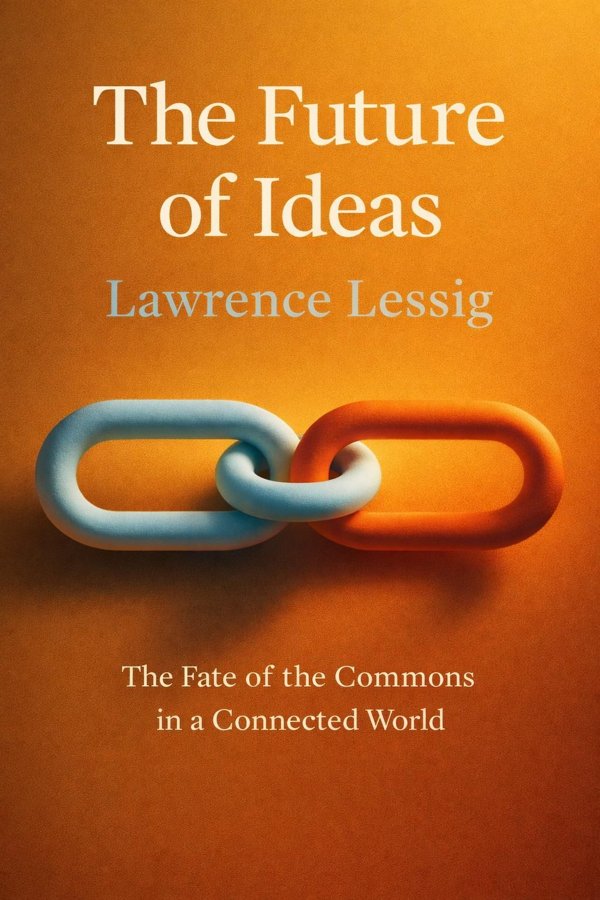
The Future of Ideas: The Fate of the Commons in a Connected World: Summary & Key Insights
 10 min10 chaptersAudio available
What Is The Future of Ideas: The Fate of the Commons in a Connected World About?
The Future of Ideas: The Fate of the Commons in a Connected World by Lawrence Lessig is a digital_culture book spanning 10 pages. In this influential work, Lawrence Lessig explores how the Internet, once a free and open space for creativity and innovation, is increasingly being constrained by legal and technological barriers. He argues that the erosion of the 'commons'—the shared resources that enable collaboration and progress—threatens the very foundation of digital creativity and freedom. Through a detailed analysis of intellectual property law, network architecture, and cultural trends, Lessig calls for a renewed commitment to preserving openness in the digital age.
This FizzRead summary covers all 10 key chapters of The Future of Ideas: The Fate of the Commons in a Connected World in approximately 10 minutes, distilling the most important ideas, arguments, and takeaways from Lawrence Lessig's work. Also available as an audio summary and Key Quotes Podcast.
The Future of Ideas: The Fate of the Commons in a Connected World
In this influential work, Lawrence Lessig explores how the Internet, once a free and open space for creativity and innovation, is increasingly being constrained by legal and technological barriers. He argues that the erosion of the 'commons'—the shared resources that enable collaboration and progress—threatens the very foundation of digital creativity and freedom. Through a detailed analysis of intellectual property law, network architecture, and cultural trends, Lessig calls for a renewed commitment to preserving openness in the digital age.
Who Should Read The Future of Ideas: The Fate of the Commons in a Connected World?
This book is perfect for anyone interested in digital_culture and looking to gain actionable insights in a short read. Whether you're a student, professional, or lifelong learner, the key ideas from The Future of Ideas: The Fate of the Commons in a Connected World by Lawrence Lessig will help you think differently.
- ✓Readers who enjoy digital_culture and want practical takeaways
- ✓Professionals looking to apply new ideas to their work and life
- ✓Anyone who wants the core insights of The Future of Ideas: The Fate of the Commons in a Connected World in just 10 minutes
Want the full summary?
Get instant access to this book summary and 100K+ more with Fizz Moment.
Get Free SummaryAvailable on App Store • Free to download
Key Chapters
When the Internet first emerged from its academic and governmental roots, its architecture embodied a radical principle: end-to-end design. This meant that the network’s intelligence was not concentrated in a central authority but left at the edges—in the hands of users. From this simple principle flowed an ocean of innovation. Entrepreneurs, students, hobbyists, and dreamers could build new tools and applications without seeking permission. The World Wide Web, email, file transfer protocols—these were the spontaneous offspring of a system where innovation was not pre-approved but naturally encouraged.
In those early years, freedom did not need to be legislated; it was encoded. The openness of the Internet’s technical protocols functioned much like a public commons—shared, accessible, and available for anyone to use. This design neutralized the barriers that had historically limited creativity to those with power or capital. Suddenly, a student in a dorm room could create something that would rival the infrastructure of a global corporation. Yet this openness was fragile. What I wanted readers to realize is that architecture is never neutral: it can empower or restrict, liberate or control. And since code functions as law in a digital world, any change in architecture becomes, in effect, a change in the rule of freedom itself.
The commons is not a romantic ideal—it’s a functional necessity for innovation. Throughout history, shared spaces of knowledge, culture, and discovery have made progress possible. Consider the scientific revolution: its culture of open inquiry and publication allowed others to build upon discoveries, leading to exponential advancement. Or the Renaissance, where artists and thinkers shared techniques and ideas freely within an open creative environment. The same was true of the early Internet—a global commons of information, where sharing, remixing, and collaboration were the cultural norm.
In my argument, the commons isn’t the opposite of property; it’s a complement. Private property fuels investment and stability, but the commons fuels experimentation and hybrid growth. They need each other. Yet, as I watched the Internet evolve, I saw the commons shrinking under the weight of control. Access was increasingly mediated by corporate networks, and the simple ability to build on existing ideas was being transformed into a licensed privilege rather than a natural right. The tragedy is that the commons, once eroded, is difficult to restore, because it depends on shared trust and collective access—conditions that control-based systems inherently undermine.
+ 8 more chapters — available in the FizzRead app
All Chapters in The Future of Ideas: The Fate of the Commons in a Connected World
About the Author
Lawrence Lessig is an American academic, attorney, and political activist. He is known for his work on copyright law, free culture, and Internet freedom. Lessig has served as a professor at Harvard Law School and Stanford Law School, and he is the founder of Creative Commons, an organization that promotes flexible copyright licensing.
Get This Summary in Your Preferred Format
Read or listen to the The Future of Ideas: The Fate of the Commons in a Connected World summary by Lawrence Lessig anytime, anywhere. FizzRead offers multiple formats so you can learn on your terms — all free.
Available formats: App · Audio · PDF · EPUB — All included free with FizzRead
Download The Future of Ideas: The Fate of the Commons in a Connected World PDF and EPUB Summary
Key Quotes from The Future of Ideas: The Fate of the Commons in a Connected World
“When the Internet first emerged from its academic and governmental roots, its architecture embodied a radical principle: end-to-end design.”
“The commons is not a romantic ideal—it’s a functional necessity for innovation.”
Frequently Asked Questions about The Future of Ideas: The Fate of the Commons in a Connected World
The Future of Ideas: The Fate of the Commons in a Connected World by Lawrence Lessig is a digital_culture book that explores key ideas across 10 chapters. In this influential work, Lawrence Lessig explores how the Internet, once a free and open space for creativity and innovation, is increasingly being constrained by legal and technological barriers. He argues that the erosion of the 'commons'—the shared resources that enable collaboration and progress—threatens the very foundation of digital creativity and freedom. Through a detailed analysis of intellectual property law, network architecture, and cultural trends, Lessig calls for a renewed commitment to preserving openness in the digital age.
More by Lawrence Lessig
You Might Also Like
An Ugly Truth: Inside Facebook’s Battle for Domination
Sheera Frenkel, Cecilia Kang
10 min
Cyber Citizens
Ian Goodfellow
10 min
Digital Minimalism: Choosing a Focused Life in a Noisy World
Cal Newport
10 min
E‑Books & Beyond
Various Authors
10 min
The Future of Media
Various Authors
10 min
This Is Why We Can't Have Nice Things
Whitney Phillips
10 minBrowse by Category
Ready to read The Future of Ideas: The Fate of the Commons in a Connected World?
Get the full summary and 100K+ more books with Fizz Moment.