
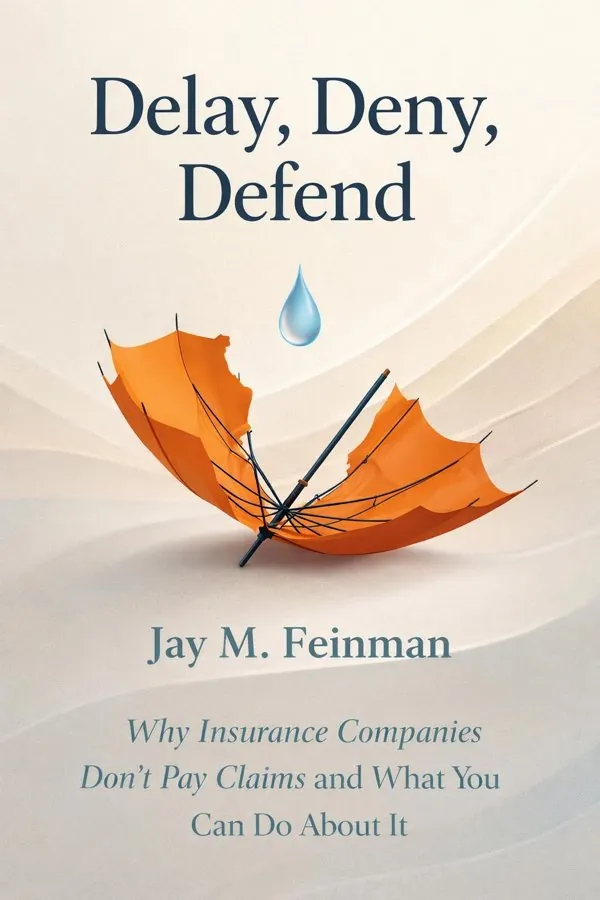
Delay, Deny, Defend: Why Insurance Companies Don't Pay Claims and What You Can Do About It: Summary & Key Insights
 10 min7 chaptersAudio available
What Is Delay, Deny, Defend: Why Insurance Companies Don't Pay Claims and What You Can Do About It About?
Delay, Deny, Defend: Why Insurance Companies Don't Pay Claims and What You Can Do About It by Jay M. Feinman is a law_crime book spanning 7 pages. This book exposes how major insurance companies systematically delay, deny, and defend against legitimate claims. Jay M. Feinman, a Rutgers Law professor, explains how these practices evolved, their impact on consumers, and what policyholders and lawmakers can do to counteract them. It provides a detailed look into the insurance industry's claim-handling strategies and advocates for reform to restore fairness and accountability.
This FizzRead summary covers all 7 key chapters of Delay, Deny, Defend: Why Insurance Companies Don't Pay Claims and What You Can Do About It in approximately 10 minutes, distilling the most important ideas, arguments, and takeaways from Jay M. Feinman's work. Also available as an audio summary and Key Quotes Podcast.
Delay, Deny, Defend: Why Insurance Companies Don't Pay Claims and What You Can Do About It
This book exposes how major insurance companies systematically delay, deny, and defend against legitimate claims. Jay M. Feinman, a Rutgers Law professor, explains how these practices evolved, their impact on consumers, and what policyholders and lawmakers can do to counteract them. It provides a detailed look into the insurance industry's claim-handling strategies and advocates for reform to restore fairness and accountability.
Who Should Read Delay, Deny, Defend: Why Insurance Companies Don't Pay Claims and What You Can Do About It?
This book is perfect for anyone interested in law_crime and looking to gain actionable insights in a short read. Whether you're a student, professional, or lifelong learner, the key ideas from Delay, Deny, Defend: Why Insurance Companies Don't Pay Claims and What You Can Do About It by Jay M. Feinman will help you think differently.
- ✓Readers who enjoy law_crime and want practical takeaways
- ✓Professionals looking to apply new ideas to their work and life
- ✓Anyone who wants the core insights of Delay, Deny, Defend: Why Insurance Companies Don't Pay Claims and What You Can Do About It in just 10 minutes
Want the full summary?
Get instant access to this book summary and 100K+ more with Fizz Moment.
Get Free SummaryAvailable on App Store • Free to download
Key Chapters
Insurance once functioned as a social promise. In its early decades, it was modeled as a mutual enterprise: policyholders essentially owned their insurers, and profits were secondary to security. The postwar years reinforced this ethos; companies competed on service and reliability, and advertising highlighted the moral trustworthiness of the brand.
But beginning in the 1980s, the industry’s economics and culture shifted. Financial deregulation, mergers, and the rise of shareholder capitalism transformed insurers into profit-maximizing corporations. Claims, once viewed as part of the bargain, became opportunities for cost-cutting. At the same time, Wall Street began evaluating insurers by their quarterly returns, not their customer satisfaction. Executives who could reduce payout ratios received bonuses and accolades. Those who prioritized fair claim handling were quietly pushed aside.
This transition marked the birth of a new corporate identity. The insurer no longer saw itself as your partner in risk; it saw you as part of its risk. Whatever was once a moral obligation became a cost center. The service ethos that had been the heart of the industry was replaced by a business model defined by actuarial precision and aggressive claims management. That redefinition is foundational to everything that follows.
The phrase ‘Delay, Deny, Defend’ encapsulates the cynical logic that has come to dominate much of modern insurance practice. This triad of tactics was refined through data analytics, management consulting, and behavioral psychology. The reasoning was brutally straightforward: if claims could be delayed long enough, some policyholders would give up; if they were denied, others would lack the means or resolve to fight; and if the insurer defended aggressively in court, even legitimate claims could be worn down to settlements at fractions of their actual value.
The origin of the strategy can be traced to consulting firms like McKinsey & Company, which in the 1990s advised major insurers—most notably Allstate and others—to convert claims processing into a profit center. Consultants built computer models that assessed each claim not as a human problem to be solved, but as a cost variable to be minimized. Training programs and internal slogans normalized this adversarial posture. Adjusters were taught to manage claimants, not assist them. Words like 'delay' and 'defend' became coded into company culture as methods of 'cost containment.'
The result was an industry-wide metamorphosis. Consumers, still believing they were buying security, were now implicitly buying into a system designed to frustrate them. The strategies worked. Profits soared, claim payout ratios declined, and the corporate winners rewrote the rules for everyone else. What’s worse, regulatory oversight failed to evolve as quickly as industry tactics, leaving millions of policyholders exposed.
+ 5 more chapters — available in the FizzRead app
All Chapters in Delay, Deny, Defend: Why Insurance Companies Don't Pay Claims and What You Can Do About It
About the Author
Jay M. Feinman is a Distinguished Professor of Law at Rutgers University. His scholarship focuses on insurance law, contract law, and torts. He has written extensively on consumer protection and the legal aspects of insurance practices, contributing to public understanding of how the insurance industry operates.
Get This Summary in Your Preferred Format
Read or listen to the Delay, Deny, Defend: Why Insurance Companies Don't Pay Claims and What You Can Do About It summary by Jay M. Feinman anytime, anywhere. FizzRead offers multiple formats so you can learn on your terms — all free.
Available formats: App · Audio · PDF · EPUB — All included free with FizzRead
Download Delay, Deny, Defend: Why Insurance Companies Don't Pay Claims and What You Can Do About It PDF and EPUB Summary
Key Quotes from Delay, Deny, Defend: Why Insurance Companies Don't Pay Claims and What You Can Do About It
“Insurance once functioned as a social promise.”
“The phrase ‘Delay, Deny, Defend’ encapsulates the cynical logic that has come to dominate much of modern insurance practice.”
Frequently Asked Questions about Delay, Deny, Defend: Why Insurance Companies Don't Pay Claims and What You Can Do About It
Delay, Deny, Defend: Why Insurance Companies Don't Pay Claims and What You Can Do About It by Jay M. Feinman is a law_crime book that explores key ideas across 7 chapters. This book exposes how major insurance companies systematically delay, deny, and defend against legitimate claims. Jay M. Feinman, a Rutgers Law professor, explains how these practices evolved, their impact on consumers, and what policyholders and lawmakers can do to counteract them. It provides a detailed look into the insurance industry's claim-handling strategies and advocates for reform to restore fairness and accountability.
You Might Also Like

Abortion and the Law in America: Roe v. Wade to the Present
Mary Ziegler
10 min
Black Edge: Inside Information, Dirty Money, and the Quest to Bring Down the Most Wanted Man on Wall Street
Sheelah Kolhatkar
10 min
Blood Feud: The Man Who Blew the Whistle on One of the Deadliest Prescription Drugs Ever
Kathleen Sharp
10 min
Catch and Kill: Lies, Spies, and a Conspiracy to Protect Predators
Ronan Farrow
10 min
Chaos: Charles Manson, the CIA, and the Secret History of the Sixties
Tom O'Neill with Dan Piepenbring
10 min
Code and Other Laws of Cyberspace
Lawrence Lessig
10 minBrowse by Category
Ready to read Delay, Deny, Defend: Why Insurance Companies Don't Pay Claims and What You Can Do About It?
Get the full summary and 100K+ more books with Fizz Moment.