
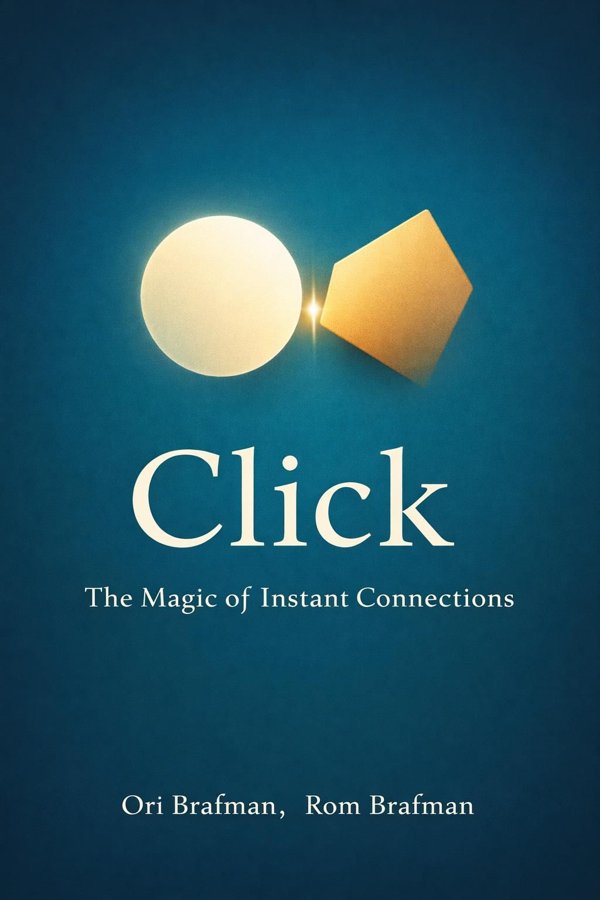
Click: The Magic of Instant Connections: Summary & Key Insights
 10 min6 chaptersAudio available
What Is Click: The Magic of Instant Connections About?
Click: The Magic of Instant Connections by Ori Brafman, Rom Brafman is a psychology book spanning 6 pages. “Click: The Magic of Instant Connections” explores the psychological and social mechanisms behind the phenomenon of instant rapport—why we sometimes feel an immediate bond with certain people or groups. Drawing on research in psychology, neuroscience, and sociology, the authors identify key factors that foster these connections, such as vulnerability, proximity, resonance, and shared values. The book offers insights into how to cultivate meaningful relationships in both personal and professional contexts.
This FizzRead summary covers all 6 key chapters of Click: The Magic of Instant Connections in approximately 10 minutes, distilling the most important ideas, arguments, and takeaways from Ori Brafman, Rom Brafman's work. Also available as an audio summary and Key Quotes Podcast.
Click: The Magic of Instant Connections
“Click: The Magic of Instant Connections” explores the psychological and social mechanisms behind the phenomenon of instant rapport—why we sometimes feel an immediate bond with certain people or groups. Drawing on research in psychology, neuroscience, and sociology, the authors identify key factors that foster these connections, such as vulnerability, proximity, resonance, and shared values. The book offers insights into how to cultivate meaningful relationships in both personal and professional contexts.
Who Should Read Click: The Magic of Instant Connections?
This book is perfect for anyone interested in psychology and looking to gain actionable insights in a short read. Whether you're a student, professional, or lifelong learner, the key ideas from Click: The Magic of Instant Connections by Ori Brafman, Rom Brafman will help you think differently.
- ✓Readers who enjoy psychology and want practical takeaways
- ✓Professionals looking to apply new ideas to their work and life
- ✓Anyone who wants the core insights of Click: The Magic of Instant Connections in just 10 minutes
Want the full summary?
Get instant access to this book summary and 100K+ more with Fizz Moment.
Get Free SummaryAvailable on App Store • Free to download
Key Chapters
When we speak of clicking, we often describe it as chemistry—and that metaphor proves surprisingly accurate. Neuroscience reveals that our brains are wired for connection. Mirror neurons, for example, are specialized cells that fire both when we act and when we observe someone else acting, enabling empathy and emotional imitation. They are one reason we literally 'feel' others’ emotions; when someone smiles warmly, our brain lights up as if we are smiling too. This mirroring becomes the biological foundation for emotional attunement—the state in which two people move and feel in harmony.
Emotional attunement acts as the first spark in the process of clicking. It’s what allows us to read subtle cues, predict responses, and feel safe enough to open up. In successful teams or friendships, attunement travels beyond conversation—it emerges in synchronized gestures, rhythm, and mutual flow. Studies of improvisational musicians show that when their connection is high, their brain waves fall into rhythm. This same synchronization occurs in romantic pairs or colleagues who collaborate effortlessly. The result is mutual trust and efficient communication that feels almost telepathic.
From a psychological perspective, this attunement drives the sense of 'flow' described by Mihaly Csikszentmihalyi. When people work together within shared focus, their attention fuses toward a common goal. Clicking, therefore, is not exclusively about liking—it’s about shared rhythm and psychological safety. When we learn to listen deeply, mirror naturally, and recognize the cues of emotional synchrony, we are actively nurturing our capacity to click.
Most people imagine that connection comes from confidence, charisma, or social skills—but in truth, it is often vulnerability that forges the fastest bond. When we let our guard down, we signal authenticity. Others instinctively trust what is real, not polished. In our interviews, those moments of shared openness consistently marked the beginning of enduring relationships. When two people disclose their fears, failures, or private hopes, the emotional intensity accelerates trust.
Vulnerability creates what researchers call 'reciprocal disclosure,' a psychological loop that deepens rapport. It’s why one heartfelt confession often inspires another. In workplace dynamics, leaders who admit uncertainty or mistakes actually increase team cohesion. Employees feel seen as human beings rather than replaceable parts. Similarly, in friendships, vulnerability is the invisible bridge that transforms acquaintanceship into intimacy. The paradox is that by showing imperfection, we become more perfectly connected.
As I reflected on these findings, I realized that vulnerability does not weaken professionalism—it strengthens humanity. Clicking requires more than shared goals; it thrives on shared humanity. Whether in a brief conversation on a plane or a lifetime partnership, it is the courage to be real that sets the connection alight.
+ 4 more chapters — available in the FizzRead app
All Chapters in Click: The Magic of Instant Connections
About the Authors
Ori Brafman is a New York Times bestselling author and organizational expert known for his work on human behavior and leadership. Rom Brafman is a psychologist specializing in social and clinical psychology. Together, they have coauthored several books exploring the dynamics of human connection and decision-making.
Get This Summary in Your Preferred Format
Read or listen to the Click: The Magic of Instant Connections summary by Ori Brafman, Rom Brafman anytime, anywhere. FizzRead offers multiple formats so you can learn on your terms — all free.
Available formats: App · Audio · PDF · EPUB — All included free with FizzRead
Download Click: The Magic of Instant Connections PDF and EPUB Summary
Key Quotes from Click: The Magic of Instant Connections
“When we speak of clicking, we often describe it as chemistry—and that metaphor proves surprisingly accurate.”
“Most people imagine that connection comes from confidence, charisma, or social skills—but in truth, it is often vulnerability that forges the fastest bond.”
Frequently Asked Questions about Click: The Magic of Instant Connections
Click: The Magic of Instant Connections by Ori Brafman, Rom Brafman is a psychology book that explores key ideas across 6 chapters. “Click: The Magic of Instant Connections” explores the psychological and social mechanisms behind the phenomenon of instant rapport—why we sometimes feel an immediate bond with certain people or groups. Drawing on research in psychology, neuroscience, and sociology, the authors identify key factors that foster these connections, such as vulnerability, proximity, resonance, and shared values. The book offers insights into how to cultivate meaningful relationships in both personal and professional contexts.
You Might Also Like
The Body Keeps the Score
Bessel van der Kolk
10 min
Surrounded by Idiots
Thomas Erikson
10 min
Emotional Intelligence
Daniel Goleman
10 min
Attached
Amir Levine
10 min
Why Does He Do That
Lundy Bancroft
10 min
Women Who Run with the Wolves
Clarissa Pinkola Estés
10 minBrowse by Category
Ready to read Click: The Magic of Instant Connections?
Get the full summary and 100K+ more books with Fizz Moment.