
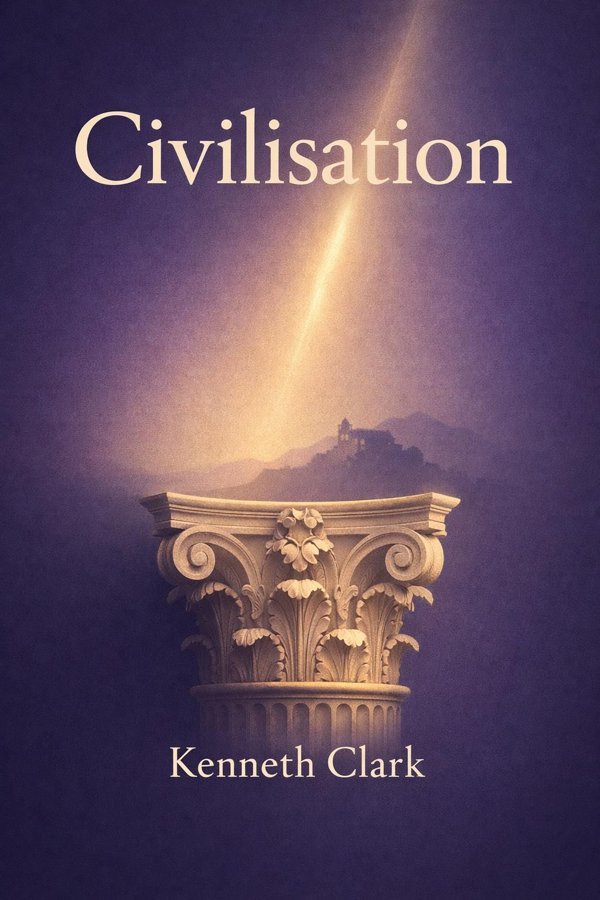
Civilisation: Summary & Key Insights
 10 min9 chaptersAudio available
Key Takeaways from Civilisation
A civilisation does not collapse only when its armies fail; it begins to weaken when people lose faith in order, purpose, and continuity.
When political unity collapsed, spiritual unity became the framework that held Europe together.
Buildings reveal what a society believes about itself.
Great cultural renewals begin when a civilisation rediscovers both its past and its own powers.
Civilisation advances not only through harmony, but also through conflict over truth.
What Is Civilisation About?
Civilisation by Kenneth Clark is a civilization book spanning 11 pages. Civilisation by Kenneth Clark is a sweeping interpretation of Western Europe’s cultural journey from the collapse of the Roman Empire to the uncertainties of the modern age. Rather than presenting history as a dry sequence of dates, Clark asks a larger question: what allows a civilisation to endure, renew itself, and create works of lasting beauty? His answer unfolds through art, architecture, religion, philosophy, science, and political thought, all treated as expressions of a society’s inner confidence. Originally developed alongside the landmark BBC series, the book combines scholarly knowledge with the accessibility of a gifted storyteller. Clark writes not simply as a historian of art, but as a cultural interpreter deeply interested in the values that produced cathedrals, paintings, scientific revolutions, and political ideals. The book matters because it argues that civilisation is fragile, sustained not only by wealth or power, but by belief, imagination, discipline, and humane standards. For readers trying to understand the roots of the modern West, Civilisation remains an elegant, provocative, and memorable guide.
This FizzRead summary covers all 9 key chapters of Civilisation in approximately 10 minutes, distilling the most important ideas, arguments, and takeaways from Kenneth Clark's work. Also available as an audio summary and Key Quotes Podcast.
Civilisation
Civilisation by Kenneth Clark is a sweeping interpretation of Western Europe’s cultural journey from the collapse of the Roman Empire to the uncertainties of the modern age. Rather than presenting history as a dry sequence of dates, Clark asks a larger question: what allows a civilisation to endure, renew itself, and create works of lasting beauty? His answer unfolds through art, architecture, religion, philosophy, science, and political thought, all treated as expressions of a society’s inner confidence. Originally developed alongside the landmark BBC series, the book combines scholarly knowledge with the accessibility of a gifted storyteller. Clark writes not simply as a historian of art, but as a cultural interpreter deeply interested in the values that produced cathedrals, paintings, scientific revolutions, and political ideals. The book matters because it argues that civilisation is fragile, sustained not only by wealth or power, but by belief, imagination, discipline, and humane standards. For readers trying to understand the roots of the modern West, Civilisation remains an elegant, provocative, and memorable guide.
Who Should Read Civilisation?
This book is perfect for anyone interested in civilization and looking to gain actionable insights in a short read. Whether you're a student, professional, or lifelong learner, the key ideas from Civilisation by Kenneth Clark will help you think differently.
- ✓Readers who enjoy civilization and want practical takeaways
- ✓Professionals looking to apply new ideas to their work and life
- ✓Anyone who wants the core insights of Civilisation in just 10 minutes
Want the full summary?
Get instant access to this book summary and 100K+ more with Fizz Moment.
Get Free SummaryAvailable on App Store • Free to download
Key Chapters
A civilisation does not collapse only when its armies fail; it begins to weaken when people lose faith in order, purpose, and continuity. This is one of Kenneth Clark’s central insights. After the fall of Rome, Europe did not become empty of human talent or spiritual aspiration. What disappeared was a unifying structure: political authority fragmented, cities declined, trade weakened, and insecurity spread. Yet Clark insists that civilisation is more than administration. It depends on a belief that life can be shaped toward excellence, that learning matters, and that beauty is worth preserving even in dark times.
This idea reframes the so-called Dark Ages. Instead of seeing them as a total void, Clark presents them as centuries of cultural fragility in which islands of order endured. Monasteries copied manuscripts, rulers patronised churches, and local communities preserved customs and craftsmanship. Civilisation narrowed, but it did not vanish. Its survival depended on institutions and individuals willing to keep standards alive when broader society could not.
The lesson remains practical today. Organisations, communities, and even families are sustained not merely by resources but by habits of care, memory, and aspiration. A school remains excellent because teachers uphold standards. A city remains humane because citizens defend public space, education, and culture. When confidence disappears, structures soon follow.
Actionable takeaway: identify one institution or tradition in your life worth preserving, and strengthen it through deliberate support, study, or participation.
When political unity collapsed, spiritual unity became the framework that held Europe together. Clark shows how Christianity became more than a religion in early medieval Europe: it became the chief source of shared meaning, literacy, symbolism, and artistic inspiration. The Church preserved texts, organised education, shaped moral law, and gave people a story large enough to endure war, instability, and poverty.
This was not merely institutional power. Christianity also redirected artistic and intellectual energy. The early medieval world no longer celebrated imperial grandeur in the Roman sense; it turned toward salvation, sacrifice, transcendence, and the dignity of the soul. Churches, illuminated manuscripts, sacred music, and theological debate all arose from the conviction that earthly life had a higher purpose. In Clark’s view, this gave European civilisation a new centre.
The practical relevance is broader than religion alone. Societies need a moral vocabulary that links individuals into something greater than private interest. Shared ideals create trust, discipline, and the willingness to build for the future. Whether in schools, companies, or nations, technical skill without moral direction rarely sustains culture for long.
One can see this in modern institutions that thrive when they articulate not just what they do, but why they exist. Hospitals grounded in care, universities committed to truth, and civic movements organised around justice all show how purpose shapes endurance.
Actionable takeaway: ask what shared values guide your own work or community, and make those values visible in decisions, rituals, and long-term goals.
Buildings reveal what a society believes about itself. Clark uses Romanesque and Gothic architecture to show how stone can become a record of collective aspiration. Romanesque churches, with their thick walls and fortress-like weight, reflect a world seeking security, order, and sacred stability. Gothic cathedrals, by contrast, rise upward in light, height, and daring engineering, embodying confidence, spiritual ambition, and communal pride.
For Clark, these styles are not just technical developments. They are forms of thought made visible. The Gothic cathedral in particular represents a civilisation able to unite faith, craftsmanship, mathematics, civic organisation, and artistic imagination. It required cooperation across generations: masons, patrons, theologians, artisans, and townspeople all contributed to a structure larger than any one life. This is civilisation at one of its highest moments, where practical skill and transcendent purpose meet.
Modern readers can apply this insight beyond cathedrals. Every built environment communicates values. A neglected public square suggests indifference. A thoughtfully designed library announces that learning matters. A home arranged for hospitality reflects care. Even workplace architecture affects behavior by shaping light, movement, openness, and dignity.
Clark reminds us that aesthetics are not superficial. The spaces we inhabit influence our emotions, standards, and relationships. Good architecture can elevate conduct because it tells people that they are part of something ordered and meaningful.
Actionable takeaway: improve one physical space you use regularly so that it better reflects the values you want to live by.
Great cultural renewals begin when a civilisation rediscovers both its past and its own powers. In Clark’s telling, the Renaissance was not simply a revival of classical art forms. It was a transformation in how human beings understood themselves. By recovering Greek and Roman learning, Renaissance thinkers and artists found models of proportion, realism, intellect, and worldly engagement. Human life could once again be depicted not only as fallen and fragile, but as energetic, curious, and capable of greatness.
This confidence appears in painting, sculpture, architecture, scholarship, and political thought. Artists such as Michelangelo and Leonardo pursued mastery with almost heroic intensity. Patrons funded works that celebrated civic life, religious mystery, and human anatomy alike. Perspective in painting, classical balance in design, and renewed attention to the individual all signaled a broader shift: the human mind was becoming an instrument of discovery.
Clark does not present this as secular triumph alone. The Renaissance still lived within a religious world. Its achievement was synthesis: reverence for antiquity, devotion to beauty, and confidence in human intelligence. That combination helped shape the modern West.
Today, the Renaissance offers a model for personal renewal. We grow when we reconnect with the best of the past while testing our own capacities. Learning from older traditions need not trap us in nostalgia; it can sharpen ambition and widen imagination.
Actionable takeaway: choose one classic work of art, literature, or philosophy and study it deeply as a way of expanding your own standards of thought and expression.
Human beings seek grandeur, but they also seek clarity. Clark explores the Baroque era and the Enlightenment as two different but related expressions of European energy. The Baroque age turned power, movement, emotion, and spectacle into cultural form. In architecture, painting, music, and religious art, it aimed to overwhelm the senses and stir devotion or awe. It reflected societies confident enough to dramatise authority, faith, and expansion on a monumental scale.
The Enlightenment shifted emphasis. Instead of theatrical magnificence, it favored balance, rational inquiry, tolerance, and intellectual order. Philosophers and scientists asked whether human affairs could be organised according to reason rather than inherited privilege. Encyclopedias, salons, academies, and scientific societies became instruments of a new public culture. The ideal was not simply beauty, but intelligibility.
Clark’s deeper point is that civilisation needs both emotional force and disciplined thought. Baroque culture reminds us that people are moved by ceremony, art, and collective imagination. Enlightenment culture reminds us that institutions must also be judged by coherence, fairness, and evidence. A society without passion becomes sterile; a society without reason becomes unstable.
This tension is visible today in leadership, education, and public life. Effective leaders inspire emotionally while thinking clearly. Good schools cultivate wonder as well as analysis. Successful social movements combine symbolism with policy.
Actionable takeaway: in your next major project, pair inspiration with structure by defining both the emotional purpose and the rational plan behind what you are trying to achieve.
The modern self was shaped by two powerful forces: political revolution and romantic feeling. Clark shows how the Age of Revolution transformed ideas of rights, citizenship, and legitimacy. Authority increasingly had to justify itself before the people, not merely inherit its place through dynasty or tradition. This was a decisive break in the political imagination of Europe.
Romanticism then deepened the focus on the individual by turning inward. Where the Enlightenment trusted reason and universality, the Romantics prized emotion, imagination, nature, memory, and personal vision. Artists and writers sought authenticity rather than formal perfection. The solitary genius, the rebel, the dreamer, and the outsider became cultural heroes.
Clark appreciates the liberation this brought. Individuals gained dignity and voice. Creativity became less bound by strict rules. National cultures drew strength from local language, landscape, and folklore. Yet he also sees a danger: when self-expression becomes supreme, shared standards can weaken. Passion can energise culture, but it can also destabilise judgment.
This remains one of the defining tensions of modern life. We want freedom, originality, and personal meaning, but we also need institutions, discipline, and common norms. In education, parenting, and work, the challenge is to develop individuality without worshipping impulse.
A practical example is artistic training: technique does not crush originality; it gives originality form. The same is true of character.
Actionable takeaway: cultivate one area of self-expression, but pair it with a discipline or craft that strengthens rather than dilutes your individuality.
Material progress can enrich civilisation, but it can also erode the very qualities that make life worth living. Clark addresses the Industrial Age with admiration and unease. Industrialisation multiplied production, transformed transport, expanded cities, and altered daily existence on an unprecedented scale. Scientific application, engineering skill, and economic growth generated new possibilities for comfort, mobility, and social change.
Yet Clark warns that power over matter is not the same as civilisation. Factories, machines, and mass systems can create wealth while diminishing craftsmanship, beauty, and human scale. Urban expansion often produced ugliness as well as opportunity. Efficiency became a dominant value, sometimes replacing the patient cultivation of form, tradition, and moral seriousness.
His concern is not anti-modern nostalgia. It is a plea to distinguish progress from mere accumulation. A society may become richer while growing spiritually thinner. If production is detached from meaning, and convenience from culture, the result is abundance without depth.
The insight is highly practical now. Digital tools, automation, and speed promise constant improvement, but they also risk fragmenting attention and flattening experience. The question remains Clark’s question: does innovation serve human flourishing, or merely expand capacity?
Communities answer this by supporting parks, museums, craftsmanship, education, humane urban planning, and time for reflection alongside commerce.
Actionable takeaway: adopt one technology or productivity tool only after asking whether it improves not just efficiency, but also quality, attention, and human connection.
The greatness of modern civilisation lies partly in its willingness to examine itself, but that same habit can turn into corrosive doubt. In Clark’s later reflections, modernity appears as both brilliant and troubled. The West produced extraordinary advances in art, science, psychology, and political freedom, yet it also experienced wars, alienation, ideological extremism, and loss of confidence in inherited values.
Modern artists often broke with tradition deliberately, rejecting older forms in search of authenticity or truth. Thinkers exposed the hidden motives behind religion, morality, and social order. Political systems promised liberation but sometimes delivered mechanised violence. Clark does not deny modern achievement; he asks whether a civilisation can endure when it distrusts every standard by which greatness was once measured.
This is what makes the book enduringly relevant. Civilisation is fragile because it depends on memory, hierarchy of value, and confidence in excellence. If all forms are treated as equal, all judgments as oppressive, and all inheritance as suspect, a culture may become inventive but spiritually homeless.
For contemporary readers, the challenge is not to return mechanically to the past, but to recover discernment. We must learn how to criticize without destroying, innovate without severing roots, and broaden access without lowering standards.
Actionable takeaway: build a personal canon of books, works of art, and ideas that anchor your judgment, so that openness to the new is guided by informed standards rather than fashion alone.
All Chapters in Civilisation
About the Author
Kenneth Clark (1903–1983) was a British art historian, museum leader, writer, and broadcaster whose work helped bring the history of European art to a mass audience. Educated at Oxford, he rose to prominence early and became Director of the National Gallery in London while still in his thirties. He played an important role in preserving Britain’s artistic heritage and was widely respected for his refined judgment and lucid prose. Clark combined deep scholarship with unusual public communication skills, making complex artistic traditions accessible without oversimplifying them. He became internationally famous through the BBC television series Civilisation in 1969, which later appeared as a book. Across his career, Clark argued that art is not ornamental but central to understanding the values, imagination, and continuity of human civilisation.
Get This Summary in Your Preferred Format
Read or listen to the Civilisation summary by Kenneth Clark anytime, anywhere. FizzRead offers multiple formats so you can learn on your terms — all free.
Available formats: App · Audio · PDF · EPUB — All included free with FizzRead
Download Civilisation PDF and EPUB Summary
Key Quotes from Civilisation
“A civilisation does not collapse only when its armies fail; it begins to weaken when people lose faith in order, purpose, and continuity.”
“When political unity collapsed, spiritual unity became the framework that held Europe together.”
“Buildings reveal what a society believes about itself.”
“Great cultural renewals begin when a civilisation rediscovers both its past and its own powers.”
“Civilisation advances not only through harmony, but also through conflict over truth.”
Frequently Asked Questions about Civilisation
Civilisation by Kenneth Clark is a civilization book that explores key ideas across 9 chapters. Civilisation by Kenneth Clark is a sweeping interpretation of Western Europe’s cultural journey from the collapse of the Roman Empire to the uncertainties of the modern age. Rather than presenting history as a dry sequence of dates, Clark asks a larger question: what allows a civilisation to endure, renew itself, and create works of lasting beauty? His answer unfolds through art, architecture, religion, philosophy, science, and political thought, all treated as expressions of a society’s inner confidence. Originally developed alongside the landmark BBC series, the book combines scholarly knowledge with the accessibility of a gifted storyteller. Clark writes not simply as a historian of art, but as a cultural interpreter deeply interested in the values that produced cathedrals, paintings, scientific revolutions, and political ideals. The book matters because it argues that civilisation is fragile, sustained not only by wealth or power, but by belief, imagination, discipline, and humane standards. For readers trying to understand the roots of the modern West, Civilisation remains an elegant, provocative, and memorable guide.
You Might Also Like
The Structure of Scientific Revolutions
Thomas S. Kuhn
10 min
Genius
Harold Bloom
10 min
A Cultural History of the Medieval Age
Various Editors
10 min
A History of God: The 4,000-Year Quest of Judaism, Christianity and Islam
Karen Armstrong
10 min
A History of the World in 10½ Chapters
Julian Barnes
10 min
A Short History of Progress
Ronald Wright
10 minBrowse by Category
Ready to read Civilisation?
Get the full summary and 100K+ more books with Fizz Moment.