
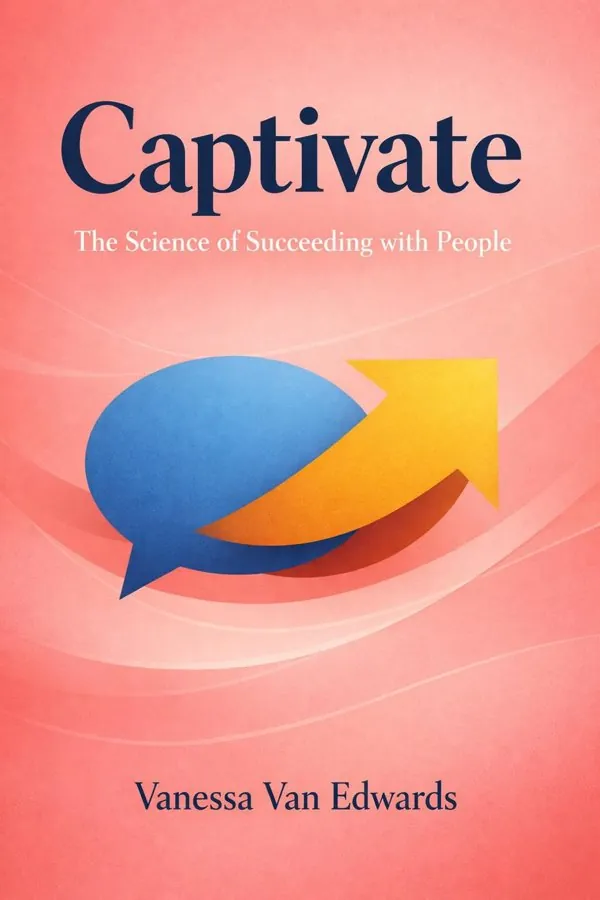
Captivate: The Science of Succeeding with People: Summary & Key Insights
 10 min6 chaptersAudio available
What Is Captivate: The Science of Succeeding with People About?
Captivate: The Science of Succeeding with People by Vanessa Van Edwards is a communication book spanning 6 pages. Captivate: The Science of Succeeding with People es un libro de no ficción que explora cómo comprender y dominar las dinámicas sociales mediante principios científicos. Vanessa Van Edwards, investigadora de comportamiento, ofrece estrategias prácticas para mejorar la comunicación, generar confianza y aumentar la influencia personal en contextos profesionales y sociales. A través de estudios de casos y experimentos, el libro enseña cómo leer el lenguaje corporal, iniciar conversaciones efectivas y construir relaciones auténticas.
This FizzRead summary covers all 6 key chapters of Captivate: The Science of Succeeding with People in approximately 10 minutes, distilling the most important ideas, arguments, and takeaways from Vanessa Van Edwards's work. Also available as an audio summary and Key Quotes Podcast.
Captivate: The Science of Succeeding with People
Captivate: The Science of Succeeding with People es un libro de no ficción que explora cómo comprender y dominar las dinámicas sociales mediante principios científicos. Vanessa Van Edwards, investigadora de comportamiento, ofrece estrategias prácticas para mejorar la comunicación, generar confianza y aumentar la influencia personal en contextos profesionales y sociales. A través de estudios de casos y experimentos, el libro enseña cómo leer el lenguaje corporal, iniciar conversaciones efectivas y construir relaciones auténticas.
Who Should Read Captivate: The Science of Succeeding with People?
This book is perfect for anyone interested in communication and looking to gain actionable insights in a short read. Whether you're a student, professional, or lifelong learner, the key ideas from Captivate: The Science of Succeeding with People by Vanessa Van Edwards will help you think differently.
- ✓Readers who enjoy communication and want practical takeaways
- ✓Professionals looking to apply new ideas to their work and life
- ✓Anyone who wants the core insights of Captivate: The Science of Succeeding with People in just 10 minutes
Want the full summary?
Get instant access to this book summary and 100K+ more with Fizz Moment.
Get Free SummaryAvailable on App Store • Free to download
Key Chapters
Most people decide if they like or trust you within the first few seconds of meeting you. Research from Princeton shows that impressions form in as little as a tenth of a second. That means before you even say your name, people’s brains have already tagged you as friend or foe, competent or uncertain. The good news is that these judgments follow predictable cues.
Our brains unconsciously assess two core questions when we meet someone: Can I trust this person? And can I respect this person? These correlate to warmth and competence, the two universal dimensions of impression. To truly captivate, you must project both — warmth signals empathy and approachability, while competence signals reliability and strength. Balancing these is the magic formula.
So how do you embody warmth and competence simultaneously? It starts before you even speak — with body language. Stand tall, open your stance, make genuine eye contact, and smile sincerely. These universal indicators instantly put others at ease. But warmth isn’t about forced friendliness; it’s about being present and attuned. When you look at someone with authentic curiosity, your body unconsciously reflects that energy.
Competence, meanwhile, is projected through stillness and confidence. Nervous fidgeting, darting eyes, or a collapsed posture signals uncertainty. In our lab, we found that the most trusted professionals display calm self-assurance. Their gestures are deliberate, movements minimal but expressive. When you walk into a room with shoulders back and head up, others’ brains register you as capable before you speak.
Think of every first encounter as an experiment in alignment — between your inner mindset and your outer signals. The more authentically confident and open you feel, the more congruent your cues become. First impressions aren’t about pretending to be someone else; they’re about letting your best self register clearly and powerfully in others’ perception.
Words are only a small part of how people read us — research suggests that up to 60–90% of communication is nonverbal. Every subtle movement transmits signals that others decode subconsciously. Learning to master nonverbal communication doesn’t mean becoming robotic; it means becoming conscious of what your body is already saying.
Open body language is your first line of connection. Crossing arms or angling your feet toward the door subconsciously communicates disinterest or discomfort. Instead, orient yourself toward the person you’re engaging with, use open gestures, and nod naturally. Mirroring — subtly matching another person’s body language — also builds rapport by creating subconscious harmony.
But perhaps the most vital nonverbal channel is microexpressions: fleeting facial movements that reveal genuine emotion before we can hide it. Drawing on Paul Ekman’s facial coding research, we at Science of People train individuals to recognize these signals — the subtle flash of contempt, the eyebrow lift of surprise, the tight mouth of anxiety. When you start noticing these micro moments, you gain insight into what people truly feel, even when words disguise it.
Your goal isn’t to control every gesture; it’s to become self-aware enough to align your words, body, and intention. When your gestures underscore your message, people sense authenticity. When they conflict, people instinctively distrust you. Social success is about synchrony — creating nonverbal congruence that others perceive as natural confidence.
+ 4 more chapters — available in the FizzRead app
All Chapters in Captivate: The Science of Succeeding with People
About the Author
Vanessa Van Edwards es una investigadora de comportamiento, conferencista y autora estadounidense. Fundadora de Science of People, se especializa en el estudio de la comunicación no verbal, la influencia y las habilidades sociales. Su trabajo ha sido presentado en medios como CNN, Forbes y Fast Company.
Get This Summary in Your Preferred Format
Read or listen to the Captivate: The Science of Succeeding with People summary by Vanessa Van Edwards anytime, anywhere. FizzRead offers multiple formats so you can learn on your terms — all free.
Available formats: App · Audio · PDF · EPUB — All included free with FizzRead
Download Captivate: The Science of Succeeding with People PDF and EPUB Summary
Key Quotes from Captivate: The Science of Succeeding with People
“Most people decide if they like or trust you within the first few seconds of meeting you.”
“Words are only a small part of how people read us — research suggests that up to 60–90% of communication is nonverbal.”
Frequently Asked Questions about Captivate: The Science of Succeeding with People
Captivate: The Science of Succeeding with People by Vanessa Van Edwards is a communication book that explores key ideas across 6 chapters. Captivate: The Science of Succeeding with People es un libro de no ficción que explora cómo comprender y dominar las dinámicas sociales mediante principios científicos. Vanessa Van Edwards, investigadora de comportamiento, ofrece estrategias prácticas para mejorar la comunicación, generar confianza y aumentar la influencia personal en contextos profesionales y sociales. A través de estudios de casos y experimentos, el libro enseña cómo leer el lenguaje corporal, iniciar conversaciones efectivas y construir relaciones auténticas.
More by Vanessa Van Edwards

You Might Also Like

Magic Words: The Science and Secrets Behind Seven Words That Motivate, Engage, and Influence
Tim David
10 min
Talking Across The Divide: How to Communicate with People You Disagree with and Maybe Even Change the World
Justin Lee
10 min
The Exceptional Presenter: A Proven Formula to Open Up! and Own the Room
Timothy J. Koegel
10 min
4 Essential Keys to Effective Communication in Love, Life, Work--Anywhere!: Including the 12-Day Communication Challenge!
Bento C. Leal III
10 min
Active Listening Techniques: 30 Practical Tools to Hone Your Communication Skills
Nisha Gupta
10 min
Bargaining for Advantage: Negotiation Strategies for Reasonable People
G. Richard Shell
10 minFeatured In
Browse by Category
Ready to read Captivate: The Science of Succeeding with People?
Get the full summary and 100K+ more books with Fizz Moment.