
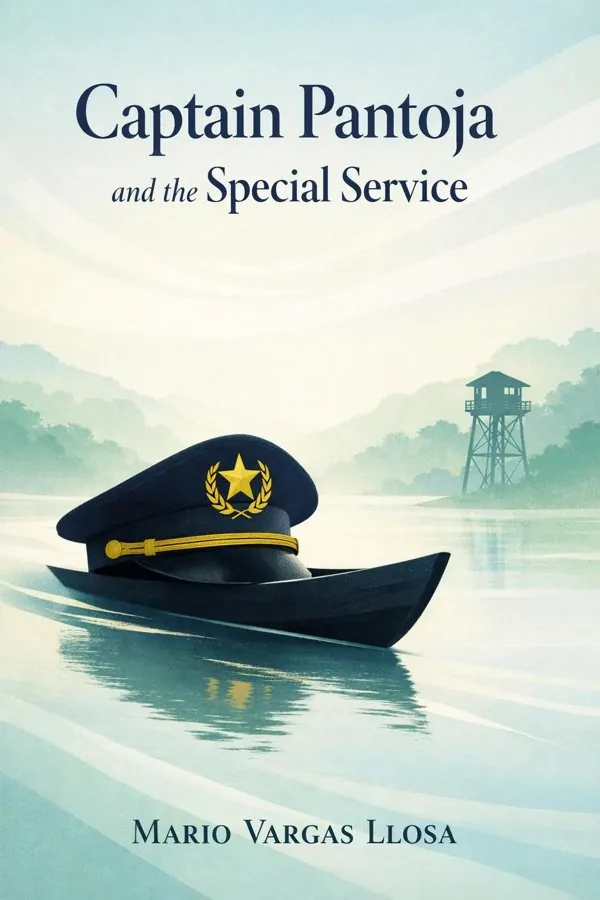
Captain Pantoja and the Special Service: Summary & Key Insights
 10 min9 chaptersAudio available
Key Takeaways from Captain Pantoja and the Special Service
The most unsettling absurdities often begin as reasonable assignments.
Bureaucracy becomes most revealing when it is forced into contact with chaos.
No system can indefinitely organize what it refuses to understand.
Words do not merely describe reality; they can anesthetize it.
Laughter is often a more precise instrument than outrage.
What Is Captain Pantoja and the Special Service About?
Captain Pantoja and the Special Service by Mario Vargas Llosa is a classics book spanning 3 pages. What happens when a model officer is asked to solve a military problem that polite society refuses to name? In Captain Pantoja and the Special Service, Mario Vargas Llosa turns that premise into one of the sharpest political satires in modern Latin American fiction. The novel follows Captain Pantaleón Pantoja, a disciplined Peruvian army officer sent to the Amazon city of Iquitos to organize a secret “special service” of prostitutes for soldiers stationed in isolated jungle posts. What begins as a practical administrative task soon becomes a comic and disturbing experiment in how institutions hide their contradictions behind procedure, secrecy, and official language. Vargas Llosa uses military reports, letters, radio transcripts, and dialogue to show how absurdity grows naturally out of systems that value efficiency over ethics. The book matters because it is not just a farce about the army; it is a wider critique of bureaucracy, masculinity, hypocrisy, and the dangerous comfort of obedience. As a Nobel Prize–winning novelist renowned for dissecting power and social illusion, Vargas Llosa brings authority, wit, and psychological precision to every page.
This FizzRead summary covers all 9 key chapters of Captain Pantoja and the Special Service in approximately 10 minutes, distilling the most important ideas, arguments, and takeaways from Mario Vargas Llosa's work. Also available as an audio summary and Key Quotes Podcast.
Captain Pantoja and the Special Service
What happens when a model officer is asked to solve a military problem that polite society refuses to name? In Captain Pantoja and the Special Service, Mario Vargas Llosa turns that premise into one of the sharpest political satires in modern Latin American fiction. The novel follows Captain Pantaleón Pantoja, a disciplined Peruvian army officer sent to the Amazon city of Iquitos to organize a secret “special service” of prostitutes for soldiers stationed in isolated jungle posts. What begins as a practical administrative task soon becomes a comic and disturbing experiment in how institutions hide their contradictions behind procedure, secrecy, and official language. Vargas Llosa uses military reports, letters, radio transcripts, and dialogue to show how absurdity grows naturally out of systems that value efficiency over ethics. The book matters because it is not just a farce about the army; it is a wider critique of bureaucracy, masculinity, hypocrisy, and the dangerous comfort of obedience. As a Nobel Prize–winning novelist renowned for dissecting power and social illusion, Vargas Llosa brings authority, wit, and psychological precision to every page.
Who Should Read Captain Pantoja and the Special Service?
This book is perfect for anyone interested in classics and looking to gain actionable insights in a short read. Whether you're a student, professional, or lifelong learner, the key ideas from Captain Pantoja and the Special Service by Mario Vargas Llosa will help you think differently.
- ✓Readers who enjoy classics and want practical takeaways
- ✓Professionals looking to apply new ideas to their work and life
- ✓Anyone who wants the core insights of Captain Pantoja and the Special Service in just 10 minutes
Want the full summary?
Get instant access to this book summary and 100K+ more with Fizz Moment.
Get Free SummaryAvailable on App Store • Free to download
Key Chapters
The most unsettling absurdities often begin as reasonable assignments. Captain Pantaleón Pantoja starts the novel as the ideal officer: punctual, sober, efficient, loyal, and almost mechanically obedient. He is the kind of man institutions trust because he does not ask whether an order is morally sound; he asks only how to execute it well. When military superiors quietly summon him and assign him the task of organizing a secret prostitution service for troops in the Amazon, the comedy appears immediately. Yet the deeper point is serious: institutions often solve human problems not by examining their causes, but by designing systems that make those problems manageable.
Pantoja approaches the mission exactly as he would approach logistics, supply, or communications. He studies demand, calculates routes, formalizes procedures, and builds a structure. Desire becomes data. Vice becomes administration. Vargas Llosa shows how professionalism can become morally blind when competence is detached from conscience. Pantoja is not corrupt in the usual sense; his tragedy is that he is too pure a servant of order.
This idea extends far beyond the military world. In workplaces, governments, and even families, people often confuse efficiency with wisdom. A manager may implement a flawless process for a harmful policy. A team may optimize productivity while ignoring burnout. A public official may enforce rules without seeing the human damage those rules create. The lesson is not that discipline is bad, but that discipline without ethical reflection becomes dangerous.
Actionable takeaway: When you are asked to solve a problem efficiently, pause and ask a prior question: should this problem be solved in this way at all?
Bureaucracy becomes most revealing when it is forced into contact with chaos. In Iquitos, deep in the Peruvian Amazon, Pantoja’s assignment evolves into a bizarre laboratory where military order collides with jungle unpredictability, local customs, gossip networks, and raw human desire. Instead of weakening under those pressures, bureaucracy adapts and expands. Forms multiply. Reports become more detailed. Schedules, rankings, quotas, and operational metrics turn the unofficial service into a strangely polished machine.
Vargas Llosa’s satire works because he understands that institutions often respond to embarrassment by becoming more procedural. The more morally compromised the operation becomes, the more formalized it gets. Official language acts as a kind of deodorant. Euphemism and documentation create the illusion that if something is well managed, it must also be legitimate. Pantoja’s reports are comic because they treat sexual commerce with the sterile precision of military logistics, but they are also unnerving because that precision hides what is actually happening.
This dynamic is easy to recognize in contemporary life. Organizations facing uncomfortable realities often rename them, standardize them, and bury them in process. Poor culture becomes “transition pain.” Exploitation becomes “resource allocation.” Emotional distress becomes a “performance issue.” Bureaucracy can help complex systems function, but it can also become a shield against moral honesty.
The jungle setting sharpens the contrast. Nature, bodies, rumor, violence, and faith resist categorization. Yet Pantoja keeps trying to fit them into charts. That is what makes the novel so funny and so incisive: reality keeps spilling past the edges of the file folder.
Actionable takeaway: Whenever a system becomes heavily procedural, ask what reality the paperwork may be concealing rather than clarifying.
No system can indefinitely organize what it refuses to understand. As Pantoja’s special service grows in scale and efficiency, the very success of the operation seeds its collapse. What was meant to remain discreet becomes visible. What was meant to serve the institution begins to reshape it. Desire, reputation, jealousy, religion, local politics, and media attention all enter the picture, and the officer who once seemed invulnerable to temptation discovers that control is more fragile than he imagined.
Pantoja’s unraveling is not just personal. Vargas Llosa shows that every rigid structure contains hidden vulnerabilities. The more completely Pantoja identifies himself with duty, the less prepared he is for the emotional and moral consequences of his work. He can plan transport and reporting chains, but he cannot fully regulate attraction, shame, scandal, or grief. In this sense, the novel argues that human beings are not administrative units. When institutions treat them that way, breakdown is inevitable.
This is true in ordinary life as well. Leaders who rely only on systems can be blindsided by culture. Parents who emphasize rules without emotional understanding may lose their children’s trust. Professionals who define themselves entirely by competence may collapse when their private lives become complicated. Structure matters, but structure alone cannot govern human experience.
The brilliance of the novel lies in how comedy gradually darkens into exposure. We laugh at the absurdity of the operation, then realize that the joke depends on a tragic misunderstanding: the belief that appetite, vulnerability, and moral consequence can be managed like inventory.
Actionable takeaway: Build systems, but never assume systems can replace self-knowledge, emotional maturity, or ethical accountability.
Words do not merely describe reality; they can anesthetize it. One of the novel’s most powerful satirical tools is its use of official, sanitized, almost comically formal language to describe an enterprise everyone knows is morally awkward and politically dangerous. The “special service” is never spoken of in plain terms by those in power. Euphemism becomes policy. Bureaucratic diction creates distance between action and responsibility.
Vargas Llosa suggests that institutions survive scandal not only through secrecy but through vocabulary. If exploitation is recast as service provision, if desire is framed as troop morale, if prostitution is converted into operational necessity, then leaders can pretend they are managing a technical issue rather than endorsing a contradiction. The result is a gap between language and reality so wide that it becomes absurd. Yet that absurdity is familiar. Modern life is full of euphemisms that soften accountability: layoffs become restructuring, manipulation becomes strategy, censorship becomes moderation, and evasion becomes messaging.
The novel invites readers to become suspicious of polished language, especially when it appears in moments of ethical discomfort. Pantoja’s reports are impressive in their precision, but that precision is part of the problem. It allows everyone involved to feel organized instead of implicated. This is not only a literary joke; it is a political insight. Language can make wrongdoing feel procedural.
In practical terms, this idea matters in workplaces, public institutions, and personal relationships. If people constantly rename hard truths instead of facing them, confusion and cynicism follow. Honest language does not solve every problem, but dishonest language ensures that no real solution can begin.
Actionable takeaway: Pay close attention to euphemisms; when language sounds unusually polished, ask what uncomfortable truth it may be trying to soften.
Laughter is often a more precise instrument than outrage. Captain Pantoja and the Special Service is deeply funny, but its humor is never decorative. Vargas Llosa uses satire to expose institutional hypocrisy with a force that direct condemnation might not achieve. By making the military’s secret arrangement both efficient and ridiculous, he reveals how power normalizes contradiction. The army publicly defends discipline and morality while privately creating a mechanism that depends on the opposite. The comedy lies in the gap between declared values and actual behavior.
Satire works here because it allows readers to see corruption not just as villainy but as absurdity. That distinction matters. Purely moralistic stories can flatten people into heroes and villains. Vargas Llosa does something richer: he shows ordinary functionaries, anxious superiors, local opportunists, religious fervor, and social gossip all interacting within a system that has lost contact with its own principles. We laugh because the logic is so meticulous and so insane. We keep reading because we recognize versions of that logic everywhere.
This remains one of satire’s greatest powers in public life. It punctures prestige. It reveals the ridiculous machinery behind solemn rhetoric. In organizations, communities, or politics, humor can expose contradictions that formal criticism leaves untouched. Used well, it disarms defensiveness and invites recognition. Used poorly, it becomes cynicism. Vargas Llosa avoids that trap by grounding the farce in human cost and emotional consequence.
For readers, the novel offers a useful habit of mind: when confronted with grand institutional language, ask where the comedy is hiding. Often the joke is the truth no one wants to state directly.
Actionable takeaway: Use humor not to dismiss serious problems, but to identify contradictions that official seriousness is trying to protect.
A society reveals its assumptions through the needs it treats as unavoidable. The military logic behind the special service rests on a familiar claim: men stationed in hardship cannot be expected to control sexual desire, so the institution must accommodate them. Vargas Llosa satirizes this assumption without reducing it to a simple slogan. The novel shows how ideas about masculinity become embedded in policy, discipline, and hierarchy. Male desire is treated as natural, urgent, and administratively manageable; the women who service that desire are treated as resources within a chain of command.
This is one of the novel’s sharpest contributions. It does not merely mock military hypocrisy; it reveals how institutions are built around gendered expectations they rarely examine. Masculinity is framed as both powerful and helpless, authoritative and excused. Soldiers are expected to embody discipline in battle but are simultaneously portrayed as incapable of restraint in sex. That contradiction enables the whole operation.
The issue remains relevant. Workplaces, schools, sports cultures, and political systems still often excuse harmful behavior as inevitable male conduct or “just the way things are.” When desire is treated as destiny, accountability weakens. When women are viewed mainly in relation to male needs, exploitation becomes easier to normalize.
The novel does not offer a neat moral program, but it does force readers to see how social myths can become administrative systems. That is a valuable insight. The stories societies tell about gender do not stay abstract; they shape institutions, permissions, and blind spots.
Actionable takeaway: Challenge any rule or custom that treats self-control as optional for the powerful and service as obligatory for everyone else.
A person can be respectable in habit yet compromised in function. Pantoja is not portrayed as a crude opportunist. He is devoted to his wife, serious about his duties, and almost old-fashioned in his sense of honor. That is exactly why the novel is so effective. Vargas Llosa shows that private decency does not automatically protect someone from becoming an instrument of public hypocrisy. Pantoja believes that if he remains orderly, discreet, and professional, he can preserve his integrity. But integrity is not only a matter of personal intentions; it also depends on the moral nature of what one agrees to serve.
This insight is uncomfortable because it implicates many ordinary forms of complicity. People often imagine corruption as something dramatic and external, carried out by obviously bad actors. The novel suggests otherwise. Harmful systems are frequently sustained by conscientious people who do their jobs well while avoiding larger moral questions. The accountant who cleans up deceptive numbers, the administrator who enforces an unjust rule, the spokesperson who rationalizes abuse—all may think of themselves as merely responsible professionals.
Pantoja’s predicament demonstrates the limits of compartmentalization. One cannot indefinitely separate domestic virtue from public function, or inner order from outer contradiction. Eventually roles bleed into identity. The man who organizes the unmentionable in the name of duty cannot remain untouched by what duty has demanded.
For readers, this is one of the novel’s deepest ethical challenges. It asks not only whether we are good in private, but whether our competence is being used in service of something unworthy.
Actionable takeaway: Evaluate your responsibilities not just by how well you perform them, but by whether they align with the values you claim to live by.
How a story is told can be part of what it means. Vargas Llosa structures the novel through a lively mix of military memoranda, letters, conversations, reports, and public discourse, creating a mosaic that mirrors the fragmented reality of the operation itself. This formal play is not mere experimentation. It dramatizes how institutions produce reality through documents, how gossip competes with authority, and how truth emerges from conflicting voices rather than a single stable narration.
The result is a reading experience that feels both fast and layered. Official reports present one version of events: measured, rational, strategic. Personal exchanges reveal anxiety, vanity, longing, and confusion. Public commentary turns rumor into spectacle. By moving among these registers, Vargas Llosa lets readers see the distance between what is said, what is meant, and what is actually happening. Form becomes satire. The documents do not simply record absurdity; they manufacture and disguise it.
This matters beyond literature because people today live among overlapping narratives all the time: emails, performance reviews, social media posts, press statements, text messages, and internal memos. Understanding reality often requires comparing genres, tones, and interests. The novel trains that skill beautifully. It teaches readers to distrust singular official versions and to notice how communication channels shape perception.
On a craft level, the book also demonstrates how comedy gains force from structure. Repetition, procedural detail, and tonal contrast create escalating absurdity. Readers are entertained, but they are also being taught how systems talk.
Actionable takeaway: When trying to understand a complex situation, compare the official record with personal testimony; the truth often lives in the gap between them.
A great satire ages well because hypocrisy changes costume, not character. Although Captain Pantoja and the Special Service is rooted in a specific Peruvian military context, its central concerns remain strikingly contemporary. Institutions still hide embarrassing realities behind euphemism, metrics, and secrecy. Leaders still claim moral authority while permitting practical exceptions that contradict their values. Professionals still confuse execution with justification. Public image still matters more than truth until scandal makes concealment impossible.
The novel also feels modern in its understanding of systems. Vargas Llosa recognizes that absurdity is often generated not by one evil mastermind, but by networks of incentives, silences, and delegated responsibilities. Everyone handles a piece; no one wants full ownership. That is why the story resonates with readers living in bureaucratic societies. Whether the setting is a corporation, a government office, a university, or a media institution, the pattern is familiar: a private workaround becomes normalized, formalized, and eventually explosive.
At the same time, the book remains deeply human. Beneath the satire are loneliness, ambition, shame, longing, and the desire to belong. That emotional undercurrent prevents the novel from becoming merely clever. It reminds us that systems are made of people, and that people can be both ridiculous and vulnerable.
For modern readers, the novel offers more than historical interest. It is a tool for interpreting contemporary life. Whenever you see an institution become extremely polished in managing what it publicly denies, you are in Vargas Llosa territory.
Actionable takeaway: Read institutional efficiency with skepticism; when an organization becomes expert at managing a contradiction, ask what future scandal is already being prepared.
All Chapters in Captain Pantoja and the Special Service
About the Author
Mario Vargas Llosa was born in Arequipa, Peru, in 1936 and became one of the most celebrated writers in the Spanish-speaking world. A novelist, essayist, journalist, and public intellectual, he emerged as a major figure of the Latin American Boom alongside writers such as Gabriel García Márquez and Julio Cortázar. His fiction often explores power, authoritarianism, social conflict, and the tensions between private desire and public life. Among his best-known works are The Time of the Hero, Conversation in the Cathedral, The War of the End of the World, and Aunt Julia and the Scriptwriter. In 2010 he was awarded the Nobel Prize in Literature for his cartography of structures of power and his vivid images of resistance, revolt, and individual defeat.
Get This Summary in Your Preferred Format
Read or listen to the Captain Pantoja and the Special Service summary by Mario Vargas Llosa anytime, anywhere. FizzRead offers multiple formats so you can learn on your terms — all free.
Available formats: App · Audio · PDF · EPUB — All included free with FizzRead
Download Captain Pantoja and the Special Service PDF and EPUB Summary
Key Quotes from Captain Pantoja and the Special Service
“The most unsettling absurdities often begin as reasonable assignments.”
“Bureaucracy becomes most revealing when it is forced into contact with chaos.”
“No system can indefinitely organize what it refuses to understand.”
“Words do not merely describe reality; they can anesthetize it.”
“Laughter is often a more precise instrument than outrage.”
Frequently Asked Questions about Captain Pantoja and the Special Service
Captain Pantoja and the Special Service by Mario Vargas Llosa is a classics book that explores key ideas across 9 chapters. What happens when a model officer is asked to solve a military problem that polite society refuses to name? In Captain Pantoja and the Special Service, Mario Vargas Llosa turns that premise into one of the sharpest political satires in modern Latin American fiction. The novel follows Captain Pantaleón Pantoja, a disciplined Peruvian army officer sent to the Amazon city of Iquitos to organize a secret “special service” of prostitutes for soldiers stationed in isolated jungle posts. What begins as a practical administrative task soon becomes a comic and disturbing experiment in how institutions hide their contradictions behind procedure, secrecy, and official language. Vargas Llosa uses military reports, letters, radio transcripts, and dialogue to show how absurdity grows naturally out of systems that value efficiency over ethics. The book matters because it is not just a farce about the army; it is a wider critique of bureaucracy, masculinity, hypocrisy, and the dangerous comfort of obedience. As a Nobel Prize–winning novelist renowned for dissecting power and social illusion, Vargas Llosa brings authority, wit, and psychological precision to every page.
More by Mario Vargas Llosa

You Might Also Like





Browse by Category
Ready to read Captain Pantoja and the Special Service?
Get the full summary and 100K+ more books with Fizz Moment.