
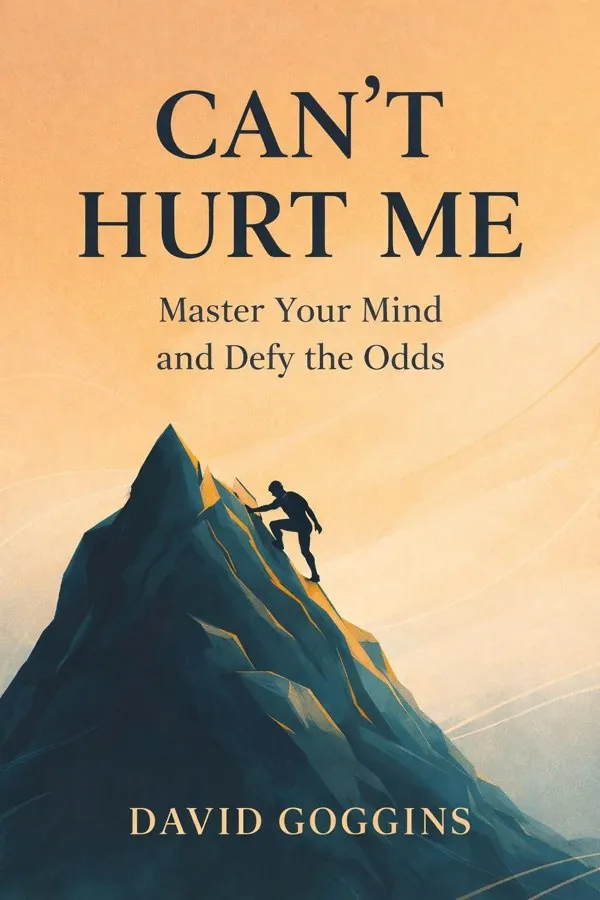
Can’t Hurt Me: Master Your Mind and Defy the Odds: Summary & Key Insights
 10 min9 chaptersAudio available
Key Takeaways from Can’t Hurt Me: Master Your Mind and Defy the Odds
Pain does not automatically make you stronger, but refusing to be defined by it can.
Sometimes the hardest battle is not against the world but against the person you start believing yourself to be.
Rock bottom often arrives quietly, disguised as routine.
When your mind screams that you are done, you are often far from finished.
Self-respect grows when you stop lying to yourself.
What Is Can’t Hurt Me: Master Your Mind and Defy the Odds About?
Can’t Hurt Me: Master Your Mind and Defy the Odds by David Goggins is a biographies book spanning 7 pages. Can’t Hurt Me is part memoir, part mental training manual, and part challenge to every excuse we use to avoid our potential. In this bestselling book, David Goggins tells the story of how he rose from a childhood marked by abuse, fear, racism, poverty, and self-doubt to become a Navy SEAL, Army Ranger, Air Force Tactical Air Control Party member, and one of the world’s most respected ultra-endurance athletes. But the book is not simply about extreme accomplishments. Its real subject is the untapped power of the human mind. Goggins argues that most people quit long before they reach their true limit. Through brutal personal stories and hard-earned lessons, he shows how suffering, discipline, and radical honesty can become tools for transformation rather than obstacles to success. His message matters because it rejects comfort-driven self-help and replaces it with responsibility, resilience, and action. Goggins writes with unusual authority because he has lived every principle he teaches, repeatedly testing himself in conditions most people would avoid at any cost. The result is a raw, unforgettable book for anyone who wants to stop negotiating with weakness and start building real mental toughness.
This FizzRead summary covers all 9 key chapters of Can’t Hurt Me: Master Your Mind and Defy the Odds in approximately 10 minutes, distilling the most important ideas, arguments, and takeaways from David Goggins's work. Also available as an audio summary and Key Quotes Podcast.
Can’t Hurt Me: Master Your Mind and Defy the Odds
Can’t Hurt Me is part memoir, part mental training manual, and part challenge to every excuse we use to avoid our potential. In this bestselling book, David Goggins tells the story of how he rose from a childhood marked by abuse, fear, racism, poverty, and self-doubt to become a Navy SEAL, Army Ranger, Air Force Tactical Air Control Party member, and one of the world’s most respected ultra-endurance athletes. But the book is not simply about extreme accomplishments. Its real subject is the untapped power of the human mind.
Goggins argues that most people quit long before they reach their true limit. Through brutal personal stories and hard-earned lessons, he shows how suffering, discipline, and radical honesty can become tools for transformation rather than obstacles to success. His message matters because it rejects comfort-driven self-help and replaces it with responsibility, resilience, and action. Goggins writes with unusual authority because he has lived every principle he teaches, repeatedly testing himself in conditions most people would avoid at any cost. The result is a raw, unforgettable book for anyone who wants to stop negotiating with weakness and start building real mental toughness.
Who Should Read Can’t Hurt Me: Master Your Mind and Defy the Odds?
This book is perfect for anyone interested in biographies and looking to gain actionable insights in a short read. Whether you're a student, professional, or lifelong learner, the key ideas from Can’t Hurt Me: Master Your Mind and Defy the Odds by David Goggins will help you think differently.
- ✓Readers who enjoy biographies and want practical takeaways
- ✓Professionals looking to apply new ideas to their work and life
- ✓Anyone who wants the core insights of Can’t Hurt Me: Master Your Mind and Defy the Odds in just 10 minutes
Want the full summary?
Get instant access to this book summary and 100K+ more with Fizz Moment.
Get Free SummaryAvailable on App Store • Free to download
Key Chapters
Pain does not automatically make you stronger, but refusing to be defined by it can. Goggins begins his story in a home ruled by fear. His father was violent, controlling, and unpredictable, and the family lived under constant tension while also working long hours in the family nightclub. This early environment taught Goggins what helplessness felt like. It also left deep scars that followed him for years.
What makes this part of the book powerful is that Goggins does not romanticize hardship. He shows how abuse damages confidence, distorts self-image, and teaches children to live in survival mode. Yet he also shows that the past does not have to become a permanent identity. His mother eventually escaped with him, creating the first opening for a different life. That escape did not magically solve his problems, but it proved that change begins when someone decides that what is happening is no longer acceptable.
For readers, the lesson is not that trauma is good, but that it can be transformed. Many people spend years letting old pain justify present stagnation. Goggins insists that while you may not be responsible for what happened to you, you are responsible for what you do next. That shift from victimhood to ownership is one of the book’s foundational ideas.
A practical way to apply this is to write down one difficult experience that still shapes your behavior. Ask yourself: how has this pain become an excuse, a fear, or a story I keep repeating? Then identify one action that turns it into fuel instead, such as building a skill, improving your health, or confronting a long-avoided challenge. Actionable takeaway: stop asking why your past happened and start asking how you will use it.
Sometimes the hardest battle is not against the world but against the person you start believing yourself to be. After escaping his father, Goggins did not step into a fresh start. In his new town, he faced racism, social isolation, and academic struggle. He fell behind in school, doubted his intelligence, and internalized the belief that he was inferior. Over time, this created a damaging identity: someone who was not capable, not disciplined, and not meant for excellence.
This section of the book matters because it explains how self-doubt is formed. It rarely appears overnight. It builds slowly through humiliation, comparison, repeated failure, and the absence of confidence-building experiences. Goggins shows how easy it is to become trapped in labels, especially when other people reinforce them. He cheated in school just to survive academically, but every shortcut deepened his sense that he could not truly succeed on merit.
The broader lesson is that identity often becomes destiny unless it is deliberately challenged. If you believe you are lazy, weak, bad with money, poor under pressure, or incapable of change, your behavior will start serving that belief. Goggins teaches that before you can build toughness, you must recognize the false story you are living inside.
A practical application is to audit the labels you use about yourself. Write down three negative identities you repeat, such as “I’m not consistent” or “I’m not good under stress.” Then gather evidence against each one, even if it is small. Replace the label with a standard: “I am becoming someone who keeps promises.” Actionable takeaway: identify one limiting label you have accepted and reject it through repeated proof, not positive thinking alone.
Rock bottom often arrives quietly, disguised as routine. Before becoming a military icon, Goggins was working as an exterminator, overweight, directionless, and deeply dissatisfied with himself. He ate poorly, avoided difficulty, and lived with the private knowledge that he was far below his potential. The turning point came when he saw a television program about Navy SEAL training. For the first time, he saw a standard so demanding that it shattered his excuses.
What follows is one of the clearest examples in the book of radical self-confrontation. Goggins did not wait for motivation, support, or ideal conditions. He looked honestly at his life and admitted that he had become soft. He was nearly 300 pounds and had only a short time to lose enough weight to qualify for military training. Instead of being intimidated by the scale of the challenge, he used it to force total commitment.
This idea is important because many people think transformation begins when they feel ready. Goggins argues the opposite: readiness often appears after you start. His life changed when he stopped negotiating with reality. He accepted the gap between who he was and who he wanted to be, then attacked that gap with extreme discipline.
In everyday life, this might mean confronting debt, poor health, addiction to comfort, or years of underachievement. The key is honesty without self-pity. Measure where you are, define where you need to go, and close the distance one hard action at a time. Actionable takeaway: do a brutally honest personal assessment today and choose one measurable standard you will improve immediately, whether it is weight, savings, study hours, or daily training.
When your mind screams that you are done, you are often far from finished. One of the book’s most famous ideas is Goggins’s “40% Rule,” the claim that when people feel they have reached their limit, they have usually tapped only a fraction of their actual capacity. He developed this belief through repeated exposure to extreme hardship, especially during Navy SEAL training, including Hell Week, one of the most grueling military training experiences in the world.
Goggins went through BUD/S multiple times due to injuries and medical setbacks. Most people would have treated these interruptions as proof that the goal was not meant for them. He treated them as tests of commitment. The 40% Rule emerged from these experiences as a counterattack against the brain’s natural desire for safety and comfort. The mind wants to conserve energy, avoid pain, and protect the ego. It often sends stop signals long before the body is truly incapable.
For readers, the lesson is not that everyone should pursue military-level suffering. The real point is that perceived limits are often psychological before they are physical or practical. We quit jobs, workouts, projects, or difficult conversations too early because discomfort feels like danger.
A practical way to use the 40% Rule is during moments of resistance. When you want to stop, pause and ask: am I truly unable to continue, or am I just uncomfortable? Then extend your effort slightly. Read ten more pages. Run five more minutes. Practice one more sales call. Stay with the task a little longer than your mind prefers. Actionable takeaway: the next time you feel like quitting, assume you have more in reserve and prove it with one extra push.
Self-respect grows when you stop lying to yourself. One of Goggins’s most practical tools is the “Accountability Mirror.” During periods when his life was falling apart or his goals felt distant, he used his bathroom mirror to post sticky notes listing his weaknesses, responsibilities, and targets. Instead of avoiding reality, he confronted it daily. The mirror became a place where excuses were stripped away.
This concept works because real discipline begins with accurate self-assessment. Most people either judge themselves too harshly in vague emotional terms or avoid judgment entirely. Goggins proposes a sharper method: be brutally honest, but specific. If you are out of shape, say so. If you are wasting time, admit it. If you failed to prepare, own it. Then pair the truth with clear assignments. The mirror is not meant to humiliate you. It is meant to focus you.
The Accountability Mirror also reinforces identity through repetition. Every day, you see what must be done and who you are becoming. Over time, this practice turns goals from abstract wishes into visible obligations. It is especially useful when motivation fades, because it anchors progress in commitment rather than mood.
Readers can apply this by creating a visible accountability system at home or work. Write down one uncomfortable truth, one short-term goal, and one action for today. For example: “I avoid hard conversations. Today I will make the call.” Review and update these notes regularly. The point is not perfection but honesty followed by action.
Actionable takeaway: create your own Accountability Mirror with three blunt truths and three concrete goals, then face it every day until your behavior changes.
Comfort is seductive because it feels harmless, yet too much of it makes us fragile. Goggins introduces the idea of “callusing the mind,” borrowing from the way hands develop toughness through repeated friction. Just as physical calluses form when skin is exposed to stress, mental resilience grows when you repeatedly face difficulty instead of avoiding it.
This idea helps explain why Goggins keeps seeking punishing challenges even after proving himself. He runs ultramarathons, competes while injured, and trains in brutal conditions not because suffering is glamorous, but because struggle strengthens his capacity to endure future pain. The point is not self-destruction. It is adaptation. Every hard thing you do honestly expands your reference point for what is possible.
In ordinary life, this principle is highly practical. If you always choose the easiest route, your tolerance for frustration shrinks. Small setbacks begin to feel overwhelming. But when you intentionally practice discomfort, you become less emotionally reactive and more effective under pressure. Waking early, finishing difficult work before entertainment, exercising when you do not feel like it, or having a hard conversation are all forms of mental callusing.
The key is consistency. One dramatic effort can inspire you, but repeated acts of chosen hardship reshape you. Start small but stay deliberate. Cold showers, digital boundaries, fixed exercise goals, or a daily block of focused work can all train your ability to hold steady when resistance appears.
Actionable takeaway: choose one safe, controlled discomfort to practice every day for the next two weeks, and use it as training for a stronger, less negotiable mind.
Failure only becomes final when you refuse to study it. Throughout Can’t Hurt Me, Goggins repeatedly fails, gets injured, falls short, or faces setbacks that would have justified quitting. Yet he treats failure differently from most people. Instead of using it as evidence of inadequacy, he treats it as data. Every breakdown becomes a chance to examine his habits, his preparation, and his response under stress.
This perspective is crucial because fear of failure stops many people before they begin. We avoid trying, stretching, or committing because we do not want to feel embarrassed or defeated. Goggins argues that this fear is far more damaging than failure itself. If you are serious about growth, setbacks are not interruptions to the process. They are the process.
He demonstrates this not just in training but in life transitions. Whether he is dealing with academic weakness, military requirements, or extreme endurance events, he keeps asking what the setback reveals. Was the preparation weak? Was the standard unclear? Was the response too emotional? This approach turns pain into information and preserves momentum.
Readers can apply this by building a review habit after difficult experiences. Instead of saying, “I’m terrible at this,” ask sharper questions: what exactly went wrong, what was under my control, and what will I change next time? This mindset is useful in business, fitness, relationships, and creative work.
A simple example: if you miss a deadline, do not just feel guilty. Identify whether the cause was poor planning, distraction, overcommitment, or avoidance. Then redesign your system. Actionable takeaway: after your next setback, write a brief after-action review and extract one lesson that immediately changes your behavior.
Pain is easier to endure when it points beyond yourself. As Goggins’s life evolves, his challenges become about more than proving his toughness. He uses suffering in service of something larger, including raising money for the families of fallen service members. This shift matters because pure self-improvement can eventually become hollow if it is disconnected from meaning.
Goggins shows that purpose gives pain direction. When hardship is attached to something bigger than comfort, ego, or appearance, people can endure more than they thought possible. This is true not only in military or athletic settings but in ordinary life. Parents sacrifice sleep for children. Caregivers push through exhaustion for loved ones. Leaders endure pressure for teams and missions. Meaning expands endurance.
The book also suggests that service can rescue people from self-absorption. When life feels heavy, focusing only on your own discomfort can make every obstacle feel larger. Serving others changes the frame. It does not erase pain, but it often makes suffering more bearable by reminding you that your effort has value beyond your own feelings.
To apply this idea, connect your hardest goals to a purpose outside personal validation. If you want to get healthy, make it about being present for your family. If you want financial stability, make it about reducing stress at home or supporting others. If you are building a career, tie it to contribution, not just status.
Actionable takeaway: take one demanding goal you are pursuing and write down who benefits from your discipline besides you. Let that answer strengthen your commitment when the work gets hard.
Achievement can become another form of complacency if you start believing you have arrived. One of Goggins’s most important messages is that growth is never complete. Even after becoming a SEAL and accomplishing extraordinary endurance feats, he continues to search for weaknesses, raise standards, and expose himself to new tests. He refuses the comfort of a finished identity.
This mindset separates temporary motivation from lifelong development. Many people work hard until they hit one milestone, then gradually drift back into ease. Goggins warns that the mind is always looking for comfort, recognition, and reasons to ease up. If you stop challenging yourself, old habits can quietly return. Continuous growth requires continued confrontation.
That does not mean living in constant misery. It means staying honest about your edge. Where are you coasting? Where have you become too dependent on reputation, routine, or past success? The goal is not endless self-criticism but ongoing expansion. Each level of discipline reveals the next level of potential.
Practically, this can mean setting fresh standards after every milestone. If you lose weight, focus next on strength, mobility, or consistency. If you grow your business, build leadership habits. If you finish a degree, develop communication or financial skills. Keep evolving rather than settling into the comfort of what you already proved.
Actionable takeaway: identify one area where recent success has made you too comfortable, and set a new challenge that forces you to grow again rather than live off past wins.
All Chapters in Can’t Hurt Me: Master Your Mind and Defy the Odds
About the Author
David Goggins is an American author, retired Navy SEAL, endurance athlete, and motivational speaker known for his extreme mental toughness and relentless discipline. Before his rise to fame, he endured an abusive childhood, poverty, racism, and years of self-doubt. He later transformed himself physically and mentally, completing Navy SEAL training, serving in the U.S. military, and becoming one of the world’s best-known ultramarathon runners and endurance competitors. Goggins has also completed Army Ranger School and worked as an Air Force Tactical Air Control Party member. Through his books, interviews, and speaking engagements, he has inspired millions to confront excuses, embrace discomfort, and pursue growth beyond perceived limits. His message centers on accountability, resilience, and the power of mastering the mind.
Get This Summary in Your Preferred Format
Read or listen to the Can’t Hurt Me: Master Your Mind and Defy the Odds summary by David Goggins anytime, anywhere. FizzRead offers multiple formats so you can learn on your terms — all free.
Available formats: App · Audio · PDF · EPUB — All included free with FizzRead
Download Can’t Hurt Me: Master Your Mind and Defy the Odds PDF and EPUB Summary
Key Quotes from Can’t Hurt Me: Master Your Mind and Defy the Odds
“Pain does not automatically make you stronger, but refusing to be defined by it can.”
“Sometimes the hardest battle is not against the world but against the person you start believing yourself to be.”
“Rock bottom often arrives quietly, disguised as routine.”
“When your mind screams that you are done, you are often far from finished.”
“Self-respect grows when you stop lying to yourself.”
Frequently Asked Questions about Can’t Hurt Me: Master Your Mind and Defy the Odds
Can’t Hurt Me: Master Your Mind and Defy the Odds by David Goggins is a biographies book that explores key ideas across 9 chapters. Can’t Hurt Me is part memoir, part mental training manual, and part challenge to every excuse we use to avoid our potential. In this bestselling book, David Goggins tells the story of how he rose from a childhood marked by abuse, fear, racism, poverty, and self-doubt to become a Navy SEAL, Army Ranger, Air Force Tactical Air Control Party member, and one of the world’s most respected ultra-endurance athletes. But the book is not simply about extreme accomplishments. Its real subject is the untapped power of the human mind. Goggins argues that most people quit long before they reach their true limit. Through brutal personal stories and hard-earned lessons, he shows how suffering, discipline, and radical honesty can become tools for transformation rather than obstacles to success. His message matters because it rejects comfort-driven self-help and replaces it with responsibility, resilience, and action. Goggins writes with unusual authority because he has lived every principle he teaches, repeatedly testing himself in conditions most people would avoid at any cost. The result is a raw, unforgettable book for anyone who wants to stop negotiating with weakness and start building real mental toughness.
More by David Goggins
You Might Also Like

An American Marriage
Tayari Jones
10 min
Benjamin Franklin: An American Life
Walter Isaacson
10 min
I Know Why The Caged Bird Sings
Maya Angelou
10 min
Long Walk to Freedom
Nelson Mandela
10 min
Persepolis
Marjane Satrapi
10 min
Surely You're Joking, Mr. Feynman!
Richard P. Feynman
10 minBrowse by Category
Ready to read Can’t Hurt Me: Master Your Mind and Defy the Odds?
Get the full summary and 100K+ more books with Fizz Moment.