
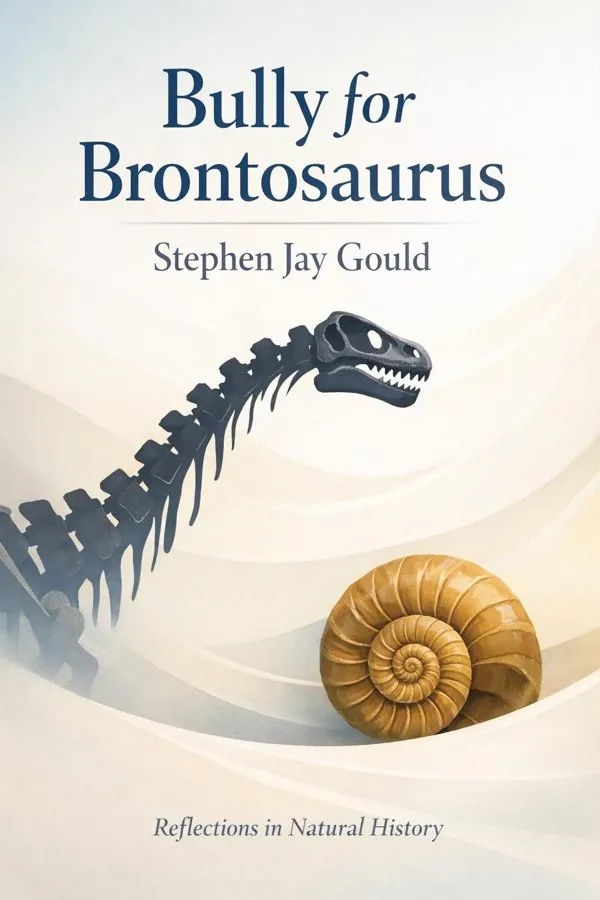
Bully for Brontosaurus: Reflections in Natural History: Summary & Key Insights
 10 min10 chaptersAudio available
Key Takeaways from Bully for Brontosaurus: Reflections in Natural History
One of Gould’s deepest insights is that science is powerful not because it is final, but because it is corrigible.
Evolution is not always a slow, smooth march.
Facts become far more illuminating when placed in historical context.
To name something is to frame it, and Gould never lets readers forget that classification is both necessary and imperfect.
Few scientific subjects capture public imagination like dinosaurs, and Gould treats that fascination as a serious intellectual topic rather than a childish distraction.
What Is Bully for Brontosaurus: Reflections in Natural History About?
Bully for Brontosaurus: Reflections in Natural History by Stephen Jay Gould is a popular_sci book spanning 12 pages. Bully for Brontosaurus: Reflections in Natural History is a lively, wide-ranging collection of essays in which Stephen Jay Gould turns fossils, scientific debates, museum displays, historical curiosities, and even language itself into windows on how science really works. Rather than presenting evolution as a fixed set of conclusions, Gould shows it as a human activity shaped by evidence, argument, error, imagination, and revision. Across the book, he examines paleontology, taxonomy, extinction, contingency, and the cultural meanings attached to scientific ideas, always insisting that natural history becomes richer when we place facts in historical and philosophical context. What makes the book matter is Gould’s ability to connect technical science with broader questions: Why do bad ideas persist? How do labels shape what we see? What can fossils teach us about chance, progress, and our place in nature? Gould was one of the twentieth century’s most influential evolutionary biologists and science writers, a Harvard paleontologist whose essays brought intellectual rigor and literary grace to public science. This book remains a masterclass in curiosity, skepticism, and scientific humility.
This FizzRead summary covers all 10 key chapters of Bully for Brontosaurus: Reflections in Natural History in approximately 10 minutes, distilling the most important ideas, arguments, and takeaways from Stephen Jay Gould's work. Also available as an audio summary and Key Quotes Podcast.
Bully for Brontosaurus: Reflections in Natural History
Bully for Brontosaurus: Reflections in Natural History is a lively, wide-ranging collection of essays in which Stephen Jay Gould turns fossils, scientific debates, museum displays, historical curiosities, and even language itself into windows on how science really works. Rather than presenting evolution as a fixed set of conclusions, Gould shows it as a human activity shaped by evidence, argument, error, imagination, and revision. Across the book, he examines paleontology, taxonomy, extinction, contingency, and the cultural meanings attached to scientific ideas, always insisting that natural history becomes richer when we place facts in historical and philosophical context. What makes the book matter is Gould’s ability to connect technical science with broader questions: Why do bad ideas persist? How do labels shape what we see? What can fossils teach us about chance, progress, and our place in nature? Gould was one of the twentieth century’s most influential evolutionary biologists and science writers, a Harvard paleontologist whose essays brought intellectual rigor and literary grace to public science. This book remains a masterclass in curiosity, skepticism, and scientific humility.
Who Should Read Bully for Brontosaurus: Reflections in Natural History?
This book is perfect for anyone interested in popular_sci and looking to gain actionable insights in a short read. Whether you're a student, professional, or lifelong learner, the key ideas from Bully for Brontosaurus: Reflections in Natural History by Stephen Jay Gould will help you think differently.
- ✓Readers who enjoy popular_sci and want practical takeaways
- ✓Professionals looking to apply new ideas to their work and life
- ✓Anyone who wants the core insights of Bully for Brontosaurus: Reflections in Natural History in just 10 minutes
Want the full summary?
Get instant access to this book summary and 100K+ more with Fizz Moment.
Get Free SummaryAvailable on App Store • Free to download
Key Chapters
One of Gould’s deepest insights is that science is powerful not because it is final, but because it is corrigible. Popular culture often imagines science as a straight road toward truth, with each discovery permanently settling what came before. Gould rejects that tidy picture. In his view, science advances through reinterpretation, dispute, and the constant testing of accepted ideas against fresh evidence. This makes science look messier than many people expect, but also far more honest and resilient.
Throughout the essays, Gould revisits episodes in natural history where later findings forced scientists to rethink classifications, extinct animals, and evolutionary patterns. The point is not that scientists are unreliable. It is that the best science includes methods for discovering its own mistakes. A fossil first interpreted one way may later fit into a different lineage. A species once thought central may turn out to be a side branch. Even cherished names, such as “Brontosaurus,” can become symbols of how evidence and tradition collide.
This matters beyond paleontology. In everyday life, people often cling to first impressions or inherited narratives because changing one’s mind feels like weakness. Gould flips that assumption. Revision is not failure. It is intellectual strength. Teachers can apply this idea by presenting science as an evolving conversation rather than a list of memorized conclusions. Managers and policymakers can use it by building processes that welcome correction instead of punishing it.
The practical lesson is simple: whenever you encounter a confident claim, ask what evidence supports it, what assumptions shape it, and what new data might change it. Treat changing your mind as progress, not embarrassment.
Evolution is not always a slow, smooth march. Gould is famous for challenging overly simple versions of Darwinian gradualism, and these essays continue that effort by exploring how the history of life often unfolds in bursts, interruptions, and uneven rhythms. Along with his collaborator Niles Eldredge, Gould argued for punctuated equilibrium, the idea that species may remain relatively stable for long stretches and then change more rapidly during episodes of speciation.
This concept does not reject evolution. Instead, it refines how we think it operates in real geological time. The fossil record, when read carefully, often shows long periods of stability rather than continuous visible transformation. Gould urges readers not to force nature into a preconceived image of steady progress. Scientific theories must fit the evidence, not the other way around.
The importance of this idea reaches beyond biology. People often expect change in careers, institutions, and societies to happen gradually and predictably. But many systems remain stable until pressure builds and a relatively rapid shift occurs. Technological industries can seem stagnant for years before a disruptive breakthrough changes everything. Personal growth can work similarly: long plateaus may precede sudden reorientation.
Gould’s larger point is that pattern matters. If we misunderstand the tempo of change, we misunderstand the process itself. Looking only for smooth transitions may blind us to periods of stability that are themselves biologically meaningful.
A useful takeaway is to pay attention not just to whether change occurs, but to when and how it happens. In science, work, and personal development, expect long stretches of apparent stillness and learn to recognize the conditions that make transformation possible.
Facts become far more illuminating when placed in historical context. Gould repeatedly shows that paleontology is not just about bones in rock layers; it is also about the people, institutions, assumptions, and accidents that shape discovery. Scientific ideas do not appear in a vacuum. They emerge from particular times, intellectual fashions, rivalries, and cultural pressures.
By revisiting historical case studies in paleontology, Gould reveals how interpretation changes as evidence accumulates and as scientists ask different questions. A specimen’s significance may depend on who found it, how museums displayed it, what theory dominated at the time, and which details researchers overlooked. These stories remind us that scientific knowledge is both objective in aspiration and human in practice.
Gould’s historical approach also protects readers from present-day arrogance. It is easy to mock earlier scientists for errors that now seem obvious. But Gould encourages a more generous stance. Many wrong turns were understandable given the tools and frameworks available at the time. Studying those mistakes teaches us how our own blind spots may operate today.
This idea has broad application. In medicine, law, education, and public policy, current systems often make sense only when viewed historically. Practices that appear irrational may be legacies of earlier assumptions. Understanding origins helps us know what to preserve, reform, or discard.
The actionable lesson is to ask historical questions whenever you confront a current belief or institution: How did this idea arise? What problem was it trying to solve? What assumptions from the past are still embedded within it? Context often reveals more than isolated facts ever can.
To name something is to frame it, and Gould never lets readers forget that classification is both necessary and imperfect. Taxonomy allows scientists to organize life, compare forms, and infer relationships. But the categories we build are not neutral mirrors. They are human tools, shaped by language, theory, and cultural assumptions. Gould examines how labels can illuminate nature while also distorting it.
The history of biological classification is full of examples where human expectations influenced what scientists thought they saw. Organisms were grouped by superficial resemblance, by assumed hierarchy, or by ideas about what counted as “primitive” or “advanced.” Gould is especially alert to the danger of smuggling social prejudice into natural categories. When people project cultural rankings onto biology, science becomes an instrument of bias rather than inquiry.
This concern extends beyond species names. The way we classify intelligence, race, sex differences, or even scientific disciplines can shape policy and public attitudes. A poor classification system can create false boundaries, reinforce stereotypes, and block better explanations. A better one can reveal relationships that were previously hidden.
In daily life, the same principle applies. Businesses segment customers, schools sort students, and institutions define success through categories that feel objective but may carry hidden values. Gould invites us to examine classification systems critically: What do they highlight? What do they erase? Who benefits from them?
The practical takeaway is to use categories as provisional tools rather than unquestioned truths. Whenever a label seems obvious, look more closely. Ask whether it reflects genuine structure in the world or merely the habits and biases of the people doing the naming.
Few scientific subjects capture public imagination like dinosaurs, and Gould treats that fascination as a serious intellectual topic rather than a childish distraction. Dinosaurs are not just extinct reptiles; they are cultural symbols onto which societies project awe, fear, grandeur, and nostalgia. Gould explores how museum displays, illustrations, names, and media narratives shape what people think dinosaurs mean.
The famous case of Brontosaurus is a perfect example. A scientific naming dispute might seem like a narrow technical matter, but Gould shows that names carry emotional and cultural weight. People do not simply consume facts about dinosaurs. They form attachments to them. This is why scientific correction can provoke resistance. The issue is not only evidence but identity, memory, and imagination.
Gould does not dismiss popular enthusiasm. Instead, he uses it to show how science communication works. Public understanding is always mediated through stories, images, metaphors, and institutions such as museums and schools. Dinosaurs become a bridge between technical paleontology and wider reflection on extinction, adaptation, and deep time.
This idea is practical for anyone who teaches, writes, or leads. People engage most strongly when information connects to wonder and narrative. Dry accuracy alone rarely inspires attention. But Gould also warns that compelling stories can harden into myths if they are never revised.
The actionable lesson is to balance excitement with precision. Use vivid images and memorable examples to make complex ideas accessible, but revisit them when evidence changes. Curiosity is strongest when wonder and intellectual honesty work together.
A central theme in Gould’s writing is that life’s history is not inevitable. The world we know emerged through countless contingent events, from mass extinctions to geographic accidents to small evolutionary divergences whose consequences became enormous over time. Gould urges readers to abandon comforting notions that evolution was destined to produce humans or any other preferred outcome.
Contingency means that if the tape of life were replayed, the result might be radically different. This does not imply chaos without structure. Natural selection still matters, and organisms must still adapt to environments. But historical pathways are constrained by chance events that cannot be derived from general laws alone. The extinction of dominant groups, the isolation of populations, or survival through catastrophe can redirect the future of life.
This perspective has philosophical force. It undermines triumphalist stories that place humanity at the top of a preordained ladder. Instead, Gould presents humans as one surprising product of a complex and accident-filled history. That view can be unsettling, but it is also liberating. Meaning need not depend on cosmic inevitability.
Contingency also applies in ordinary life. Careers often hinge on chance encounters. Institutions are shaped by historical accidents. Even personal identities emerge from combinations of intention and circumstance. Recognizing contingency can make us less self-congratulatory in success and less fatalistic in difficulty.
A practical takeaway is to plan seriously while respecting the role of unpredictability. Build adaptable systems, keep multiple paths open, and avoid reading inevitability into outcomes after the fact. History, biological or personal, is often shaped by what almost did not happen.
Science is often celebrated as a body of facts, but Gould emphasizes that its real strength lies in method: skepticism, evidence, comparison, and disciplined argument. He resists the myth that scientists simply collect neutral data and allow truth to emerge automatically. Observation is always guided by concepts, and interpretation is always necessary. What makes science reliable is not purity from bias, but procedures for confronting and correcting it.
Across the essays, Gould shows how good science depends on careful attention to scale, context, and alternative explanations. A fossil is not self-explanatory. A pattern in nature may reflect selection, constraint, developmental history, or chance. Scientists must test rival interpretations rather than settle for the most intuitive one. This is why scientific literacy involves understanding how conclusions are reached, not just memorizing the conclusions themselves.
In public debate, this lesson is crucial. Many arguments misuse science by borrowing its prestige while ignoring its standards. Cherry-picked studies, oversimplified headlines, and exaggerated certainty all mimic science without practicing its discipline. Gould encourages readers to think like investigators, not spectators.
The same approach improves decision-making in business, health, and public life. Instead of asking, “What do I want to be true?” ask, “What evidence would genuinely test this belief?” Instead of relying on one metric, compare multiple lines of evidence. Instead of treating disagreement as nuisance, use it to sharpen understanding.
The practical takeaway is to adopt scientific habits in everyday reasoning: define your claim clearly, seek disconfirming evidence, compare explanations, and remain open to revision when better arguments appear.
Science is often presented as impersonal, but Gould repeatedly restores the human dimension. Theories are developed by people with ambitions, loyalties, blind spots, stylistic preferences, and moral commitments. Biographical essays in the collection show that understanding scientists as people does not weaken science. It clarifies how discovery actually happens.
Gould is especially good at recovering figures whose contributions are more complex than textbook summaries suggest. Some were brilliant but flawed. Others were neglected because they did not fit dominant narratives. By telling these stories, Gould demonstrates that science is a social activity shaped by mentorship, institutions, competition, and historical circumstance.
This human focus serves two purposes. First, it makes scientific ideas more memorable. Readers connect abstract theories to lives, decisions, and struggles. Second, it creates a healthier picture of expertise. Scientists are not oracles. They are disciplined thinkers working within traditions and limitations. Respect for expertise should therefore include critical engagement rather than passive reverence.
This insight has practical use wherever specialized knowledge matters. In academia, companies, medicine, and government, ideas gain traction partly because of networks, reputations, and storytelling. Understanding the human side of expertise can help us assess claims more realistically. We can admire achievement without imagining infallibility.
The actionable lesson is to read intellectual work with double vision: attend to the strength of the evidence, but also ask who produced the claim, under what pressures, and within what community. Knowledge improves when we understand both the idea and the human life behind it.
Words do not merely describe science; they shape it. Gould is exceptionally alert to the influence of metaphor, analogy, and inherited language on scientific understanding. Terms such as “higher,” “lower,” “primitive,” “advanced,” or even “survival of the fittest” can smuggle assumptions into explanation. Once a metaphor takes hold, it can guide attention toward some patterns and away from others.
In evolutionary discussion, this is especially dangerous because language easily turns branching history into ladders of progress. Organisms are described as if they were striving toward perfection, and extinct forms become “failures” rather than successful beings in past environments. Gould pushes back against such distortions by insisting on more careful language. Evolution is adaptation within contexts, not a moral drama of winners and losers ascending a universal scale.
This issue reaches beyond biology. In politics, economics, education, and technology, metaphors structure debate. If the economy is imagined as a machine, certain solutions seem natural. If it is imagined as an ecosystem, different questions arise. If intelligence is framed only as a score, then human ability is narrowed to what can be measured in one format.
Gould’s essays train readers to hear the hidden philosophy in ordinary words. That habit is immensely practical. It helps us detect when language oversimplifies complexity or lends ideological force to uncertain claims.
The takeaway is to interrogate your metaphors. When an explanation seems persuasive, ask what imagery supports it and what that imagery leaves out. Better thinking often begins by replacing a misleading metaphor with a more accurate one.
The more deeply Gould explores natural history, the more he stresses humility. Nature is older, stranger, and less centered on human concerns than our instincts prefer. Fossils reveal worlds unlike our own, lineages that flourished and vanished, and patterns that often resist simple moral interpretation. For Gould, the proper response to this immensity is not despair but disciplined wonder.
Humility in his essays has several forms. It means recognizing the limits of current knowledge. It means refusing to read human values directly into natural processes. It means accepting that some scientific questions remain open and that certainty should be proportioned to evidence. Most importantly, it means seeing humanity as part of nature rather than its predetermined culmination.
This is not a call to intellectual passivity. Gould’s humility is active. It motivates closer observation, broader historical awareness, and greater care in argument. Arrogance narrows inquiry because it assumes too much too quickly. Humility expands inquiry because it leaves room for surprise.
The same principle is useful in daily life. Overconfidence distorts judgment, weakens collaboration, and makes learning harder. Humility allows us to listen, update beliefs, and appreciate complexity without rushing to flatten it. In leadership, it encourages better questions. In education, it creates genuine curiosity. In public discourse, it lowers the temperature of ideological certainty.
The actionable takeaway is to practice informed modesty: state what you know, distinguish it from what you infer, and remain willing to be surprised. Gould’s enduring lesson is that reverence for evidence begins with humility before reality.
All Chapters in Bully for Brontosaurus: Reflections in Natural History
About the Author
Stephen Jay Gould (1941–2002) was an American paleontologist, evolutionary biologist, historian of science, and one of the most celebrated science essayists of the modern era. A longtime professor at Harvard University and curator at the Museum of Comparative Zoology, he specialized in evolutionary theory and the fossil record. Gould became especially influential through his work on punctuated equilibrium, developed with Niles Eldredge, which argued that evolutionary change often occurs in relatively rapid bursts separated by long periods of stability. Beyond academic research, he was renowned for bringing complex scientific ideas to general readers with wit, historical depth, and literary elegance. His essays and books consistently explored not only what science discovers, but how scientists think, argue, and sometimes go wrong. He remains a major voice in popular science and intellectual history.
Get This Summary in Your Preferred Format
Read or listen to the Bully for Brontosaurus: Reflections in Natural History summary by Stephen Jay Gould anytime, anywhere. FizzRead offers multiple formats so you can learn on your terms — all free.
Available formats: App · Audio · PDF · EPUB — All included free with FizzRead
Download Bully for Brontosaurus: Reflections in Natural History PDF and EPUB Summary
Key Quotes from Bully for Brontosaurus: Reflections in Natural History
“One of Gould’s deepest insights is that science is powerful not because it is final, but because it is corrigible.”
“Evolution is not always a slow, smooth march.”
“Facts become far more illuminating when placed in historical context.”
“To name something is to frame it, and Gould never lets readers forget that classification is both necessary and imperfect.”
“Few scientific subjects capture public imagination like dinosaurs, and Gould treats that fascination as a serious intellectual topic rather than a childish distraction.”
Frequently Asked Questions about Bully for Brontosaurus: Reflections in Natural History
Bully for Brontosaurus: Reflections in Natural History by Stephen Jay Gould is a popular_sci book that explores key ideas across 10 chapters. Bully for Brontosaurus: Reflections in Natural History is a lively, wide-ranging collection of essays in which Stephen Jay Gould turns fossils, scientific debates, museum displays, historical curiosities, and even language itself into windows on how science really works. Rather than presenting evolution as a fixed set of conclusions, Gould shows it as a human activity shaped by evidence, argument, error, imagination, and revision. Across the book, he examines paleontology, taxonomy, extinction, contingency, and the cultural meanings attached to scientific ideas, always insisting that natural history becomes richer when we place facts in historical and philosophical context. What makes the book matter is Gould’s ability to connect technical science with broader questions: Why do bad ideas persist? How do labels shape what we see? What can fossils teach us about chance, progress, and our place in nature? Gould was one of the twentieth century’s most influential evolutionary biologists and science writers, a Harvard paleontologist whose essays brought intellectual rigor and literary grace to public science. This book remains a masterclass in curiosity, skepticism, and scientific humility.
More by Stephen Jay Gould
The Desert Evolution
Stephen Jay Gould
10 min
Ever Since Darwin: Reflections in Natural History
Stephen Jay Gould
10 min
The Panda’s Thumb: More Reflections in Natural History
Stephen Jay Gould
10 min
Full House: The Spread of Excellence from Plato to Darwin
Stephen Jay Gould
10 minYou Might Also Like

Structures: Or Why Things Don"t Fall Down
J.E. Gordon
10 min
The Road to Wigan Pier
George Orwell
10 min
Bonk: The Curious Coupling of Science and Sex
Mary Roach
10 min
First Bite: How We Learn to Eat
Bee Wilson
10 min
In Pursuit Of The Unknown: 17 Equations That Changed The World
Ian Stewart
10 min
Napoleon's Buttons: 17 Molecules That Changed History
Penny Le Couteur and Jay Burreson
10 minBrowse by Category
Ready to read Bully for Brontosaurus: Reflections in Natural History?
Get the full summary and 100K+ more books with Fizz Moment.