
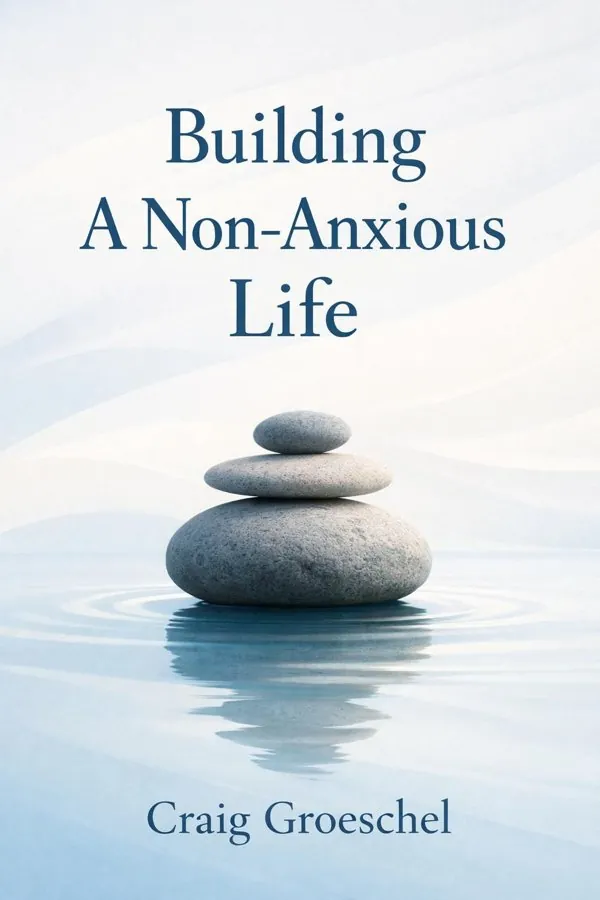
Building A Non-Anxious Life: Summary & Key Insights
 10 min8 chaptersAudio available
Key Takeaways from Building A Non-Anxious Life
One of the book’s most important insights is that anxiety is no longer an occasional disruption for many people; it has become the background noise of daily life.
At the heart of much anxiety lies a painful reality: we desperately want control over things we cannot control.
A powerful theme in the book is that prayer is not merely a religious duty; it is a way of retraining the mind and redirecting the heart.
An anxious mind usually scans for what is missing, fragile, or under threat.
Anxiety often gets louder in isolation.
What Is Building A Non-Anxious Life About?
Building A Non-Anxious Life by Craig Groeschel is a mental_health book spanning 8 pages. In Building A Non-Anxious Life, Craig Groeschel tackles one of the defining struggles of modern life: the persistent, exhausting hum of anxiety that follows people through work, relationships, parenting, decision-making, and even moments that are supposed to feel restful. Rather than offering shallow positivity or a one-size-fits-all cure, Groeschel presents a deeply practical framework for becoming emotionally steady in an unstable world. His central idea is simple but powerful: peace is not something we stumble into by accident; it is something we build through intentional choices. Drawing on Scripture, pastoral experience, leadership wisdom, and relatable personal stories, Groeschel explores six foundational decisions that help readers move from fear-driven living to trust-filled living. He shows how anxiety often grows where control, isolation, negativity, and purposelessness dominate, and how trust, prayer, gratitude, community, purpose, and hope create a different kind of inner life. As the founding pastor of Life.Church and a widely respected teacher on leadership and spiritual growth, Groeschel brings both authority and empathy to the subject. This book matters because it speaks directly to people who feel overwhelmed yet still long for peace, resilience, and a life anchored in something deeper than circumstances.
This FizzRead summary covers all 8 key chapters of Building A Non-Anxious Life in approximately 10 minutes, distilling the most important ideas, arguments, and takeaways from Craig Groeschel's work. Also available as an audio summary and Key Quotes Podcast.
Building A Non-Anxious Life
In Building A Non-Anxious Life, Craig Groeschel tackles one of the defining struggles of modern life: the persistent, exhausting hum of anxiety that follows people through work, relationships, parenting, decision-making, and even moments that are supposed to feel restful. Rather than offering shallow positivity or a one-size-fits-all cure, Groeschel presents a deeply practical framework for becoming emotionally steady in an unstable world. His central idea is simple but powerful: peace is not something we stumble into by accident; it is something we build through intentional choices.
Drawing on Scripture, pastoral experience, leadership wisdom, and relatable personal stories, Groeschel explores six foundational decisions that help readers move from fear-driven living to trust-filled living. He shows how anxiety often grows where control, isolation, negativity, and purposelessness dominate, and how trust, prayer, gratitude, community, purpose, and hope create a different kind of inner life. As the founding pastor of Life.Church and a widely respected teacher on leadership and spiritual growth, Groeschel brings both authority and empathy to the subject. This book matters because it speaks directly to people who feel overwhelmed yet still long for peace, resilience, and a life anchored in something deeper than circumstances.
Who Should Read Building A Non-Anxious Life?
This book is perfect for anyone interested in mental_health and looking to gain actionable insights in a short read. Whether you're a student, professional, or lifelong learner, the key ideas from Building A Non-Anxious Life by Craig Groeschel will help you think differently.
- ✓Readers who enjoy mental_health and want practical takeaways
- ✓Professionals looking to apply new ideas to their work and life
- ✓Anyone who wants the core insights of Building A Non-Anxious Life in just 10 minutes
Want the full summary?
Get instant access to this book summary and 100K+ more with Fizz Moment.
Get Free SummaryAvailable on App Store • Free to download
Key Chapters
One of the book’s most important insights is that anxiety is no longer an occasional disruption for many people; it has become the background noise of daily life. We wake up to notifications, absorb bad news before breakfast, compare ourselves to curated images all day, and carry unfinished worries into the night. Groeschel argues that this environment doesn’t merely expose anxiety; it often intensifies it. The modern world trains people to expect urgency, anticipate problems, and stay mentally on guard.
He does not treat anxiety as a sign of weakness or lack of intelligence. Instead, he frames it as a deeply human response to living in a world filled with uncertainty, overstimulation, and pressure. Yet he also insists that while anxiety may be common, it does not have to become our identity. Feeling anxious is not the same as being defined by anxiety. That distinction matters, because many people move from saying “I feel anxious” to “I am an anxious person,” and that shift can make change feel impossible.
Groeschel invites readers to notice the conditions that fuel their inner unrest. Is it nonstop media consumption? Perfectionism? Fear of disappointing others? A need to control outcomes? Naming the sources of anxiety is the first step toward loosening their grip. For example, someone who feels overwhelmed every evening might realize that doomscrolling after work is keeping the nervous system activated. Another person may discover that saying yes to everything creates chronic mental overload.
The takeaway is practical: stop normalizing anxiety as an unchangeable way of life. Begin by identifying the habits, inputs, and assumptions that keep your mind in a constant state of alert.
At the heart of much anxiety lies a painful reality: we desperately want control over things we cannot control. Groeschel argues that anxious thinking often grows out of the gap between what we wish we could guarantee and what life actually allows. We want certainty about health, finances, children, careers, relationships, and the future. When certainty doesn’t come, we try to compensate by overthinking, planning obsessively, or mentally rehearsing every possible disaster.
Building with trust means accepting that peace does not come from mastering every variable. It comes from surrendering what is beyond our reach and anchoring ourselves in God’s character instead of our own ability to manage outcomes. This is not passive resignation. Trust still plans, works, prepares, and acts responsibly. But it refuses to believe that constant vigilance can save us.
Groeschel’s faith-centered approach is especially clear here. He invites readers to replace “What if everything goes wrong?” with “What if God is already present in what I fear?” For a parent, trust might mean doing everything wise and loving for a child while resisting the temptation to obsess over every possible danger. For a leader, it may mean making a thoughtful decision without spiraling over every future consequence. For someone facing uncertainty at work, it can mean preparing diligently but refusing to let career outcomes determine emotional stability.
The practice of trust often looks small and repetitive: praying before reacting, releasing imagined scenarios, and reminding yourself that responsibility is yours, but ultimate control is not. Groeschel emphasizes that trust is not a one-time feeling; it is a daily construction project.
The takeaway is clear: identify one area where control has become your coping mechanism, and intentionally replace that control habit with an act of trust.
A powerful theme in the book is that prayer is not merely a religious duty; it is a way of retraining the mind and redirecting the heart. Anxiety often pulls attention inward, trapping people in loops of fear, prediction, and self-protection. Prayer interrupts that cycle by turning panic into conversation and worry into dependence. Groeschel presents prayer as one of the most practical tools for emotional regulation because it shifts us from mental isolation to relational connection with God.
He is careful not to reduce prayer to magic words that instantly remove distress. Instead, prayer changes the person who prays. It slows reactivity, clarifies desire, and creates space between fear and response. When someone brings specific concerns before God, the burden is no longer spinning unchecked in the mind. It is being named, held, and surrendered. This can be especially important for those whose anxiety escalates because they carry everything internally.
Groeschel encourages honest prayer rather than polished performance. A sincere prayer can be as simple as, “God, I am overwhelmed. Help me trust You with this meeting, this diagnosis, this conversation, this bill, this child.” He also highlights the value of consistency. Short, repeated prayers throughout the day can keep anxiety from gathering force. A person might pray during a commute, before opening email, while waiting for test results, or whenever spiraling thoughts begin.
Prayer also makes room for listening. Instead of treating God as an emergency hotline, Groeschel invites readers to develop a rhythm of daily connection that grounds the soul before crises hit. Over time, prayer becomes less about escaping life and more about walking through life with a steadier center.
The takeaway: create a simple daily prayer habit tied to a recurring moment in your routine, and use it to hand one specific worry to God each day.
An anxious mind usually scans for what is missing, fragile, or under threat. Groeschel shows how gratitude counters that instinct by training attention toward what is present, good, and already given. This does not mean denying pain or pretending hard things are easy. It means refusing to let fear become the only lens through which life is interpreted. Gratitude is powerful because it shifts internal focus from scarcity to provision.
When people are anxious, they often assume that peace will arrive once enough problems are solved. But Groeschel argues that peace grows when we deliberately notice reasons for thankfulness even before circumstances improve. Gratitude reminds us that life contains gifts alongside burdens. It softens the nervous system, reduces fixation on worst-case scenarios, and strengthens trust by making us remember how we have been sustained before.
In practical terms, gratitude can be woven into ordinary life. A person worried about work may pause to thank God for current opportunities, existing skills, supportive colleagues, or simply the ability to try again. Someone navigating family stress may intentionally notice small evidences of love, health, laughter, or progress. Keeping a gratitude journal, naming three blessings before bed, or beginning prayer with thanksgiving are simple but effective practices.
Groeschel’s point is not that gratitude erases struggle. It changes our posture within struggle. A grateful person may still have unanswered questions, but is less likely to become consumed by helplessness. Gratitude expands emotional bandwidth by proving that fear is not the whole story.
The actionable takeaway is to build a daily gratitude ritual. Choose one consistent time each day and write down three specific things you are thankful for, especially on the days when anxiety feels strongest.
Anxiety often gets louder in isolation. Left alone with our thoughts, fears tend to distort, intensify, and multiply. Groeschel emphasizes that one of the most healing choices a person can make is to build a life with community rather than trying to carry every burden privately. Many people hide anxiety out of shame, pride, or the fear of becoming a burden. But secrecy usually deepens distress instead of solving it.
Healthy community does several things at once. It gives perspective when your thoughts become exaggerated. It offers prayer, encouragement, and wisdom when your strength feels low. And it reminds you that you are not uniquely broken for struggling. Groeschel’s framework is deeply relational: peace is not only an internal state but also something reinforced by supportive, truthful, grace-filled relationships.
This can look different depending on the season of life. For some, community means a spouse or close friend who knows what triggers anxious spirals and can respond with empathy. For others, it means joining a church group, support circle, recovery program, or counseling process where honesty is welcomed. Community also requires vulnerability. It is not enough to be around people socially if no one knows your real burdens.
Groeschel suggests that healing often begins when someone says, “Here is what I’m carrying,” instead of pretending everything is fine. Just as importantly, community is not only about receiving support but also giving it. Helping others interrupts self-absorption and strengthens mutual resilience.
The practical takeaway is to choose one trusted person this week and share one anxiety you have been carrying alone. Ask for prayer, perspective, or simply presence, and resist the urge to minimize what you feel.
One of Groeschel’s most energizing ideas is that anxiety grows when life becomes overly centered on avoidance. If the main goal is simply not to fail, not to suffer, not to be embarrassed, or not to lose control, then fear dominates decision-making. Purpose offers a stronger organizing principle. It gives the mind and heart somewhere meaningful to go. Instead of asking, “How do I prevent discomfort?” the purpose-driven person asks, “What am I called to do, contribute, or become?”
Groeschel argues that people become more emotionally grounded when they live for something larger than immediate self-protection. Purpose does not eliminate anxiety, but it changes our relationship to it. A teacher may still feel nervous before a difficult class, but purpose reminds her that she is there to serve students, not merely protect her image. A parent may still worry, but purpose redirects energy toward loving, guiding, and modeling faithfulness. A business leader may feel pressure, but purpose helps him focus on stewardship and impact instead of constant reputation management.
This chapter pushes readers to think beyond personal comfort. Anxiety narrows life; purpose expands it. Purpose clarifies priorities, helps filter distractions, and gives suffering context. It also makes decisions easier because not every opportunity deserves equal attention. If you know what matters most, you can say no to many anxiety-producing demands.
Groeschel encourages readers to ask where their gifts, values, burdens, and opportunities intersect. In that space, purpose becomes concrete rather than abstract. It may involve family, faith, work, service, creativity, mentoring, or generosity.
The takeaway is to write a short personal purpose statement for your current season of life, then use it as a filter for one major decision or anxiety trigger this week.
Groeschel makes an important distinction between optimism and hope. Optimism often depends on favorable circumstances or the expectation that things will work out quickly. Hope runs deeper. It is the settled conviction that even when life is painful, uncertain, or unresolved, God is present and the story is not over. For anxious people, this distinction is crucial, because fragile optimism collapses easily when reality becomes hard. Hope endures.
Building with hope means refusing to interpret present difficulty as final defeat. Groeschel does not promise that every fear will disappear or every prayer will be answered on our preferred timeline. Instead, he argues that resilient peace grows when we anchor ourselves in a future larger than today’s trouble. Hope keeps anxiety from becoming absolute. It reminds us that current feelings, however intense, are not the final authority over reality.
Practically, hope can be strengthened through memory and imagination. Looking back at times when God provided, healed, guided, or sustained us builds confidence for what lies ahead. Looking forward with faith helps us resist catastrophic thinking. Someone in a season of grief may not be able to feel cheerful, but hope says grief will not have the last word. Someone facing financial uncertainty may not know the exact outcome, but hope allows them to keep acting wisely rather than freezing in fear.
Groeschel’s approach gives readers a durable emotional framework. Hope does not ask us to deny pain. It asks us to place pain inside a bigger story. That shift can create remarkable endurance.
The actionable takeaway is to make a personal “hope list” of past moments when you were sustained through difficulty, and revisit it whenever your mind begins predicting hopeless outcomes.
A recurring lesson in the book is that insight alone does not create transformation. It is possible to agree with every principle about trust, prayer, gratitude, and hope while continuing to live in frantic, reactive patterns. Groeschel emphasizes that a non-anxious life is built through repeated habits that shape thought, attention, and behavior over time. Peace is less a sudden breakthrough than a structure formed by everyday practices.
This is encouraging because it means change does not depend on dramatic emotion. You do not have to feel strong to practice stabilizing habits. You simply need to begin. Small rhythms matter: limiting digital overload, praying at fixed times, keeping a gratitude list, attending a weekly group, resting intentionally, and speaking truth aloud when fear rises. These habits may seem ordinary, but they compound. Just as anxious patterns are reinforced through repetition, peaceful patterns are also built through repetition.
Groeschel’s language of building is especially helpful here. Buildings are not created in a moment. They are constructed layer by layer with consistency and care. The same is true of emotional and spiritual resilience. When readers stop waiting for anxiety to disappear and instead start practicing the choices that weaken it, they gain agency. They begin participating in their own healing rather than feeling trapped by inner chaos.
Examples are easy to imagine: someone might set app limits to reduce overstimulation, start each morning with five minutes of prayer before checking messages, or schedule one weekly conversation with a trusted friend. None of these solves everything immediately, but together they change the atmosphere of a life.
The takeaway is to choose two repeatable habits from the book and commit to practicing them for the next thirty days, tracking how they affect your anxiety and sense of peace.
All Chapters in Building A Non-Anxious Life
About the Author
Craig Groeschel is the founding and senior pastor of Life.Church, one of the most influential and widely attended churches in the United States. Known for combining biblical teaching with practical guidance, he has built a reputation as a trusted voice on leadership, faith, emotional health, and personal growth. In addition to his pastoral work, Groeschel is a bestselling author and the host of the popular Craig Groeschel Leadership Podcast, where he interviews leaders and shares insights on decision-making, influence, and character. His writing often focuses on helping readers develop healthier habits and stronger spiritual foundations in everyday life. Through his books, sermons, and leadership content, he has reached millions of people seeking wisdom that is both deeply rooted in Christian faith and immediately applicable.
Get This Summary in Your Preferred Format
Read or listen to the Building A Non-Anxious Life summary by Craig Groeschel anytime, anywhere. FizzRead offers multiple formats so you can learn on your terms — all free.
Available formats: App · Audio · PDF · EPUB — All included free with FizzRead
Download Building A Non-Anxious Life PDF and EPUB Summary
Key Quotes from Building A Non-Anxious Life
“One of the book’s most important insights is that anxiety is no longer an occasional disruption for many people; it has become the background noise of daily life.”
“At the heart of much anxiety lies a painful reality: we desperately want control over things we cannot control.”
“A powerful theme in the book is that prayer is not merely a religious duty; it is a way of retraining the mind and redirecting the heart.”
“An anxious mind usually scans for what is missing, fragile, or under threat.”
“Left alone with our thoughts, fears tend to distort, intensify, and multiply.”
Frequently Asked Questions about Building A Non-Anxious Life
Building A Non-Anxious Life by Craig Groeschel is a mental_health book that explores key ideas across 8 chapters. In Building A Non-Anxious Life, Craig Groeschel tackles one of the defining struggles of modern life: the persistent, exhausting hum of anxiety that follows people through work, relationships, parenting, decision-making, and even moments that are supposed to feel restful. Rather than offering shallow positivity or a one-size-fits-all cure, Groeschel presents a deeply practical framework for becoming emotionally steady in an unstable world. His central idea is simple but powerful: peace is not something we stumble into by accident; it is something we build through intentional choices. Drawing on Scripture, pastoral experience, leadership wisdom, and relatable personal stories, Groeschel explores six foundational decisions that help readers move from fear-driven living to trust-filled living. He shows how anxiety often grows where control, isolation, negativity, and purposelessness dominate, and how trust, prayer, gratitude, community, purpose, and hope create a different kind of inner life. As the founding pastor of Life.Church and a widely respected teacher on leadership and spiritual growth, Groeschel brings both authority and empathy to the subject. This book matters because it speaks directly to people who feel overwhelmed yet still long for peace, resilience, and a life anchored in something deeper than circumstances.
More by Craig Groeschel
You Might Also Like
Big Feelings: How to Be Okay When Things Are Not Okay
Liz Fosslien, Mollie West Duffy
10 min
Creative Arts Therapies Handbook: Art, Music and Dance Therapy Practices for Wellbeing
Susan I. Buchalter
10 min
Emotional First Aid: Healing Rejection, Guilt, Failure, and Other Everyday Hurts
Guy Winch
10 min
Lost Connections: Why You're Depressed and How to Find Hope
Johann Hari
10 min
No Time to Panic: How to Stop Worrying and Embrace Life
Matt Gutman
10 min
Overcoming Mobbing: A Recovery Guide for Workplace Aggression and Bullying
Maureen Duffy, Len Sperry
10 minFeatured In
Browse by Category
Ready to read Building A Non-Anxious Life?
Get the full summary and 100K+ more books with Fizz Moment.