
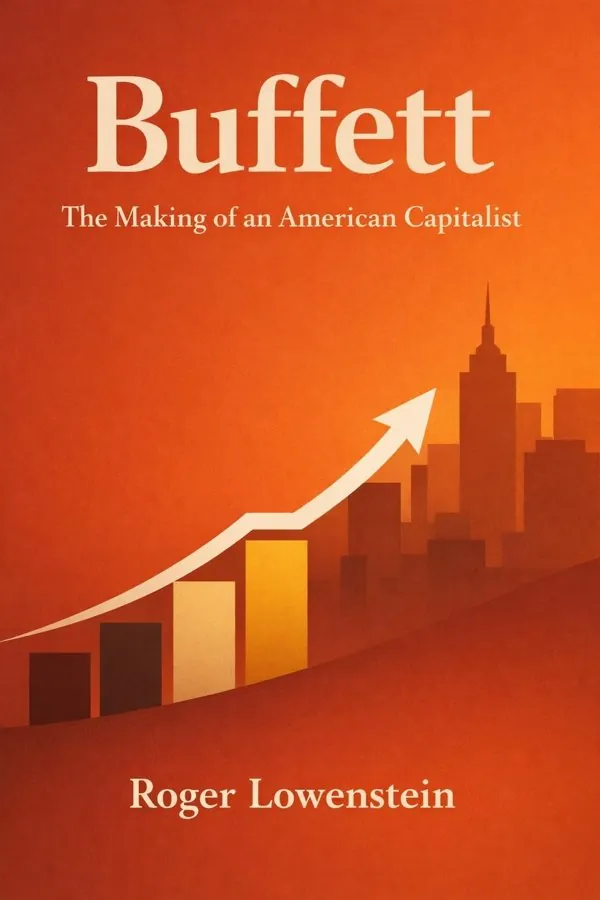
Buffett: The Making of an American Capitalist: Summary & Key Insights
 10 min6 chaptersAudio available
What Is Buffett: The Making of an American Capitalist About?
Buffett: The Making of an American Capitalist by Roger Lowenstein is a biographies book spanning 6 pages. This biography offers a comprehensive portrait of Warren Buffett, tracing his journey from a young investor in Omaha to becoming one of the most successful and respected figures in global finance. The book explores Buffett’s investment philosophy, personal life, and the principles that shaped his approach to business and wealth.
This FizzRead summary covers all 6 key chapters of Buffett: The Making of an American Capitalist in approximately 10 minutes, distilling the most important ideas, arguments, and takeaways from Roger Lowenstein's work. Also available as an audio summary and Key Quotes Podcast.
Buffett: The Making of an American Capitalist
This biography offers a comprehensive portrait of Warren Buffett, tracing his journey from a young investor in Omaha to becoming one of the most successful and respected figures in global finance. The book explores Buffett’s investment philosophy, personal life, and the principles that shaped his approach to business and wealth.
Who Should Read Buffett: The Making of an American Capitalist?
This book is perfect for anyone interested in biographies and looking to gain actionable insights in a short read. Whether you're a student, professional, or lifelong learner, the key ideas from Buffett: The Making of an American Capitalist by Roger Lowenstein will help you think differently.
- ✓Readers who enjoy biographies and want practical takeaways
- ✓Professionals looking to apply new ideas to their work and life
- ✓Anyone who wants the core insights of Buffett: The Making of an American Capitalist in just 10 minutes
Want the full summary?
Get instant access to this book summary and 100K+ more with Fizz Moment.
Get Free SummaryAvailable on App Store • Free to download
Key Chapters
Buffett’s beginnings were modest yet rich in the soil of Midwestern enterprise. Omaha in the 1930s was a city steeped in pragmatism, a community of small businesses where reputation mattered more than showmanship. It was here that Warren inherited his father Howard’s quiet conservatism and his mother Leila’s emotional steadiness—traits that would define his later view that temperament is more critical than intellect in investment.
From an early age, Warren saw numbers not as abstractions but as stories waiting to be unraveled. The boy who tallied bottle caps and tracked baseball statistics was already rehearsing the discipline of analysis. Lowenstein brings these scenes alive: the precocious ten-year-old visiting brokerage houses, memorizing stock tables, and setting up his own ventures like newspaper delivery routes and pinball machines. They were not trivial childhood play; they were exercises in learning margins, customer behavior, and scale.
Through such episodes, Lowenstein emphasizes that Buffett’s genius was not for speculation but for systems—how money flowed, compounded, and reflected effort. His Omaha upbringing instilled a sense of decency and the belief that business was not a zero-sum game but a mutual pact. That sense of moral proportion would later help him resist the temptations of greed that undid so many of his peers.
Buffett’s education was an intellectual pilgrimage. His early years at the University of Nebraska were marked by impatience—he already understood business better than his professors, yet hungered for more rigorous thought. At Columbia Business School, he found it in Benjamin Graham, whose teachings provided not only method but moral compass. Graham’s concept of value investing—buying securities below their intrinsic value by reasoning rather than speculation—was revelation to Buffett. He discovered that markets were not mystical forces but psychological theaters, filled with bargains and errors.
Lowenstein portrays their relationship with warmth and precision. Graham was Buffett’s intellectual father, teaching him that the margin of safety is a principle of life as much as finance. Under Graham’s influence, Buffett learned the discipline of restraint. He saw that patience yields compounding results that no speculation can match. But even then, Buffett’s individuality surfaced. While Graham sought mathematical undervaluation, Buffett soon began looking for qualitative excellence—companies with enduring franchises and trustworthy management.
Lowenstein captures this divergence as the first flowering of Buffett’s philosophy: value must be tied to permanence, not just price. The Columbia years were the crucible where Buffett’s intellectual independence was forged—a mind learning to synthesize theory and instinct.
+ 4 more chapters — available in the FizzRead app
All Chapters in Buffett: The Making of an American Capitalist
About the Author
Roger Lowenstein is an American financial journalist and author known for his insightful works on economics and investing. He has written for The Wall Street Journal and authored several acclaimed books on finance and business leadership.
Get This Summary in Your Preferred Format
Read or listen to the Buffett: The Making of an American Capitalist summary by Roger Lowenstein anytime, anywhere. FizzRead offers multiple formats so you can learn on your terms — all free.
Available formats: App · Audio · PDF · EPUB — All included free with FizzRead
Download Buffett: The Making of an American Capitalist PDF and EPUB Summary
Key Quotes from Buffett: The Making of an American Capitalist
“Buffett’s beginnings were modest yet rich in the soil of Midwestern enterprise.”
“Buffett’s education was an intellectual pilgrimage.”
Frequently Asked Questions about Buffett: The Making of an American Capitalist
Buffett: The Making of an American Capitalist by Roger Lowenstein is a biographies book that explores key ideas across 6 chapters. This biography offers a comprehensive portrait of Warren Buffett, tracing his journey from a young investor in Omaha to becoming one of the most successful and respected figures in global finance. The book explores Buffett’s investment philosophy, personal life, and the principles that shaped his approach to business and wealth.
More by Roger Lowenstein
You Might Also Like

An American Marriage
Tayari Jones
10 min
Benjamin Franklin: An American Life
Walter Isaacson
10 min
I Know Why The Caged Bird Sings
Maya Angelou
10 min
Long Walk to Freedom
Nelson Mandela
10 min
Persepolis
Marjane Satrapi
10 min
Surely You're Joking, Mr. Feynman!
Richard P. Feynman
10 minBrowse by Category
Ready to read Buffett: The Making of an American Capitalist?
Get the full summary and 100K+ more books with Fizz Moment.