
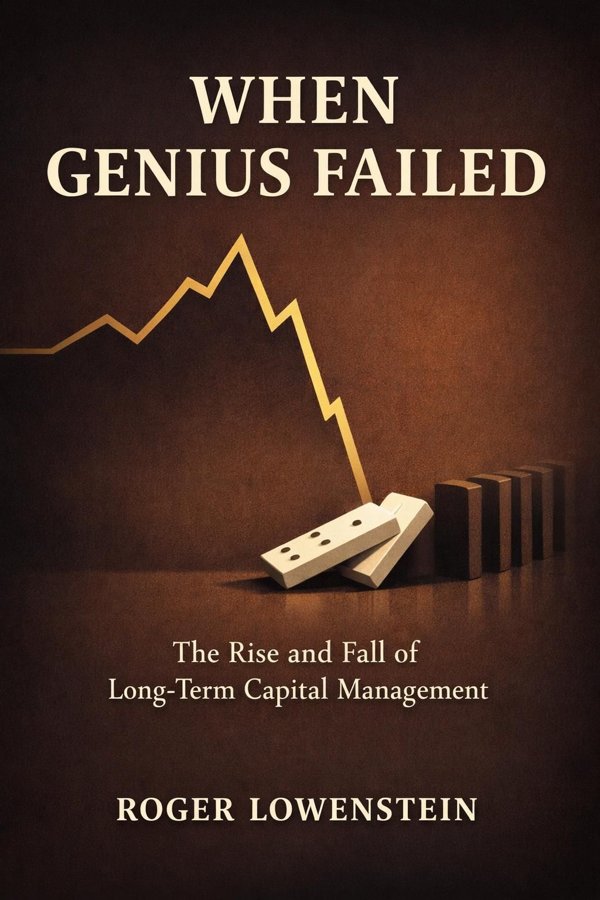
When Genius Failed: The Rise and Fall of Long-Term Capital Management: Summary & Key Insights
 10 min9 chaptersAudio available
Key Takeaways from When Genius Failed: The Rise and Fall of Long-Term Capital Management
Every financial era develops a story about why old rules no longer apply.
Institutions often fail long before they collapse on paper; they fail first in culture.
The danger of a model is not that it is wrong, but that it feels precise.
A great strategy can still be a terrible bet if it is financed badly.
Many investors assume they can exit a position when they decide to.
What Is When Genius Failed: The Rise and Fall of Long-Term Capital Management About?
When Genius Failed: The Rise and Fall of Long-Term Capital Management by Roger Lowenstein is a finance book spanning 5 pages. What happens when some of the smartest people in finance become convinced they have mastered risk? In When Genius Failed, Roger Lowenstein tells the riveting story of Long-Term Capital Management, the legendary hedge fund that seemed to embody the future of investing before collapsing with breathtaking speed in 1998. Founded by famed bond trader John Meriwether and staffed by elite Wall Street minds, including Nobel Prize-winning economists, LTCM promised a new era in which mathematical precision could turn tiny market inefficiencies into enormous profits. For a few years, it appeared to succeed brilliantly. Then market turmoil exposed how fragile that brilliance really was. More than a history of one hedge fund, this book is a study of leverage, overconfidence, and the dangerous gap between elegant theory and messy reality. Lowenstein, an accomplished financial journalist and former Wall Street Journal reporter, combines narrative drama with sharp analysis, making a complex financial crisis understandable and compelling. The result is an essential account of how intelligence, prestige, and sophisticated models can still produce catastrophic mistakes—and why those lessons remain urgent in modern finance.
This FizzRead summary covers all 9 key chapters of When Genius Failed: The Rise and Fall of Long-Term Capital Management in approximately 10 minutes, distilling the most important ideas, arguments, and takeaways from Roger Lowenstein's work. Also available as an audio summary and Key Quotes Podcast.
When Genius Failed: The Rise and Fall of Long-Term Capital Management
What happens when some of the smartest people in finance become convinced they have mastered risk? In When Genius Failed, Roger Lowenstein tells the riveting story of Long-Term Capital Management, the legendary hedge fund that seemed to embody the future of investing before collapsing with breathtaking speed in 1998. Founded by famed bond trader John Meriwether and staffed by elite Wall Street minds, including Nobel Prize-winning economists, LTCM promised a new era in which mathematical precision could turn tiny market inefficiencies into enormous profits. For a few years, it appeared to succeed brilliantly. Then market turmoil exposed how fragile that brilliance really was.
More than a history of one hedge fund, this book is a study of leverage, overconfidence, and the dangerous gap between elegant theory and messy reality. Lowenstein, an accomplished financial journalist and former Wall Street Journal reporter, combines narrative drama with sharp analysis, making a complex financial crisis understandable and compelling. The result is an essential account of how intelligence, prestige, and sophisticated models can still produce catastrophic mistakes—and why those lessons remain urgent in modern finance.
Who Should Read When Genius Failed: The Rise and Fall of Long-Term Capital Management?
This book is perfect for anyone interested in finance and looking to gain actionable insights in a short read. Whether you're a student, professional, or lifelong learner, the key ideas from When Genius Failed: The Rise and Fall of Long-Term Capital Management by Roger Lowenstein will help you think differently.
- ✓Readers who enjoy finance and want practical takeaways
- ✓Professionals looking to apply new ideas to their work and life
- ✓Anyone who wants the core insights of When Genius Failed: The Rise and Fall of Long-Term Capital Management in just 10 minutes
Want the full summary?
Get instant access to this book summary and 100K+ more with Fizz Moment.
Get Free SummaryAvailable on App Store • Free to download
Key Chapters
Every financial era develops a story about why old rules no longer apply. In the early 1990s, that story was built on globalization, faster computers, advanced derivatives, and growing faith in quantitative finance. Markets were becoming more connected, data was more abundant, and financial institutions believed that sophisticated analysis could identify tiny mispricings across bonds, currencies, and derivatives. Against this backdrop, Long-Term Capital Management emerged not as an outlier, but as the ultimate expression of the era’s confidence.
LTCM was founded by John Meriwether, the former Salomon Brothers bond-trading star whose reputation for brilliance and nerve attracted extraordinary talent. The fund assembled an almost mythic team: top traders, PhDs, and later Nobel laureates Robert Merton and Myron Scholes. Their core strategy sounded modest and scientific. They sought small pricing discrepancies between related securities and bet that those spreads would eventually converge. Since the differences were tiny, the fund amplified returns through leverage, borrowing heavily to turn slight advantages into large profits.
At first, the results were dazzling. Investors saw consistency, sophistication, and exclusivity. LTCM charged premium fees, accepted only elite clients, and cultivated an aura of near-infallibility. The fund’s success reinforced a broader market belief that finance had entered a more rational age, one in which volatility could be measured, managed, and monetized.
The practical lesson extends beyond hedge funds. New tools often create real advantages, but they also tempt people to confuse innovation with invulnerability. In business, investing, and even technology, early success can make a fragile system look strong. Actionable takeaway: whenever a strategy seems revolutionary, ask not only how it works in normal times, but what assumptions it depends on when the world stops behaving normally.
Institutions often fail long before they collapse on paper; they fail first in culture. Lowenstein shows that LTCM was shaped not only by mathematical models but by the temperament of its founder, John Meriwether. At Salomon Brothers, Meriwether had built a formidable bond arbitrage operation and developed a reputation for calm under pressure, intellectual rigor, and intense loyalty to his inner circle. When he launched LTCM after leaving Salomon, he recreated that elite culture—tight-knit, private, and deeply convinced of its own superiority.
This culture had strengths. LTCM recruited exceptional people, focused intensely on research, and made decisions with analytical discipline. The partners believed they were not speculators chasing hunches, but professionals identifying structural inefficiencies. Their self-image mattered: they saw themselves as different from ordinary traders because they were guided by reason and evidence.
But confidence hardened into insularity. The same loyalty that created cohesion also reduced dissent. The same prestige that attracted capital also shielded the firm from skepticism. Investors, banks, and counterparties were often more impressed by the reputations in the room than by the risks on the balance sheet. Internally, LTCM’s success made it harder to challenge assumptions, scale back positions, or consider that markets could remain irrational longer than the fund could remain solvent.
This pattern appears far beyond finance. Teams led by celebrated experts often mistake credentials for immunity to error. A brilliant culture can become a closed culture, especially when everyone speaks the same language of excellence. Practical application: in any high-performing organization, create formal space for disagreement, scenario testing, and red-team thinking. Actionable takeaway: judge a team not only by how smart its members are, but by how willing they are to challenge one another before reality does it for them.
The danger of a model is not that it is wrong, but that it feels precise. At LTCM, models were central to identity and strategy. The fund’s partners believed that financial relationships followed observable patterns and that enough data could convert uncertainty into calculable risk. Their trades were grounded in historical behavior: bonds with similar cash flows should converge in price, market dislocations should eventually normalize, and extreme events should remain rare. In ordinary conditions, these assumptions often worked.
The problem was not the use of models themselves. Models are indispensable tools in modern finance. The problem was the subtle shift from using models as aids to treating them as authorities. LTCM’s strategies depended on historical correlations, assumptions about liquidity, and estimates of market behavior that did not account for systemic panic. The fund measured risk with impressive sophistication, but much of that sophistication rested on the belief that the future would resemble the past closely enough to make the numbers reliable.
This is a universal management lesson. In medicine, technology, logistics, and public policy, quantitative tools can sharpen decisions—but they cannot eliminate ambiguity. A supply chain forecast can fail under geopolitical stress. A hiring algorithm can miss human nuance. A risk dashboard can obscure the possibility of simultaneous breakdowns.
Lowenstein’s account reveals how intelligence can become captive to its own abstractions. When reality diverged from the model, LTCM did not immediately rethink the model; instead, it often doubled down on the belief that markets were temporarily wrong. Actionable takeaway: use models to inform judgment, never replace it. Always ask what conditions the model leaves out, what happens in tail scenarios, and what real-world behavior could overwhelm elegant mathematics.
A great strategy can still be a terrible bet if it is financed badly. One of Lowenstein’s clearest lessons is that leverage—borrowing money to magnify returns—was the force that transformed LTCM from a highly skilled arbitrage operation into a systemically dangerous institution. Because the fund’s trades targeted narrow pricing gaps, the raw returns were modest. To make those profits meaningful, LTCM borrowed heavily and built enormous positions across global markets.
Leverage can make a strategy look more effective than it really is. In stable conditions, LTCM’s positions generated steady gains, reinforcing the belief that the fund had discovered a superior method. But leverage also reduced room for error. Small adverse price movements, which might have been manageable in an unlevered portfolio, became existential threats when multiplied across gigantic positions. The fund’s complexity made the problem worse. LTCM had exposure through swaps, derivatives, and off-balance-sheet arrangements that obscured the full scale of its commitments.
This lesson matters for households, companies, and institutions alike. A business that expands too aggressively with debt may look efficient until revenue falls. A real-estate investor can appear brilliant in a rising market while quietly becoming dependent on favorable financing. A personal portfolio can become dangerously fragile when margin is involved.
Lowenstein shows that LTCM was not ruined because every idea was foolish. It was ruined because sound ideas were pursued at a scale that left no margin for stress. Actionable takeaway: whenever returns seem unusually smooth or attractive, ask how much leverage is creating that appearance—and whether the strategy could survive a period of forced selling, tighter credit, or delayed recovery.
Many investors assume they can exit a position when they decide to. Crises reveal the opposite: liquidity is abundant until everyone reaches for it at once. LTCM’s models generally assumed that markets would remain sufficiently liquid for the fund to adjust positions, hedge exposures, and wait for convergence. But during turmoil, the relationships that looked stable on a spreadsheet became unstable in practice. Prices moved violently, and the cost of trading rose as buyers disappeared.
LTCM held positions in many markets that seemed deep under normal conditions—government bonds, swaps, and various spread trades. Yet the fund’s size was so large that unwinding positions without moving prices became nearly impossible. Worse, other market participants began to infer LTCM’s distress and positioned themselves accordingly. The fund was not merely experiencing market volatility; it was trapped by its own footprint.
This dynamic appears in other settings. A startup may assume future funding will always be available, only to find capital markets suddenly closed. A retailer may rely on rapid inventory turnover until supply-chain delays and demand shifts make its stock illiquid in an economic sense. In all these cases, what looked flexible becomes rigid under pressure.
Lowenstein’s account underscores a neglected truth: risk is not only about whether an asset will regain value eventually, but whether you can endure the path it takes. Actionable takeaway: assess liquidity as a stress variable, not a constant. Before entering any major commitment, ask how quickly you could reduce exposure in a crisis, what the cost would be, and whether everyone else would be trying to do the same thing at once.
The most dangerous shocks often begin far from where people are looking. LTCM’s downfall accelerated when financial crises in Asia and then Russia unsettled markets that the fund believed it understood well enough to navigate. In theory, LTCM’s trades were diversified across instruments and geographies. In practice, global stress pushed many positions in the same wrong direction at once. Assets that had seemed only loosely connected became linked through fear, deleveraging, and a universal flight to safety.
The Russian default in 1998 was especially devastating. Investors around the world suddenly reassessed risk, sold less liquid or more complicated positions, and crowded into the safest government bonds. The spreads LTCM expected to narrow instead widened dramatically. Securities the fund thought should converge diverged even more. Historical relationships broke down not because mathematics had no value, but because crises change behavior. In panics, people do not optimize elegantly; they scramble, hoard cash, and reduce exposure wherever they can.
This is the essence of contagion. A problem in one region or asset class can ripple through unrelated portfolios because institutions share funding sources, risk models, and human psychology. Today, the same dynamic can appear through banking stress, geopolitical conflict, or sudden shifts in rates.
Lowenstein makes clear that globalization increases opportunity but also creates hidden channels of transmission. Diversification is weaker than it appears when everyone is levered and emotionally synchronized. Actionable takeaway: when evaluating risk, do not ask only whether positions are different in name. Ask whether they may behave similarly under stress because they depend on the same financing conditions, investor sentiment, or rush toward safety.
Some failures become public dramas because private mistakes can threaten public stability. As LTCM’s losses mounted in 1998, the fund moved from being an elite investment vehicle to a source of systemic concern. Its counterparties included many of the largest banks and dealers in the world. Because its positions were so vast and intertwined, an uncontrolled liquidation risked destabilizing already fragile markets. The issue was no longer whether LTCM deserved to survive, but whether the financial system could afford the consequences of its disorderly collapse.
Lowenstein vividly recounts the extraordinary role of the Federal Reserve Bank of New York, which convened major Wall Street firms and helped organize a private-sector recapitalization. This was not a government bailout in the narrow sense; public money was not directly injected into the fund. Yet the Fed’s involvement signaled how serious the threat had become. The rescue aimed to prevent a fire sale of assets that could have spread panic across bond markets, derivatives markets, and bank balance sheets.
The episode raises enduring questions about moral hazard. If institutions believe the system will be protected from catastrophic fallout, they may take greater risks in the future. But if authorities do nothing in the middle of a panic, collateral damage can be immense. This tension remains central in every major financial crisis.
For leaders, the broader lesson is about second-order effects. A decision that seems private can become public when scale, interconnectedness, and leverage are large enough. Actionable takeaway: evaluate not just direct risk, but network risk—who depends on you, who finances you, and how your distress could cascade through a larger system.
Catastrophic overconfidence rarely announces itself. It accumulates through a series of small validations that make caution feel unnecessary. Lowenstein shows that LTCM’s greatest vulnerability was not a single bad trade or unforeseeable event, but a gradual psychological drift. Years of profits convinced the partners that they were not merely skilled, but exceptionally able to identify when markets were wrong. Success reduced humility and made adverse moves look like opportunities rather than warnings.
This is one of the book’s deepest insights. Human beings tend to infer permanent ability from temporary outcomes, especially when those outcomes are reinforced by status and admiration. LTCM’s prestige insulated it from ordinary skepticism. Investors wanted access. Banks wanted relationships. The partners themselves had every reason to believe they were seeing reality more clearly than the crowd. As losses mounted, the same confidence that had driven success encouraged the firm to hold on, add risk, and trust that convergence would return.
The pattern is familiar outside finance. A company with a hit product may overexpand. A celebrated executive may ignore changes in consumer behavior. A high-performing student may stop questioning their study methods because past results came easily. The trap is psychological before it becomes operational.
Lowenstein reminds readers that intelligence does not cancel bias; it often rationalizes it more elegantly. Actionable takeaway: treat success as a moment for deeper review, not self-congratulation. Build habits that force you to ask what could invalidate your current approach, what evidence you are discounting, and whether confidence is coming from analysis or from a flattering track record.
Financial disasters matter most when their lessons are remembered before the next boom, not after the next bust. The collapse of LTCM became a landmark case in modern finance because it exposed several structural weaknesses at once: excessive leverage, misplaced faith in historical models, hidden interconnectedness, and the tendency of markets to become most irrational when participants are most exposed. Lowenstein’s book is powerful precisely because it avoids a simplistic moral. LTCM was not a fraud, nor was it led by fools. It was a sophisticated institution undone by a combination of brilliance, scale, and blind spots.
The aftermath influenced risk management, bank lending practices, and regulatory thinking. Market participants became more attentive to stress testing, liquidity risk, and the dangers of crowded trades. Yet later crises showed how quickly these lessons can fade. New instruments emerge, memories shorten, and each generation finds fresh reasons to believe it is more advanced than the last.
For everyday readers, the implications are surprisingly practical. Diversification is not just owning many things; it is understanding how they may fail together. Risk is not volatility alone; it is the possibility of being forced out at the worst time. Expertise is valuable, but no level of intelligence removes the need for humility, buffers, and contingency plans.
The enduring value of When Genius Failed lies in its human realism. Systems break not only because numbers are wrong, but because people become too certain. Actionable takeaway: in any domain involving uncertainty, build margin for error, respect tail risks, and assume that conditions can become stranger and harsher than your best models predict.
All Chapters in When Genius Failed: The Rise and Fall of Long-Term Capital Management
About the Author
Roger Lowenstein is an American journalist and author renowned for his clear, authoritative writing on finance, markets, and economic history. A former reporter and columnist for The Wall Street Journal, he built his reputation by explaining complex financial subjects in a way that is both rigorous and accessible. Lowenstein is the author of several acclaimed books, including Buffett: The Making of an American Capitalist, When Genius Failed, and Origins of the Crash. His work often focuses on the intersection of money, institutions, ambition, and human error. What distinguishes him is his ability to combine investigative depth with strong storytelling, turning technical financial events into vivid narratives. In When Genius Failed, that skill allows him to make one of Wall Street’s most famous collapses understandable, dramatic, and deeply instructive.
Get This Summary in Your Preferred Format
Read or listen to the When Genius Failed: The Rise and Fall of Long-Term Capital Management summary by Roger Lowenstein anytime, anywhere. FizzRead offers multiple formats so you can learn on your terms — all free.
Available formats: App · Audio · PDF · EPUB — All included free with FizzRead
Download When Genius Failed: The Rise and Fall of Long-Term Capital Management PDF and EPUB Summary
Key Quotes from When Genius Failed: The Rise and Fall of Long-Term Capital Management
“Every financial era develops a story about why old rules no longer apply.”
“Institutions often fail long before they collapse on paper; they fail first in culture.”
“The danger of a model is not that it is wrong, but that it feels precise.”
“A great strategy can still be a terrible bet if it is financed badly.”
“Many investors assume they can exit a position when they decide to.”
Frequently Asked Questions about When Genius Failed: The Rise and Fall of Long-Term Capital Management
When Genius Failed: The Rise and Fall of Long-Term Capital Management by Roger Lowenstein is a finance book that explores key ideas across 9 chapters. What happens when some of the smartest people in finance become convinced they have mastered risk? In When Genius Failed, Roger Lowenstein tells the riveting story of Long-Term Capital Management, the legendary hedge fund that seemed to embody the future of investing before collapsing with breathtaking speed in 1998. Founded by famed bond trader John Meriwether and staffed by elite Wall Street minds, including Nobel Prize-winning economists, LTCM promised a new era in which mathematical precision could turn tiny market inefficiencies into enormous profits. For a few years, it appeared to succeed brilliantly. Then market turmoil exposed how fragile that brilliance really was. More than a history of one hedge fund, this book is a study of leverage, overconfidence, and the dangerous gap between elegant theory and messy reality. Lowenstein, an accomplished financial journalist and former Wall Street Journal reporter, combines narrative drama with sharp analysis, making a complex financial crisis understandable and compelling. The result is an essential account of how intelligence, prestige, and sophisticated models can still produce catastrophic mistakes—and why those lessons remain urgent in modern finance.
More by Roger Lowenstein
You Might Also Like




Browse by Category
Ready to read When Genius Failed: The Rise and Fall of Long-Term Capital Management?
Get the full summary and 100K+ more books with Fizz Moment.