
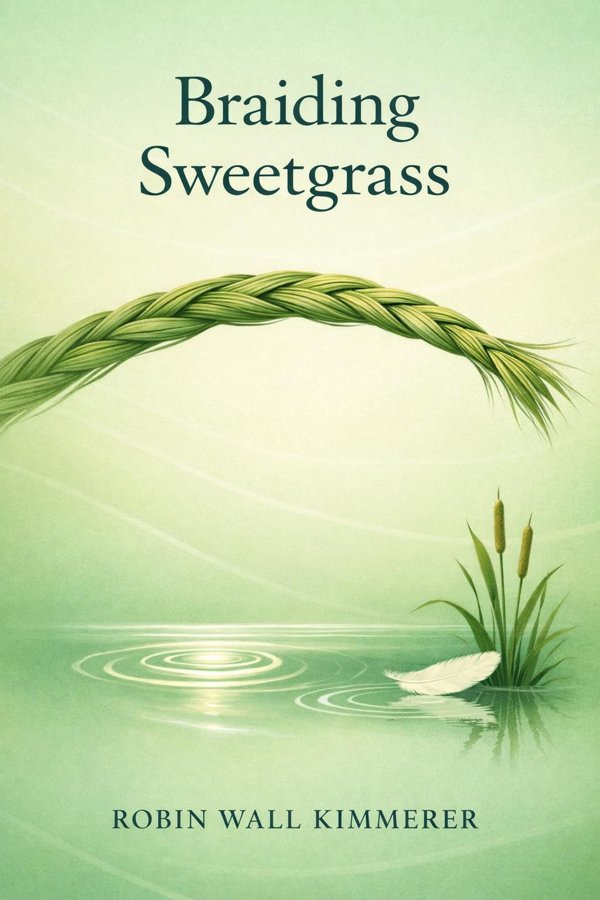
Braiding Sweetgrass: Indigenous Wisdom, Scientific Knowledge, and the Teachings of Plants: Summary & Key Insights
 10 min9 chaptersAudio available
Key Takeaways from Braiding Sweetgrass: Indigenous Wisdom, Scientific Knowledge, and the Teachings of Plants
A plant can be more than a species; it can be a doorway into identity.
The modern economy teaches us to ask what something is worth; the living world invites us to ask what has been given.
Language does not merely describe the world; it trains us how to see it.
Sustainability is not only a technical problem; it is a moral practice of knowing when enough is enough.
Some forms of wealth cannot be accumulated by one person because they belong to a whole community.
What Is Braiding Sweetgrass: Indigenous Wisdom, Scientific Knowledge, and the Teachings of Plants About?
Braiding Sweetgrass: Indigenous Wisdom, Scientific Knowledge, and the Teachings of Plants by Robin Wall Kimmerer is a environment book spanning 8 pages. What if the natural world were not a collection of resources to be managed, but a community of living beings to whom we owe gratitude, respect, and reciprocity? In Braiding Sweetgrass, Robin Wall Kimmerer invites readers into exactly that shift in perception. Blending memoir, ecology, Indigenous philosophy, and lyrical storytelling, she explores how plants, animals, waters, and landscapes can become teachers when we learn to listen differently. The book is not only about botany or environmental ethics; it is about repairing a broken relationship between people and the Earth. Kimmerer writes with unusual authority because she stands in two intellectual traditions at once. She is a trained botanist and professor of environmental biology, and she is also a member of the Citizen Potawatomi Nation, shaped by Indigenous teachings that understand humans as part of a web of reciprocal relationships. Rather than treating science and Indigenous knowledge as opposites, she braids them together to reveal a richer understanding of life. The result is a deeply moving, intellectually generous work that challenges modern assumptions about ownership, progress, and stewardship while offering a more hopeful, grounded way to live on the planet.
This FizzRead summary covers all 9 key chapters of Braiding Sweetgrass: Indigenous Wisdom, Scientific Knowledge, and the Teachings of Plants in approximately 10 minutes, distilling the most important ideas, arguments, and takeaways from Robin Wall Kimmerer's work. Also available as an audio summary and Key Quotes Podcast.
Braiding Sweetgrass: Indigenous Wisdom, Scientific Knowledge, and the Teachings of Plants
What if the natural world were not a collection of resources to be managed, but a community of living beings to whom we owe gratitude, respect, and reciprocity? In Braiding Sweetgrass, Robin Wall Kimmerer invites readers into exactly that shift in perception. Blending memoir, ecology, Indigenous philosophy, and lyrical storytelling, she explores how plants, animals, waters, and landscapes can become teachers when we learn to listen differently. The book is not only about botany or environmental ethics; it is about repairing a broken relationship between people and the Earth.
Kimmerer writes with unusual authority because she stands in two intellectual traditions at once. She is a trained botanist and professor of environmental biology, and she is also a member of the Citizen Potawatomi Nation, shaped by Indigenous teachings that understand humans as part of a web of reciprocal relationships. Rather than treating science and Indigenous knowledge as opposites, she braids them together to reveal a richer understanding of life. The result is a deeply moving, intellectually generous work that challenges modern assumptions about ownership, progress, and stewardship while offering a more hopeful, grounded way to live on the planet.
Who Should Read Braiding Sweetgrass: Indigenous Wisdom, Scientific Knowledge, and the Teachings of Plants?
This book is perfect for anyone interested in environment and looking to gain actionable insights in a short read. Whether you're a student, professional, or lifelong learner, the key ideas from Braiding Sweetgrass: Indigenous Wisdom, Scientific Knowledge, and the Teachings of Plants by Robin Wall Kimmerer will help you think differently.
- ✓Readers who enjoy environment and want practical takeaways
- ✓Professionals looking to apply new ideas to their work and life
- ✓Anyone who wants the core insights of Braiding Sweetgrass: Indigenous Wisdom, Scientific Knowledge, and the Teachings of Plants in just 10 minutes
Want the full summary?
Get instant access to this book summary and 100K+ more with Fizz Moment.
Get Free SummaryAvailable on App Store • Free to download
Key Chapters
A plant can be more than a species; it can be a doorway into identity. Kimmerer begins with sweetgrass because it carries memory, ceremony, and belonging. For her, the plant is tied to childhood landscapes, Potawatomi teachings, and the inherited knowledge of how humans are meant to live in respectful relationship with the land. But it also marks a tension: as she entered the world of scientific education, she found that the language of data and objectivity often left little room for reverence, kinship, or gratitude. This split between scientific training and Indigenous understanding becomes one of the book’s central concerns.
Rather than choosing one way of knowing over the other, Kimmerer shows that both can illuminate the living world. Science can explain how plants grow, reproduce, and interact in ecosystems. Indigenous teachings can explain how humans ought to behave in response to those realities. Sweetgrass, then, becomes both subject and symbol: it is a plant to be studied, but also a relative to be honored.
In practical terms, this idea encourages readers to reconsider the stories attached to the places and species around them. A garden, a tree in a neighborhood park, or a native plant growing by a roadside can become a starting point for noticing not only ecological function but cultural meaning and personal connection. Environmental care becomes stronger when it is rooted in affection rather than abstraction.
Actionable takeaway: Choose one plant in your local environment and learn about it in two ways this week: scientifically, by understanding its ecological role, and personally, by reflecting on what memories, meanings, or responsibilities it evokes in you.
The modern economy teaches us to ask what something is worth; the living world invites us to ask what has been given. Kimmerer contrasts market logic with what she calls the gift economy of nature. Forests produce oxygen, berries, shade, medicine, and beauty without sending invoices. Pollinators fertilize crops. Rivers carry water. Soil organisms quietly sustain fertility. Life is made possible by countless offerings that are not bought or sold, yet contemporary culture often responds to these gifts with extraction, waste, and entitlement.
In Indigenous traditions, gifts carry obligations. To receive well means to respond with gratitude, restraint, and reciprocity. This changes the ethical structure of environmental thought. If the Earth is not a warehouse of commodities but a giver of gifts, then taking without giving back becomes not just inefficient but dishonorable. Gratitude is not sentimental here; it is a practical discipline that leads to better behavior. People who truly recognize food, water, and land as gifts are less likely to squander them.
This idea has concrete applications. A family might shift from wasteful consumption toward mindful use of food and energy. A community might support watershed restoration, native planting, or local conservation not as charity, but as repayment. Even businesses and institutions can adopt reciprocity-minded policies, such as restoring habitat where they operate or investing in circular systems that reduce harm.
Actionable takeaway: At the end of each day, identify one gift you received from the natural world, such as food, clean air, warmth, or beauty, and pair that gratitude with one small act of reciprocity, like reducing waste, planting native species, or supporting ecological restoration.
Language does not merely describe the world; it trains us how to see it. One of Kimmerer’s most powerful insights is that English often reduces living beings to objects through the word “it.” In many Indigenous languages, by contrast, plants, animals, waters, and even places may be addressed with forms of respect usually reserved in English for persons. This is not a grammatical curiosity. It reflects an entirely different worldview, one in which other lives are acknowledged as active presences rather than passive things.
When a tree is an “it,” it becomes easier to imagine it as lumber. When it is recognized as a being with its own life, history, and role in the community of creation, exploitation becomes morally more difficult. Kimmerer is not claiming that language alone solves environmental destruction, but she shows that speech patterns shape habits of attention. Grammar can either reinforce domination or cultivate humility.
Readers can apply this insight by becoming more mindful in how they talk about the world. This does not require appropriating another language. It begins with noticing the assumptions buried in everyday speech. Instead of speaking as though land is inert property, we can speak of watersheds, forests, and species as communities with which we are in relationship. Educators can bring this awareness into classrooms; parents can model respectful naming for children; writers can choose words that make aliveness visible.
Actionable takeaway: For one week, pay close attention to how you refer to nonhuman life and intentionally use language of respect and relationship, whether by naming species specifically, avoiding dismissive objectification, or speaking of the natural world as a living community rather than a stockpile of things.
Sustainability is not only a technical problem; it is a moral practice of knowing when enough is enough. In Kimmerer’s teaching of the Honorable Harvest, taking from the Earth is not forbidden, but it is governed by principles: ask permission, take only what you need, use what you take, minimize harm, give thanks, and reciprocate the gift. These guidelines transform harvesting from extraction into relationship.
This matters because environmental destruction often begins with the belief that ability justifies taking. Modern tools allow societies to remove fish, timber, fossil fuels, and topsoil at extraordinary speed, but power is not wisdom. The Honorable Harvest insists that ethics must limit appetite. It challenges the assumption that maximum yield is the goal. Instead, the goal is continuity, respect, and mutual flourishing.
The principle applies far beyond foraging. A person buying clothes can ask whether they need another item or are simply responding to manufactured desire. A company can decide whether short-term profit justifies long-term ecological damage. Farmers can design systems that protect soil rather than mine it. Gardeners can harvest herbs or vegetables in ways that allow plants to keep thriving. Communities can regulate local resources according to what ecosystems can regenerate.
Kimmerer’s broader point is that ecological crises are inseparable from cultural habits of greed and disconnection. Rules alone are not enough unless they are supported by values of gratitude and self-restraint.
Actionable takeaway: Before acquiring, harvesting, or consuming something this week, pause and ask three questions: Do I truly need it? Can it regenerate? What can I give back in return?
Some forms of wealth cannot be accumulated by one person because they belong to a whole community. In Kimmerer’s reflections on maple syrup, she describes how sugaring season is not merely a process of extracting sap from trees. It is a cultural practice that gathers people, seasons memory, and reveals a pattern of abundance that is shared rather than hoarded. Maple trees offer sweetness in a brief window, and receiving that gift depends on attention, patience, and cooperation.
The lesson is ecological and social at once. Maple sap flows according to rhythms larger than human schedules, reminding us that not everything obeys industrial efficiency. The labor of gathering and boiling sap often becomes communal, linking food with relationship. This contrasts sharply with consumer culture, which isolates people from the sources of what they consume and treats sweetness as a constant entitlement available from any shelf, at any time.
Kimmerer uses maple trees to show that reciprocity can be celebratory, not burdensome. People respond to the gift of sweetness with care for the trees, gratitude for the season, and participation in traditions that strengthen both land and community. The deeper point is that many of life’s richest goods are relational: they arise through shared labor, seasonal awareness, and mutual dependence.
Readers can apply this by reconnecting food with place and people. Visit a local farm, learn what grows seasonally in your region, participate in community-supported agriculture, or create rituals around meals that honor where food came from.
Actionable takeaway: Choose one food you regularly consume and trace its seasonal, ecological, and human origins; then find one way to support a more local, communal, or regenerative source of that food.
Competition is not the only law of life; cooperation is just as fundamental. Kimmerer’s discussion of the Three Sisters, corn, beans, and squash, illustrates how traditional Indigenous agriculture embodies ecological intelligence. These plants are often grown together because each contributes something the others need: corn provides a stalk for beans to climb, beans enrich the soil with nitrogen, and squash shades the ground, helping retain moisture and suppress weeds. Together, they produce more than they would in isolation.
This planting method challenges simplistic versions of survival-of-the-fittest thinking that dominate both economics and popular interpretations of nature. Kimmerer does not deny competition, but she reminds readers that ecosystems also depend on reciprocity, complementarity, and partnership. The Three Sisters offer a living metaphor for healthy communities, where difference is not a problem to overcome but a strength to organize around.
The application extends beyond farming. Teams work better when members contribute distinct strengths that support one another. Neighborhoods become more resilient when people share skills and resources. Schools and workplaces can be designed to reward collaboration rather than constant individual rivalry. Even personal life improves when we stop measuring worth by self-sufficiency alone and begin asking what relationships help us all thrive.
Ecologically, the lesson also supports regenerative agriculture. Polycultures often protect biodiversity, reduce chemical dependence, and improve soil health compared with monocultures. Ancient knowledge here anticipates many principles of modern sustainability.
Actionable takeaway: Identify one area of your life, work, family, or community, where people or elements are being treated as isolated units, and redesign it to encourage complementary cooperation rather than individual competition.
Healing damaged land requires more than technical repair; it requires renewed belonging. Kimmerer’s reflections on restoration ecology show that environmental recovery is not simply a matter of replanting species or correcting chemical imbalances, though those things matter. True restoration also asks whether humans can recover a respectful relationship with place. A wetland, prairie, or forest can be scientifically rehabilitated yet still remain vulnerable if the culture around it continues to treat land as disposable.
Kimmerer draws on both ecological science and Indigenous understanding to argue that restoration is reciprocal. Humans heal ecosystems, and ecosystems in turn heal humans by restoring attention, humility, and participation. This changes the emotional meaning of environmental work. Instead of seeing conservation only as sacrifice or crisis management, we can experience it as an act of rejoining the living world.
Practical examples include habitat restoration projects that involve local communities rather than outside experts alone, school gardens that teach stewardship, and land management practices that integrate traditional ecological knowledge. A restoration project succeeds more deeply when people know the names of the species returning, celebrate their presence, and feel responsible for their future. This is one reason Kimmerer emphasizes story, ceremony, and gratitude alongside science.
The same principle applies at smaller scales. Restoring a patch of native plants in a backyard, reducing invasive species in a local park, or volunteering for watershed cleanup can reshape one’s sense of participation in the world.
Actionable takeaway: Join or begin one restoration effort, however modest, and approach it not as fixing a broken object but as renewing a relationship with a living place.
Values become real when they are practiced repeatedly. Throughout Braiding Sweetgrass, Kimmerer shows that gratitude is not just a private feeling but a disciplined way of living, often sustained through ceremony, ritual, and shared acknowledgment. In many modern settings, people express concern for the environment while remaining embedded in routines of speed, consumption, and distraction. Ceremony interrupts those routines and reminds us that life is sustained by countless gifts beyond our control.
Kimmerer’s stories about prayer, offering, thanksgiving, and the burning of sweetgrass point toward a broader principle: humans need practices that keep reverence alive. Without them, even noble beliefs fade under the pressure of convenience. Ceremony can be formal, rooted in a specific culture, but the underlying lesson is widely accessible. Repeating acts of thanks before meals, marking seasonal changes, gathering in community to honor a river or forest, or creating intentional moments of silence outdoors can all train attention toward reciprocity.
This is not about romantic symbolism detached from action. For Kimmerer, gratitude naturally leads to responsibility. If you regularly remember that your food, water, and shelter depend on living systems, you are more likely to defend those systems. Ritual helps convert environmental awareness into durable ethics.
In practical life, families can establish seasonal traditions tied to local nature. Schools can begin outdoor lessons with moments of acknowledgment. Communities can celebrate restoration milestones or harvest times. Small practices can reshape large habits.
Actionable takeaway: Create one simple recurring ritual of gratitude connected to the natural world, such as a daily thank-you before eating or a weekly walk of attentive observation, and let it guide one concrete act of environmental care.
Environmental crises are also crises of imagination. Kimmerer argues that many destructive systems persist because they are supported by stories people mistake for reality: that humans stand above nature, that land exists mainly for profit, that endless growth is normal, or that only measurable knowledge counts as true knowledge. These stories shape institutions, habits, and policies. If we want different outcomes, we need different cultural narratives.
Braiding Sweetgrass offers such a narrative. It does not reject science, but it refuses to let science remain severed from ethics, gratitude, and kinship. It proposes that humans are not masters of the Earth nor outsiders to it, but younger siblings in a wider family of life. This story changes what success looks like. Prosperity becomes not accumulation, but participation in mutual flourishing. Intelligence becomes not only analytical skill, but the wisdom to live respectfully within limits.
This insight matters because policy changes alone often fail when deeper assumptions remain untouched. A society that still worships extraction will find new ways to damage the world. But a society that teaches children to see rivers, forests, and species as relatives will create different laws, economies, and aspirations. Story is not decoration; it is infrastructure for behavior.
Readers can practice this by examining the narratives behind their own choices and by sharing more life-giving stories in homes, schools, organizations, and public conversation. Change begins when people stop repeating the myths that justify harm.
Actionable takeaway: Identify one inherited belief you hold about nature, progress, or ownership, question where it came from, and replace it with a more reciprocal guiding story you can consciously live by.
All Chapters in Braiding Sweetgrass: Indigenous Wisdom, Scientific Knowledge, and the Teachings of Plants
About the Author
Robin Wall Kimmerer is a botanist, essayist, professor of environmental biology, and enrolled member of the Citizen Potawatomi Nation. She teaches at the State University of New York College of Environmental Science and Forestry, where her work focuses on plant ecology, mosses, restoration, and the relationship between people and land. Kimmerer is also the founder of the Center for Native Peoples and the Environment, which works to bring Indigenous and scientific knowledge into conversation. Her writing is known for combining ecological expertise with memoir, cultural reflection, and moral clarity. In books such as Braiding Sweetgrass, she has become an influential voice in contemporary environmental thought, helping readers imagine a more reciprocal, respectful, and sustainable relationship with the living world.
Get This Summary in Your Preferred Format
Read or listen to the Braiding Sweetgrass: Indigenous Wisdom, Scientific Knowledge, and the Teachings of Plants summary by Robin Wall Kimmerer anytime, anywhere. FizzRead offers multiple formats so you can learn on your terms — all free.
Available formats: App · Audio · PDF · EPUB — All included free with FizzRead
Download Braiding Sweetgrass: Indigenous Wisdom, Scientific Knowledge, and the Teachings of Plants PDF and EPUB Summary
Key Quotes from Braiding Sweetgrass: Indigenous Wisdom, Scientific Knowledge, and the Teachings of Plants
“A plant can be more than a species; it can be a doorway into identity.”
“The modern economy teaches us to ask what something is worth; the living world invites us to ask what has been given.”
“Language does not merely describe the world; it trains us how to see it.”
“Sustainability is not only a technical problem; it is a moral practice of knowing when enough is enough.”
“Some forms of wealth cannot be accumulated by one person because they belong to a whole community.”
Frequently Asked Questions about Braiding Sweetgrass: Indigenous Wisdom, Scientific Knowledge, and the Teachings of Plants
Braiding Sweetgrass: Indigenous Wisdom, Scientific Knowledge, and the Teachings of Plants by Robin Wall Kimmerer is a environment book that explores key ideas across 9 chapters. What if the natural world were not a collection of resources to be managed, but a community of living beings to whom we owe gratitude, respect, and reciprocity? In Braiding Sweetgrass, Robin Wall Kimmerer invites readers into exactly that shift in perception. Blending memoir, ecology, Indigenous philosophy, and lyrical storytelling, she explores how plants, animals, waters, and landscapes can become teachers when we learn to listen differently. The book is not only about botany or environmental ethics; it is about repairing a broken relationship between people and the Earth. Kimmerer writes with unusual authority because she stands in two intellectual traditions at once. She is a trained botanist and professor of environmental biology, and she is also a member of the Citizen Potawatomi Nation, shaped by Indigenous teachings that understand humans as part of a web of reciprocal relationships. Rather than treating science and Indigenous knowledge as opposites, she braids them together to reveal a richer understanding of life. The result is a deeply moving, intellectually generous work that challenges modern assumptions about ownership, progress, and stewardship while offering a more hopeful, grounded way to live on the planet.
More by Robin Wall Kimmerer
You Might Also Like

A Life on Our Planet: My Witness Statement and a Vision for the Future
David Attenborough
10 min
A Sky Full Of Birds
Matt Merritt
10 min
Carbon Zero: Imagining Cities That Can Save the Planet
Alex Steffen
10 min
Eaarth: Making a Life on a Tough New Planet
Bill McKibben
10 min
The Social Contract and Environmental Governance
Various Editors
10 min
The Wild Places
Robert Macfarlane
10 minBrowse by Category
Ready to read Braiding Sweetgrass: Indigenous Wisdom, Scientific Knowledge, and the Teachings of Plants?
Get the full summary and 100K+ more books with Fizz Moment.