
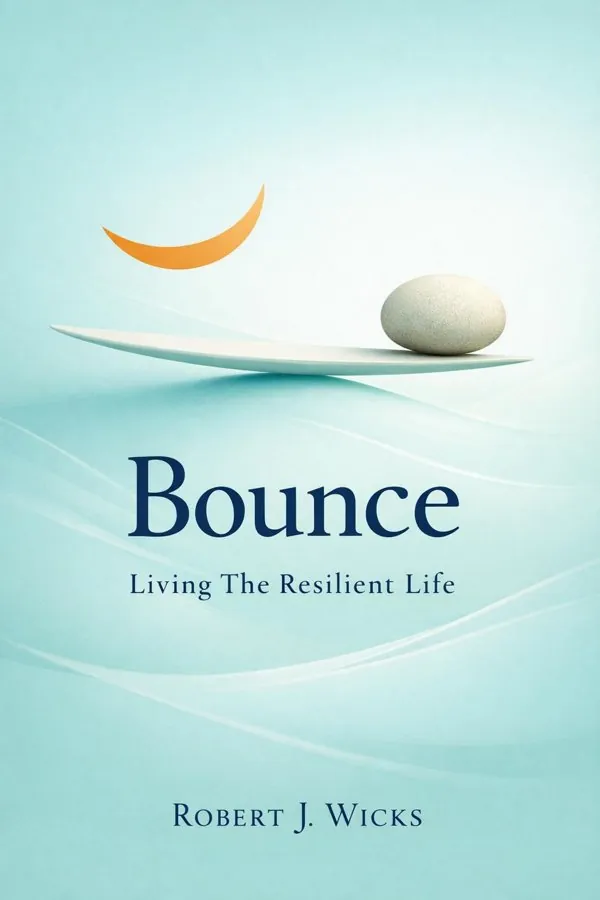
Bounce: Living The Resilient Life: Summary & Key Insights
 10 min9 chaptersAudio available
Key Takeaways from Bounce: Living The Resilient Life
Stress becomes most dangerous when it is unnamed.
Resilient people are not immune to pain; they simply relate to it more wisely.
You cannot protect an inner life you do not examine.
Resilience does not come from intensity alone; it comes from rhythm.
Caring deeply for others is noble, but compassion without limits eventually collapses under its own weight.
What Is Bounce: Living The Resilient Life About?
Bounce: Living The Resilient Life by Robert J. Wicks is a mental_health book spanning 7 pages. Bounce: Living The Resilient Life is a thoughtful guide to staying grounded, humane, and emotionally healthy in a world that often feels exhausting. Robert J. Wicks argues that resilience is not simply the ability to endure hardship or "tough it out." Instead, it is a disciplined way of living that combines self-awareness, emotional honesty, perspective, compassion, and renewal. The book speaks directly to people who feel stretched by work, relationships, caregiving, uncertainty, or the steady pressure of modern life. Rather than offering quick fixes, Wicks shows how resilience grows through habits of reflection, balance, humility, gratitude, and connection. What makes this book especially valuable is the author’s authority. Wicks is a clinical psychologist who has spent decades working with caregivers, counselors, educators, and others exposed to stress and suffering. He also draws on spiritual insight without becoming abstract or preachy. The result is a practical and deeply humane book that helps readers recognize burnout before it takes over, recover perspective when life narrows, and build an inner life strong enough to meet adversity with steadiness, wisdom, and hope.
This FizzRead summary covers all 9 key chapters of Bounce: Living The Resilient Life in approximately 10 minutes, distilling the most important ideas, arguments, and takeaways from Robert J. Wicks's work. Also available as an audio summary and Key Quotes Podcast.
Bounce: Living The Resilient Life
Bounce: Living The Resilient Life is a thoughtful guide to staying grounded, humane, and emotionally healthy in a world that often feels exhausting. Robert J. Wicks argues that resilience is not simply the ability to endure hardship or "tough it out." Instead, it is a disciplined way of living that combines self-awareness, emotional honesty, perspective, compassion, and renewal. The book speaks directly to people who feel stretched by work, relationships, caregiving, uncertainty, or the steady pressure of modern life. Rather than offering quick fixes, Wicks shows how resilience grows through habits of reflection, balance, humility, gratitude, and connection.
What makes this book especially valuable is the author’s authority. Wicks is a clinical psychologist who has spent decades working with caregivers, counselors, educators, and others exposed to stress and suffering. He also draws on spiritual insight without becoming abstract or preachy. The result is a practical and deeply humane book that helps readers recognize burnout before it takes over, recover perspective when life narrows, and build an inner life strong enough to meet adversity with steadiness, wisdom, and hope.
Who Should Read Bounce: Living The Resilient Life?
This book is perfect for anyone interested in mental_health and looking to gain actionable insights in a short read. Whether you're a student, professional, or lifelong learner, the key ideas from Bounce: Living The Resilient Life by Robert J. Wicks will help you think differently.
- ✓Readers who enjoy mental_health and want practical takeaways
- ✓Professionals looking to apply new ideas to their work and life
- ✓Anyone who wants the core insights of Bounce: Living The Resilient Life in just 10 minutes
Want the full summary?
Get instant access to this book summary and 100K+ more with Fizz Moment.
Get Free SummaryAvailable on App Store • Free to download
Key Chapters
Stress becomes most dangerous when it is unnamed. One of Wicks’s most important insights is that resilience begins with recognizing what is actually draining us rather than simply calling life "busy" and moving on. Modern stress rarely arrives as one dramatic event. More often, it accumulates through constant demands, emotional overload, financial uncertainty, digital distraction, unresolved grief, difficult people, and the unspoken pressure to always perform well. When these burdens pile up unnoticed, they narrow our perspective and quietly weaken our capacity to respond wisely.
Wicks encourages readers to see adversity clearly and honestly. Some stress is external: deadlines, caregiving, illness, conflict, unstable institutions. Some is internal: perfectionism, unrealistic expectations, fear of disappointing others, a need for control, or the habit of comparing ourselves to people who seem more composed. Often what exhausts us most is not the event itself but the story we attach to it. A setback becomes proof that we are failing. A conflict becomes evidence that we are unlovable. An overloaded week becomes a permanent identity.
A teacher, for example, may think she is simply tired, when in reality she is carrying classroom stress, family concerns, guilt about not doing enough, and the belief that asking for help means weakness. Once these elements are named, they become more manageable. The fog lifts. She can begin to distinguish what can be changed, what must be accepted, and where support is needed.
Actionable takeaway: make a personal stress inventory. List your current pressures under three headings: external demands, inner pressures, and recurring emotional triggers. Naming stress is the first act of resilience.
Resilient people are not immune to pain; they simply relate to it more wisely. Wicks rejects the myth that emotionally strong people are always confident, upbeat, or endlessly productive. In his view, resilient people are often ordinary individuals who have learned how to remain steady without becoming rigid, hopeful without becoming naive, and compassionate without losing themselves.
He observes several qualities again and again in people who endure stress well. They maintain perspective under pressure. They can step back from immediate emotion and ask, "What is really happening here?" They know their limits and respect them. They do not confuse self-sacrifice with health. They are capable of humor, which helps break the spell of fear and self-importance. They also tend to be grounded in values larger than momentary success, whether those values are faith, service, integrity, or love.
Another trait of resilience is flexibility. A resilient physician whose schedule becomes overwhelming may reorganize priorities, ask colleagues for help, and simplify nonessential commitments. A less resilient person may continue pushing until resentment, numbness, or burnout takes over. Resilient people also recover faster because they practice restoration before collapse. They do not wait until life becomes unmanageable.
Importantly, Wicks does not describe resilience as perfection. Strong people still get discouraged, irritated, and tired. What distinguishes them is their willingness to return to center. They notice when they are drifting and choose to recalibrate.
Actionable takeaway: identify one resilient person you admire and write down three qualities they embody. Then choose one of those qualities, such as perspective, humor, or boundaries, and practice it deliberately this week.
You cannot protect an inner life you do not examine. Wicks places self-awareness at the center of resilience because people often break down not from a single burden, but from living too long without reflection. When we move from task to task without pausing, we lose touch with our motives, our fatigue, our fears, and our emotional blind spots. Eventually, we become strangers to ourselves.
For Wicks, reflection is not self-absorption. It is the quiet discipline of noticing what is happening within us before it erupts in unhelpful ways. A person who reflects regularly can catch resentment before it turns into cynicism, sadness before it hardens into numbness, and anxiety before it dictates every decision. Self-awareness also reveals patterns. Maybe you always overcommit when you want approval. Maybe you become impatient when you are sleep deprived. Maybe you withdraw from loved ones when you feel inadequate.
This kind of honesty makes wiser action possible. Consider a social worker who feels increasingly irritable with clients. Without reflection, she may assume the problem is simply a difficult caseload. With reflection, she may realize she is grieving a personal loss, skipping rest, and trying to appear strong at all times. That insight changes what she needs: not just better scheduling, but support, space, and compassion toward herself.
Wicks recommends simple practices such as journaling, quiet review of the day, honest conversation with a trusted friend, or moments of silence before sleep. These practices help people remain awake to their inner state and therefore less likely to live on automatic pilot.
Actionable takeaway: spend ten minutes each evening asking three questions: What gave me life today? What drained me? What truth about myself am I being invited to see?
Resilience does not come from intensity alone; it comes from rhythm. Wicks emphasizes that a balanced life is not a luxury for the privileged but a necessity for anyone who wants to remain emotionally and spiritually healthy. In a culture that rewards overwork and celebrates constant availability, many people mistake imbalance for dedication. Yet what looks like commitment can quietly become depletion.
Wicks connects balance with mindfulness and gratitude. Mindfulness allows us to inhabit the present moment rather than living in mental chaos. Gratitude loosens the grip of scarcity and helps us notice what is still good, beautiful, and sustaining. Together, these practices restore perspective. Instead of being swallowed by problems, we begin to see that hardship is real but not total.
Balance can be practical and concrete. It may mean pausing between meetings rather than carrying one emotional tone into the next. It may mean eating lunch without a screen, taking a walk after difficult work, or refusing to answer nonurgent messages late at night. It also means balancing seriousness with play, effort with rest, solitude with companionship, ambition with humility.
A parent caring for children and aging relatives may feel there is no room for balance. Wicks would not deny the pressure. But he would argue that even in constrained circumstances, micro-practices matter: two minutes of steady breathing in the car, a gratitude list before bed, a brief walk, a conscious transition ritual after a hard conversation. Small acts repeated faithfully can keep the soul from drying out.
Actionable takeaway: choose one balancing ritual you can realistically sustain every day for the next week, such as five minutes of silence, a short walk, or writing down three things you are grateful for.
Caring deeply for others is noble, but compassion without limits eventually collapses under its own weight. Wicks writes with particular wisdom for caregivers, helpers, teachers, ministers, clinicians, and anyone who feels responsible for others’ wellbeing. He knows that generous people are often vulnerable to exhaustion precisely because they are sincere. They want to help, to be present, to relieve suffering. But when compassion is not balanced by boundaries, it turns into overextension, resentment, or quiet despair.
True compassion, in Wicks’s view, does not mean absorbing everyone’s pain or solving every problem. It means offering presence, skill, and kindness while remembering that you are also human. Boundaries are not the enemy of love; they are what allow love to remain steady over time. A counselor who never rests, a manager who never says no, or a friend who constantly rescues others may appear admirable for a while, but such patterns are rarely sustainable.
Wicks also points to the sustaining power of spiritual and relational connection. People remain compassionate longer when they are connected to something deeper than ego or approval. Faith, prayer, community, nature, and meaningful relationships can all remind us that we are not carrying life alone. They return us to humility: we can contribute, but we are not omnipotent.
In practice, this may mean setting office hours, taking real days off, declining roles that do not fit your capacity, or listening to someone’s pain without taking ownership of their outcome. It may also mean seeking your own support instead of pretending to be endlessly strong.
Actionable takeaway: identify one relationship or responsibility where compassion has become overextension. Set one clear boundary that protects your ability to care well without burning out.
People who serve others often believe their work excuses them from tending to themselves. Wicks challenges this dangerous assumption. Whether you are a nurse, parent, leader, volunteer, therapist, pastor, or friend, your capacity to be helpful depends on the condition of your inner life. Service without renewal may continue outwardly for a time, but inwardly it becomes brittle. You begin to give from irritation, depletion, or habit rather than generosity.
Wicks has spent years working with professionals exposed to suffering, and he repeatedly returns to one lesson: unaddressed fatigue changes how we see people. We become less patient, more judgmental, more hurried, less able to listen, and more likely to reduce others to problems. Renewal is therefore not self-indulgence. It is an ethical responsibility. If you want to remain kind, wise, and present, you must replenish the emotional and spiritual sources from which you serve.
Renewal can take many forms: prayer, solitude, therapy, honest friendship, laughter, exercise, sleep, retreat, reading, nature, or creative activity. The form matters less than the regularity and honesty behind it. A physician who schedules ten quiet minutes before entering the hospital, debriefs difficult days with a colleague, and protects one evening a week for family may be building exactly the kind of rhythm that prevents compassion fatigue.
Wicks also warns against fantasy solutions. A single vacation cannot compensate for a chronically unsustainable life. Real renewal is woven into ordinary days. It is less about escape than about returning to what keeps us alive inside.
Actionable takeaway: create a personal renewal plan with three categories: daily practices, weekly restoration, and emergency signs that tell you you’re running on empty.
Many people imagine resilience as invulnerability, but Wicks insists the opposite is true. Resilience grows when we stop denying our limits and begin meeting them with honesty. Pretending to be unaffected by pain may help us survive briefly, but over time it isolates us from ourselves and from others. Vulnerability is not weakness in this framework. It is the courage to acknowledge fear, grief, uncertainty, and need without surrendering to them.
This matters because denial often disguises itself as strength. A person may insist they are "fine" while becoming more impatient, emotionally distant, or physically exhausted. Another may refuse help because they fear appearing dependent. Yet such strategies narrow life. They keep us from receiving support, learning from hardship, and discovering that suffering can deepen wisdom when it is faced openly.
Wicks presents renewal as an ongoing journey rather than a one-time breakthrough. We do not become resilient and stay there automatically. We drift, break down, recover, and learn. A difficult season may reveal old wounds, unrealistic expectations, or neglected needs. If we respond with humility, those revelations can refine us. The person who admits burnout can rebuild a healthier way of working. The person who acknowledges loneliness can seek connection. The person who names grief can finally begin healing.
Vulnerability also strengthens relationships. When leaders, parents, or caregivers model grounded honesty, they create space for others to do the same. This does not mean oversharing every emotion. It means being real enough that trust can grow.
Actionable takeaway: tell one trusted person the truth about an area where you are struggling. Let resilience begin not with performance, but with honest connection.
Under pressure, the mind shrinks. A minor criticism feels catastrophic, a temporary setback feels permanent, and one painful interaction can overshadow ten good ones. Wicks shows that one of resilience’s quiet superpowers is perspective: the capacity to see events in proportion rather than through the magnifying glass of fear, ego, or fatigue. Without perspective, stress hijacks meaning. We become reactive, dramatic, or hopeless, not because reality is always dire, but because our view of it has narrowed.
Perspective does not minimize suffering. It places suffering in a larger frame. When a project fails, perspective asks whether this is truly ruin or simply disappointment. When someone behaves harshly, perspective wonders what pressures they may be carrying without excusing the behavior. When we make mistakes, perspective reminds us that being flawed is part of being human, not proof that we are unworthy.
Wicks values humor as an ally here. Healthy humor interrupts self-importance and helps us remember that not every frustration deserves total emotional investment. A leader who can smile at a minor inconvenience rather than treating it like a moral emergency is protecting both their peace and the emotional climate of everyone around them.
Perspective can be cultivated through simple questions: Will this matter in a month? What story am I telling myself? Am I reacting from fatigue? What would a wise friend say? These pauses create breathing room between event and interpretation.
Actionable takeaway: the next time you feel overwhelmed, write down the event, your first interpretation, and one alternative interpretation. That small act can loosen emotional distortion and restore wiser perspective.
People often wait for dramatic change while overlooking the power of ordinary practices. Wicks makes clear that resilient living is less about rare moments of heroism and more about consistent habits that strengthen us over time. Just as physical fitness comes from repeated exercise rather than one intense workout, emotional resilience grows through small choices made day after day.
This is encouraging because it means resilience is accessible. You do not need a perfect personality, unlimited free time, or a crisis to begin. You need repeatable practices that support clarity, steadiness, and renewal. These may include waking a little earlier for silence, taking honest stock of your mood before work, limiting media that inflames anxiety, calling a friend instead of isolating, stepping outside between tasks, or ending the day with gratitude rather than rumination.
Small habits matter especially when life feels chaotic. During difficult seasons, people often abandon basic disciplines first: sleep, movement, reflection, prayer, healthy meals, boundaries. Yet those are the very practices that keep us from being swallowed by stress. A busy executive who starts each morning by checking email may begin the day already reactive. The same person who spends five minutes centering before opening devices may enter the day with more intention and less emotional scattering.
Wicks’s broader message is that resilience should be prepared in advance. In hard times, we rarely rise above our habits; we fall back on them. If our habits are grounding, restorative, and truthful, they become a stable foundation when adversity arrives.
Actionable takeaway: choose two tiny resilience habits you can maintain even on difficult days, such as three minutes of silence and one brief check-in with a supportive person.
All Chapters in Bounce: Living The Resilient Life
About the Author
Robert J. Wicks is a clinical psychologist, professor, and widely respected author whose work focuses on resilience, self-care, spiritual growth, and the emotional challenges faced by caregivers and helping professionals. Over the course of his career, he has taught and consulted in settings that include health care, counseling, education, and pastoral care, giving him deep insight into how stress and suffering affect those who serve others. Wicks is known for blending psychological expertise with practical wisdom and a reflective spiritual sensibility. His books often address burnout, perspective, compassion fatigue, and the habits that sustain emotional balance over time. In Bounce: Living The Resilient Life, he brings this experience together to offer a grounded, humane guide to building inner strength in demanding circumstances.
Get This Summary in Your Preferred Format
Read or listen to the Bounce: Living The Resilient Life summary by Robert J. Wicks anytime, anywhere. FizzRead offers multiple formats so you can learn on your terms — all free.
Available formats: App · Audio · PDF · EPUB — All included free with FizzRead
Download Bounce: Living The Resilient Life PDF and EPUB Summary
Key Quotes from Bounce: Living The Resilient Life
“Stress becomes most dangerous when it is unnamed.”
“Resilient people are not immune to pain; they simply relate to it more wisely.”
“You cannot protect an inner life you do not examine.”
“Resilience does not come from intensity alone; it comes from rhythm.”
“Caring deeply for others is noble, but compassion without limits eventually collapses under its own weight.”
Frequently Asked Questions about Bounce: Living The Resilient Life
Bounce: Living The Resilient Life by Robert J. Wicks is a mental_health book that explores key ideas across 9 chapters. Bounce: Living The Resilient Life is a thoughtful guide to staying grounded, humane, and emotionally healthy in a world that often feels exhausting. Robert J. Wicks argues that resilience is not simply the ability to endure hardship or "tough it out." Instead, it is a disciplined way of living that combines self-awareness, emotional honesty, perspective, compassion, and renewal. The book speaks directly to people who feel stretched by work, relationships, caregiving, uncertainty, or the steady pressure of modern life. Rather than offering quick fixes, Wicks shows how resilience grows through habits of reflection, balance, humility, gratitude, and connection. What makes this book especially valuable is the author’s authority. Wicks is a clinical psychologist who has spent decades working with caregivers, counselors, educators, and others exposed to stress and suffering. He also draws on spiritual insight without becoming abstract or preachy. The result is a practical and deeply humane book that helps readers recognize burnout before it takes over, recover perspective when life narrows, and build an inner life strong enough to meet adversity with steadiness, wisdom, and hope.
More by Robert J. Wicks
You Might Also Like
Big Feelings: How to Be Okay When Things Are Not Okay
Liz Fosslien, Mollie West Duffy
10 min
Creative Arts Therapies Handbook: Art, Music and Dance Therapy Practices for Wellbeing
Susan I. Buchalter
10 min
Emotional First Aid: Healing Rejection, Guilt, Failure, and Other Everyday Hurts
Guy Winch
10 min
Lost Connections: Why You're Depressed and How to Find Hope
Johann Hari
10 min
No Time to Panic: How to Stop Worrying and Embrace Life
Matt Gutman
10 min
Overcoming Mobbing: A Recovery Guide for Workplace Aggression and Bullying
Maureen Duffy, Len Sperry
10 minFeatured In
Browse by Category
Ready to read Bounce: Living The Resilient Life?
Get the full summary and 100K+ more books with Fizz Moment.