
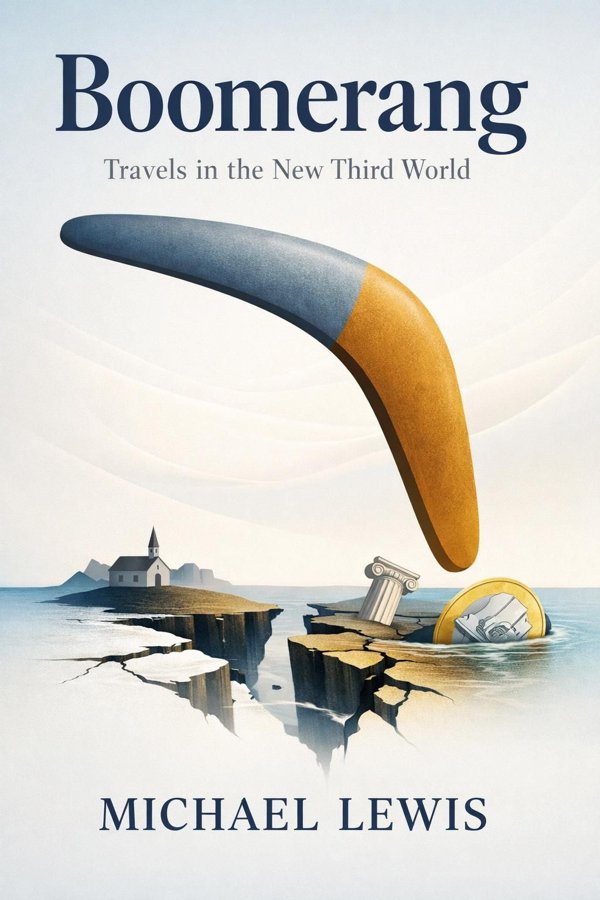
Boomerang: Travels in the New Third World: Summary & Key Insights
 10 min6 chaptersAudio available
What Is Boomerang: Travels in the New Third World About?
Boomerang: Travels in the New Third World by Michael Lewis is a economics book spanning 6 pages. In this nonfiction work, Michael Lewis explores the aftermath of the 2008 global financial crisis by traveling to countries that were most affected by the economic collapse, including Iceland, Greece, Ireland, Germany, and the United States. Through vivid storytelling and sharp analysis, Lewis reveals how national character, greed, and financial mismanagement combined to create a worldwide economic disaster.
This FizzRead summary covers all 6 key chapters of Boomerang: Travels in the New Third World in approximately 10 minutes, distilling the most important ideas, arguments, and takeaways from Michael Lewis's work. Also available as an audio summary and Key Quotes Podcast.
Boomerang: Travels in the New Third World
In this nonfiction work, Michael Lewis explores the aftermath of the 2008 global financial crisis by traveling to countries that were most affected by the economic collapse, including Iceland, Greece, Ireland, Germany, and the United States. Through vivid storytelling and sharp analysis, Lewis reveals how national character, greed, and financial mismanagement combined to create a worldwide economic disaster.
Who Should Read Boomerang: Travels in the New Third World?
This book is perfect for anyone interested in economics and looking to gain actionable insights in a short read. Whether you're a student, professional, or lifelong learner, the key ideas from Boomerang: Travels in the New Third World by Michael Lewis will help you think differently.
- ✓Readers who enjoy economics and want practical takeaways
- ✓Professionals looking to apply new ideas to their work and life
- ✓Anyone who wants the core insights of Boomerang: Travels in the New Third World in just 10 minutes
Want the full summary?
Get instant access to this book summary and 100K+ more with Fizz Moment.
Get Free SummaryAvailable on App Store • Free to download
Key Chapters
When I first landed in Iceland, it felt as if I had discovered a country that had woken up inside a dream of wealth. Here was a fishing nation that had, almost overnight, reinvented itself as a financial hub. The transformation was breathtaking and absurd in equal measure. Icelandic fishermen, who just a few years earlier had measured success in tons of cod, now bragged about trading foreign currencies and running global investment portfolios.
This shift was more than economic—it was psychological. For centuries, Icelanders had survived by cooperation and humility in the face of their brutal natural environment. Suddenly, they had become masters of leverage, borrowing billions to bet on assets they could barely explain. The Icelandic banks expanded to ten times the country’s GDP. The entire nation caught a fever for global finance, and why not? The returns were staggering—on paper. The world was lending Iceland money because it seemed, in the manic glow of pre-2008 optimism, like everyone was trustworthy and wise. But most Icelanders didn’t understand how their newfound fortune actually worked; they trusted the illusion of perpetual motion.
When reality struck, it was merciless. The banks collapsed under the weight of their own fantasies, turning Reykjavik’s streets into metaphors for hubris. But the tragedy had cultural roots. Iceland’s tight-knit society, its trust in its own people, became its downfall. No one stopped to ask whether those running the banks were truly equipped to handle global risk. They were friends, classmates, fishermen turned financiers. The collapse was not just financial but moral—a collective failure to imagine that greed could reside within their own reflection.
Traveling to Greece felt like stepping into the opposite of Iceland. Where Iceland’s crisis was born from too much faith in itself, Greece’s was rooted in a national habit of evading accountability. The numbers simply didn’t add up—deficits were hidden, tax collection was a fiction, and bureaucracy had become an art form of inertia. But beneath the statistics lay a profound cultural story.
In conversations with monks from Mount Athos, government officials, and ordinary citizens, I encountered a country where the concept of money had become detached from responsibility. Years of political patronage, underreporting, and public sector excess had built a machine that could only run on borrowed funds. Yet when the reckoning came, many Greeks framed themselves as victims of external forces—of Brussels, of the markets, of Germany—anyone but themselves.
But Greece’s crisis wasn’t only about economics; it was also about trust. Citizens didn’t trust the state, the state didn’t trust citizens, and together they had built an economy on mutual deception. It’s a haunting lesson in how collective denial becomes a national narrative, until one day the bills demand to be paid. Watching Greece burn in protest, I realized that its tragedy was less about fiscal insolvency than about moral exhaustion. The real debt was not only in euros—it was in truth deferred.
+ 4 more chapters — available in the FizzRead app
All Chapters in Boomerang: Travels in the New Third World
About the Author
Michael Lewis is an American author and financial journalist known for his insightful and accessible writing on economics, finance, and human behavior. His notable works include 'Liar’s Poker', 'The Big Short', and 'Moneyball'.
Get This Summary in Your Preferred Format
Read or listen to the Boomerang: Travels in the New Third World summary by Michael Lewis anytime, anywhere. FizzRead offers multiple formats so you can learn on your terms — all free.
Available formats: App · Audio · PDF · EPUB — All included free with FizzRead
Download Boomerang: Travels in the New Third World PDF and EPUB Summary
Key Quotes from Boomerang: Travels in the New Third World
“When I first landed in Iceland, it felt as if I had discovered a country that had woken up inside a dream of wealth.”
“Traveling to Greece felt like stepping into the opposite of Iceland.”
Frequently Asked Questions about Boomerang: Travels in the New Third World
Boomerang: Travels in the New Third World by Michael Lewis is a economics book that explores key ideas across 6 chapters. In this nonfiction work, Michael Lewis explores the aftermath of the 2008 global financial crisis by traveling to countries that were most affected by the economic collapse, including Iceland, Greece, Ireland, Germany, and the United States. Through vivid storytelling and sharp analysis, Lewis reveals how national character, greed, and financial mismanagement combined to create a worldwide economic disaster.
More by Michael Lewis



You Might Also Like
Business Adventures
John Brooks
10 min
Nudge
Richard H. Thaler, Cass R. Sunstein
10 min
The Hitchhiker"s Guide to the Galaxy
Douglas Adams
10 minThe Muqaddimah
Ibn Khaldun
10 minThe Outsiders
William N. Thorndike
10 min
A Little History of Economics
Niall Kishtainy
10 minBrowse by Category
Ready to read Boomerang: Travels in the New Third World?
Get the full summary and 100K+ more books with Fizz Moment.