
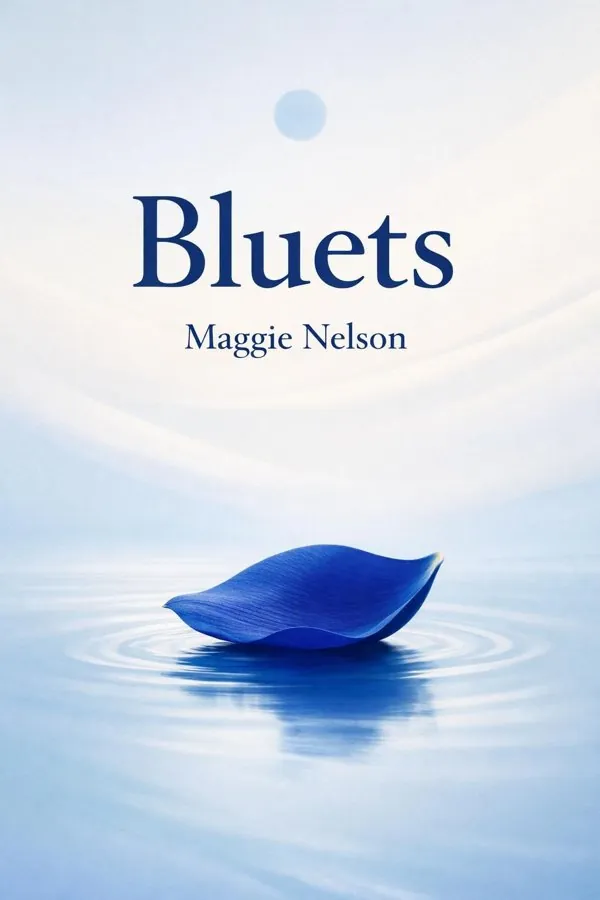
Bluets: Summary & Key Insights
 10 min9 chaptersAudio available
Key Takeaways from Bluets
Sometimes a fixation is not a distraction from life but a way into its deepest questions.
Desire often survives the collapse of the story that was supposed to contain it.
The hardest experiences are not always those that hurt most, but those that resist being said.
Healing rarely arrives as a dramatic breakthrough; more often, it emerges as a quieter willingness to keep living alongside what cannot be undone.
A fragmented structure can be more truthful than a seamless narrative.
What Is Bluets About?
Bluets by Maggie Nelson is a writing book spanning 4 pages. What if a color could become a philosophy, a wound, a companion, and a method of thinking? In Bluets, Maggie Nelson turns her fascination with the color blue into something far greater than an aesthetic meditation. Through 240 numbered fragments, she explores heartbreak, erotic longing, depression, injury, memory, art, and the struggle to make language equal to experience. The result is a work that feels at once like memoir, prose poem, critical essay, and spiritual inquiry. Rather than offering a linear story, Nelson builds a mosaic in which blue becomes the thread connecting private pain to wider questions about beauty, attachment, and survival. The book matters because it shows how writing can hold contradictions without resolving them too quickly. Nelson does not flatten grief into a lesson or transform desire into a neat moral. Instead, she lingers in complexity, allowing thought and feeling to sharpen each other. As a poet, critic, and boundary-crossing nonfiction writer, Nelson brings unusual authority to this project: she is deeply literate in philosophy and art, yet intensely personal on the page. Bluets is a small book with immense emotional and intellectual force, especially for readers interested in writing, perception, and the uses of obsession.
This FizzRead summary covers all 9 key chapters of Bluets in approximately 10 minutes, distilling the most important ideas, arguments, and takeaways from Maggie Nelson's work. Also available as an audio summary and Key Quotes Podcast.
Bluets
What if a color could become a philosophy, a wound, a companion, and a method of thinking? In Bluets, Maggie Nelson turns her fascination with the color blue into something far greater than an aesthetic meditation. Through 240 numbered fragments, she explores heartbreak, erotic longing, depression, injury, memory, art, and the struggle to make language equal to experience. The result is a work that feels at once like memoir, prose poem, critical essay, and spiritual inquiry. Rather than offering a linear story, Nelson builds a mosaic in which blue becomes the thread connecting private pain to wider questions about beauty, attachment, and survival.
The book matters because it shows how writing can hold contradictions without resolving them too quickly. Nelson does not flatten grief into a lesson or transform desire into a neat moral. Instead, she lingers in complexity, allowing thought and feeling to sharpen each other. As a poet, critic, and boundary-crossing nonfiction writer, Nelson brings unusual authority to this project: she is deeply literate in philosophy and art, yet intensely personal on the page. Bluets is a small book with immense emotional and intellectual force, especially for readers interested in writing, perception, and the uses of obsession.
Who Should Read Bluets?
This book is perfect for anyone interested in writing and looking to gain actionable insights in a short read. Whether you're a student, professional, or lifelong learner, the key ideas from Bluets by Maggie Nelson will help you think differently.
- ✓Readers who enjoy writing and want practical takeaways
- ✓Professionals looking to apply new ideas to their work and life
- ✓Anyone who wants the core insights of Bluets in just 10 minutes
Want the full summary?
Get instant access to this book summary and 100K+ more with Fizz Moment.
Get Free SummaryAvailable on App Store • Free to download
Key Chapters
Sometimes a fixation is not a distraction from life but a way into its deepest questions. In Bluets, the color blue arrives first as an attraction almost too simple to justify: Maggie Nelson loves it, collects it, notices it everywhere, and feels summoned by it. Yet this preference quickly becomes more than taste. Blue turns into an emotional weather system, a philosophical object, and a structure for thought. It is cool and distant, erotic and mournful, celestial and bruised. Nelson does not treat blue as a symbol with one stable meaning; she lets it remain multiple, and that multiplicity is the point.
By tracking what blue means across art, music, history, and personal memory, she demonstrates how attention transforms perception. A color that might seem merely decorative becomes a site where desire, loneliness, beauty, and intellect intersect. The book suggests that our obsessions often reveal how we organize the world. One person may be drawn to order, another to speed, another to silence. Nelson is drawn to blue because it offers a language for states that resist direct naming.
This has practical implications beyond literature. Writers can use recurring images to discover what they truly care about. Readers can examine their own inexplicable fixations as clues rather than quirks. Even in daily life, paying close attention to what repeatedly moves us can expose hidden structures of feeling.
Actionable takeaway: Identify one image, object, or color that persistently follows you, and write for ten minutes about every feeling and memory attached to it without trying to force a single meaning.
Desire often survives the collapse of the story that was supposed to contain it. One of Bluets' central currents is a love affair that has unraveled, leaving behind not closure but residue: longing, humiliation, memory, and the stubborn afterlife of attachment. Nelson shows that the end of a relationship is rarely a clean event. It is a gradual dispersal of intensity into recollection, fantasy, self-scrutiny, and recurring pain. Blue becomes the atmosphere of this dissolution, the hue of what remains vivid even after it is gone.
What makes her treatment of heartbreak so striking is its refusal of sentimental formulas. She does not offer the comforting narrative that loss automatically produces wisdom or self-improvement. Instead, she examines the mind's compulsion to revisit scenes, rehearse meanings, and keep company with absence. Desire, in her account, is both sustaining and destabilizing. It expands perception but also traps us in idealization. The beloved becomes less a person than a force field through which the self is altered.
This idea applies widely. Anyone who has struggled to detach from a person, role, or future they imagined will recognize the pattern. The book invites readers to ask not only whom they loved, but what version of themselves that love made possible. For writers, it is also a lesson in how to depict intimacy without reducing it to confession.
Actionable takeaway: When reflecting on a broken relationship, separate the person from the meanings you attached to them. Make two lists: what was actually present, and what you projected or hoped for.
The hardest experiences are not always those that hurt most, but those that resist being said. In Bluets, grief and melancholy are not framed as grand tragedies alone; they appear as textures of consciousness, as durations, as states that stain perception. Nelson explores how sorrow can make language feel both necessary and inadequate. We reach for words because suffering demands witness, yet words often arrive too late, too polished, or too abstract to match the rawness of feeling.
Rather than hiding this inadequacy, Nelson makes it part of the book's method. The fragmentary form mirrors emotional interruption: grief comes in flashes, returns unexpectedly, and refuses stable narration. By placing personal pain alongside quotations, anecdotes, and philosophical reflections, she acknowledges that no single voice is sufficient. The self in grief borrows from others, tests phrases, and circles around what cannot be captured directly.
This is useful for anyone who has felt frustrated by the pressure to "express" suffering neatly. Bluets suggests that partial speech is still meaningful. A broken form can be an honest form. In practical terms, writers and journalers need not wait for coherence before beginning. Even fragments, images, and disconnected notes can preserve the truth of an experience better than a forced explanation.
The book also reminds readers that melancholy is not always a problem to be fixed immediately. Sometimes it must be observed, described, and endured. Language may not cure pain, but it can create companionship around it.
Actionable takeaway: If you cannot write a full account of something painful, write it in fragments: one image, one sentence, one memory at a time. Let form follow feeling instead of forcing order too soon.
Healing rarely arrives as a dramatic breakthrough; more often, it emerges as a quieter willingness to keep living alongside what cannot be undone. In the later movements of Bluets, Nelson turns from acute fixation toward a more spacious, though never simplistic, form of acceptance. The book does not end by solving sorrow. Instead, it asks whether one can remain open to beauty, continuity, and relation after loss has rearranged the self.
Blue continues to matter here, but its meaning shifts. It is no longer only the color of desire and melancholy; it also becomes a medium of persistence. The world remains full of blue objects, blue skies, blue artworks, blue songs. Beauty survives private devastation, and this survival is both consoling and unsettling. It suggests that one's suffering is real but not central to the life of the world. That recognition can feel diminishing, yet it also grants release.
Nelson's notion of transcendence is modest. It is not escape from the body, memory, or pain. It is the ability to inhabit continuity without denying fracture. This is relevant in everyday life whenever people expect recovery to mean forgetting. Bluets offers another model: you may carry the mark of an experience and still move forward with greater receptivity.
For writers and artists, this idea is especially important. A work can emerge from suffering without becoming trapped in it. The goal is not to convert pain into a tidy moral but to allow it to alter perception in durable ways.
Actionable takeaway: Ask yourself not "How do I get over this?" but "How do I continue with this honestly?" Write one paragraph describing what remains possible in your life, even with the wound still present.
A fragmented structure can be more truthful than a seamless narrative. Bluets is composed of numbered propositions, observations, memories, and reflections rather than chapters that progress in a straightforward line. This form is not a stylistic gimmick. It reflects how consciousness actually works when preoccupied by longing, art, and pain: one thought triggers another; a quotation interrupts a memory; an image carries more weight than an explanation. Nelson embraces this discontinuity and turns it into a rigorous method.
The effect is twofold. First, the reader experiences thought as movement rather than conclusion. We are invited to participate in making connections. Second, the fragmented form protects complexity. A traditional narrative often pressures experience into causality and resolution. Nelson resists that pressure, allowing contradiction to stand. She can love blue and distrust symbolism, desire transcendence and remain attached to the body, seek language and expose its failure.
This matters for anyone engaged in writing. Many people assume they must fully understand an experience before writing about it. Bluets proves the opposite: form can be a tool for discovery. Notes, numbered entries, and associative leaps can reveal patterns that linear exposition would conceal. The book is especially instructive for essayists, memoirists, and poets who want to think on the page without pretending certainty.
Outside literature, the lesson applies to reflection itself. Our lives are often non-linear, and our attempts to make sense of them may need to be equally flexible. Fragmentation is not always disorder; sometimes it is fidelity.
Actionable takeaway: Try writing a page in numbered fragments about a single subject. Do not force transitions. Let each entry approach the subject from a new angle and notice what coherence emerges naturally.
However lofty our thoughts become, the body eventually recalls us to material limits. In Bluets, Nelson's meditations on love, color, and philosophy are sharpened by bodily vulnerability, including the aftermath of a friend's catastrophic accident and the book's ongoing awareness of physical suffering. This is crucial because it prevents the text from floating into pure aestheticism. Blue may evoke the infinite, but pain insists on gravity, dependence, and the mundane facts of care.
Nelson repeatedly stages an encounter between abstraction and embodiment. Ideas about beauty or transcendence are tested against illness, injury, fatigue, and the practical labor of tending to another person. The result is ethically significant. It reminds readers that any philosophy worth keeping must survive contact with lived vulnerability. Intellectual elegance is not enough if it has no room for damaged bodies, interrupted plans, and asymmetrical forms of caregiving.
This tension has broad application. Many people use ideas to distance themselves from pain, whether by overanalyzing relationships, aestheticizing sadness, or treating hardship as a lesson before it has been lived through. Bluets does not reject thought; it asks thought to become more accountable. The body is not an obstacle to meaning but one of its deepest sources.
For writers, this means grounding reflection in sensory and physical reality. For readers, it means honoring bodily experience as knowledge. If you are exhausted, grieving, injured, or caring for someone else, your understanding of the world has changed in ways theory alone cannot capture.
Actionable takeaway: The next time you reflect on a difficult experience, include the body's perspective. Describe what happened physically: posture, fatigue, breath, pain, touch, or routine. Let those details complicate your interpretation.
One of Bluets' most unsettling insights is that beauty can intensify pain as easily as relieve it. Blue is gorgeous, seductive, and sublime, yet it is also the shade through which Nelson encounters melancholy and absence. The book refuses the comforting assumption that beauty naturally heals. Sometimes beauty wounds by sharpening awareness of what is lost. A song can reopen grief. A beautiful object can expose loneliness. A clear sky can make one's inner darkness feel even more stark.
Yet Nelson does not conclude that beauty is deceptive or cruel. Instead, she presents it as morally neutral but existentially powerful. Beauty heightens experience. It can console by offering form, radiance, and continuity; it can also hurt by reminding us that the world remains lovely without regard for our suffering. This double edge is central to the book's emotional intelligence.
In ordinary life, people often seek beauty as escape: redecorating after heartbreak, walking in nature, listening to music during grief. Bluets suggests we can approach these acts more honestly. Beauty may not make us feel better in a simple way, but it can help us feel more fully, and that fullness has value. It enlarges our capacity to remain present.
For creative work, the lesson is equally important. Writing beautifully about pain should not sanitize it. The most enduring art preserves tension between allure and ache.
Actionable takeaway: When something beautiful affects you deeply, ask two questions: What pleasure does this give me, and what sorrow does it awaken? Hold both answers together instead of choosing only one.
To attend closely to life is both a gift and a burden. Bluets shows writing not merely as self-expression but as a means of surviving intense perception. Nelson notices too much: shades of blue, tonal shifts in memory, the afterimages of desire, the inadequacy of available language. Writing becomes the apparatus through which she can bear this surplus of feeling and thought. It does not solve obsession, but it organizes it enough to make continued life possible.
This is why the book matters so much to writers. Nelson demonstrates that craft is not separate from emotional necessity. The precision of her fragments, the elegance of her references, and the restraint of her confessional voice all arise from the need to shape experience without betraying its disorder. Writing here is neither therapy alone nor intellectual performance alone. It is a discipline of attention.
Readers can apply this idea even if they are not authors. Journaling, note-taking, and descriptive observation can help metabolize experiences that otherwise remain overwhelming. The key is not to demand immediate catharsis. Bluets models a slower process in which repetition, revision, and form gradually reveal what one is actually trying to say.
The book also warns that attention has costs. To look closely is to risk disturbance. But avoiding attention has costs too: numbness, vagueness, and the loss of contact with one's own life. Nelson chooses the harder path and makes art from it.
Actionable takeaway: Start an "attention notebook" for one week. Each day, record one image, one feeling, and one sentence you cannot stop thinking about. Review the entries at week's end to see what themes your mind is already writing.
All Chapters in Bluets
About the Author
Maggie Nelson is an acclaimed American writer, poet, and critic celebrated for books that dissolve the boundaries between memoir, theory, cultural criticism, and lyric essay. Born in 1973, she has built a reputation for intellectually adventurous, emotionally precise writing that engages questions of art, sexuality, embodiment, family, and feeling. Her major works include Bluets, The Argonauts, The Red Parts, and Jane: A Murder. Nelson's voice is distinctive for its ability to combine philosophical range with intimate vulnerability, making complex ideas feel urgent and lived rather than abstract. She has also taught writing and critical theory, contributing significantly to contemporary literary nonfiction. Across genres, her work challenges conventional forms while remaining deeply attentive to language, ethics, and the textures of experience.
Get This Summary in Your Preferred Format
Read or listen to the Bluets summary by Maggie Nelson anytime, anywhere. FizzRead offers multiple formats so you can learn on your terms — all free.
Available formats: App · Audio · PDF · EPUB — All included free with FizzRead
Download Bluets PDF and EPUB Summary
Key Quotes from Bluets
“Sometimes a fixation is not a distraction from life but a way into its deepest questions.”
“Desire often survives the collapse of the story that was supposed to contain it.”
“The hardest experiences are not always those that hurt most, but those that resist being said.”
“Healing rarely arrives as a dramatic breakthrough; more often, it emerges as a quieter willingness to keep living alongside what cannot be undone.”
“A fragmented structure can be more truthful than a seamless narrative.”
Frequently Asked Questions about Bluets
Bluets by Maggie Nelson is a writing book that explores key ideas across 9 chapters. What if a color could become a philosophy, a wound, a companion, and a method of thinking? In Bluets, Maggie Nelson turns her fascination with the color blue into something far greater than an aesthetic meditation. Through 240 numbered fragments, she explores heartbreak, erotic longing, depression, injury, memory, art, and the struggle to make language equal to experience. The result is a work that feels at once like memoir, prose poem, critical essay, and spiritual inquiry. Rather than offering a linear story, Nelson builds a mosaic in which blue becomes the thread connecting private pain to wider questions about beauty, attachment, and survival. The book matters because it shows how writing can hold contradictions without resolving them too quickly. Nelson does not flatten grief into a lesson or transform desire into a neat moral. Instead, she lingers in complexity, allowing thought and feeling to sharpen each other. As a poet, critic, and boundary-crossing nonfiction writer, Nelson brings unusual authority to this project: she is deeply literate in philosophy and art, yet intensely personal on the page. Bluets is a small book with immense emotional and intellectual force, especially for readers interested in writing, perception, and the uses of obsession.
More by Maggie Nelson
You Might Also Like
The Art of Perspective
Christopher Castellani
10 min
Making a Point: The Persnickety Story of English Punctuation
David Crystal
10 min
The Elements Of Eloquence: How To Turn The Perfect English Phrase
Mark Forsyth
10 min
The Pocket Muse: Ideas and Inspirations for Writing
Monica Wood
10 min
A Little Book on Form: An Exploration into the Formal Imagination of Poetry
Robert Hass
10 min
Adventures In The Screen Trade: A Personal View Of Hollywood And Screenwriting
William Goldman
10 minBrowse by Category
Ready to read Bluets?
Get the full summary and 100K+ more books with Fizz Moment.