
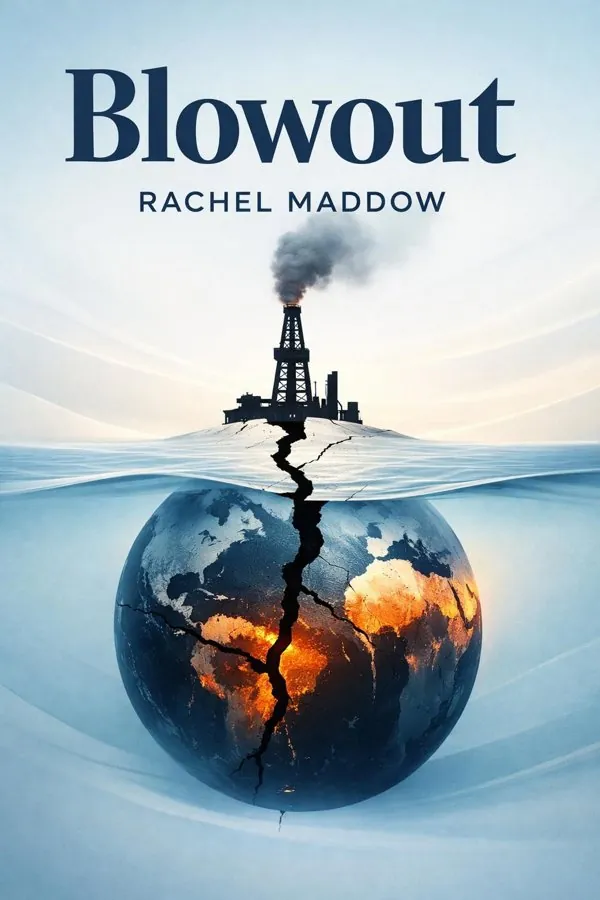
Blowout: Corrupted Democracy, Rogue State Russia, and the Richest, Most Destructive Industry on Earth: Summary & Key Insights
 10 min9 chaptersAudio available
Key Takeaways from Blowout: Corrupted Democracy, Rogue State Russia, and the Richest, Most Destructive Industry on Earth
The history of oil is really a history of who gets to rule.
A company does not need a flag to behave like a state.
A petro-state does not just export fuel; it can export dependence.
An energy boom can feel like a miracle right up until the bill arrives.
Easy money often weakens hard-earned accountability.
What Is Blowout: Corrupted Democracy, Rogue State Russia, and the Richest, Most Destructive Industry on Earth About?
Blowout: Corrupted Democracy, Rogue State Russia, and the Richest, Most Destructive Industry on Earth by Rachel Maddow is a politics book spanning 6 pages. In Blowout, Rachel Maddow argues that oil and gas are not just commodities; they are political weapons that have warped governments, enriched oligarchs, and destabilized democracies across the world. Moving from the early history of petroleum to the rise of Vladimir Putin’s Russia and the shale boom in the United States, she shows how fossil fuel wealth often creates corruption instead of prosperity. Countries rich in oil frequently become less accountable, less democratic, and more vulnerable to secrecy, violence, and elite capture. Maddow’s central insight is unsettling but clear: the modern energy system has rewarded bad governance on a global scale. What makes this book especially powerful is its blend of investigative reporting, geopolitical analysis, and dark humor. Maddow connects seemingly separate stories—Russian aggression, pipeline diplomacy, corporate lobbying, environmental disasters, and local corruption—into one coherent pattern. As a longtime political journalist with a doctorate in politics from Oxford, she brings both research depth and storytelling skill. Blowout matters because it helps readers see how energy dependence shapes elections, foreign policy, public institutions, and everyday life—and why moving beyond fossil fuels is not only an environmental necessity, but a democratic one.
This FizzRead summary covers all 9 key chapters of Blowout: Corrupted Democracy, Rogue State Russia, and the Richest, Most Destructive Industry on Earth in approximately 10 minutes, distilling the most important ideas, arguments, and takeaways from Rachel Maddow's work. Also available as an audio summary and Key Quotes Podcast.
Blowout: Corrupted Democracy, Rogue State Russia, and the Richest, Most Destructive Industry on Earth
In Blowout, Rachel Maddow argues that oil and gas are not just commodities; they are political weapons that have warped governments, enriched oligarchs, and destabilized democracies across the world. Moving from the early history of petroleum to the rise of Vladimir Putin’s Russia and the shale boom in the United States, she shows how fossil fuel wealth often creates corruption instead of prosperity. Countries rich in oil frequently become less accountable, less democratic, and more vulnerable to secrecy, violence, and elite capture. Maddow’s central insight is unsettling but clear: the modern energy system has rewarded bad governance on a global scale.
What makes this book especially powerful is its blend of investigative reporting, geopolitical analysis, and dark humor. Maddow connects seemingly separate stories—Russian aggression, pipeline diplomacy, corporate lobbying, environmental disasters, and local corruption—into one coherent pattern. As a longtime political journalist with a doctorate in politics from Oxford, she brings both research depth and storytelling skill. Blowout matters because it helps readers see how energy dependence shapes elections, foreign policy, public institutions, and everyday life—and why moving beyond fossil fuels is not only an environmental necessity, but a democratic one.
Who Should Read Blowout: Corrupted Democracy, Rogue State Russia, and the Richest, Most Destructive Industry on Earth?
This book is perfect for anyone interested in politics and looking to gain actionable insights in a short read. Whether you're a student, professional, or lifelong learner, the key ideas from Blowout: Corrupted Democracy, Rogue State Russia, and the Richest, Most Destructive Industry on Earth by Rachel Maddow will help you think differently.
- ✓Readers who enjoy politics and want practical takeaways
- ✓Professionals looking to apply new ideas to their work and life
- ✓Anyone who wants the core insights of Blowout: Corrupted Democracy, Rogue State Russia, and the Richest, Most Destructive Industry on Earth in just 10 minutes
Want the full summary?
Get instant access to this book summary and 100K+ more with Fizz Moment.
Get Free SummaryAvailable on App Store • Free to download
Key Chapters
The history of oil is really a history of who gets to rule. Long before modern climate debates, petroleum transformed the balance of power between nations, corporations, and political elites. Maddow shows that oil was never simply a useful fuel for factories, cars, or armies. It quickly became a strategic asset that could decide wars, redraw alliances, and concentrate enormous wealth in the hands of those who controlled extraction and distribution.
This matters because oil riches rarely behave like ordinary economic growth. In many places, fossil fuel wealth allowed leaders to avoid building healthy civic institutions. Instead of relying on citizens through taxation and representation, governments could rely on resource revenues. That weakened accountability. If a state does not need broad public consent to raise money, it has less incentive to govern transparently. This pattern helps explain why so many petro-states drift toward authoritarianism, corruption, and repression.
Maddow also traces how powerful countries and companies learned to treat oil supplies as instruments of national strategy. Control over reserves and transport routes became as important as military strength. The scramble for influence around pipelines, ports, and drilling rights is therefore not a side story in global politics; it is often the main story.
You can apply this insight by reading energy headlines as political headlines. When you see disputes over pipelines, refinery access, sanctions, or drilling leases, ask who gains leverage, who loses independence, and what institutions may be distorted. The practical takeaway is simple: to understand modern power, follow the fuel as carefully as you follow the money.
A company does not need a flag to behave like a state. One of Maddow’s most striking arguments is that large oil and gas firms acquired influence so vast that they often operated like geopolitical actors. Their budgets rivaled those of nations, their legal teams outmatched regulators, and their lobbying power shaped laws that were supposed to constrain them. In this world, energy corporations did not merely participate in politics; they frequently rewrote the rules of politics.
Maddow explains how this happened through a mix of deregulation, campaign spending, opaque financing, and regulatory capture. Once energy companies embedded themselves deeply enough in the political system, officials often began treating industry priorities as if they were the same as the national interest. Tax breaks, weak oversight, and permissive environmental standards were justified as necessary for growth, jobs, or energy security. But the gains were often privatized while the risks were socialized through pollution, corruption, and public cleanup costs.
Practical examples are everywhere. When a community faces a major drilling project, the debate is rarely a neutral comparison of costs and benefits. Industry groups may fund studies, pressure local officials, shape media narratives, and threaten economic consequences if permits are denied. At the national level, corporate influence can affect foreign policy, sanctions design, and infrastructure planning.
The key lesson is not that all energy companies are identical, but that concentrated wealth in a politically essential industry creates structural dangers. Citizens, journalists, and policymakers must pay close attention to who writes energy policy and who profits from it. The actionable takeaway: support transparency rules, anti-corruption enforcement, and independent oversight so that public institutions serve voters rather than extractive interests.
A petro-state does not just export fuel; it can export dependence. Maddow presents Vladimir Putin’s Russia as one of the clearest modern examples of how oil and gas revenues can sustain authoritarian rule while extending influence abroad. Rather than building a diversified economy and accountable institutions, the Kremlin used resource wealth to enrich loyalists, discipline rivals, and project power beyond its borders.
The mechanism is straightforward but potent. Countries that rely heavily on Russian gas become vulnerable to pressure. Supply cuts, pricing disputes, pipeline routes, and long-term contracts can all serve political goals. Energy dependence creates hesitation. Governments may soften criticism, delay sanctions, or overlook aggression if they fear disruptions to heat, electricity, or industrial output. In that sense, the pipeline becomes a diplomatic instrument.
Maddow links this dynamic to a broader pattern of corruption. Resource wealth can nurture oligarch networks, offshore money flows, and patronage systems that blur the line between state policy and personal enrichment. Russia’s energy system is not just an economic base; it is part of the architecture of regime survival. That is why Western energy ties with Russia often had consequences far beyond commerce.
For readers, the practical application is to evaluate energy security as a democratic issue, not only an engineering problem. Diversified supply, strategic reserves, interconnection, and investment in renewables are forms of political resilience. When a country reduces dependence on an authoritarian supplier, it gains freedom to act on its values. The actionable takeaway: support energy strategies that reduce geopolitical vulnerability, because democracy is stronger when hostile states cannot turn the thermostat into leverage.
Easy money often weakens hard-earned accountability. One of Maddow’s recurring themes is the “resource curse,” the paradox in which countries rich in oil and gas often end up with weaker institutions, more corruption, and less democratic responsiveness. The problem is not the resource itself. The problem is what happens when huge revenues flow into political systems that can be captured by elites.
In a healthy democracy, leaders must negotiate with citizens, justify taxation, and maintain trust. In a petro-state, rulers may bypass that relationship because resource income replaces the need for broad public consent. That can produce patronage networks, bribery, opaque contracts, and state violence used to protect rents. Even in established democracies, concentrated fossil fuel wealth can distort legislatures, regulators, courts, and local governments.
Maddow is especially effective at showing that corruption is not always dramatic. It can appear as revolving doors between industry and government, legal campaign donations that buy access, shell companies masking ownership, or public agencies quietly deferring to private actors. These softer forms of corruption are dangerous precisely because they are normalized.
A practical example is local governance around drilling, pipelines, or export terminals. Citizens may be told decisions are technical and inevitable, even when major conflicts of interest exist. Without transparency, communities cannot know whether choices reflect public need or private influence.
The lesson is that anti-corruption work and climate work are often the same struggle. Strong disclosure laws, public-interest journalism, procurement transparency, and independent watchdogs are essential defenses. The actionable takeaway: whenever large resource revenues are involved, demand visibility into contracts, ownership, lobbying, and political donations. Democracy depends on making hidden influence harder to hide.
Pollution does not stop at harming land, water, or air; it also damages trust in public institutions. Maddow argues that the environmental costs of the fossil fuel industry cannot be separated from its democratic costs. Oil spills, methane leaks, poisoned water, and industrial accidents are not merely technical failures. They often reveal a deeper pattern of weak oversight, captured regulators, and communities forced to bear risks they did not freely choose.
This is a crucial reframing. We often discuss environmental harm as if it were a tradeoff against economic necessity. Maddow shows that in many cases the real tradeoff is between public accountability and private impunity. When corporations can externalize their costs onto residents, ecosystems, and future generations, democratic decision-making has already been compromised. The people profiting from extraction are not the same people paying the price.
The effects are concrete. A town near drilling operations may face contaminated groundwater, increased truck traffic, health concerns, and falling confidence in local officials who appear too close to industry. Disaster response can also expose inequality: affluent actors have lawyers and insurers, while ordinary residents navigate medical costs, legal complexity, and uncertainty.
For readers, the application is to see environmental review, emissions standards, and cleanup liability not as bureaucratic obstacles but as democratic safeguards. Good regulation gives voice to those who would otherwise be ignored. The actionable takeaway: support policies that force polluters to internalize the true costs of extraction, because systems become more honest when profits cannot be separated from responsibility.
Nations do not always act according to their principles; often they act according to their fuel vulnerabilities. Maddow makes a compelling case that dependence on oil and gas can bend foreign policy in subtle and consequential ways. Governments that rely on unstable suppliers or politically sensitive transport routes may hesitate to confront aggression, human rights abuses, or corruption. Energy insecurity narrows the space for moral and strategic independence.
This helps explain why some alliances appear inconsistent or why democracies tolerate behavior abroad that contradicts their stated values. When a country fears price spikes, blackouts, or supply disruptions, its leaders may prioritize short-term stability over long-term principles. Autocratic exporters understand this. They use contracts, infrastructure investments, and strategic scarcity to gain leverage.
The concept also applies domestically. A nation’s external vulnerability can justify rushed approvals for risky projects, inflated subsidies for politically connected firms, or expensive commitments framed as unavoidable in the name of energy security. Citizens are then told there is no alternative, even when alternatives exist but require different investment choices.
A practical way to use this insight is to ask, during international crises, what role energy dependence may be playing behind the scenes. Why is one state reluctant to sanction another? Why is a pipeline project defended so fiercely? Why are some infrastructure decisions called strategic priorities? Often the answer is not ideology alone, but exposure.
The actionable takeaway: support diversified energy systems, grid modernization, efficiency, and renewable expansion. These are not only environmental solutions; they increase a country’s freedom to make foreign policy based on law, security, and democratic values rather than fear of supply disruption.
The most hopeful idea in Blowout is that the fossil fuel order is powerful, but not permanent. Maddow points to technological change—especially advances in renewable energy, storage, electrification, and grid systems—as a real opportunity to weaken the political structure built around oil and gas. This matters because energy transitions are not only about replacing one fuel with another. They can redistribute power more broadly and reduce the strategic advantages that fossil fuel monopolies have enjoyed for decades.
Oil and gas create chokepoints: wells, pipelines, ports, export terminals, and centralized ownership structures. Those chokepoints are politically useful to powerful actors because they can be controlled. By contrast, a cleaner energy system can be more distributed. Rooftop solar, regional grids, battery storage, heat pumps, and electric transport reduce dependence on fuel imports and centralized extraction. That lowers both emissions and vulnerability to coercion.
Maddow does not suggest that technology alone solves corruption. New systems can also be captured if governance remains weak. But she insists that the transition away from fossil fuels creates a rare political opening. The less economies rely on concentrated hydrocarbon wealth, the harder it becomes for petro-states and entrenched interests to dominate public life.
For individuals, practical applications include supporting local clean energy projects, advocating for building efficiency, and paying attention to infrastructure decisions that shape future dependence. For policymakers, it means treating energy innovation as democratic reform. The actionable takeaway: back technologies and policies that reduce centralized fossil dependence, because cleaner energy is also a pathway to more resilient, more accountable politics.
Knowing the system is corrupt is not enough; democratic societies need ways to change it. Maddow’s broader argument is that fossil fuel corruption persists because institutions allow it to persist. That means reform has to be structural, not merely rhetorical. Outrage may expose the problem, but accountability requires rules, enforcement, public pressure, and long-term civic commitment.
The reforms implied throughout Blowout are practical: stronger campaign finance rules, tougher anti-money-laundering enforcement, ownership transparency, independent regulators, robust investigative journalism, environmental liability standards, and serious investment in alternatives to fossil fuel dependence. None of these measures is glamorous on its own. Together, however, they make it harder for oil and gas wealth to dominate politics in the dark.
Maddow also suggests that citizens should reject fatalism. The scale of the fossil fuel system can make individuals feel powerless, yet major shifts often begin with local fights over permits, public records, utility commissions, pension investments, and state-level policy. Democracy is not defended only in presidential elections. It is defended in zoning meetings, procurement rules, disclosure laws, and watchdog institutions that most people rarely notice until they fail.
A practical example is public pension oversight. If public funds invest in opaque or politically risky energy ventures, citizens have a legitimate interest in asking whether financial returns, climate risk, and governance standards align. Similar scrutiny applies to utility rate cases, infrastructure bonds, and public subsidies.
The actionable takeaway: turn concern into participation. Support independent media, vote in local and national elections, follow energy policy decisions, and demand transparency wherever public power intersects with private extraction. Democracy is strongest when citizens treat energy governance as a civic issue, not a niche technical field.
All Chapters in Blowout: Corrupted Democracy, Rogue State Russia, and the Richest, Most Destructive Industry on Earth
About the Author
Rachel Maddow is an American television host, political commentator, and bestselling author known for her rigorous research and accessible political analysis. She rose to national prominence as the host of The Rachel Maddow Show on MSNBC, where she became recognized for connecting complex events into clear, compelling narratives. Maddow studied public policy at Stanford University and later earned a doctorate in politics from the University of Oxford as a Rhodes Scholar. Her work often focuses on democracy, authoritarianism, national security, and the hidden systems of power that shape public life. In her books, including Blowout, she combines investigative reporting, historical context, and sharp wit to examine how political institutions are influenced by money, corruption, and concentrated power.
Get This Summary in Your Preferred Format
Read or listen to the Blowout: Corrupted Democracy, Rogue State Russia, and the Richest, Most Destructive Industry on Earth summary by Rachel Maddow anytime, anywhere. FizzRead offers multiple formats so you can learn on your terms — all free.
Available formats: App · Audio · PDF · EPUB — All included free with FizzRead
Download Blowout: Corrupted Democracy, Rogue State Russia, and the Richest, Most Destructive Industry on Earth PDF and EPUB Summary
Key Quotes from Blowout: Corrupted Democracy, Rogue State Russia, and the Richest, Most Destructive Industry on Earth
“The history of oil is really a history of who gets to rule.”
“A company does not need a flag to behave like a state.”
“A petro-state does not just export fuel; it can export dependence.”
“An energy boom can feel like a miracle right up until the bill arrives.”
“Easy money often weakens hard-earned accountability.”
Frequently Asked Questions about Blowout: Corrupted Democracy, Rogue State Russia, and the Richest, Most Destructive Industry on Earth
Blowout: Corrupted Democracy, Rogue State Russia, and the Richest, Most Destructive Industry on Earth by Rachel Maddow is a politics book that explores key ideas across 9 chapters. In Blowout, Rachel Maddow argues that oil and gas are not just commodities; they are political weapons that have warped governments, enriched oligarchs, and destabilized democracies across the world. Moving from the early history of petroleum to the rise of Vladimir Putin’s Russia and the shale boom in the United States, she shows how fossil fuel wealth often creates corruption instead of prosperity. Countries rich in oil frequently become less accountable, less democratic, and more vulnerable to secrecy, violence, and elite capture. Maddow’s central insight is unsettling but clear: the modern energy system has rewarded bad governance on a global scale. What makes this book especially powerful is its blend of investigative reporting, geopolitical analysis, and dark humor. Maddow connects seemingly separate stories—Russian aggression, pipeline diplomacy, corporate lobbying, environmental disasters, and local corruption—into one coherent pattern. As a longtime political journalist with a doctorate in politics from Oxford, she brings both research depth and storytelling skill. Blowout matters because it helps readers see how energy dependence shapes elections, foreign policy, public institutions, and everyday life—and why moving beyond fossil fuels is not only an environmental necessity, but a democratic one.
More by Rachel Maddow

You Might Also Like
Antifa: The Anti-Fascist Handbook
Mark Bray
10 min
Attack from Within: How Disinformation Is Sabotaging America
Barbara McQuade
10 min
Coercion, Capital, and European States, AD 990–1992
Charles Tilly
10 min
Digital Democracy: Concepts, Methodologies, Tools, and Applications
Various Authors
10 min
Fascism
Stanley G. Payne
10 min
Fire And Fury: Inside The Trump White House
Michael Wolff
10 minBrowse by Category
Ready to read Blowout: Corrupted Democracy, Rogue State Russia, and the Richest, Most Destructive Industry on Earth?
Get the full summary and 100K+ more books with Fizz Moment.