
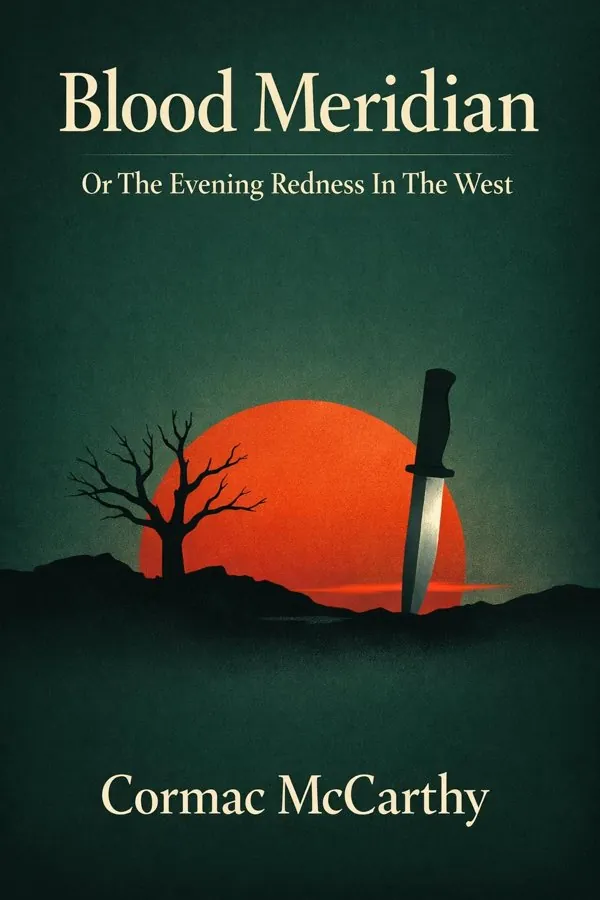
Blood Meridian: Summary & Key Insights
 10 min8 chaptersAudio available
Key Takeaways from Blood Meridian
Some people enter violence by choice; in Blood Meridian, the more disturbing idea is that violence may be waiting for them before they even understand themselves.
The frontier in Blood Meridian is not a place of freedom but a proving ground where moral language loses its force.
Violence becomes most terrifying when it is given a paycheck, a banner, and a justification.
The most frightening villains are not those who love violence blindly, but those who can explain it brilliantly.
One of Blood Meridian’s deepest shocks is that its most beautiful sentences often describe its ugliest acts.
What Is Blood Meridian About?
Blood Meridian by Cormac McCarthy is a fiction book published in 1985 spanning 4 pages. Blood Meridian is Cormac McCarthy’s ferocious, hallucinatory vision of the American frontier, set along the U.S.-Mexico border in the mid-nineteenth century. At its center is the Kid, a teenage runaway who drifts into a world where war, scalp hunting, and random slaughter are not exceptions but the daily logic of survival and profit. He falls in with John Joel Glanton’s gang, a historical band of mercenaries, and comes under the terrifying influence of Judge Holden, one of the most unforgettable figures in modern fiction. More than a western, the novel is a philosophical reckoning with violence: where it comes from, how societies excuse it, and whether any trace of mercy can survive inside it. McCarthy, widely regarded as one of America’s greatest novelists, brings extraordinary authority to this material through biblical cadence, historical detail, and an unblinking moral imagination. Blood Meridian matters because it strips away the frontier myth of noble conquest and reveals a harsher truth: civilization is often built not despite bloodshed, but through it.
This FizzRead summary covers all 8 key chapters of Blood Meridian in approximately 10 minutes, distilling the most important ideas, arguments, and takeaways from Cormac McCarthy's work. Also available as an audio summary and Key Quotes Podcast.
Blood Meridian
Blood Meridian is Cormac McCarthy’s ferocious, hallucinatory vision of the American frontier, set along the U.S.-Mexico border in the mid-nineteenth century. At its center is the Kid, a teenage runaway who drifts into a world where war, scalp hunting, and random slaughter are not exceptions but the daily logic of survival and profit. He falls in with John Joel Glanton’s gang, a historical band of mercenaries, and comes under the terrifying influence of Judge Holden, one of the most unforgettable figures in modern fiction. More than a western, the novel is a philosophical reckoning with violence: where it comes from, how societies excuse it, and whether any trace of mercy can survive inside it. McCarthy, widely regarded as one of America’s greatest novelists, brings extraordinary authority to this material through biblical cadence, historical detail, and an unblinking moral imagination. Blood Meridian matters because it strips away the frontier myth of noble conquest and reveals a harsher truth: civilization is often built not despite bloodshed, but through it.
Who Should Read Blood Meridian?
This book is perfect for anyone interested in fiction and looking to gain actionable insights in a short read. Whether you're a student, professional, or lifelong learner, the key ideas from Blood Meridian by Cormac McCarthy will help you think differently.
- ✓Readers who enjoy fiction and want practical takeaways
- ✓Professionals looking to apply new ideas to their work and life
- ✓Anyone who wants the core insights of Blood Meridian in just 10 minutes
Want the full summary?
Get instant access to this book summary and 100K+ more with Fizz Moment.
Get Free SummaryAvailable on App Store • Free to download
Key Chapters
Some people enter violence by choice; in Blood Meridian, the more disturbing idea is that violence may be waiting for them before they even understand themselves. McCarthy introduces the Kid as a neglected Tennessee boy, born into hardship and already inclined toward aggression. He grows up without guidance, affection, or structure, and the world he inhabits offers little reason to believe in order, justice, or moral restraint. From the beginning, he is less a heroic protagonist than a vessel moving through a brutal landscape that seems prepared to claim him.
The Kid’s early life matters because McCarthy refuses easy explanations. The boy is not made monstrous by one event, nor is he simply innocent. He carries a latent appetite for conflict, but he is also capable of restraint in small, important moments. That tension becomes central to the novel. The Kid represents a human being shaped by violence yet not fully surrendered to it. In that sense, he is not just a character from the frontier; he is McCarthy’s test case for whether moral choice can survive in an amoral world.
In practical terms, this opening invites readers to think about how environments normalize harm. Institutions, families, and social conditions can make cruelty seem natural long before a person consciously endorses it. The Kid’s journey reminds us to look closely at the formative forces that turn survival into hardness and hardness into habit.
Actionable takeaway: pay attention to the conditions that shape character early, because what seems like destiny is often a pattern learned before it is questioned.
The frontier in Blood Meridian is not a place of freedom but a proving ground where moral language loses its force. McCarthy dismantles the familiar American myth of the West as a landscape of opportunity, courage, and self-invention. Instead, the borderlands appear as zones of lawlessness where race, nation, and commerce blur into a continuous struggle for domination. Every group claims righteousness, yet nearly all participate in atrocity.
This matters because the novel is historical without being sentimental. The Kid drifts through settlements, battlefields, deserts, and camps where institutions are weak and violence fills the vacuum. McCarthy shows how quickly ideals collapse when profit, revenge, and fear become the real governing principles. The frontier is not empty land waiting for civilization; it is already crowded with competing powers, all willing to sanctify murder in the name of order.
Readers can apply this insight beyond the novel by recognizing how myths often hide systems of harm. Nations romanticize their origins. Companies glamorize competition. Individuals reframe self-interest as necessity. Blood Meridian asks us to examine the stories we tell about conquest, progress, and exceptionalism. When a culture celebrates expansion without asking who was destroyed to make it possible, it risks turning brutality into heritage.
McCarthy’s West is therefore not only a historical setting but a moral warning. It suggests that when accountability disappears, human beings do not become freer; they become more inventive in cruelty.
Actionable takeaway: question any heroic narrative that erases the suffering required to sustain it, whether in history, politics, or your own personal ambitions.
Violence becomes most terrifying when it is given a paycheck, a banner, and a justification. The Kid eventually joins Glanton’s gang, a mercenary company hired by Mexican authorities to hunt Apache raiders and collect bounties for scalps. What begins as a sanctioned military mission quickly mutates into indiscriminate massacre. The gang kills not only enemies but innocents, then turns murder into an economy. Scalps become currency, and human life becomes an administrative detail.
McCarthy uses the gang to expose how institutions can legitimize barbarity. These men are not random outlaws acting outside society. They are, at least initially, contracted agents serving official interests. That distinction is crucial. Blood Meridian argues that mass violence often grows not from chaos alone, but from systems that reward it. Once payment is attached to blood, atrocity becomes efficient. Once authority blesses cruelty, conscience becomes inconvenient.
The gang also illustrates how group belonging corrodes individual judgment. Men who might hesitate alone become bolder in company. Shared brutality creates its own fellowship. This dynamic appears far beyond warfare: in toxic workplaces, online mobs, political movements, and any environment where collective identity overrides moral reflection. People can commit horrors more easily when they feel absorbed into a cause larger than themselves.
By showing violence as organized labor, McCarthy strips away the illusion that evil is always impulsive or irrational. Sometimes it is methodical, profitable, and publicly endorsed.
Actionable takeaway: whenever harm is being justified as duty, policy, or efficiency, stop and ask who benefits, who is dehumanized, and what moral lines are being quietly erased.
The most frightening villains are not those who love violence blindly, but those who can explain it brilliantly. Judge Holden towers over Blood Meridian as a hairless, immense, educated, and almost supernatural figure who seems to embody intellect without conscience. He sketches artifacts, studies languages, lectures on nature, and commits atrocities with chilling calm. More than a man, he feels like a principle moving through the world.
The Judge’s central belief is that war is the truest human activity. In his view, conflict determines value, establishes hierarchy, and gives reality its shape. Anything that exists outside his control must be cataloged, possessed, or destroyed. His philosophy joins knowledge and domination: to name something is to claim it, and to claim it is to submit it to will. That makes him far more than a sadist. He is a totalizing thinker who sees mercy, innocence, and limits as weaknesses.
This idea has modern relevance because the Judge represents the seduction of power disguised as logic. Many destructive systems present themselves as realism. They say competition is natural, domination is inevitable, and compassion is naive. The Judge pushes that worldview to its extreme conclusion. He is persuasive precisely because he speaks in grand principles rather than crude impulses.
Readers do not need to accept his philosophy to feel its danger. McCarthy forces us to confront how intelligence can serve brutality when detached from humility or ethics.
Actionable takeaway: be wary of any worldview that treats domination as wisdom and reduces human worth to victory, control, or force.
Destructive systems often appear strongest just before they collapse. As Blood Meridian progresses, Glanton’s gang becomes more paranoid, isolated, and predatory. Their campaign of killing invites retaliation from every side, and whatever official legitimacy they once possessed evaporates. The group that moved through the borderlands as an engine of terror gradually turns inward, governed less by mission than by appetite, fear, and momentum.
This phase of the novel shows that violence cannot remain controlled simply because it was once organized. A group built on blood will eventually consume the conditions that made it profitable. Trust disappears, alliances fail, and the world answers back. McCarthy does not present this as poetic justice in any neat sense; many innocents have already paid the price. But he does show that chaos is the natural partner of sustained brutality. Those who live by domination become increasingly vulnerable to the same lawlessness they helped create.
The Judge remains eerily composed amid this unraveling, which deepens his symbolic role. Others are broken by events; he seems almost fed by them. The Kid, however, becomes more morally legible during this collapse because he does not wholly merge with the gang’s logic. His occasional gestures of restraint matter precisely because they occur inside a world that rewards none.
The gang’s destruction also has practical resonance. Organizations that normalize abuse, corruption, or intimidation often look formidable from the outside while hollowing out internally. Their crisis is not accidental; it is the long-term result of their operating model.
Actionable takeaway: if a group depends on cruelty to function, do not confuse its short-term power with stability; collapse is often built into its foundations.
In a novel famous for its darkness, the most meaningful acts are often the smallest refusals. The Kid does not become virtuous in any conventional sense, but he occasionally resists the absolute logic of violence represented by the Judge. He shows flashes of pity, withholds total surrender, and remains imperfectly human in ways the book treats as significant. McCarthy suggests that goodness in a brutal world may not look triumphant or pure. It may survive only as hesitation.
This is one of the novel’s most important moral insights. Blood Meridian does not offer redemption through heroic transformation. Instead, it asks whether minimal compassion still matters when history seems driven by slaughter. McCarthy’s answer appears to be yes, though not sentimentally. Mercy does not stop the machinery of violence. It does not rewrite the past. But it marks a boundary the soul has not fully abandoned.
That idea is practical and demanding. In systems that reward hardness, people often dismiss small ethical choices as meaningless. Yet everyday decency—refusing humiliation, resisting cruelty, helping the vulnerable, declining to join collective contempt—may be exactly where moral life begins. The novel reminds us that the absence of grand solutions does not excuse personal surrender.
The Kid’s partial resistance also makes the ending more haunting. He is not judged against sainthood but against whether he could be entirely claimed by the world he crossed.
Actionable takeaway: do not underestimate restrained, ordinary acts of mercy; when cruelty is normal, even limited compassion becomes a form of resistance.
Some novels resolve conflict; Blood Meridian leaves readers in the presence of something unresolved and enduring. In the final movement, the Kid has become the man, older but not cleansed by time. His past has not disappeared, and neither has the Judge, who returns as both memory and menace. Their confrontation is among the most debated endings in American fiction because McCarthy refuses clear closure while making the moral stakes unmistakable.
The ending matters because it rejects the idea that experience naturally produces wisdom or peace. Survival is not redemption. Time does not cancel complicity. The Judge’s final presence suggests that violence is not merely episodic or historical; it is a recurring possibility lodged within culture and within the self. That is why the novel continues to feel contemporary. It does not trap evil in the nineteenth century. It presents it as adaptive, theatrical, and always ready to return.
For readers, the ambiguity is productive rather than frustrating. It forces reflection instead of supplying comfort. Did the man ever truly escape the Judge’s worldview? Can anyone who has lived inside systematic violence step wholly outside it? McCarthy leaves these questions open because simple answers would weaken the novel’s challenge.
In life, people often seek neat endings to morally complex experiences: a confession, an apology, a lesson learned. Blood Meridian warns that some realities do not resolve so cleanly. They must be remembered, examined, and guarded against.
Actionable takeaway: when confronting violence, whether historical or personal, resist the urge for easy closure; vigilance begins where false resolution ends.
All Chapters in Blood Meridian
About the Author
Cormac McCarthy (1933–2023) was one of the most acclaimed American novelists of the modern era. Known for his austere punctuation, biblical rhythms, and haunting moral seriousness, he wrote fiction that explored violence, fate, survival, and the fragile boundaries of civilization. His major works include Blood Meridian, Suttree, All the Pretty Horses, No Country for Old Men, and The Road, the last of which won the Pulitzer Prize. McCarthy’s novels often center on drifters, outcasts, and men confronting vast, indifferent landscapes, both physical and spiritual. Though famously private, he earned a towering literary reputation for prose that could be both brutally spare and lyrically sublime. Blood Meridian is often considered his masterpiece and a defining achievement in American literature.
Get This Summary in Your Preferred Format
Read or listen to the Blood Meridian summary by Cormac McCarthy anytime, anywhere. FizzRead offers multiple formats so you can learn on your terms — all free.
Available formats: App · Audio · PDF · EPUB — All included free with FizzRead
Download Blood Meridian PDF and EPUB Summary
Key Quotes from Blood Meridian
“Some people enter violence by choice; in Blood Meridian, the more disturbing idea is that violence may be waiting for them before they even understand themselves.”
“The frontier in Blood Meridian is not a place of freedom but a proving ground where moral language loses its force.”
“Violence becomes most terrifying when it is given a paycheck, a banner, and a justification.”
“The most frightening villains are not those who love violence blindly, but those who can explain it brilliantly.”
“One of Blood Meridian’s deepest shocks is that its most beautiful sentences often describe its ugliest acts.”
Frequently Asked Questions about Blood Meridian
Blood Meridian by Cormac McCarthy is a fiction book that explores key ideas across 8 chapters. Blood Meridian is Cormac McCarthy’s ferocious, hallucinatory vision of the American frontier, set along the U.S.-Mexico border in the mid-nineteenth century. At its center is the Kid, a teenage runaway who drifts into a world where war, scalp hunting, and random slaughter are not exceptions but the daily logic of survival and profit. He falls in with John Joel Glanton’s gang, a historical band of mercenaries, and comes under the terrifying influence of Judge Holden, one of the most unforgettable figures in modern fiction. More than a western, the novel is a philosophical reckoning with violence: where it comes from, how societies excuse it, and whether any trace of mercy can survive inside it. McCarthy, widely regarded as one of America’s greatest novelists, brings extraordinary authority to this material through biblical cadence, historical detail, and an unblinking moral imagination. Blood Meridian matters because it strips away the frontier myth of noble conquest and reveals a harsher truth: civilization is often built not despite bloodshed, but through it.
More by Cormac McCarthy
You Might Also Like


Featured In
Browse by Category
Ready to read Blood Meridian?
Get the full summary and 100K+ more books with Fizz Moment.