
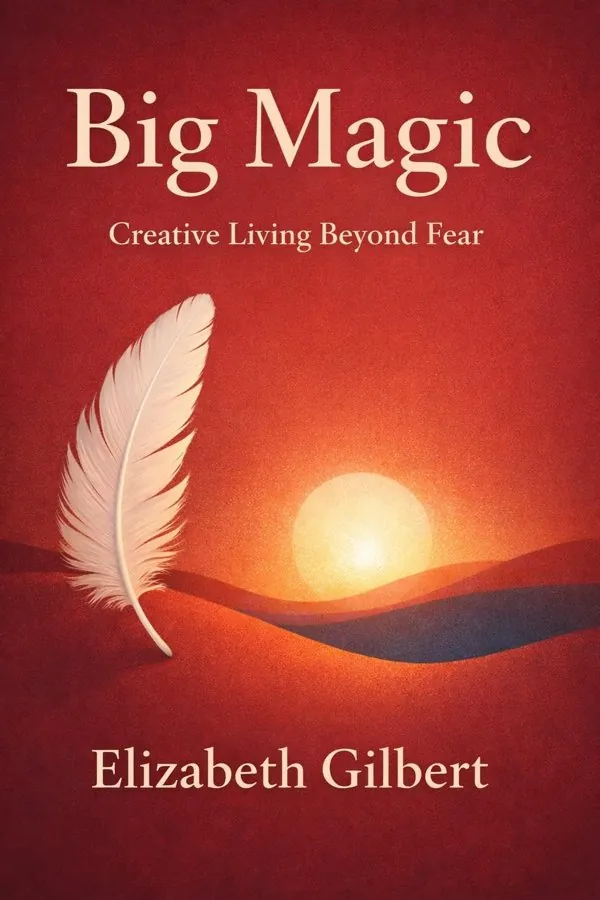
Big Magic: Creative Living Beyond Fear: Summary & Key Insights
 10 min9 chaptersAudio available
Key Takeaways from Big Magic: Creative Living Beyond Fear
The biggest myth about creativity is that brave people create and fearful people do not.
Gilbert treats inspiration as something almost alive—restless, searching, and drawn toward people who will welcome it.
Many creative lives stall because people wait for certification that never arrives.
A creative life is not built from rare bursts of intensity.
Gilbert encourages readers to loosen their grip on overplanning and perfectionism.
What Is Big Magic: Creative Living Beyond Fear About?
Big Magic: Creative Living Beyond Fear by Elizabeth Gilbert is a creativity book spanning 9 pages. Big Magic: Creative Living Beyond Fear is Elizabeth Gilbert’s spirited invitation to stop waiting for permission and start participating in the creative life you already sense calling to you. Rather than treating creativity as a rare gift reserved for artists, Gilbert argues that it is a natural human force available to anyone willing to approach life with curiosity, courage, and playfulness. The book explores how fear disrupts expression, how inspiration arrives, why discipline matters, and how we can keep creating without becoming crushed by perfectionism, failure, or the need for approval. What makes this book matter is its liberating tone: Gilbert does not promise genius, fame, or mastery. She offers something more useful—a practical and humane philosophy for making things, trying things, and living more vividly. Gilbert writes with unusual authority because she speaks both as a bestselling author and as someone who has wrestled publicly with success, doubt, expectation, and reinvention. Through essays, stories, and sharp observations, she reframes creativity not as a tortured struggle, but as a joyful, resilient, deeply personal practice.
This FizzRead summary covers all 9 key chapters of Big Magic: Creative Living Beyond Fear in approximately 10 minutes, distilling the most important ideas, arguments, and takeaways from Elizabeth Gilbert's work. Also available as an audio summary and Key Quotes Podcast.
Big Magic: Creative Living Beyond Fear
Big Magic: Creative Living Beyond Fear is Elizabeth Gilbert’s spirited invitation to stop waiting for permission and start participating in the creative life you already sense calling to you. Rather than treating creativity as a rare gift reserved for artists, Gilbert argues that it is a natural human force available to anyone willing to approach life with curiosity, courage, and playfulness. The book explores how fear disrupts expression, how inspiration arrives, why discipline matters, and how we can keep creating without becoming crushed by perfectionism, failure, or the need for approval. What makes this book matter is its liberating tone: Gilbert does not promise genius, fame, or mastery. She offers something more useful—a practical and humane philosophy for making things, trying things, and living more vividly. Gilbert writes with unusual authority because she speaks both as a bestselling author and as someone who has wrestled publicly with success, doubt, expectation, and reinvention. Through essays, stories, and sharp observations, she reframes creativity not as a tortured struggle, but as a joyful, resilient, deeply personal practice.
Who Should Read Big Magic: Creative Living Beyond Fear?
This book is perfect for anyone interested in creativity and looking to gain actionable insights in a short read. Whether you're a student, professional, or lifelong learner, the key ideas from Big Magic: Creative Living Beyond Fear by Elizabeth Gilbert will help you think differently.
- ✓Readers who enjoy creativity and want practical takeaways
- ✓Professionals looking to apply new ideas to their work and life
- ✓Anyone who wants the core insights of Big Magic: Creative Living Beyond Fear in just 10 minutes
Want the full summary?
Get instant access to this book summary and 100K+ more with Fizz Moment.
Get Free SummaryAvailable on App Store • Free to download
Key Chapters
The biggest myth about creativity is that brave people create and fearful people do not. Gilbert overturns that idea immediately: fear never disappears, and waiting for fearlessness is one of the fastest ways to abandon your most meaningful work. Creative living begins not when confidence arrives, but when you decide that fear does not get to drive the car. Fear can come along for the ride, she says, but it cannot choose the route, touch the radio, or control your hands on the wheel.
This matters because most people interpret anxiety as a stop sign. They assume that if a project scares them, they must not be talented enough, ready enough, or worthy enough. Gilbert argues the opposite. Fear often appears precisely because something matters. Writing a novel, launching a business, painting publicly, auditioning, speaking honestly, or changing careers all stir vulnerability. The goal is not to silence fear but to demote it.
In practice, this means building routines that make action easier than avoidance. A writer might commit to drafting 300 words before checking email. A designer might submit imperfect concepts instead of waiting for a flawless breakthrough. A teacher might start a podcast even while worrying nobody will listen. Courage becomes less dramatic and more habitual.
Gilbert’s point is freeing: you do not need evidence that your work will succeed before you begin. You need willingness to begin while uncertain. Creative confidence is often the result of action, not the prerequisite for it.
Actionable takeaway: Name one creative act you have delayed because of fear, and complete a small version of it within the next 24 hours.
Gilbert treats inspiration as something almost alive—restless, searching, and drawn toward people who will welcome it. Whether you interpret this literally or metaphorically, the insight is powerful: ideas rarely stay with the passive. They favor engagement. The more available, attentive, and responsive you are, the more likely it is that a promising thought becomes a real project instead of a forgotten spark.
Her view challenges the common belief that creativity is an internal possession. Instead, she suggests that ideas come into our lives as invitations. You may suddenly feel obsessed with a story, recipe, invention, class, or business concept. That burst of energy is precious but temporary. If you dismiss it repeatedly, the idea may move on. Many people have had the eerie experience of delaying a project only to see someone else produce something strikingly similar later.
The practical implication is that creative life depends on receptivity. Keep notes. Start before you feel fully prepared. Follow fascination when it appears. If a musician hears a melody while driving, record it. If an entrepreneur notices a recurring problem customers face, sketch a solution before the insight fades. If a parent keeps imagining a children’s book, write the opening scene instead of waiting for a free summer.
This idea also removes some ego from the process. You are not required to force brilliance into existence. Your job is to notice, respond, and collaborate with what arrives. Inspiration rewards motion, not worship.
Actionable takeaway: Create an “idea capture” system today—a notebook, voice memo folder, or document—and use it immediately for the next idea that appears.
Many creative lives stall because people wait for certification that never arrives. They want permission from parents, teachers, institutions, audiences, markets, or experts before taking themselves seriously. Gilbert’s message is blunt and liberating: nobody is coming to hand you an official badge authorizing your creative life. If you want to write, paint, sing, build, design, garden, perform, or invent, your first permission slip must come from you.
This is especially important because creative ambition often feels illegitimate unless it generates money, prestige, or measurable impact. People say, “I can’t call myself a writer unless I’m published,” or “I’ll take art seriously when I know I’m good enough.” Gilbert rejects that gatekeeping mindset. Creativity is not a title bestowed by authority; it is a relationship you choose to enter. You are allowed to make things because you are human, not because you have already proven excellence.
Self-permission changes behavior. A person who grants themselves permission stops treating creative work as a guilty indulgence and starts making room for it. That might mean waking early to sketch, joining a local theater group, taking dance lessons at 50, posting your photography online, or writing essays no one has commissioned. The work becomes real because you are doing it, not because someone has endorsed it.
This mindset also reduces dependence on praise. External validation is pleasant, but it cannot be the foundation of a durable creative life. If your permission comes from others, they can also revoke it.
Actionable takeaway: Finish this sentence in writing: “I give myself permission to…” and then schedule one recurring block each week to honor that commitment.
A creative life is not built from rare bursts of intensity. It is built from return—returning to the page, the studio, the rehearsal room, the prototype, the practice, even after boredom, distraction, or disappointment. Gilbert emphasizes that creativity is sustained less by dramatic inspiration than by steadiness. The people who complete meaningful work are often not the most naturally gifted, but the most consistently engaged.
This matters because many people romanticize artistic flow while underestimating the value of routine. They assume that if they truly loved a project, showing up would always feel exciting. In reality, every creative practice includes dull stretches, administrative chores, false starts, and long periods where progress feels invisible. Persistence allows an idea to mature beyond the fragile beginning stage.
Consider practical examples. A novelist who writes four days a week for a year may finish a manuscript while a more “inspired” writer never gets past chapter three. A startup founder who keeps refining based on user feedback can outperform someone with a brilliant but abandoned concept. A painter who maintains a weekly habit steadily develops technique, even if some sessions feel flat.
Persistence also protects against identity drama. Instead of constantly asking, “Am I talented enough?” you ask, “Will I return tomorrow?” That is a far more useful question. Creative work often becomes manageable once you treat it like a practice rather than a referendum on your worth.
Actionable takeaway: Choose a sustainable creative frequency—daily, three times weekly, or weekly—and commit to it for 30 days without evaluating results until the end.
Creative work requires a subtle kind of trust: trust that you can begin before the whole path is visible, trust that your voice will sharpen through use, and trust that not every step must be managed in advance. Gilbert encourages readers to loosen their grip on overplanning and perfectionism. Control feels safe, but excessive control suffocates discovery.
Trust does not mean passivity or magical thinking. It means recognizing that creativity is partly collaborative and partly emergent. You may begin a project with one intention and discover a better one midway. A memoir might become a novel. A business idea might reveal a stronger audience than expected. A painting might improve when the original plan collapses. If you cling too tightly to your first vision, you may miss the richer version trying to emerge.
This is especially helpful for people who equate uncertainty with failure. Trust allows experimentation. A podcaster can publish early episodes and learn in public. A product designer can test prototypes rather than obsess over invisible flaws. A poet can accept that some lines arrive mysteriously while others require patient revision. The work often knows more than the planner.
Trust also includes trusting yourself to survive imperfection. You do not need guarantees before sharing your efforts. You need enough self-respect to keep learning openly.
When creators release the fantasy of total control, they become more flexible, more curious, and often more original. The point is not to lower standards but to stop confusing rigidity with excellence.
Actionable takeaway: On your current project, identify one place where you are overcontrolling the process, and replace that with a small experiment this week.
Gilbert’s notion of “divine ideas” gives creativity a sense of wonder without making it inaccessible. She suggests that inspiration can feel like contact with something larger than the individual ego—an encounter with mystery, beauty, timing, or meaning. You do not need to share her metaphysics to benefit from the underlying principle: creativity flourishes when treated with respect, devotion, and openness rather than cynicism.
Seeing ideas as a partnership changes your posture. Instead of demanding that creativity prove your worth, you become a collaborator in service of something interesting. That shift can reduce self-consciousness. If a story wants to be told, your task is to help tell it well. If a social initiative keeps pressing on your mind, your task is to give it shape. The emphasis moves from self-display to faithful participation.
This perspective also helps during periods when creative work feels elusive. Rather than concluding “I have nothing,” you can cultivate conditions that welcome ideas: solitude, walks, reading, conversation, boredom, play, and attention. Many people discover that good thoughts arrive in liminal spaces—while showering, commuting, gardening, or drifting before sleep—because the mind has softened enough to receive them.
A reverent attitude does not require solemnity. In Gilbert’s world, enchantment and discipline coexist. You can honor inspiration while also doing the practical labor of revision, budgeting, rehearsing, and finishing.
Actionable takeaway: Build one weekly ritual that signals respect for your creativity—such as a walk without your phone, an hour of reading, or a dedicated workspace used only for making.
Most people fear creative failure not because they dislike inconvenience, but because they think failure reveals something permanent about their value. Gilbert works hard to break that illusion. Rejection, embarrassment, bad reviews, abandoned drafts, weak launches, and commercial disappointment are not evidence that you should stop creating. They are normal features of making anything real.
This message matters because creativity exposes us publicly and privately. You may spend years on a project that lands quietly. You may share work and receive indifference. You may watch someone less prepared succeed faster. Gilbert does not deny the sting of these experiences. Instead, she asks a tougher and more mature question: do you care enough about the work itself to continue without guarantees?
Failure becomes survivable when it is contextualized. One failed book proposal does not mean you are not a writer. A canceled exhibition does not erase your eye. A startup that stalls may still teach you product sense, resilience, and customer understanding. Even work that “fails” externally can refine craft internally.
Practically, creators need systems for recovering. That might include taking a short break after rejection, reviewing what can be improved, seeking honest feedback from trusted peers, and then reentering the arena quickly. The danger is not failure itself but turning it into identity.
Gilbert’s broader point is that creative maturity involves emotional stamina. If you require constant success to keep going, your practice will remain fragile.
Actionable takeaway: Write down one past creative disappointment and list three things it taught you that still benefit your work today.
One of Gilbert’s most practical contributions is her refusal to romanticize suffering. She warns against structuring your identity around the belief that true creativity requires chaos, self-destruction, or total sacrifice. Instead, she advocates balancing art and life in a way that protects your ability to keep creating over the long term. Stability, work, relationships, and health are not enemies of creativity; they can support it.
This is a crucial corrective for people who think they must blow up their lives to honor their gifts. Gilbert often encourages creators not to burden their art with unrealistic financial or emotional demands too early. A day job, for example, can be a stabilizing container rather than an insult to your calling. It can preserve freedom, reduce desperation, and allow your creative work to develop without the pressure of immediate monetization.
This approach is useful across fields. A musician may keep part-time work while building an audience. A writer may protect mornings for drafting before heading to a regular job. A craft maker may grow slowly through weekend markets rather than taking unsustainable risks. A parent may create in short, consistent windows instead of waiting for perfect spaciousness.
Balancing art and life also means protecting relationships and well-being. Creativity deepens when life is livable. Burnout, resentment, and financial panic can narrow imagination.
Gilbert invites us to make creativity compatible with adulthood, not opposed to it. The aim is not glamorous struggle; it is durable devotion.
Actionable takeaway: Redesign your creative practice to fit your current life realistically by choosing a schedule, budget, and scope you can sustain for the next three months.
Perhaps the most refreshing idea in Big Magic is that creativity need not be grim to be serious. Gilbert resists the cultural script that associates artistic legitimacy with anguish, torment, and heaviness. She argues that curiosity, amusement, delight, and lightness are not superficial moods; they are powerful creative energies. People often make their most original discoveries when they are engaged, playful, and less obsessed with proving importance.
This does not mean denying pain or trivializing profound art. It means refusing to worship misery as a prerequisite for value. When creators become overly solemn, they can freeze under the weight of expectation. Everything must matter too much. Every project must justify their identity. Lightness relaxes that pressure. It opens space for experimentation, surprise, and pleasure.
In practical terms, joy can be cultivated by choosing projects that genuinely interest you rather than those that seem strategically impressive. A writer may switch from an “important” but dead manuscript to essays they cannot stop thinking about. A designer may create side projects just for play and discover a new direction. A team may brainstorm with humor instead of defensiveness and end up producing better ideas.
Lightness also helps resilience. If your creative life contains pleasure, you are more likely to return after setbacks. Joy is sustainable fuel. Gloom can feel dramatic, but it often burns out quickly.
Gilbert’s larger claim is almost radical in its simplicity: a meaningful creative life should feel alive. If curiosity is pulling you, trust that signal.
Actionable takeaway: Start one low-stakes creative project this week purely because it interests or delights you, not because it might impress anyone.
All Chapters in Big Magic: Creative Living Beyond Fear
About the Author
Elizabeth Gilbert is an American author whose work spans memoir, fiction, essays, and nonfiction on creativity and personal growth. She became internationally known with Eat, Pray, Love, a bestselling memoir that resonated with readers for its candor, humor, and search for meaning. Gilbert had already established herself as a respected writer through journalism and earlier books, and she has continued to explore themes such as identity, desire, courage, and transformation throughout her career. In Big Magic, she brings her experience as a novelist, memoirist, and public creative figure to the subject of inspiration and fear. Her writing is known for blending intelligence with warmth, making complex emotional ideas feel accessible, practical, and deeply human.
Get This Summary in Your Preferred Format
Read or listen to the Big Magic: Creative Living Beyond Fear summary by Elizabeth Gilbert anytime, anywhere. FizzRead offers multiple formats so you can learn on your terms — all free.
Available formats: App · Audio · PDF · EPUB — All included free with FizzRead
Download Big Magic: Creative Living Beyond Fear PDF and EPUB Summary
Key Quotes from Big Magic: Creative Living Beyond Fear
“The biggest myth about creativity is that brave people create and fearful people do not.”
“Gilbert treats inspiration as something almost alive—restless, searching, and drawn toward people who will welcome it.”
“Many creative lives stall because people wait for certification that never arrives.”
“A creative life is not built from rare bursts of intensity.”
“Gilbert encourages readers to loosen their grip on overplanning and perfectionism.”
Frequently Asked Questions about Big Magic: Creative Living Beyond Fear
Big Magic: Creative Living Beyond Fear by Elizabeth Gilbert is a creativity book that explores key ideas across 9 chapters. Big Magic: Creative Living Beyond Fear is Elizabeth Gilbert’s spirited invitation to stop waiting for permission and start participating in the creative life you already sense calling to you. Rather than treating creativity as a rare gift reserved for artists, Gilbert argues that it is a natural human force available to anyone willing to approach life with curiosity, courage, and playfulness. The book explores how fear disrupts expression, how inspiration arrives, why discipline matters, and how we can keep creating without becoming crushed by perfectionism, failure, or the need for approval. What makes this book matter is its liberating tone: Gilbert does not promise genius, fame, or mastery. She offers something more useful—a practical and humane philosophy for making things, trying things, and living more vividly. Gilbert writes with unusual authority because she speaks both as a bestselling author and as someone who has wrestled publicly with success, doubt, expectation, and reinvention. Through essays, stories, and sharp observations, she reframes creativity not as a tortured struggle, but as a joyful, resilient, deeply personal practice.
More by Elizabeth Gilbert


You Might Also Like
Dimensions Of Creativity
Margaret A. Boden
10 min
How to Fly a Horse: The Secret History of Creation, Invention, and Discovery
Kevin Ashton
10 min
Imagine: How Creativity Works
Jonah Lehrer
10 min
The Accidental Creative: How to Be Brilliant at a Moment's Notice
Todd Henry
10 min
The Origins of Creativity
Edward O. Wilson
10 min
Wired to Create: Unraveling the Mysteries of the Creative Mind
Scott Barry Kaufman, Carolyn Gregoire
10 minFeatured In
Browse by Category
Ready to read Big Magic: Creative Living Beyond Fear?
Get the full summary and 100K+ more books with Fizz Moment.