
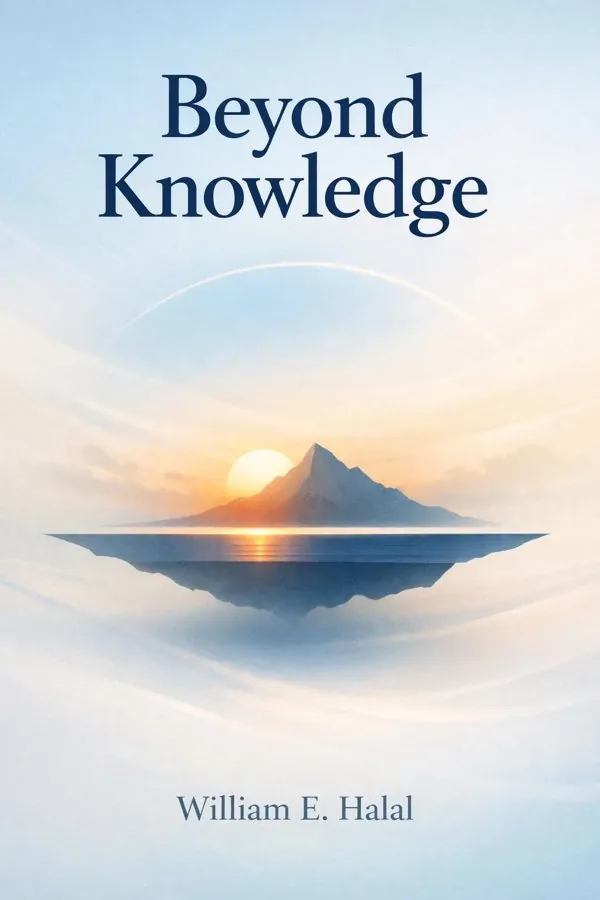
Beyond Knowledge: How Technology Is Driving an Age of Consciousness: Summary & Key Insights
 10 min9 chaptersAudio available
Key Takeaways from Beyond Knowledge: How Technology Is Driving an Age of Consciousness
Every great era solves old problems, then creates new ones it cannot manage.
When truth becomes harder to recognize, the problem is not merely informational; it is civilizational.
Technology does more than solve problems; it reorganizes the way society thinks, works, and evolves.
The next major advance in civilization may not be external at all; it may be the development of inner capacity.
A society with immense power but weak values becomes dangerous to itself.
What Is Beyond Knowledge: How Technology Is Driving an Age of Consciousness About?
Beyond Knowledge: How Technology Is Driving an Age of Consciousness by William E. Halal is a future_trends book spanning 8 pages. Beyond Knowledge argues that humanity is approaching a civilizational turning point. After decades of celebrating information, expertise, and digital connectivity, William E. Halal suggests that knowledge alone is no longer enough to guide progress. The same technologies that once expanded education, productivity, and global communication now also intensify misinformation, social fragmentation, ethical confusion, and political paralysis. In Halal’s view, these tensions signal not simply a crisis, but a transition: the Knowledge Age is evolving into an Age of Consciousness. The book explores how emerging technologies, from artificial intelligence to global networks, are forcing societies to pay greater attention to awareness, values, ethics, emotional maturity, and collective intelligence. Rather than treating consciousness as a mystical abstraction, Halal frames it as a practical next stage in social evolution, one that can shape institutions, markets, governance, and culture. This perspective matters because it offers more than diagnosis. It provides a roadmap for individuals, leaders, and institutions trying to navigate a world where technical power is accelerating faster than moral wisdom. As a respected scholar of technology, management, and forecasting, Halal brings unusual authority to this ambitious attempt to connect innovation with human development.
This FizzRead summary covers all 9 key chapters of Beyond Knowledge: How Technology Is Driving an Age of Consciousness in approximately 10 minutes, distilling the most important ideas, arguments, and takeaways from William E. Halal's work. Also available as an audio summary and Key Quotes Podcast.
Beyond Knowledge: How Technology Is Driving an Age of Consciousness
Beyond Knowledge argues that humanity is approaching a civilizational turning point. After decades of celebrating information, expertise, and digital connectivity, William E. Halal suggests that knowledge alone is no longer enough to guide progress. The same technologies that once expanded education, productivity, and global communication now also intensify misinformation, social fragmentation, ethical confusion, and political paralysis. In Halal’s view, these tensions signal not simply a crisis, but a transition: the Knowledge Age is evolving into an Age of Consciousness.
The book explores how emerging technologies, from artificial intelligence to global networks, are forcing societies to pay greater attention to awareness, values, ethics, emotional maturity, and collective intelligence. Rather than treating consciousness as a mystical abstraction, Halal frames it as a practical next stage in social evolution, one that can shape institutions, markets, governance, and culture.
This perspective matters because it offers more than diagnosis. It provides a roadmap for individuals, leaders, and institutions trying to navigate a world where technical power is accelerating faster than moral wisdom. As a respected scholar of technology, management, and forecasting, Halal brings unusual authority to this ambitious attempt to connect innovation with human development.
Who Should Read Beyond Knowledge: How Technology Is Driving an Age of Consciousness?
This book is perfect for anyone interested in future_trends and looking to gain actionable insights in a short read. Whether you're a student, professional, or lifelong learner, the key ideas from Beyond Knowledge: How Technology Is Driving an Age of Consciousness by William E. Halal will help you think differently.
- ✓Readers who enjoy future_trends and want practical takeaways
- ✓Professionals looking to apply new ideas to their work and life
- ✓Anyone who wants the core insights of Beyond Knowledge: How Technology Is Driving an Age of Consciousness in just 10 minutes
Want the full summary?
Get instant access to this book summary and 100K+ more with Fizz Moment.
Get Free SummaryAvailable on App Store • Free to download
Key Chapters
Every great era solves old problems, then creates new ones it cannot manage. Halal argues that the Knowledge Age was a historic triumph because it expanded education, science, computing, and global communications on an unprecedented scale. Societies learned to treat information as the key resource of progress. Economies shifted from factories to services and ideas. Experts, analysts, engineers, and digital platforms became the architects of modern life.
Yet the very strengths of this age exposed its limits. More information did not automatically produce wisdom. Greater connectivity did not guarantee trust. Technical expertise often improved systems while neglecting human meaning, ethical responsibility, and social cohesion. In practice, people became flooded with data but starved for direction. Institutions optimized efficiency while struggling with alienation, burnout, and moral confusion.
Halal’s point is not that knowledge failed. On the contrary, it succeeded so well that it pushed civilization to a more advanced challenge. Once basic material and informational systems become highly developed, the next frontier is how human beings use them. That means attention must shift from accumulating facts to developing judgment, self-awareness, emotional intelligence, and ethical clarity.
You can see this transition in workplaces that now value collaboration and purpose as much as technical skill, in schools adding social-emotional learning, and in leaders judged not only by competence but by integrity. The old model asked, “What do we know?” The new era increasingly asks, “How consciously do we act on what we know?”
Actionable takeaway: Audit one area of your life or work where you are collecting more information than you can meaningfully use, and replace some of that input with reflection, prioritization, and values-based decision-making.
When truth becomes harder to recognize, the problem is not merely informational; it is civilizational. Halal treats the rise of misinformation, polarization, and digital tribalism as evidence that the Knowledge Age has entered a destabilizing phase. The internet promised open access to facts, but in practice it also created attention markets that reward outrage, simplify complexity, and amplify emotional reactions over careful reasoning.
This is why falsehood can spread faster than verified knowledge. People do not consume information as neutral machines; they interpret it through identity, fear, status, and belonging. Social media platforms intensify these tendencies by surrounding users with algorithmically curated content that confirms prior beliefs. As a result, societies become rich in data but poor in shared reality.
Halal sees this as a sign that human development must catch up with technological power. Better fact-checking and platform regulation matter, but they are not enough on their own. A more conscious society requires citizens who can tolerate ambiguity, evaluate evidence, notice emotional manipulation, and engage disagreement without collapsing into hostility.
Consider practical applications in education and organizations. Media literacy programs can teach people to verify claims, distinguish opinion from evidence, and understand how incentives shape online content. Leaders can create cultures where thoughtful dissent is encouraged rather than punished. Families can discuss how news and platforms influence mood and beliefs.
The deeper lesson is that information ecosystems reflect inner ecosystems. A population lacking self-awareness is easier to divide and mislead. Consciousness, in this sense, becomes a public necessity rather than a private luxury.
Actionable takeaway: Before sharing any emotionally charged claim, pause for two minutes, verify the source, identify the emotion it triggers, and ask whether passing it on contributes to clarity or confusion.
The next major advance in civilization may not be external at all; it may be the development of inner capacity. Halal presents consciousness as the logical frontier beyond knowledge. He does not reduce it to vague spirituality or private introspection. Instead, he treats consciousness as a practical expansion of awareness that includes self-understanding, empathy, ethical sensitivity, systems thinking, and the ability to align action with deeper values.
This matters because highly complex societies cannot be managed by information alone. Modern life involves interdependent systems, conflicting interests, long-term risks, and cultural pluralism. Navigating these realities requires more than technical competence. It requires the ability to see wholes rather than fragments, to hold competing perspectives, and to respond with maturity instead of impulse.
Halal implies that consciousness grows at multiple levels. Individuals can become more reflective, emotionally balanced, and purpose-driven. Organizations can become more transparent, collaborative, and values-led. Societies can become more inclusive, future-oriented, and capable of collective learning. Consciousness is therefore not simply a state of mind; it is a developmental capacity with institutional consequences.
Practical applications are already emerging. Mindfulness training in schools can improve attention and emotional regulation. Executive coaching can help leaders understand blind spots and lead with greater integrity. Community dialogues can build empathy across political and cultural divides. Even design practices in technology can incorporate human flourishing rather than raw engagement metrics.
Halal’s central insight is that progress in the twenty-first century depends on the quality of awareness directing technological power. The real question is not whether we can build more powerful systems, but whether we can become wise enough to guide them.
Actionable takeaway: Establish a daily reflection practice, even for ten minutes, to strengthen self-awareness and improve how you make decisions under pressure.
A society with immense power but weak values becomes dangerous to itself. Halal argues that ethics and values are no longer optional moral add-ons to innovation; they are now foundational requirements for survival and progress. As technologies become more capable, scalable, and intrusive, the consequences of poor judgment grow larger. Artificial intelligence can reinforce bias, surveillance tools can erode liberty, and profit-driven systems can externalize social and environmental costs at massive scale.
The Age of Consciousness therefore demands that ethical development catch up with technical development. This means asking harder questions before and during innovation: Who benefits? Who bears the risks? What human goods are being protected or undermined? What kind of society does this technology encourage?
Halal’s view challenges the assumption that markets or technical expertise alone can resolve these issues. Engineers can optimize performance, but societies must still determine legitimate boundaries. Investors can reward efficiency, but communities must decide what kinds of outcomes are worth pursuing. In this sense, ethics becomes an operating system for a mature civilization.
Examples are everywhere. Companies building AI need governance processes for bias, transparency, and accountability. Healthcare systems using genetic technologies need frameworks for consent, privacy, and fairness. Educational institutions deploying data analytics need safeguards against manipulation and inequity. Ethical literacy must expand beyond specialists to citizens, consumers, managers, and policymakers.
Values are not barriers to progress. Properly understood, they direct progress toward human flourishing. Halal’s message is that future success will depend less on who innovates fastest and more on who integrates innovation with responsibility.
Actionable takeaway: In any major decision, add an explicit ethics checkpoint by asking three questions: Is it fair? Is it transparent? Does it support long-term human well-being?
Many of today’s institutions are trying to solve twenty-first-century problems with twentieth-century assumptions. Halal argues that governments, corporations, schools, and media systems were largely designed for earlier stages of social development, when stability, hierarchy, and specialization were more effective than they are today. In a rapidly changing and deeply interconnected world, these structures increasingly appear slow, fragmented, and mistrusted.
The transition to an Age of Consciousness requires institutional redesign. That does not mean abandoning expertise or structure, but reimagining them around adaptability, transparency, participation, and long-term thinking. Institutions must become better at learning, integrating diverse perspectives, and responding to systemic risks rather than narrow short-term incentives.
Consider governance. Traditional political systems often reward polarization and election-cycle thinking, even when societies face complex issues like climate change, AI governance, or public health resilience. More conscious governance would invest in foresight, evidence-based dialogue, citizen participation, and cross-sector collaboration. In business, firms may need to move beyond shareholder primacy toward stakeholder models that include workers, communities, and ecological impact. In education, memorization-based systems must give way to models that cultivate discernment, adaptability, and ethical intelligence.
Halal’s broader point is that consciousness is not only personal. It must be embedded in the rules, incentives, and cultures of collective life. Otherwise even well-intentioned individuals get trapped in systems that reward short-termism and division.
Institutional change can begin modestly. Teams can use more inclusive decision processes. Schools can teach futures thinking. Organizations can align metrics with mission instead of chasing superficial output. Over time, these changes can create structures that support more mature forms of society.
Actionable takeaway: Choose one institution you influence, such as a team, classroom, or community group, and redesign one rule or routine so it promotes reflection, inclusion, and long-term thinking.
No single expert, nation, or ideology can master problems that are global, interconnected, and fast-moving. Halal emphasizes that challenges such as climate change, inequality, pandemics, technological disruption, and geopolitical instability require collective intelligence. This is the ability of groups and systems to combine knowledge, perspectives, and creativity more effectively than isolated actors can.
The Knowledge Age gave humanity access to vast information networks, but the Age of Consciousness asks whether we can use those networks wisely. Collective intelligence is not just about pooling data. It also depends on trust, open communication, diversity of viewpoints, and the capacity to coordinate around shared goals. Without those qualities, networks can produce noise, conflict, and paralysis instead of insight.
Halal’s framework suggests that global problems are also tests of human maturity. Can societies think beyond nationalism when risks are planetary? Can institutions work across sectors rather than defend turf? Can citizens recognize long-term threats before crisis forces action? These are questions of consciousness as much as policy.
Practical examples include international scientific collaboration, participatory budgeting, open-source innovation, and cross-disciplinary problem-solving teams. In business, collective intelligence can improve strategy when companies integrate frontline experience, customer feedback, and ethical oversight into decision-making. In civic life, deliberative forums can help communities weigh trade-offs rather than default to slogans.
The book’s optimism lies in the idea that our networked world already contains the infrastructure for more intelligent cooperation. What remains uncertain is whether we will cultivate the awareness and values needed to use it well.
Actionable takeaway: For any complex problem you face, deliberately involve at least one person from a different discipline, generation, or worldview, and treat disagreement as a resource for better thinking rather than a threat.
The future is not predetermined by crisis; it is shaped by the level of awareness brought to crisis. Halal concludes with a vision of a conscious civilization, a society that uses advanced technology while grounding itself in wisdom, ethics, and human development. This is not a utopian fantasy in which conflict disappears. Rather, it is a more mature form of civilization capable of handling conflict, complexity, and change with greater intelligence and care.
In such a society, progress would be measured by more than GDP, output, or technical prowess. Well-being, social trust, ecological sustainability, ethical responsibility, and meaningful participation would matter just as much. Education would cultivate the whole person. Business would create value without sacrificing dignity or the planet. Governance would be more transparent, future-focused, and cooperative. Technology would serve human flourishing rather than exploit human attention.
Halal’s vision is ambitious, but it is grounded in observable trends: growing interest in mindfulness, stakeholder capitalism, systems thinking, sustainability, mental health, values-based leadership, and global collaboration. These developments suggest that many institutions are already groping toward a more conscious paradigm, even if unevenly.
The book’s hope comes from seeing transition not only as disruption but as evolution. Civilizations repeatedly move to higher forms of organization when old systems can no longer manage new realities. The pressures of our time may therefore be catalysts for growth.
A conscious civilization will not emerge automatically. It must be built through choices, cultures, and institutions that align power with wisdom. Halal’s message is ultimately an invitation: technological progress has brought humanity to the threshold, but crossing it requires deliberate development.
Actionable takeaway: Define three metrics of progress for your own life or organization that go beyond performance alone, such as well-being, trust, learning, or social contribution, and review them regularly.
All Chapters in Beyond Knowledge: How Technology Is Driving an Age of Consciousness
About the Author
William E. Halal is Professor Emeritus of Management, Technology, and Innovation at George Washington University and a longtime thinker on the future of business and society. His work focuses on emerging technologies, strategic foresight, organizational transformation, and social evolution. Over the course of his career, he has examined how economic systems, institutions, and innovation reshape the world, often combining management insight with broad civilizational analysis. Halal is known for translating complex future trends into practical frameworks for leaders, policymakers, and general readers. In Beyond Knowledge, he brings together decades of research on technology and change to argue that humanity is moving from the Knowledge Age into an Age of Consciousness, where ethics, awareness, and collective intelligence become essential to progress.
Get This Summary in Your Preferred Format
Read or listen to the Beyond Knowledge: How Technology Is Driving an Age of Consciousness summary by William E. Halal anytime, anywhere. FizzRead offers multiple formats so you can learn on your terms — all free.
Available formats: App · Audio · PDF · EPUB — All included free with FizzRead
Download Beyond Knowledge: How Technology Is Driving an Age of Consciousness PDF and EPUB Summary
Key Quotes from Beyond Knowledge: How Technology Is Driving an Age of Consciousness
“Every great era solves old problems, then creates new ones it cannot manage.”
“When truth becomes harder to recognize, the problem is not merely informational; it is civilizational.”
“Technology does more than solve problems; it reorganizes the way society thinks, works, and evolves.”
“The next major advance in civilization may not be external at all; it may be the development of inner capacity.”
“A society with immense power but weak values becomes dangerous to itself.”
Frequently Asked Questions about Beyond Knowledge: How Technology Is Driving an Age of Consciousness
Beyond Knowledge: How Technology Is Driving an Age of Consciousness by William E. Halal is a future_trends book that explores key ideas across 9 chapters. Beyond Knowledge argues that humanity is approaching a civilizational turning point. After decades of celebrating information, expertise, and digital connectivity, William E. Halal suggests that knowledge alone is no longer enough to guide progress. The same technologies that once expanded education, productivity, and global communication now also intensify misinformation, social fragmentation, ethical confusion, and political paralysis. In Halal’s view, these tensions signal not simply a crisis, but a transition: the Knowledge Age is evolving into an Age of Consciousness. The book explores how emerging technologies, from artificial intelligence to global networks, are forcing societies to pay greater attention to awareness, values, ethics, emotional maturity, and collective intelligence. Rather than treating consciousness as a mystical abstraction, Halal frames it as a practical next stage in social evolution, one that can shape institutions, markets, governance, and culture. This perspective matters because it offers more than diagnosis. It provides a roadmap for individuals, leaders, and institutions trying to navigate a world where technical power is accelerating faster than moral wisdom. As a respected scholar of technology, management, and forecasting, Halal brings unusual authority to this ambitious attempt to connect innovation with human development.
You Might Also Like
Futureproof: 9 Rules for Humans in the Age of Automation
Kevin Roose
10 min
The Third Wave
Alvin Toffler
10 min
2030: How Today's Biggest Trends Will Collide and Reshape the Future of Everything
Mauro F. Guillén
10 min
A Very Human Future: Enriching Humanity in a Digitized World
Rohit Talwar, Steve Wells, Alexandra Whittington
10 min
AI 2041: Ten Visions for Our Future
Kai-Fu Lee, Chen Qiufan
10 min
Abundance: The Future Is Better Than You Think
Peter H. Diamandis, Steven Kotler
10 minBrowse by Category
Ready to read Beyond Knowledge: How Technology Is Driving an Age of Consciousness?
Get the full summary and 100K+ more books with Fizz Moment.