
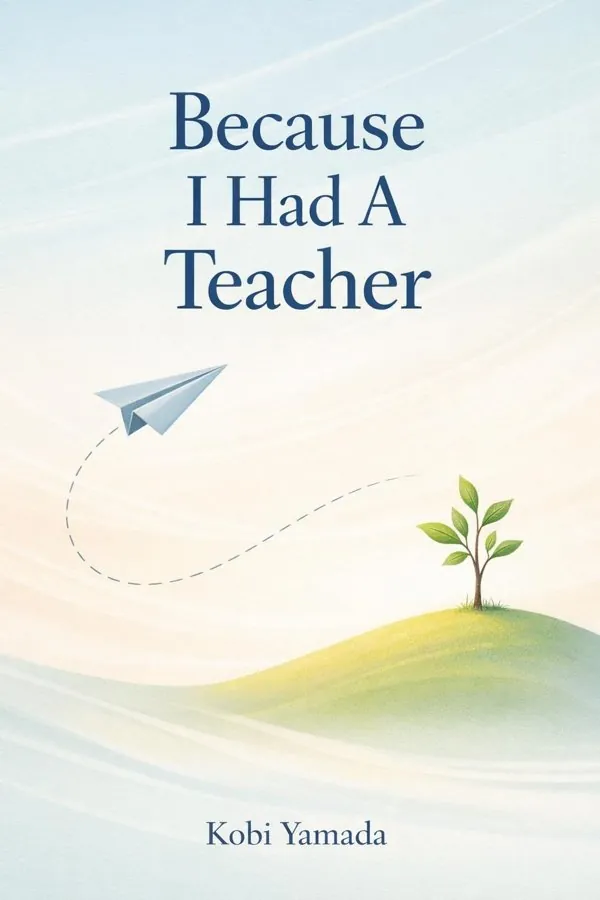
Because I Had A Teacher: Summary & Key Insights
by Kobi Yamada
 10 min9 chaptersAudio available
Key Takeaways from Because I Had A Teacher
Real learning often begins not with an answer, but with a spark.
Many people remember a teacher not because the work was easy, but because someone believed they could do hard things.
Sometimes the most life-changing thing an adult can do is notice a possibility a child cannot yet see in themselves.
A child does not only need instruction when things are going well; they also need comfort when the world feels overwhelming.
Children dream more boldly when an adult treats imagination as valuable rather than impractical.
What Is Because I Had A Teacher About?
Because I Had A Teacher by Kobi Yamada is a education book spanning 7 pages. Because I Had A Teacher by Kobi Yamada is a brief but deeply moving picture book that honors one of the most important relationships in life: the bond between a teacher and a student. Rather than focusing on grades, subjects, or school routines, the book shines a light on the lasting emotional and personal impact teachers have. It shows how a caring educator can awaken curiosity, build confidence, calm fears, encourage creativity, and help a child believe in a bigger future. In just a few pages, Yamada captures the truth that great teachers do far more than deliver lessons. They shape identity, character, and possibility. This message matters because nearly everyone can name a teacher whose words or presence changed them. The book invites readers to remember those people with gratitude while also recognizing the profound responsibility carried by anyone who teaches, mentors, coaches, or guides children. Kobi Yamada is especially suited to this theme. Known for inspirational books such as What Do You Do With an Idea? and Maybe, he writes with emotional clarity, warmth, and wisdom. Here, he creates a heartfelt tribute that speaks to students, parents, teachers, and anyone reflecting on the power of encouragement.
This FizzRead summary covers all 9 key chapters of Because I Had A Teacher in approximately 10 minutes, distilling the most important ideas, arguments, and takeaways from Kobi Yamada's work. Also available as an audio summary and Key Quotes Podcast.
Because I Had A Teacher
Because I Had A Teacher by Kobi Yamada is a brief but deeply moving picture book that honors one of the most important relationships in life: the bond between a teacher and a student. Rather than focusing on grades, subjects, or school routines, the book shines a light on the lasting emotional and personal impact teachers have. It shows how a caring educator can awaken curiosity, build confidence, calm fears, encourage creativity, and help a child believe in a bigger future. In just a few pages, Yamada captures the truth that great teachers do far more than deliver lessons. They shape identity, character, and possibility.
This message matters because nearly everyone can name a teacher whose words or presence changed them. The book invites readers to remember those people with gratitude while also recognizing the profound responsibility carried by anyone who teaches, mentors, coaches, or guides children. Kobi Yamada is especially suited to this theme. Known for inspirational books such as What Do You Do With an Idea? and Maybe, he writes with emotional clarity, warmth, and wisdom. Here, he creates a heartfelt tribute that speaks to students, parents, teachers, and anyone reflecting on the power of encouragement.
Who Should Read Because I Had A Teacher?
This book is perfect for anyone interested in education and looking to gain actionable insights in a short read. Whether you're a student, professional, or lifelong learner, the key ideas from Because I Had A Teacher by Kobi Yamada will help you think differently.
- ✓Readers who enjoy education and want practical takeaways
- ✓Professionals looking to apply new ideas to their work and life
- ✓Anyone who wants the core insights of Because I Had A Teacher in just 10 minutes
Want the full summary?
Get instant access to this book summary and 100K+ more with Fizz Moment.
Get Free SummaryAvailable on App Store • Free to download
Key Chapters
Real learning often begins not with an answer, but with a spark. One of the central ideas in Because I Had A Teacher is that teachers do something more important than simply explain facts: they awaken curiosity. A memorable teacher does not just say, “Here is what you need to know.” Instead, they quietly help a student wonder, question, notice, and explore. That shift changes learning from obligation into discovery.
Yamada’s message suggests that teaching is not only about information transfer. It is about opening inner doors. A teacher can make a child look at the night sky differently, hear music differently, or approach a problem with fresh interest rather than fear. Curiosity is powerful because it keeps working long after a class ends. A student who becomes curious learns how to teach themselves, and that is one of the greatest gifts education can offer.
In practical terms, this happens through small choices. A teacher might ask open-ended questions instead of rushing to the “right” answer. They may connect a lesson to real life, invite experimentation, or encourage students to pursue their own interests. A science teacher who says, “What do you think would happen if...?” creates more engagement than one who only assigns definitions. A reading teacher who lets students connect stories to their own lives helps literature feel alive.
This idea also applies beyond classrooms. Parents, coaches, and mentors can cultivate curiosity by listening seriously, encouraging questions, and praising exploration rather than only performance. Children often become interested in what adults treat as meaningful.
Actionable takeaway: Instead of asking only, “Did you finish the lesson?” ask, “What made you curious today?” That simple question can keep the teacher’s spark alive.
Many people remember a teacher not because the work was easy, but because someone believed they could do hard things. Because I Had A Teacher highlights the quiet power of encouragement. Great teachers do more than cheer students on; they help them build confidence rooted in effort, progress, and resilience. Their belief becomes a mirror in which children begin to see their own strength.
This matters because students often struggle long before they succeed. They hesitate, compare themselves with others, make mistakes, and sometimes assume failure means they are incapable. A wise teacher interrupts that false conclusion. Through patience and reassurance, they teach that difficulty is not a verdict but part of growth. Encouragement, in this sense, is not empty praise. It is steady support that says, “Keep going. You are learning. You can do this.”
In everyday school life, encouragement can take many forms. A teacher might praise a student for revising a paragraph instead of only admiring the final essay. They might notice persistence in a child who keeps trying to solve a math problem. They may remind a shy student that courage can look like speaking up once, not becoming instantly fearless. These moments seem small, but they help students connect effort with identity. Instead of thinking, “I’m bad at this,” they begin to think, “I’m still learning.”
Adults outside school can apply the same principle. If a child struggles with sports, music, reading, or friendships, encouragement should focus on persistence, strategy, and improvement. The goal is not to remove challenge, but to help children stay engaged through it.
Actionable takeaway: The next time a child or student feels stuck, replace evaluation with encouragement. Try saying, “I can see how hard you’re working, and that matters,” then help them take one more step forward.
Sometimes the most life-changing thing an adult can do is notice a possibility a child cannot yet see in themselves. Because I Had A Teacher honors educators who recognize hidden strengths and reflect them back to students. This kind of guidance is powerful because identity is often shaped by what trusted adults consistently notice and name.
Children do not always understand their own gifts. A student may think they are merely talkative, while a teacher sees leadership. Another may believe they are too sensitive, while a teacher recognizes empathy and insight. A child who doodles in every margin may be dismissed as distracted by some, but a thoughtful teacher may see an emerging artist or visual thinker. Great teachers look beneath behavior, insecurity, and uneven performance to find capacity.
This matters especially for students who are overlooked. Not every child shines in obvious ways. Some are quiet. Some struggle academically. Some have talents that do not fit neatly into standard measures. Yamada’s tribute reminds us that a teacher’s faith can become the first bridge between uncertainty and self-belief. When a teacher says, “You have something special,” they are not merely complimenting; they are helping a student imagine a future self.
Practically, this means teachers pay attention to patterns. Who asks thoughtful questions? Who helps classmates? Who shows imagination, discipline, humor, precision, or courage? Guidance is not only about correcting weakness. It is also about cultivating strength. A teacher who steers a student toward writing, science club, art, debate, or mentorship may change the direction of that student’s life.
Parents and mentors can do this too by naming specific qualities rather than using vague praise. Instead of saying, “You’re great,” say, “You explain things clearly,” or “You stay kind even when things are hard.”
Actionable takeaway: Identify one strength in a child that they may not fully recognize yet, and name it clearly. Repeated, specific affirmation can help potential become purpose.
A child does not only need instruction when things are going well; they also need comfort when the world feels overwhelming. One of the gentlest themes in Because I Had A Teacher is that teachers often provide emotional steadiness in moments of uncertainty. They help students feel safe enough to keep learning, trying, and growing.
This is important because fear can block progress. A student who is anxious about reading aloud, worried about making mistakes, or carrying stress from life outside school may not be able to fully engage with learning. In those moments, reassurance is not a soft extra. It is part of what makes education possible. A calm, patient teacher communicates, “You are safe here. You do not have to be perfect to belong.”
In practice, reassurance can appear in subtle forms: a warm greeting at the classroom door, a quiet check-in after a hard day, a gentle explanation when a student is confused, or a reminder that mistakes are normal. Teachers often become emotional anchors simply through consistency. Their tone, attention, and patience can regulate a child’s sense of stability.
This lesson extends beyond schools. Any adult who supports children can remember that encouragement is not always energetic. Sometimes what a child needs most is calm presence. If a student receives a disappointing grade, reassurance might sound like, “This result does not define you. Let’s look at what to do next.” If a child feels excluded or embarrassed, support might begin with listening rather than fixing.
Yamada’s message dignifies these quieter acts of care. They may not be visible on report cards, but they leave deep marks on memory. Many adults remember a teacher who made them feel less alone.
Actionable takeaway: When a child is upset or discouraged, respond first with steadiness, not solutions. A reassuring presence often creates the emotional space needed for growth.
Children dream more boldly when an adult treats imagination as valuable rather than impractical. Because I Had A Teacher celebrates the educators who make room for creativity, wonder, and big possibilities. These teachers understand that imagination is not a distraction from learning; it is one of the engines of learning itself.
Creative thinking helps children solve problems, express emotions, and envision futures beyond their current circumstances. When a teacher encourages storytelling, experimentation, drawing, role-play, invention, or unusual questions, they are helping students trust their own minds. This matters because many children gradually learn to censor themselves. They stop raising unusual ideas because they fear being wrong or odd. A supportive teacher protects the freedom to imagine.
In classrooms, this can look like inviting multiple solutions, asking students to create rather than only repeat, or connecting lessons to personal expression. A history teacher might ask students to write diary entries from the perspective of someone in another era. A science teacher may let students design their own mini experiments. An elementary teacher who welcomes curious tangents may do more for innovation than one who always rushes back to the worksheet.
Creativity also requires emotional permission. Students need to know their ideas will be heard respectfully. Not every idea will be practical, polished, or correct, but the habit of imagining matters. Teachers who celebrate originality help students become more flexible, inventive thinkers.
Outside school, families can support this by allowing unstructured play, asking “What could you make?” and valuing process over perfection. The point is not to produce artists alone, but to raise humans who can think expansively.
Actionable takeaway: Give a child one regular opportunity to create something with no single right answer. Imagination grows when children feel trusted to explore.
Students learn best when they feel seen as human beings, not just as assignments, scores, or behavior problems. Because I Had A Teacher emphasizes the relational side of education: trust and kindness. A strong teacher-student connection does not remove standards or discipline, but it creates the emotional foundation that makes meaningful learning possible.
Trust is built when students experience consistency, fairness, and respect. Kindness is felt when a teacher listens, remembers details, notices effort, and treats each child with dignity. These qualities may sound simple, yet they shape the entire learning environment. A student who trusts a teacher is more likely to ask for help, take intellectual risks, admit confusion, and recover from mistakes.
This theme matters because education is deeply relational. Even the best curriculum has limited power if students feel unseen or afraid. Conversely, a caring connection can transform a difficult subject into one a student is willing to attempt. Children often work harder for adults who they believe genuinely care about them.
Practical examples include learning students’ names quickly, greeting them personally, following through on promises, apologizing when necessary, and correcting behavior without humiliation. Trust grows when students know what to expect. Kindness grows when they sense they matter beyond performance. A teacher who says, “I’m glad you’re here,” may be shaping a student’s belonging more than they realize.
Parents, leaders, and mentors can apply the same principle. Before giving advice or correction, build connection. Children are more open to guidance from adults who have earned their trust.
Yamada’s tribute reminds readers that what students remember most may not be a lesson plan, but a relationship. Long after details fade, the feeling of being treated with kindness remains.
Actionable takeaway: If you want to help a child learn, strengthen the relationship first. Trust is not separate from teaching; it is one of its most powerful tools.
Some of the most important lessons in school never appear on a test. Because I Had A Teacher points to a truth many adults recognize only later: teachers influence values, habits, and ways of being in the world. They do not simply teach children what to know; they help teach them how to live.
Students absorb much more than subject content. They watch how teachers respond to mistakes, handle pressure, treat others, resolve conflict, and speak about effort, fairness, curiosity, and responsibility. In that sense, every teacher models a philosophy of life. A teacher who treats each student with respect teaches respect. A teacher who admits not knowing something teaches humility. A teacher who persists through challenges teaches resilience without needing to give a speech about it.
This broader influence explains why teachers are often remembered for character as much as competence. A child may forget the details of a lesson on grammar or geography, but remember forever that a teacher taught them to be brave, thoughtful, honest, or compassionate. These values become part of a student’s internal guide.
In practical terms, this means education should not be reduced to achievement alone. Teachers can intentionally reinforce values by praising integrity, cooperation, responsibility, courage, and empathy. Families can continue these lessons by asking not only, “What did you learn today?” but also, “How were you kind?” or “What challenge did you handle well?”
Yamada’s book honors this invisible curriculum. It suggests that dream-building is inseparable from character-building. Children need skills, but they also need values to help them use those skills wisely.
Actionable takeaway: Notice and name life values when you see them in a child. Recognizing honesty, effort, empathy, or courage teaches children that who they are matters as much as what they accomplish.
Transformation does not always arrive through dramatic speeches or grand milestones. Often, it comes through small moments repeated over time. Because I Had A Teacher is powerful partly because it recognizes this quiet truth. A smile of welcome, a timely note, a patient explanation, a second chance, or one sentence of belief can alter the way a child sees themselves.
This idea is easy to underestimate because educational impact is not always visible immediately. Teachers may never know which comment a student carries for years. A brief affirmation like “You have a gift for this” can become a lifelong source of courage. Likewise, a teacher’s steady kindness during a difficult season can remain in memory long after the details of the classroom have faded.
The lesson here is that influence is cumulative. Children form self-understanding through repeated experiences. If they repeatedly encounter patience, expectation, care, and opportunity, they begin to imagine themselves as capable and worthy. If they repeatedly experience dismissal, the opposite may happen. This is why ordinary daily interactions matter so much.
Practically, educators and caregivers should not wait for perfect opportunities to make a difference. The everyday rhythm is the opportunity. Learn one more detail about a student’s interests. Pause to notice effort. Offer a reset after a bad day. Celebrate one small improvement. These modest actions often do more than occasional big gestures.
For readers, this theme is also hopeful. You do not need extraordinary authority to influence a young person. Presence and consistency count. Mentorship is often built in minutes, not monuments.
Actionable takeaway: Choose one small habit of encouragement or attention to practice daily with a child or student. Tiny, repeated moments of care are often what create lasting change.
One of the most moving aspects of Because I Had A Teacher is its spirit of gratitude. The book is not merely about what teachers do; it is about what their care means to the people they shape. Gratitude turns memory into recognition. It helps students and former students see that growth rarely happens alone.
This matters because modern life often treats education as transactional. Teachers are measured by outcomes, schedules, standards, and performance. While those things matter, Yamada’s book reminds readers that the heart of teaching is relational and deeply human. Gratitude restores perspective. It says that behind every lesson, there may have been patience, preparation, emotional labor, sacrifice, and faith that students did not fully perceive at the time.
For students, gratitude encourages humility and reflection. Looking back at the adults who guided us helps us see how support shaped our confidence, direction, and dreams. For teachers, gratitude can be renewing. Teaching is demanding work, and educators often do not immediately see the fruit of their efforts. Appreciation reminds them that what feels ordinary to them may be unforgettable to someone else.
There are practical ways to live this message. A former student can write a note to a teacher who made a difference. Parents can help children express thanks at the end of a school year. Schools can create cultures where appreciation is spoken openly, not reserved for special occasions. Even privately reflecting on a meaningful teacher can deepen a sense of connection and responsibility.
Gratitude also invites imitation. When we appreciate those who believed in us, we become more likely to offer that same belief to others.
Actionable takeaway: Think of one teacher or mentor who shaped your life, and tell them specifically how. Gratitude is most powerful when it is expressed, not merely felt.
All Chapters in Because I Had A Teacher
About the Author
Kobi Yamada is an American author, creative leader, and entrepreneur best known for writing inspirational books that blend simple storytelling with emotional depth. His titles, including What Do You Do With an Idea?, What Do You Do With a Problem?, Maybe, and Because I Had A Teacher, have reached a wide audience of children, parents, teachers, and gift-book readers. Yamada’s work often explores themes such as courage, possibility, gratitude, growth, and the quiet ways people influence one another. He is also the president of Compendium, a company known for producing meaningful books, journals, and gifts designed to encourage reflection and connection. His writing stands out for its warmth, clarity, and ability to speak across age groups, making complex feelings accessible in a gentle, memorable way.
Get This Summary in Your Preferred Format
Read or listen to the Because I Had A Teacher summary by Kobi Yamada anytime, anywhere. FizzRead offers multiple formats so you can learn on your terms — all free.
Available formats: App · Audio · PDF · EPUB — All included free with FizzRead
Download Because I Had A Teacher PDF and EPUB Summary
Key Quotes from Because I Had A Teacher
“Real learning often begins not with an answer, but with a spark.”
“Many people remember a teacher not because the work was easy, but because someone believed they could do hard things.”
“Sometimes the most life-changing thing an adult can do is notice a possibility a child cannot yet see in themselves.”
“A child does not only need instruction when things are going well; they also need comfort when the world feels overwhelming.”
“Children dream more boldly when an adult treats imagination as valuable rather than impractical.”
Frequently Asked Questions about Because I Had A Teacher
Because I Had A Teacher by Kobi Yamada is a education book that explores key ideas across 9 chapters. Because I Had A Teacher by Kobi Yamada is a brief but deeply moving picture book that honors one of the most important relationships in life: the bond between a teacher and a student. Rather than focusing on grades, subjects, or school routines, the book shines a light on the lasting emotional and personal impact teachers have. It shows how a caring educator can awaken curiosity, build confidence, calm fears, encourage creativity, and help a child believe in a bigger future. In just a few pages, Yamada captures the truth that great teachers do far more than deliver lessons. They shape identity, character, and possibility. This message matters because nearly everyone can name a teacher whose words or presence changed them. The book invites readers to remember those people with gratitude while also recognizing the profound responsibility carried by anyone who teaches, mentors, coaches, or guides children. Kobi Yamada is especially suited to this theme. Known for inspirational books such as What Do You Do With an Idea? and Maybe, he writes with emotional clarity, warmth, and wisdom. Here, he creates a heartfelt tribute that speaks to students, parents, teachers, and anyone reflecting on the power of encouragement.
You Might Also Like

Bedtime Biography: Florence Nightingale
Isabel Thomas
10 min
Introduction To Museum Studies
Howard H. Hoyt
10 min
A Mind for Numbers: How to Excel at Math and Science (Even If You Flunked Algebra)
Barbara Oakley
10 min
AI for Educators: Learning Strategies, Teacher Empowerment, and the Future of Education
Matt Miller
10 min
Animation For Beginners
Morr Meroz
10 min
Artificial Intelligence for Learning
Donald Clark
10 minFeatured In
Browse by Category
Ready to read Because I Had A Teacher?
Get the full summary and 100K+ more books with Fizz Moment.