
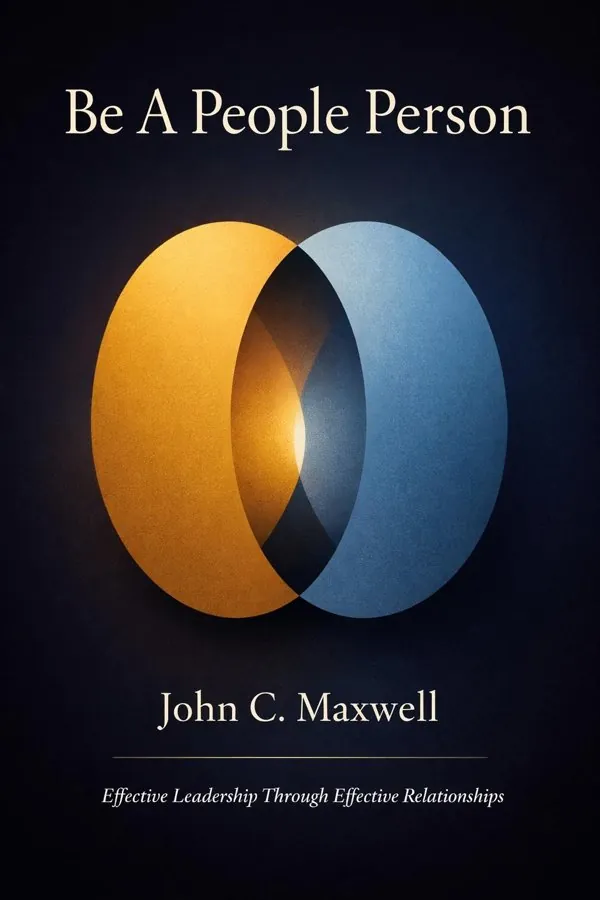
Be A People Person: Effective Leadership Through Effective Relationships: Summary & Key Insights
 10 min9 chaptersAudio available
Key Takeaways from Be A People Person: Effective Leadership Through Effective Relationships
One of leadership’s biggest mistakes is assuming that people can be managed without first being understood.
Many people perform below their potential not because they lack ability, but because they rarely feel genuinely valued.
Without trust, even the best leadership techniques collapse.
The strongest influence rarely comes from control; it comes from service.
People skills are often treated as natural gifts, but Maxwell argues they are learnable disciplines.
What Is Be A People Person: Effective Leadership Through Effective Relationships About?
Be A People Person: Effective Leadership Through Effective Relationships by John C. Maxwell is a leadership book spanning 5 pages. Leadership is often mistaken for authority, talent, or the ability to command attention. John C. Maxwell argues that its real foundation is far simpler and far more demanding: the ability to build healthy, trusting, productive relationships with people. In Be A People Person, Maxwell shows that success in leadership, work, family, and community depends less on technique and more on how well we understand, value, and serve others. This is a practical guide to becoming the kind of person others want to follow, work with, and grow alongside. What makes the book powerful is its accessibility. Maxwell avoids abstract leadership theory and focuses on everyday human realities: communication, trust, empathy, encouragement, conflict, and influence. He explains why people skills are not optional extras but central to lasting impact. His message is especially relevant in a world where many organizations struggle not from lack of strategy, but from poor relationships. Maxwell writes with the authority of a longtime leadership teacher, speaker, and bestselling author whose work has shaped leaders across business, ministry, education, and personal development. His core insight is timeless: if you want to lead people well, you must first learn to relate to them well.
This FizzRead summary covers all 9 key chapters of Be A People Person: Effective Leadership Through Effective Relationships in approximately 10 minutes, distilling the most important ideas, arguments, and takeaways from John C. Maxwell's work. Also available as an audio summary and Key Quotes Podcast.
Be A People Person: Effective Leadership Through Effective Relationships
Leadership is often mistaken for authority, talent, or the ability to command attention. John C. Maxwell argues that its real foundation is far simpler and far more demanding: the ability to build healthy, trusting, productive relationships with people. In Be A People Person, Maxwell shows that success in leadership, work, family, and community depends less on technique and more on how well we understand, value, and serve others. This is a practical guide to becoming the kind of person others want to follow, work with, and grow alongside.
What makes the book powerful is its accessibility. Maxwell avoids abstract leadership theory and focuses on everyday human realities: communication, trust, empathy, encouragement, conflict, and influence. He explains why people skills are not optional extras but central to lasting impact. His message is especially relevant in a world where many organizations struggle not from lack of strategy, but from poor relationships.
Maxwell writes with the authority of a longtime leadership teacher, speaker, and bestselling author whose work has shaped leaders across business, ministry, education, and personal development. His core insight is timeless: if you want to lead people well, you must first learn to relate to them well.
Who Should Read Be A People Person: Effective Leadership Through Effective Relationships?
This book is perfect for anyone interested in leadership and looking to gain actionable insights in a short read. Whether you're a student, professional, or lifelong learner, the key ideas from Be A People Person: Effective Leadership Through Effective Relationships by John C. Maxwell will help you think differently.
- ✓Readers who enjoy leadership and want practical takeaways
- ✓Professionals looking to apply new ideas to their work and life
- ✓Anyone who wants the core insights of Be A People Person: Effective Leadership Through Effective Relationships in just 10 minutes
Want the full summary?
Get instant access to this book summary and 100K+ more with Fizz Moment.
Get Free SummaryAvailable on App Store • Free to download
Key Chapters
One of leadership’s biggest mistakes is assuming that people can be managed without first being understood. Maxwell insists that effective leadership begins with insight into human nature: people carry hopes, fears, insecurities, ambitions, and emotional needs that deeply influence how they respond. If you treat everyone the same, you may feel fair, but you will often be ineffective. Real leadership requires paying attention to what drives each person.
Understanding people means listening beyond words. A team member who seems resistant may actually feel overlooked. A family member who appears distant may be carrying stress they cannot express. A direct report who underperforms may not need pressure as much as clarity, confidence, or support. Maxwell encourages leaders to become students of people by observing behavior, asking questions, and learning what matters to individuals.
This idea has practical value in every setting. In the workplace, understanding someone’s goals can help you assign responsibilities that fit their strengths. In parenting, recognizing whether a child needs encouragement or structure changes how you guide them. In friendships, noticing emotional cues can prevent unnecessary conflict. Leaders who understand people can motivate more wisely, correct more gently, and connect more deeply.
Maxwell’s broader point is that people are not problems to solve but individuals to know. Influence grows when others feel seen, not merely used. The better you understand what people need, fear, and value, the better you can lead them toward meaningful results.
Actionable takeaway: choose one person you lead or work with and spend this week asking better questions, listening carefully, and identifying what truly motivates them.
Many people perform below their potential not because they lack ability, but because they rarely feel genuinely valued. Maxwell argues that one of a leader’s most important responsibilities is to communicate worth. When people believe they matter, they become more confident, committed, and open to growth. Leadership is not only about achieving results; it is about helping others recognize their own significance.
Seeing value in others requires more than polite words. It means choosing to look past flaws, titles, and current performance to the person’s deeper potential. Maxwell warns that leaders often drift into transactional thinking, appreciating people only for what they produce. But healthy relationships are built when individuals know they are respected as people first. This creates emotional safety, trust, and loyalty.
Affirmation can be expressed in simple but powerful ways: sincere praise, thoughtful attention, public recognition, and private encouragement. A manager who thanks a quiet employee for consistent reliability strengthens morale. A teacher who highlights effort, not only talent, helps students build resilience. A spouse or friend who acknowledges growth rather than only pointing out mistakes creates a more supportive relationship.
Importantly, affirmation must be honest. Empty compliments feel manipulative. Effective leaders learn to notice specific strengths and speak to them clearly. This helps others understand what they contribute and where they can keep growing. Over time, affirmation becomes a culture, not an occasional gesture.
Maxwell’s insight is that people often become what important voices in their life consistently tell them they can become. When a leader treats people as valuable, they often begin acting accordingly.
Actionable takeaway: identify three people in your circle and offer each one a specific, sincere affirmation about a strength, contribution, or area of growth you genuinely see in them.
Without trust, even the best leadership techniques collapse. Maxwell makes clear that relationships cannot thrive on charisma, intelligence, or authority alone. People may comply with a leader they do not trust, but they will rarely give their best energy, creativity, or loyalty. Trust is what turns position into influence and interaction into partnership.
Trust is built through consistency. People watch whether your words match your actions, whether your standards apply to yourself, and whether you are reliable when circumstances become difficult. A leader who keeps commitments, admits mistakes, and acts fairly creates stability. A leader who changes direction without explanation, takes credit unfairly, or withholds truth weakens every relationship around them.
Maxwell also emphasizes that trust grows in small moments. It is shaped when you follow up on a promise, protect confidential information, show up on time, and respond honestly. In teams, trust allows healthy disagreement because people believe the relationship is secure. In families, trust creates emotional safety. In friendships, it allows vulnerability. Once broken, trust can be rebuilt, but only through patience, transparency, and changed behavior.
A practical application is to examine where people may experience you as unpredictable. Do you overpromise? Avoid difficult conversations? Shift expectations without warning? Trust increases when people know what to expect from your character. Competence matters, but character sustains influence.
Maxwell’s message is simple but demanding: if you want stronger relationships, become a more trustworthy person. Trust is not something you demand from others; it is something you earn.
Actionable takeaway: review one area where your credibility may be weak and strengthen it through one concrete act of consistency, honesty, or follow-through this week.
The strongest influence rarely comes from control; it comes from service. Maxwell challenges the common belief that leadership is about being in charge. Instead, he argues that people willingly follow leaders who clearly care about helping them succeed. Service shifts leadership from self-centered ambition to other-centered contribution.
Serving people does not mean becoming passive or avoiding authority. It means using authority for the good of others rather than for ego, convenience, or status. A servant-minded leader asks: What does this person need to thrive? How can I remove obstacles? How can I support growth while still expecting responsibility? This approach builds respect because people sense the leader’s motives.
In practical terms, service can look like mentoring a struggling employee instead of simply criticizing them, giving credit generously, making time for people when it is inconvenient, or advocating for a team’s needs. In the home, it may mean listening before correcting, helping without being asked, or creating an environment where others feel supported. In community life, it means contributing in ways that strengthen people rather than seeking recognition.
Service also increases influence because it creates reciprocity. When people feel genuinely helped, they are more open to guidance, correction, and shared goals. A leader who serves earns the moral right to challenge others toward excellence. By contrast, leaders who demand sacrifice without showing care breed resentment.
Maxwell’s point is not sentimental. Service is strategic in the best sense: it is the most sustainable way to create trust, loyalty, and collective strength. When people know you are for them, they become more willing to move with you.
Actionable takeaway: ask one person you lead, support, or live with, “What would help you most right now?” and act on the answer in a practical way.
People skills are often treated as natural gifts, but Maxwell argues they are learnable disciplines. Some individuals seem naturally warm or persuasive, yet strong relational ability usually comes from habits: listening well, reading situations, respecting differences, expressing ideas clearly, and handling tension wisely. Leaders who neglect these skills eventually hit a ceiling, no matter how talented they are in other areas.
Intentional growth in people skills begins with self-awareness. How do you come across under pressure? Do you interrupt? Dominate conversations? Withdraw when conflict appears? Misread emotional cues? Maxwell encourages readers to accept that good intentions are not enough. If your behavior consistently leaves people feeling dismissed, confused, or discouraged, your impact is being weakened.
Improvement requires practice. You can become a better listener by asking follow-up questions instead of preparing your next response. You can become more approachable by making eye contact, learning names, and showing interest in others’ concerns. You can communicate more effectively by being clear, calm, and specific. You can handle disagreement more productively by addressing issues directly without attacking people personally.
These skills matter because relationships are often won or lost in ordinary interactions. A brilliant leader who cannot connect may be admired but not trusted. A capable professional who creates friction may be tolerated but not promoted. By contrast, someone who helps others feel respected and understood becomes a stabilizing force in any environment.
Maxwell’s larger lesson is that relational effectiveness is not accidental. It is built one conversation, one response, and one habit at a time.
Actionable takeaway: choose one people skill to practice for the next seven days—listening, clarity, encouragement, or conflict management—and evaluate your progress daily.
Most relationship breakdowns are not caused by bad intentions but by poor communication. Maxwell emphasizes that leaders must do more than speak; they must connect. Communication becomes effective when the message is clear, timely, respectful, and shaped with the listener in mind. If people do not understand you, trust you, or feel considered by you, your words will have limited power.
Strong communication starts with empathy. Different people hear the same message differently depending on personality, experience, and emotional state. A highly direct approach may motivate one person and discourage another. A leader must ask not only, “What do I want to say?” but also, “How will this person likely receive it?” This does not mean avoiding truth; it means delivering truth in a way that can actually be heard.
Maxwell also underscores the importance of clarity. Vague instructions create frustration. Hidden expectations create resentment. Unspoken assumptions create confusion. In teams, this means defining responsibilities and feedback clearly. In personal relationships, it means expressing concerns before they become bitterness. Good communicators reduce unnecessary ambiguity.
Listening is equally essential. People do not feel connected simply because you talked to them. They feel connected when they sense they were heard. Reflecting back what someone said, asking clarifying questions, and resisting the urge to fix everything too quickly all deepen understanding.
A practical example is difficult feedback. Instead of saying, “You need to do better,” a strong communicator says, “This report missed two deadlines and caused confusion for the team. Let’s talk about what support you need to improve.” The issue is addressed without attacking the person.
Actionable takeaway: before your next important conversation, define your message, consider the listener’s perspective, and plan to spend at least as much time listening as speaking.
Conflict is not proof that a relationship has failed; often it is proof that real people are involved. Maxwell teaches that mature leaders do not avoid conflict, but they learn how to address it without destroying trust. Because people differ in goals, expectations, communication styles, and emotions, tension is inevitable. The real question is whether conflict becomes destructive or constructive.
One reason conflict escalates is that people attack character instead of addressing issues. Maxwell encourages readers to separate the person from the problem. If someone missed a responsibility, discuss the missed responsibility, not their entire worth or motives. This keeps disagreement focused and prevents unnecessary emotional damage.
Timing and tone also matter. Correcting someone publicly may embarrass them and trigger defensiveness. Delaying an important conversation too long may allow resentment to grow. Wise leaders address conflict directly, privately when possible, and with the goal of resolution rather than victory. They ask questions, seek facts, and avoid exaggeration.
In practical life, this could mean discussing recurring tension with a colleague before it poisons team culture, or talking honestly with a spouse or friend before hurt turns into distance. Conflict handled well can actually strengthen relationships because it proves that honesty is possible without rejection.
Maxwell’s approach is rooted in humility. You may be right about the issue and still wrong in your attitude. Effective leaders stay open to correction, own their part, and pursue reconciliation where possible. The aim is not to avoid discomfort but to protect the relationship while confronting reality.
Actionable takeaway: identify one unresolved tension and schedule a calm, direct conversation focused on facts, shared goals, and mutual respect rather than blame.
Before leaders influence others through strategy or skill, they influence them through attitude. Maxwell shows that attitude is contagious: optimism, bitterness, humility, defensiveness, gratitude, and cynicism all spread quickly through relationships. People may not remember every word you say, but they strongly feel the emotional climate you create.
A healthy attitude does not mean pretending problems do not exist. It means approaching people and challenges with steadiness, hope, and responsibility. Leaders with poor attitudes often drain others through negativity, pride, or constant criticism. Even if they are competent, they become difficult to follow. By contrast, leaders with resilient attitudes help others stay focused and constructive during uncertainty.
This idea is especially important under stress. Anyone can seem relationally skilled when things are easy. But pressure exposes inner habits. Do you become impatient, sarcastic, controlling, or withdrawn? Maxwell encourages readers to see attitude as a leadership issue, not merely a personality trait. Your inner posture affects morale, trust, and collaboration.
Practically, attitude can be strengthened through gratitude, perspective, and self-management. Starting meetings by recognizing progress changes team energy. Refusing to gossip preserves culture. Admitting, “I was wrong,” demonstrates humility. Choosing encouragement in difficult moments often gives others emotional permission to keep going.
In families and friendships, attitude has similar power. A home shaped by irritation feels unsafe. A home shaped by patience and appreciation becomes more open and honest. Small daily responses build long-term relational atmosphere.
Maxwell’s point is that people are drawn not only to competence, but to emotional consistency and hope. A strong attitude does not remove hardship, but it changes how people experience hardship together.
Actionable takeaway: monitor your tone and emotional impact for one full day, then ask yourself honestly whether your attitude made people feel heavier or stronger.
A leader’s success is limited if it depends entirely on their own effort. Maxwell argues that one of the highest forms of relational leadership is developing other people. Many leaders use relationships to get tasks done; great leaders use relationships to help people become more capable, confident, and mature. This creates multiplying impact.
Helping others grow begins with belief. People often rise when someone trusted them before they fully trusted themselves. Maxwell encourages leaders to look for potential, not merely current output. This does not mean ignoring accountability. It means combining expectation with investment. Growth happens when people are challenged and supported at the same time.
Practical development includes coaching, feedback, delegation, and opportunity. Instead of solving every problem yourself, let others take ownership with guidance. Instead of only evaluating mistakes, help people understand how to improve. Instead of keeping responsibility centralized, share it in ways that stretch others. In personal life, this can mean encouraging a child’s initiative, helping a friend pursue a goal, or mentoring someone earlier in their journey.
Development also requires patience. People learn unevenly. They need room to fail, reflect, and try again. Leaders who only value immediate performance may get short-term efficiency but miss long-term capacity. By contrast, leaders who build people create stronger teams, healthier cultures, and deeper loyalty.
Maxwell’s larger message is that relationships become most meaningful when they contribute to transformation. If your leadership ends with your own productivity, its reach stays small. If your leadership helps others grow, your influence expands beyond what you could accomplish alone.
Actionable takeaway: choose one person with potential and invest in their growth this month through feedback, opportunity, encouragement, or regular mentoring conversation.
All Chapters in Be A People Person: Effective Leadership Through Effective Relationships
About the Author
John C. Maxwell is an American leadership author, speaker, and coach whose work has influenced millions of readers and leaders worldwide. He is best known for writing practical books on leadership, influence, teamwork, communication, and personal growth, many of which have become international bestsellers. Maxwell’s teaching style combines clear principles with everyday application, making his ideas accessible to business professionals, nonprofit leaders, educators, pastors, and individuals seeking personal development. Over the course of his career, he has trained leaders in organizations and countries around the world, building a reputation as one of the most widely recognized voices in modern leadership. His central theme across much of his work is that leadership is rooted in influence, character, and the ability to connect meaningfully with people.
Get This Summary in Your Preferred Format
Read or listen to the Be A People Person: Effective Leadership Through Effective Relationships summary by John C. Maxwell anytime, anywhere. FizzRead offers multiple formats so you can learn on your terms — all free.
Available formats: App · Audio · PDF · EPUB — All included free with FizzRead
Download Be A People Person: Effective Leadership Through Effective Relationships PDF and EPUB Summary
Key Quotes from Be A People Person: Effective Leadership Through Effective Relationships
“One of leadership’s biggest mistakes is assuming that people can be managed without first being understood.”
“Many people perform below their potential not because they lack ability, but because they rarely feel genuinely valued.”
“Without trust, even the best leadership techniques collapse.”
“The strongest influence rarely comes from control; it comes from service.”
“People skills are often treated as natural gifts, but Maxwell argues they are learnable disciplines.”
Frequently Asked Questions about Be A People Person: Effective Leadership Through Effective Relationships
Be A People Person: Effective Leadership Through Effective Relationships by John C. Maxwell is a leadership book that explores key ideas across 9 chapters. Leadership is often mistaken for authority, talent, or the ability to command attention. John C. Maxwell argues that its real foundation is far simpler and far more demanding: the ability to build healthy, trusting, productive relationships with people. In Be A People Person, Maxwell shows that success in leadership, work, family, and community depends less on technique and more on how well we understand, value, and serve others. This is a practical guide to becoming the kind of person others want to follow, work with, and grow alongside. What makes the book powerful is its accessibility. Maxwell avoids abstract leadership theory and focuses on everyday human realities: communication, trust, empathy, encouragement, conflict, and influence. He explains why people skills are not optional extras but central to lasting impact. His message is especially relevant in a world where many organizations struggle not from lack of strategy, but from poor relationships. Maxwell writes with the authority of a longtime leadership teacher, speaker, and bestselling author whose work has shaped leaders across business, ministry, education, and personal development. His core insight is timeless: if you want to lead people well, you must first learn to relate to them well.
More by John C. Maxwell
Developing the Leader Within You
John C. Maxwell
10 min
Intentional Living: Choosing a Life That Matters
John C. Maxwell
10 min
Failing Forward: Turning Mistakes into Stepping Stones for Success
John C. Maxwell
10 min
How Successful People Lead: Taking Your Influence to the Next Level
John C. Maxwell
10 minYou Might Also Like

Extreme Ownership
Jocko Willink
10 min
Dare to Lead
Brene Brown
10 min
Leaders Eat Last
Simon Sinek
10 min
The 21 Irrefutable Laws of Leadership
John Maxwell
10 min
Start With Why
Simon Sinek
10 min
How to Lead When You're Not in Charge
Clay Scroggins
10 minBrowse by Category
Ready to read Be A People Person: Effective Leadership Through Effective Relationships?
Get the full summary and 100K+ more books with Fizz Moment.