
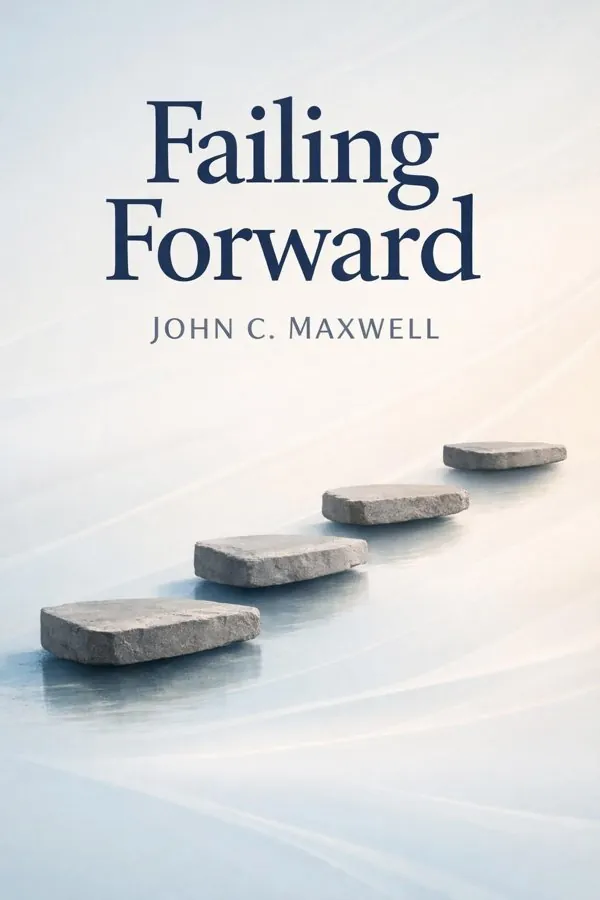
Failing Forward: Turning Mistakes into Stepping Stones for Success: Summary & Key Insights
 10 min9 chaptersAudio available
Key Takeaways from Failing Forward: Turning Mistakes into Stepping Stones for Success
A single setback can either become a stopping point or a starting point.
Many people do not fall short because they lack talent; they fall short because inner barriers quietly sabotage their efforts.
The most successful people are not protected from failure; they are educated by it.
Mistakes become destructive when they trigger shame, denial, or paralysis.
One reason failure feels so devastating is that people often experience it in isolation.
What Is Failing Forward: Turning Mistakes into Stepping Stones for Success About?
Failing Forward: Turning Mistakes into Stepping Stones for Success by John C. Maxwell is a leadership book spanning 8 pages. Failure is one of the few experiences everyone shares, yet most people are taught to fear it, hide it, or treat it as proof that they are not good enough. In Failing Forward, John C. Maxwell challenges that belief and offers a far more empowering idea: failure is not the end of the road, but part of the road to growth, leadership, and meaningful achievement. The book is a practical guide to changing how we think about mistakes, setbacks, rejection, and disappointment so that they become lessons rather than limits. Maxwell argues that the difference between successful people and unsuccessful people is not the absence of failure, but the way they respond to it. Drawing on his decades of leadership teaching, coaching, and writing, he shows how attitude, responsibility, persistence, and self-awareness turn painful experiences into progress. His message is especially powerful in leadership, where risk, uncertainty, and criticism are unavoidable. This book matters because it helps readers replace shame with learning and fear with action. For anyone who has ever felt stuck after a setback, Maxwell offers a hopeful and practical blueprint for moving forward stronger than before.
This FizzRead summary covers all 9 key chapters of Failing Forward: Turning Mistakes into Stepping Stones for Success in approximately 10 minutes, distilling the most important ideas, arguments, and takeaways from John C. Maxwell's work. Also available as an audio summary and Key Quotes Podcast.
Failing Forward: Turning Mistakes into Stepping Stones for Success
Failure is one of the few experiences everyone shares, yet most people are taught to fear it, hide it, or treat it as proof that they are not good enough. In Failing Forward, John C. Maxwell challenges that belief and offers a far more empowering idea: failure is not the end of the road, but part of the road to growth, leadership, and meaningful achievement. The book is a practical guide to changing how we think about mistakes, setbacks, rejection, and disappointment so that they become lessons rather than limits.
Maxwell argues that the difference between successful people and unsuccessful people is not the absence of failure, but the way they respond to it. Drawing on his decades of leadership teaching, coaching, and writing, he shows how attitude, responsibility, persistence, and self-awareness turn painful experiences into progress. His message is especially powerful in leadership, where risk, uncertainty, and criticism are unavoidable.
This book matters because it helps readers replace shame with learning and fear with action. For anyone who has ever felt stuck after a setback, Maxwell offers a hopeful and practical blueprint for moving forward stronger than before.
Who Should Read Failing Forward: Turning Mistakes into Stepping Stones for Success?
This book is perfect for anyone interested in leadership and looking to gain actionable insights in a short read. Whether you're a student, professional, or lifelong learner, the key ideas from Failing Forward: Turning Mistakes into Stepping Stones for Success by John C. Maxwell will help you think differently.
- ✓Readers who enjoy leadership and want practical takeaways
- ✓Professionals looking to apply new ideas to their work and life
- ✓Anyone who wants the core insights of Failing Forward: Turning Mistakes into Stepping Stones for Success in just 10 minutes
Want the full summary?
Get instant access to this book summary and 100K+ more with Fizz Moment.
Get Free SummaryAvailable on App Store • Free to download
Key Chapters
A single setback can either become a stopping point or a starting point. That is the core distinction Maxwell makes between failing backward and failing forward. People who fail backward allow mistakes to define them. They replay the disappointment, internalize the loss, and begin to believe that one bad result says something permanent about their worth or ability. In contrast, people who fail forward experience the same pain, but they process it differently. They ask what happened, what can be learned, and what must change next time.
This idea is powerful because it shifts failure from identity to information. Instead of saying, “I failed, therefore I am a failure,” Maxwell encourages readers to think, “I failed at this attempt, so now I know more than I did before.” That difference may sound small, but it determines whether someone grows or gives up.
In leadership, this distinction shows up constantly. A manager launches an initiative that misses its target. Failing backward means blaming the team, becoming more cautious, and avoiding future innovation. Failing forward means reviewing assumptions, gathering feedback, and applying those lessons to the next strategy. In personal life, a failed job interview can either trigger self-doubt or become a chance to refine communication, improve preparation, and better target future roles.
Maxwell’s message is not that failure feels good. It often does not. The point is that progress belongs to those who decide that failure will educate them instead of imprison them. The practical takeaway: after every setback, write down three lessons, one adjustment, and one immediate next step. That habit trains you to fail forward.
Many people do not fall short because they lack talent; they fall short because inner barriers quietly sabotage their efforts. Maxwell identifies several common causes of failure, including fear, poor self-image, unwillingness to change, lack of persistence, and the tendency to focus on problems rather than possibilities. These patterns are dangerous because they often operate unnoticed. People think circumstances are blocking them, when in reality their mindset is narrowing their options.
Fear is one of the strongest forces Maxwell addresses. Fear of looking foolish keeps people from trying. Fear of rejection keeps them from speaking up. Fear of uncertainty keeps them from pursuing opportunities that could transform their lives. Poor self-image deepens the problem. If someone secretly believes they are not capable or worthy, they will hesitate, underperform, or abandon effort too soon. Add impatience or weak discipline, and even gifted individuals can stall.
Maxwell does not present these causes of failure to blame readers. He presents them so they can be recognized and corrected. A salesperson who avoids making calls because of possible rejection is not doomed; they simply need to build resilience and reframe rejection as part of the process. An aspiring leader who lacks confidence can strengthen self-image through preparation, small wins, mentoring, and honest self-reflection.
The deeper lesson is that external failure often begins as internal surrender. The good news is that inner patterns can change. Once people identify the beliefs and habits that repeatedly trip them up, they regain the power to choose differently. The practical takeaway: identify the top two mental habits that have contributed to your past setbacks, and create a concrete plan to replace each one with a better response.
The most successful people are not protected from failure; they are educated by it. Maxwell emphasizes that achievers see disappointment as data. They do not romanticize mistakes, but they refuse to waste them. Every setback contains information about timing, preparation, assumptions, relationships, strategy, or execution. What sets high performers apart is their willingness to study that information honestly.
This learning mindset creates long-term advantage. Someone who quits after a setback gains only pain. Someone who reflects deeply gains pain plus wisdom. Over time, that accumulated wisdom becomes judgment, and judgment improves future performance. This is why experience matters so much in leadership and business: not because time alone teaches, but because reflective experience teaches.
Consider an entrepreneur whose first product launch fails. A defensive response might blame the market and move on emotionally unchanged. A learning response would examine customer needs, messaging, pricing, distribution, and product design. The same principle applies to everyday life. A difficult conversation that goes badly can reveal problems in tone, timing, assumptions, or listening skills. If the person reflects rather than reacts, future conversations improve.
Maxwell’s approach also requires humility. Learning from failure means admitting that something about your method, decision, or preparation was incomplete. That can sting, especially for leaders who feel pressure to look confident. Yet humility is not weakness here; it is the doorway to progress. People who always need to appear right rarely become better.
The practical takeaway: conduct a short “failure review” after any disappointing result. Ask four questions: What worked? What did not work? What did I assume that proved wrong? What will I do differently next time? Turn every loss into a lesson plan.
Mistakes become destructive when they trigger shame, denial, or paralysis. Maxwell argues that one of the most important success skills is learning to respond to mistakes with a constructive attitude. A positive attitude does not mean pretending everything is fine or refusing to feel disappointment. It means choosing a posture of growth instead of defeat. It means believing that mistakes are temporary events, not final verdicts.
This shift matters because attitude shapes behavior. When people treat mistakes as proof of inadequacy, they hide them, repeat them, or overcorrect in fearful ways. When they treat mistakes as normal and instructive, they become more open, adaptable, and resilient. Teams led by such people also become healthier. In workplaces where leaders punish every mistake harshly, innovation dies. In workplaces where errors are examined intelligently, people learn faster and improve systems more effectively.
A positive response to mistakes also reduces emotional distortion. Right after failure, people often exaggerate. A missed opportunity becomes “I never get things right.” A weak presentation becomes “I am terrible at public speaking.” Maxwell pushes readers to reject this kind of self-talk. The truth is almost always narrower and more manageable: “That presentation did not go well, and I can improve my structure and delivery.”
Practical optimism allows for both honesty and hope. Parents can use this with children by praising effort, reflection, and improvement instead of demanding perfection. Leaders can normalize post-project learning reviews. Individuals can practice self-correction without self-condemnation.
The practical takeaway: the next time you make a mistake, avoid emotional labels and describe it objectively in one sentence. Then identify one lesson and one improvement. This simple habit helps convert frustration into forward motion.
One reason failure feels so devastating is that people often experience it in isolation. Maxwell counters this by reminding readers that nearly every accomplished person has a history of setbacks, rejection, embarrassment, or delay. Success stories usually look smooth in hindsight, but real growth is messy. Learning from the failures of others helps readers normalize their own struggles and borrow tested strategies for resilience.
This principle matters because examples reshape belief. When people see that admired leaders, inventors, athletes, and entrepreneurs faced repeated defeats before succeeding, failure loses some of its power to intimidate. It becomes less a sign of personal inadequacy and more a common stage in achievement. Maxwell uses stories of successful individuals to show that persistence, adaptation, and purpose often matter more than early results.
For instance, many business leaders launched ideas that failed before finding a workable model. Many writers were rejected repeatedly before publication. Many speakers gave poor early presentations before becoming persuasive communicators. These stories are not just motivational. They reveal patterns: achievers keep learning, stay connected to purpose, seek feedback, and continue acting before they feel fully confident.
Readers can apply this idea by building a personal library of resilience. Instead of consuming only polished success narratives, look for biographies, interviews, and case studies that include the struggle. Ask: What obstacle did this person face? How did they respond? What changed in their thinking or strategy? Those answers provide practical models for your own setbacks.
The practical takeaway: choose one person you admire and study the failures behind their success. Write down three principles from their journey that you can apply to your current challenge. Borrow courage from real examples.
Blame may protect the ego for a moment, but it weakens growth. Maxwell insists that one of the defining traits of people who fail forward is personal responsibility. They do not deny that circumstances, other people, or unfair systems can influence outcomes. But they focus first on what they can own, improve, and control. That mindset creates resilience because it keeps power in the hands of the learner rather than the excuse-maker.
Responsibility is not the same as harsh self-criticism. It is a sober commitment to truth. If a project failed because communication was unclear, a responsible leader addresses communication. If a relationship suffered because of avoidance, a responsible person learns to have difficult conversations earlier. This habit accelerates growth because every honest admission becomes a point of leverage.
Resilience grows out of this process. When people stop expecting an easy path, they become less fragile when obstacles appear. They understand that difficulty is part of meaningful effort, not evidence that they should quit. Maxwell encourages readers to develop emotional endurance, to recover quickly, and to keep moving without becoming bitter.
In practical terms, resilient people build support systems, maintain perspective, and refuse to let one event determine their future. They may rest, grieve, reassess, and change strategy, but they do not surrender their long-term purpose. This is especially important in leadership, where criticism and setbacks are unavoidable. Teams trust leaders who can admit mistakes, learn openly, and keep moving with composure.
The practical takeaway: after a setback, list what was outside your control and what was inside your control. Spend your energy on the second list. Ownership is the fastest path from disappointment to strength.
Hope without a plan rarely changes anything. Maxwell goes beyond mindset and urges readers to create a personal growth strategy that includes deliberate risk. If failure is part of success, then avoiding all risk is actually a quiet way of avoiding growth. People often say they want better results while keeping the same routines, same comfort zone, and same level of exposure. Maxwell argues that progress requires intentional stretching.
A growth plan gives failure context. Without a plan, setbacks feel random and discouraging. With a plan, they become expected checkpoints in development. For example, someone who wants to become a better leader might set goals around public speaking, delegation, mentoring, and conflict resolution. Each effort may include mistakes, but those mistakes are no longer pointless; they are part of a defined process of improvement.
Risk is essential here because new levels always involve unfamiliar territory. Starting a business, changing careers, speaking publicly, or leading a team all carry the possibility of failure. Yet the greater risk is often staying where you are while your potential remains unused. Maxwell encourages readers to choose purposeful risk rather than passive safety.
This idea also invites incremental courage. You do not need one giant leap. You can take structured risks: volunteer to lead a meeting, pitch one new idea, apply for one stretch role, ask for feedback from one trusted mentor. Over time, repeated exposure builds confidence and competence.
The practical takeaway: create a 90-day growth plan with one clear skill goal, one measurable action each week, and one intentional risk you will take. Review your progress monthly and record what each setback teaches you.
Courage is not the absence of fear; it is movement in spite of fear. Maxwell repeatedly returns to the idea that waiting to feel perfectly ready is a trap. Fear rarely disappears before action. More often, clarity and confidence grow after action begins. This is why successful people learn to interpret failure as feedback rather than as a verdict on their future.
Feedback is one of the most practical reframes in the book. If an attempt does not work, it is telling you something. Maybe the timing was wrong. Maybe the preparation was thin. Maybe the message missed the audience. Maybe the goal itself needs revision. Seen this way, failure is not meaningless pain but directional information. The challenge is emotional: can you stay open enough to receive the lesson without collapsing under the discomfort?
This approach transforms performance in every domain. In sales, a rejected pitch can reveal customer objections that sharpen the next conversation. In leadership, resistance from a team may reveal a communication gap rather than a bad idea. In creative work, criticism may point toward stronger execution. Action creates feedback; feedback creates learning; learning creates improvement.
Maxwell’s view is especially relevant for people trapped in overthinking. Perfectionism often disguises fear. People want certainty before beginning, but certainty is rarely available. Progress comes from trying, adjusting, and trying again. Leaders who embrace this become more agile, and teams under them become more innovative because they are not paralyzed by the possibility of being wrong.
The practical takeaway: choose one action you have been postponing out of fear and do it within 48 hours. Then collect feedback, separate useful insight from emotion, and apply one concrete improvement immediately.
Many people suffer unnecessarily because they define success too narrowly. Maxwell encourages readers to see success not as a single event, trophy, or flawless outcome, but as a lifelong process of growth, contribution, and persistence. When success is defined only by immediate results, failure becomes unbearable. But when success includes learning, character development, and repeated effort, setbacks lose their power to destroy momentum.
This broader definition is especially important in leadership. A leader may not achieve every goal on the first attempt, but if they are growing in judgment, building trust, and improving their team’s capacity, they are moving toward real success. The same applies personally. Someone trying to improve health, finances, relationships, or confidence may experience setbacks, but those setbacks do not erase progress. They are part of the longer path.
Maxwell’s perspective frees readers from all-or-nothing thinking. A failed deal does not mean a failed career. A rough season does not mean a wasted life. Long-term success belongs to people who remain teachable over time. They understand that excellence is cumulative. Small lessons, repeated adjustments, and consistent effort eventually compound into meaningful achievement.
This redefinition also protects against arrogance. If success is a journey, then no one is finished learning. Past victories do not remove the need for humility, reflection, and growth. This makes the book especially useful for experienced leaders who may be tempted to rely too heavily on past formulas.
The practical takeaway: rewrite your personal definition of success to include growth, resilience, and contribution, not just outcomes. Then measure your progress weekly by asking, “What did I learn? How did I improve? Whom did I help?”
All Chapters in Failing Forward: Turning Mistakes into Stepping Stones for Success
About the Author
John C. Maxwell is a bestselling American author, leadership speaker, and coach whose work has influenced millions of readers and leaders around the world. He is widely recognized for making leadership principles practical, accessible, and actionable across business, nonprofit, educational, and personal settings. Over the course of his career, he has written dozens of books on leadership, growth, communication, teamwork, and success, including several international bestsellers. Maxwell has also founded organizations focused on leadership training and development, helping equip individuals and teams in many countries. His teaching combines clear frameworks, personal stories, and motivational insight, with a strong emphasis on character and continual improvement. In Failing Forward, he applies that leadership wisdom to one of the most universal experiences of all: learning how to respond to failure in a way that leads to growth and long-term achievement.
Get This Summary in Your Preferred Format
Read or listen to the Failing Forward: Turning Mistakes into Stepping Stones for Success summary by John C. Maxwell anytime, anywhere. FizzRead offers multiple formats so you can learn on your terms — all free.
Available formats: App · Audio · PDF · EPUB — All included free with FizzRead
Download Failing Forward: Turning Mistakes into Stepping Stones for Success PDF and EPUB Summary
Key Quotes from Failing Forward: Turning Mistakes into Stepping Stones for Success
“A single setback can either become a stopping point or a starting point.”
“Many people do not fall short because they lack talent; they fall short because inner barriers quietly sabotage their efforts.”
“The most successful people are not protected from failure; they are educated by it.”
“Mistakes become destructive when they trigger shame, denial, or paralysis.”
“One reason failure feels so devastating is that people often experience it in isolation.”
Frequently Asked Questions about Failing Forward: Turning Mistakes into Stepping Stones for Success
Failing Forward: Turning Mistakes into Stepping Stones for Success by John C. Maxwell is a leadership book that explores key ideas across 9 chapters. Failure is one of the few experiences everyone shares, yet most people are taught to fear it, hide it, or treat it as proof that they are not good enough. In Failing Forward, John C. Maxwell challenges that belief and offers a far more empowering idea: failure is not the end of the road, but part of the road to growth, leadership, and meaningful achievement. The book is a practical guide to changing how we think about mistakes, setbacks, rejection, and disappointment so that they become lessons rather than limits. Maxwell argues that the difference between successful people and unsuccessful people is not the absence of failure, but the way they respond to it. Drawing on his decades of leadership teaching, coaching, and writing, he shows how attitude, responsibility, persistence, and self-awareness turn painful experiences into progress. His message is especially powerful in leadership, where risk, uncertainty, and criticism are unavoidable. This book matters because it helps readers replace shame with learning and fear with action. For anyone who has ever felt stuck after a setback, Maxwell offers a hopeful and practical blueprint for moving forward stronger than before.
More by John C. Maxwell

Developing the Leader Within You
John C. Maxwell
10 min
Intentional Living: Choosing a Life That Matters
John C. Maxwell
10 min
How Successful People Lead: Taking Your Influence to the Next Level
John C. Maxwell
10 min
The Leader's Greatest Return: Attracting, Developing, and Multiplying Leaders
John C. Maxwell
10 minYou Might Also Like

Extreme Ownership
Jocko Willink
10 min
Dare to Lead
Brene Brown
10 min
Leaders Eat Last
Simon Sinek
10 min
The 21 Irrefutable Laws of Leadership
John Maxwell
10 min
Start With Why
Simon Sinek
10 min
How to Lead When You're Not in Charge
Clay Scroggins
10 minBrowse by Category
Ready to read Failing Forward: Turning Mistakes into Stepping Stones for Success?
Get the full summary and 100K+ more books with Fizz Moment.