
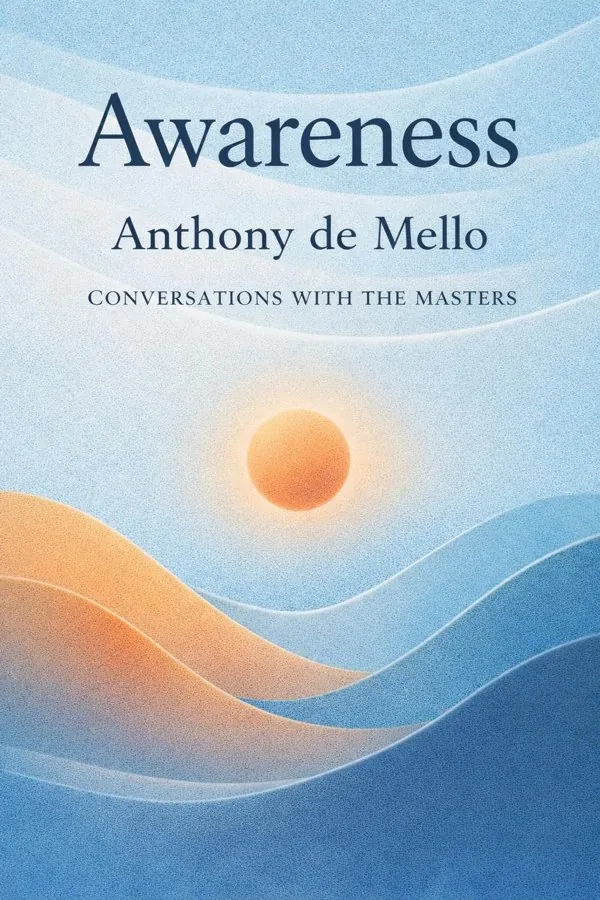
Awareness: Conversations with the Masters: Summary & Key Insights
 10 min9 chaptersAudio available
Key Takeaways from Awareness: Conversations with the Masters
One of the book’s most startling claims is that much of your suffering comes from protecting an identity that is largely imagined.
Most people think awareness is something they must force, but de Mello says real awareness is effortless seeing.
A central theme of the book is that most people do not see reality as it is; they see it through conditioning.
De Mello makes a difficult but liberating distinction: enjoyment is not the problem, attachment is.
According to de Mello, suffering is often not just a painful event but a diagnostic tool.
What Is Awareness: Conversations with the Masters About?
Awareness: Conversations with the Masters by Anthony de Mello is a eastern_wisdom book spanning 9 pages. Awareness: Conversations with the Masters is a bold, unsettling, and deeply liberating book about waking up from the mental and emotional habits that govern most human life. In a series of sharp, conversational reflections, Anthony de Mello argues that people are rarely in direct contact with reality. Instead, they live through conditioning, social approval, fear, attachment, and a false sense of self. His invitation is not to become more religious, more moral, or more successful, but more awake. That awakening begins with simple, honest awareness. What makes this book matter is its refusal to comfort the reader with easy inspiration. De Mello challenges cherished assumptions about love, ambition, suffering, spirituality, and personal identity. He does so with clarity, humor, and a rare ability to expose self-deception without becoming abstract. As an Indian Jesuit priest, psychotherapist, and spiritual teacher influenced by both Christian and Eastern traditions, de Mello speaks with unusual authority across spiritual worlds. His message is timeless: freedom does not come from changing the world first, but from seeing clearly how your mind creates bondage. For readers seeking inner freedom rather than self-improvement slogans, this book remains strikingly relevant.
This FizzRead summary covers all 9 key chapters of Awareness: Conversations with the Masters in approximately 10 minutes, distilling the most important ideas, arguments, and takeaways from Anthony de Mello's work. Also available as an audio summary and Key Quotes Podcast.
Awareness: Conversations with the Masters
Awareness: Conversations with the Masters is a bold, unsettling, and deeply liberating book about waking up from the mental and emotional habits that govern most human life. In a series of sharp, conversational reflections, Anthony de Mello argues that people are rarely in direct contact with reality. Instead, they live through conditioning, social approval, fear, attachment, and a false sense of self. His invitation is not to become more religious, more moral, or more successful, but more awake. That awakening begins with simple, honest awareness.
What makes this book matter is its refusal to comfort the reader with easy inspiration. De Mello challenges cherished assumptions about love, ambition, suffering, spirituality, and personal identity. He does so with clarity, humor, and a rare ability to expose self-deception without becoming abstract. As an Indian Jesuit priest, psychotherapist, and spiritual teacher influenced by both Christian and Eastern traditions, de Mello speaks with unusual authority across spiritual worlds. His message is timeless: freedom does not come from changing the world first, but from seeing clearly how your mind creates bondage. For readers seeking inner freedom rather than self-improvement slogans, this book remains strikingly relevant.
Who Should Read Awareness: Conversations with the Masters?
This book is perfect for anyone interested in eastern_wisdom and looking to gain actionable insights in a short read. Whether you're a student, professional, or lifelong learner, the key ideas from Awareness: Conversations with the Masters by Anthony de Mello will help you think differently.
- ✓Readers who enjoy eastern_wisdom and want practical takeaways
- ✓Professionals looking to apply new ideas to their work and life
- ✓Anyone who wants the core insights of Awareness: Conversations with the Masters in just 10 minutes
Want the full summary?
Get instant access to this book summary and 100K+ more with Fizz Moment.
Get Free SummaryAvailable on App Store • Free to download
Key Chapters
One of the book’s most startling claims is that much of your suffering comes from protecting an identity that is largely imagined. De Mello argues that the person you spend so much energy defending, polishing, and promoting is not your true self but a socially constructed image. It is made of labels, roles, reputation, memories, ambitions, and the opinions of others. You call it “me,” but in practice it is a fragile performance.
This false self is built through conditioning. From childhood, you are taught who you should be: intelligent, obedient, successful, attractive, spiritual, respectable, or important. Over time, you become attached to these images and fear anything that threatens them. A criticism feels like an attack. Failure feels like annihilation. Rejection feels unbearable. The problem is not simply pain; it is identification. You believe that your image is your life.
De Mello’s point is not that personality disappears or that practical identity has no value. Rather, he distinguishes between useful social roles and deep psychological attachment. You can be a parent, teacher, manager, or friend without being imprisoned by those roles. Freedom begins when you see that your worth does not depend on maintaining a flattering concept of yourself.
In everyday life, this idea becomes practical very quickly. Notice how often your mood changes because someone praises or ignores you. Notice the anxiety before a performance, meeting, or social interaction. Much of it comes from trying to manage an image. Awareness loosens that compulsion.
Actionable takeaway: For one day, observe every moment you feel defensive, embarrassed, proud, or eager to impress. Ask quietly, “What image of myself am I trying to protect right now?”
Most people think awareness is something they must force, but de Mello says real awareness is effortless seeing. It is not analysis, self-judgment, or mental control. It is the simple capacity to observe what is happening within and around you without immediately distorting it through fear, desire, or opinion. Awareness does not manufacture peace; it reveals reality. And reality, when clearly seen, has a way of dissolving confusion.
This matters because many attempts at spiritual growth become subtle forms of struggle. People try to become calmer, kinder, holier, or more mindful through willpower. They monitor themselves constantly, hoping to create an ideal inner state. But this often strengthens the ego rather than weakens it. The observer becomes another manager, another controller, another self-image.
De Mello invites a more direct approach. Instead of trying to change jealousy, watch jealousy. Instead of trying to suppress fear, notice how fear appears in the body, the thoughts, the stories. Instead of saying, “I should not feel this,” say, “This is what is present.” That shift from resistance to observation is transformative.
For example, imagine you are irritated by a colleague. Normally, the mind quickly builds a case: they are rude, unfair, incompetent, or disrespectful. Awareness interrupts the story and notices the raw experience: tension, hurt pride, expectation, comparison. You begin to see that your reaction is not only about the other person but also about your conditioning.
Actionable takeaway: Practice three pauses a day. Stop for one minute and notice your thoughts, body sensations, and emotions without trying to alter them. Name what is present, then let it be.
A central theme of the book is that most people do not see reality as it is; they see it through conditioning. Your mind has been programmed by family, religion, culture, education, trauma, ideology, and habit. As a result, your reactions often feel natural or rational when they are actually inherited patterns. You think you are choosing freely, but much of the time you are repeating what has been installed in you.
De Mello is especially sharp on the way conditioning affects values. You may pursue money, romance, status, approval, success, or even holiness not because these things genuinely matter to you, but because you were taught they should. You may dislike people because of group identities, admire others because of prestige, or judge yourself because you do not fit a social script. These reactions can feel deeply personal while being largely borrowed.
The first step toward freedom is not to replace one set of beliefs with another, but to notice the machinery itself. Why does criticism upset you so much? Why does one career path seem noble and another shameful? Why does being alone feel like failure? Often the answers reveal hidden programming.
In practical terms, this insight changes how you relate to your daily preferences and emotional triggers. Suppose you feel inferior when a friend buys a larger house or gets a promotion. Awareness asks: is this genuine need, or social conditioning about success? That question can break the spell.
De Mello does not suggest rejecting all culture or tradition. He suggests seeing clearly enough that you are no longer unconsciously ruled by them.
Actionable takeaway: Pick one recurring desire or insecurity and trace its origins. Ask, “Who taught me this matters so much?” Write down your answers honestly.
De Mello makes a difficult but liberating distinction: enjoyment is not the problem, attachment is. You can appreciate people, possessions, success, health, and comfort. Bondage begins when your peace depends on them. The attached mind says, “I must have this to be okay,” or “I cannot lose this and remain whole.” At that point, life becomes fear-driven.
Attachment is often mistaken for love, dedication, or ambition. But beneath it lies dependency. If you need another person’s approval in order to feel worthy, that is not love but psychological hunger. If you need constant success to feel real, that is not excellence but bondage. When your identity and emotional stability rest on external conditions, you become vulnerable to anxiety, jealousy, control, and despair.
De Mello does not advocate indifference or withdrawal. He does not tell you to stop caring. Rather, he invites you to care without clinging. You can love someone deeply without trying to possess them. You can work passionately without making your self-worth depend on the outcome. You can enjoy beauty without panicking at its impermanence.
Consider a parent who wants the best for a child. Care is natural, but attachment says, “My child must live according to my expectations, or I will feel devastated.” The child becomes an extension of the parent’s identity. Awareness exposes this dynamic and creates space for wiser love.
Freedom from attachment does not make life flat. It makes it lighter, less desperate, less manipulative. You become able to receive joy fully because you are no longer trying to imprison it.
Actionable takeaway: Notice one thing you deeply value and ask, “If this changed or disappeared, what story would I tell about myself?” That story often reveals the attachment.
According to de Mello, suffering is often not just a painful event but a diagnostic tool. It shows you where you are attached, deceived, or asleep. This does not mean all pain is chosen or that tragedy is unreal. Loss, illness, rejection, and disappointment are part of human life. But the psychological suffering layered on top of these experiences frequently comes from resistance, expectation, and false belief.
When something painful happens, the mind immediately asks, “Why me?” or “How could this happen?” Behind these reactions is usually an assumption that life was supposed to obey your plans. Suffering intensifies when reality contradicts your script. The event hurts, but the collapse of expectation hurts even more.
De Mello encourages readers to use suffering as a doorway to awareness. If jealousy appears, what attachment does it expose? If loneliness becomes unbearable, what does it reveal about your dependency on external validation? If failure crushes you, what image of yourself has been threatened? Suffering becomes instructive when it is observed rather than dramatized.
This perspective is practical in ordinary disappointments as well as major crises. Imagine not getting a job you wanted. The initial pain is natural. But awareness may reveal additional suffering created by thoughts such as “I am nobody now,” “Others are ahead of me,” or “My future is ruined.” Once seen, these mental additions lose some of their power.
De Mello’s point is compassionate, not cold: pain can awaken you if you stop using it only to reinforce your stories.
Actionable takeaway: The next time you suffer emotionally, separate the facts from the interpretation. Write two lists: “What happened” and “What I am telling myself about what happened.”
One of de Mello’s most challenging ideas is that what many people call love is actually attachment, dependency, or control. True love, in his view, is impossible without inner freedom. If you need someone in order to feel secure, complete, or important, your relationship may contain affection, devotion, and tenderness, but it is also shaped by fear. Fear of loss, fear of abandonment, fear of not being enough.
This kind of dependency easily becomes possessive. You want the other person to behave in ways that protect your comfort. You become upset not only because they suffer, but because their choices disturb your emotional equilibrium. In subtle ways, you ask them to manage your inner life.
De Mello does not dismiss closeness or intimacy. He wants something deeper than emotional bargaining. Genuine love allows the other person to be themselves. It does not erase boundaries, but it does reduce the urge to own, manipulate, or extract constant reassurance. Detached love is not coldness; it is care without captivity.
This insight applies beyond romance. Parents may control children in the name of love. Friends may become resentful when loyalty is not returned on their terms. Even helping others can become egoic if you need to be needed.
A simple example: if a friend cancels plans, attachment quickly says, “I am not important.” Love sees the disappointment but does not transform it into a crisis of identity. It responds proportionately.
To love well, de Mello suggests, you must first see how much fear and need are mixed into your affection. Awareness purifies love by removing dependence.
Actionable takeaway: In one important relationship, ask yourself, “Where am I loving, and where am I demanding?” Be specific, and choose one controlling habit to soften this week.
It sounds paradoxical, but de Mello warns that the desire to improve yourself can become another trap. Much personal growth is fueled by dissatisfaction with who you are. You want to become calmer, more impressive, more spiritual, more disciplined, more admired. But if that effort is driven by self-rejection, it simply refines the ego instead of freeing you from it. You become a more sophisticated version of the same restless self.
This is why endless striving often produces anxiety rather than peace. There is always another ideal to reach. You compare yourself to an imagined better self and feel perpetually inadequate. Even spiritual practices can become vanity projects. You meditate to become superior. You serve to feel noble. You read wisdom texts to enhance identity.
De Mello’s alternative is radical honesty rather than self-manufacture. See your anger, vanity, fear, laziness, ambition, and insecurity clearly. Not to condemn them, not to excuse them, but to understand them. Awareness itself begins to transform what force cannot.
Imagine someone who wants to become more patient. The usual route is suppression: “I must not get irritated.” But irritation stays active beneath the surface. De Mello would advise observing impatience in real time: the tightening body, the expectation of speed, the entitlement, the inner narrative. As these mechanics become visible, patience emerges more naturally.
This does not mean abandoning growth. It means replacing compulsive self-editing with lucid awareness. Change that arises from seeing is more stable than change imposed by will.
Actionable takeaway: Replace one “I should be different” thought with a question: “What is actually happening in me right now?” Stay with observation before making any correction.
De Mello repeatedly brings the reader back to the present moment, not as a slogan but as a fact of freedom. Most people live in memory and anticipation. They replay old injuries, rehearse future scenarios, and rarely meet the life unfolding in front of them. The mind is occupied with what was lost, what might happen, or how things should be. In that mental noise, reality is missed.
Living in the present does not mean ignoring the future or forgetting the past. It means refusing to be psychologically colonized by them. Practical planning is useful. Obsessive mental occupation is bondage. The present is where life is actually lived, where awareness functions, and where change can occur.
This insight is especially relevant in a culture of distraction. Many people eat without tasting, listen without hearing, walk without noticing, work without presence, and speak without attention. They are physically somewhere and mentally elsewhere. De Mello sees this fragmentation as a form of sleep.
The practice is simple but not easy: return to immediate experience. Feel your breath. Hear the sounds in the room. Notice the sensations in your body. Attend fully to the person in front of you. When the mind drifts into fantasy or rumination, gently come back.
For example, if you are worrying about tomorrow’s meeting, awareness asks whether the meeting is happening now. If not, can you prepare appropriately and then return to the current task? This shift restores energy that anxiety consumes.
Actionable takeaway: Choose one routine activity today, such as drinking coffee, walking, or washing dishes, and do it with complete attention, without multitasking or mental escape.
The transformation de Mello points toward is not dramatic self-reinvention but awakening. Awakening is the gradual or sudden recognition that you have been living through illusions: false identity, compulsive desire, unconscious fear, social conditioning, and emotional dependency. Once seen clearly, these patterns do not disappear instantly, but their authority weakens. You stop obeying every thought and emotion as if it were truth.
Importantly, awakening is not the acquisition of special experiences. It is not mystical performance, moral superiority, or a new spiritual identity. In fact, de Mello distrusts all forms of spiritual vanity. Awakening often looks ordinary from the outside. A person becomes less reactive, less needy, less fearful, less controlled by praise and blame. They begin to respond rather than mechanically react.
This change affects every sphere of life. Work becomes less ego-driven. Relationships become less possessive. Suffering becomes more intelligible. Solitude becomes less threatening. Religion becomes less about belief and more about direct seeing. Even joy becomes simpler, because it is no longer burdened by grasping.
A helpful example is conflict. Before awakening, criticism may trigger instant defensiveness. After some awareness, criticism is still felt, but there is space. You notice the sting, the story, the urge to retaliate. In that pause, freedom appears. You may still respond firmly, but no longer automatically.
De Mello’s promise is not perfection. It is lucidity. And lucidity is enough to begin reshaping a life.
Actionable takeaway: At the end of each day, reflect on one moment when you reacted automatically and one moment when you were conscious. Learn to recognize the difference, without self-blame.
All Chapters in Awareness: Conversations with the Masters
About the Author
Anthony de Mello (1931–1987) was an Indian Jesuit priest, psychotherapist, speaker, and spiritual teacher whose work continues to influence readers across religious and secular audiences. Born in Mumbai, he entered the Society of Jesus and later became known for leading retreats that combined Christian spirituality with insights from Eastern traditions, especially Buddhism and Hindu philosophy. De Mello had a rare gift for making profound spiritual ideas feel immediate, practical, and psychologically precise. His teachings centered on awareness, inner freedom, and liberation from conditioning, attachment, and ego. Through books such as Awareness, The Way to Love, and Sadhana, he challenged readers to move beyond dogma and into direct perception. His voice remains distinctive for its clarity, humor, and uncompromising call to wake up.
Get This Summary in Your Preferred Format
Read or listen to the Awareness: Conversations with the Masters summary by Anthony de Mello anytime, anywhere. FizzRead offers multiple formats so you can learn on your terms — all free.
Available formats: App · Audio · PDF · EPUB — All included free with FizzRead
Download Awareness: Conversations with the Masters PDF and EPUB Summary
Key Quotes from Awareness: Conversations with the Masters
“One of the book’s most startling claims is that much of your suffering comes from protecting an identity that is largely imagined.”
“Most people think awareness is something they must force, but de Mello says real awareness is effortless seeing.”
“A central theme of the book is that most people do not see reality as it is; they see it through conditioning.”
“De Mello makes a difficult but liberating distinction: enjoyment is not the problem, attachment is.”
“According to de Mello, suffering is often not just a painful event but a diagnostic tool.”
Frequently Asked Questions about Awareness: Conversations with the Masters
Awareness: Conversations with the Masters by Anthony de Mello is a eastern_wisdom book that explores key ideas across 9 chapters. Awareness: Conversations with the Masters is a bold, unsettling, and deeply liberating book about waking up from the mental and emotional habits that govern most human life. In a series of sharp, conversational reflections, Anthony de Mello argues that people are rarely in direct contact with reality. Instead, they live through conditioning, social approval, fear, attachment, and a false sense of self. His invitation is not to become more religious, more moral, or more successful, but more awake. That awakening begins with simple, honest awareness. What makes this book matter is its refusal to comfort the reader with easy inspiration. De Mello challenges cherished assumptions about love, ambition, suffering, spirituality, and personal identity. He does so with clarity, humor, and a rare ability to expose self-deception without becoming abstract. As an Indian Jesuit priest, psychotherapist, and spiritual teacher influenced by both Christian and Eastern traditions, de Mello speaks with unusual authority across spiritual worlds. His message is timeless: freedom does not come from changing the world first, but from seeing clearly how your mind creates bondage. For readers seeking inner freedom rather than self-improvement slogans, this book remains strikingly relevant.
You Might Also Like
A New Earth
Eckhart Tolle
10 min
The Daily Stoic
Ryan Holiday, Stephen Hanselman
10 min
Buddhism: Plain and Simple
Steve Hagen
10 min
Enchiridion
Epictetus
10 min
The Book of Tea
Kakuzō Okakura
10 min
The Light We Give: How Sikh Wisdom Can Transform Your Life
Simran Jeet Singh
10 minFeatured In
Browse by Category
Ready to read Awareness: Conversations with the Masters?
Get the full summary and 100K+ more books with Fizz Moment.