
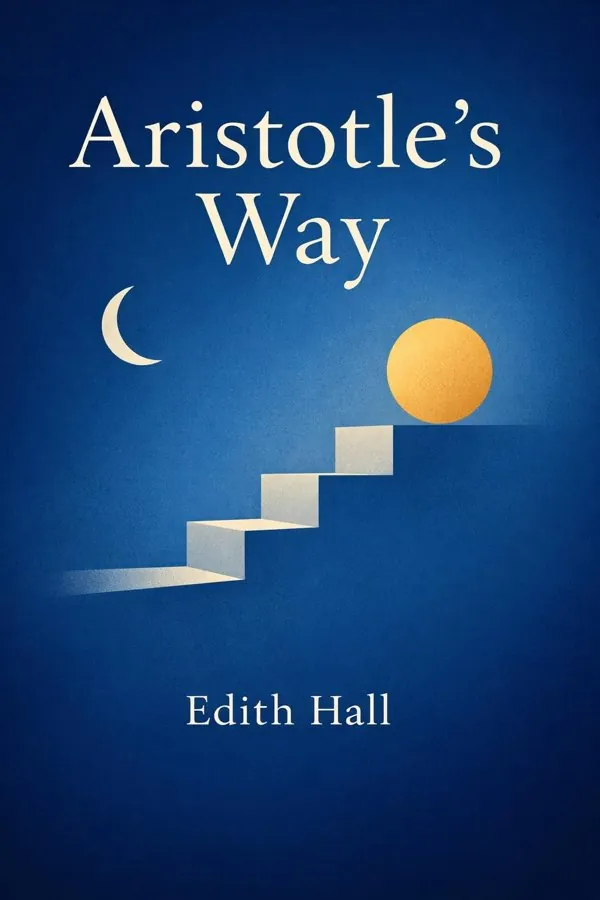
Aristotle's Way: How Ancient Wisdom Can Change Your Life: Summary & Key Insights
by Edith Hall
 10 min11 chaptersAudio available
What Is Aristotle's Way: How Ancient Wisdom Can Change Your Life About?
Aristotle's Way: How Ancient Wisdom Can Change Your Life by Edith Hall is a eastern_wisdom book spanning 11 pages. In this engaging and accessible work, classicist Edith Hall explores how Aristotle’s philosophy can guide us toward a happier and more meaningful life. Drawing on Aristotle’s teachings about ethics, friendship, purpose, and virtue, Hall translates ancient wisdom into practical advice for modern readers seeking fulfillment and balance.
This FizzRead summary covers all 11 key chapters of Aristotle's Way: How Ancient Wisdom Can Change Your Life in approximately 10 minutes, distilling the most important ideas, arguments, and takeaways from Edith Hall's work. Also available as an audio summary and Key Quotes Podcast.
Aristotle's Way: How Ancient Wisdom Can Change Your Life
In this engaging and accessible work, classicist Edith Hall explores how Aristotle’s philosophy can guide us toward a happier and more meaningful life. Drawing on Aristotle’s teachings about ethics, friendship, purpose, and virtue, Hall translates ancient wisdom into practical advice for modern readers seeking fulfillment and balance.
Who Should Read Aristotle's Way: How Ancient Wisdom Can Change Your Life?
This book is perfect for anyone interested in eastern_wisdom and looking to gain actionable insights in a short read. Whether you're a student, professional, or lifelong learner, the key ideas from Aristotle's Way: How Ancient Wisdom Can Change Your Life by Edith Hall will help you think differently.
- ✓Readers who enjoy eastern_wisdom and want practical takeaways
- ✓Professionals looking to apply new ideas to their work and life
- ✓Anyone who wants the core insights of Aristotle's Way: How Ancient Wisdom Can Change Your Life in just 10 minutes
Want the full summary?
Get instant access to this book summary and 100K+ more with Fizz Moment.
Get Free SummaryAvailable on App Store • Free to download
Key Chapters
Eudaimonia is the foundation of all Aristotelian ethics and the guiding star of this book’s journey. Aristotle begins his Nicomachean Ethics with the profound question: what is the ultimate good at which every human activity aims? The answer is eudaimonia—living well and doing well. Unlike fleeting happiness, it represents a whole-life condition where one’s rational, emotional, and moral faculties all harmonize. To live eudaimonically means realizing your full human potential, exercising your capacities of thought, emotion, and action, in accordance with virtue.
In today’s culture, we tend to equate happiness with satisfaction or external achievements. Aristotle, however, insists that flourishing is not granted by fortune or status; it is cultivated through conscious effort and self-mastery. You can lose material wealth or reputation, he says, yet still sustain your eudaimonia if your inner disposition of virtue remains intact. In my interpretation, Aristotle’s insight offers a vital correction to the modern obsession with outcomes: it calls us back to processes, character, and integrity.
When you live according to reason, governing your impulses and shaping your habits deliberately, you gradually build a moral architecture within yourself. The goal is not perfection but balance. Aristotle’s happiness is dynamic—it lives in the way you navigate change, meet adversity, and choose courage or temperance in real moments. Thus, eudaimonia is self-earned and deeply personal, not a gift from luck but the art of living with purpose.
Aristotle’s second major gift to our self-understanding is his concept of telos, meaning an inherent purpose or end. Everything in the universe, he argues, has a function toward which it naturally strives. The telos of a seed is a mature plant; of a musician, harmony; of a human being, rational and virtuous activity. Our fulfillment, therefore, lies in aligning what we do with what we are made to do best.
In a modern context, this teaching resonates as a framework for self-determination. Many of us drift from one external expectation to another: career, status, consumption. Aristotle challenges us to reverse the direction of that search—from outward goals to inner potentialities. The question becomes, not ‘What should I achieve?’ but ‘Who am I meant to become?’
Through this lens, purpose ceases to be an abstract moral command and becomes a process of discovery. We identify our telos through reflection, curiosity, and practice. The happiest lives, Aristotle reminds us, belong to those who devote their energies to activities expressing their essential capacities. A scientist reasoning through complexity, a teacher fostering understanding, a craftsperson honing excellence—all embody purpose not by chance, but by living their telos intentionally.
Today, reclaiming this sense of purpose can anchor us amid distraction. It invites us to reconnect with what we do out of love, mastery, and service. Only when function and aspiration converge do we feel the deep satisfaction of meaningful endeavor.
+ 9 more chapters — available in the FizzRead app
All Chapters in Aristotle's Way: How Ancient Wisdom Can Change Your Life
About the Author
Edith Hall is a British classicist, cultural historian, and professor known for her work on ancient Greek literature and philosophy. She has written extensively on classical reception and the relevance of ancient thought to contemporary life.
Get This Summary in Your Preferred Format
Read or listen to the Aristotle's Way: How Ancient Wisdom Can Change Your Life summary by Edith Hall anytime, anywhere. FizzRead offers multiple formats so you can learn on your terms — all free.
Available formats: App · Audio · PDF · EPUB — All included free with FizzRead
Download Aristotle's Way: How Ancient Wisdom Can Change Your Life PDF and EPUB Summary
Key Quotes from Aristotle's Way: How Ancient Wisdom Can Change Your Life
“Eudaimonia is the foundation of all Aristotelian ethics and the guiding star of this book’s journey.”
“Aristotle’s second major gift to our self-understanding is his concept of telos, meaning an inherent purpose or end.”
Frequently Asked Questions about Aristotle's Way: How Ancient Wisdom Can Change Your Life
Aristotle's Way: How Ancient Wisdom Can Change Your Life by Edith Hall is a eastern_wisdom book that explores key ideas across 11 chapters. In this engaging and accessible work, classicist Edith Hall explores how Aristotle’s philosophy can guide us toward a happier and more meaningful life. Drawing on Aristotle’s teachings about ethics, friendship, purpose, and virtue, Hall translates ancient wisdom into practical advice for modern readers seeking fulfillment and balance.
You Might Also Like
A New Earth
Eckhart Tolle
10 min
The Daily Stoic
Ryan Holiday, Stephen Hanselman
10 min
Buddhism: Plain and Simple
Steve Hagen
10 min
Enchiridion
Epictetus
10 min
The Book of Tea
Kakuzō Okakura
10 min
The Light We Give: How Sikh Wisdom Can Transform Your Life
Simran Jeet Singh
10 minFeatured In
Browse by Category
Ready to read Aristotle's Way: How Ancient Wisdom Can Change Your Life?
Get the full summary and 100K+ more books with Fizz Moment.