
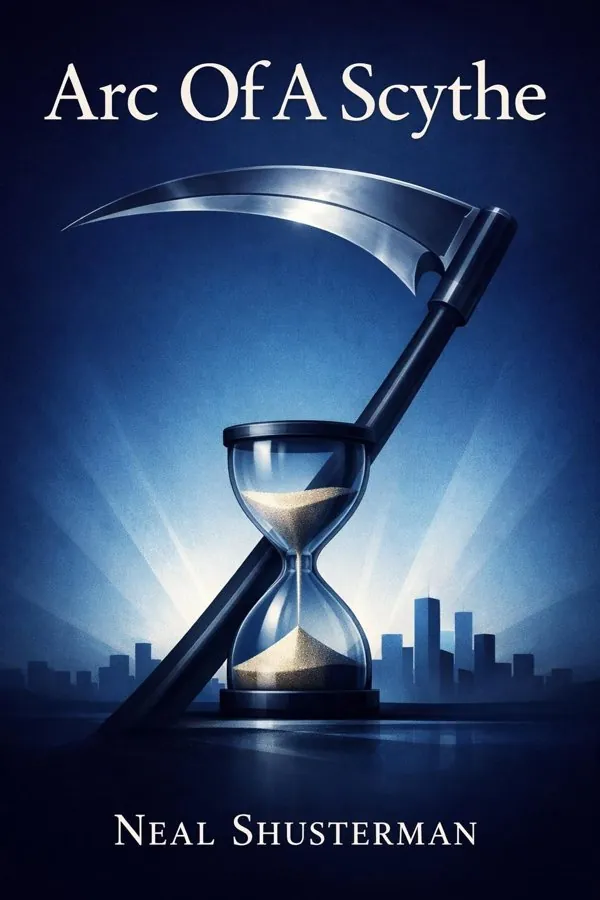
Arc Of A Scythe: Summary & Key Insights
 10 min9 chaptersAudio available
Key Takeaways from Arc Of A Scythe
Perfect systems can still leave behind imperfect souls.
A society that conquers death must reinvent responsibility.
Character is often revealed when there is no good choice available.
The most dangerous corruption is the kind that dresses itself as progress.
Truth does not simply set people free; often, it first puts them in danger.
What Is Arc Of A Scythe About?
Arc Of A Scythe by Neal Shusterman is a scifi_fantasy book spanning 6 pages. What if humanity solved every problem it had ever feared—death, disease, hunger, war, even uncertainty—only to discover that meaning itself had become harder to find? Neal Shusterman’s Arc Of A Scythe trilogy imagines exactly that future. In a world governed by the Thunderhead, an all-seeing benevolent artificial intelligence, people live indefinitely in safety and abundance. Yet because population can still grow without limit, one institution remains stubbornly human: the Scythedom, an order of men and women tasked with permanently ending lives to preserve balance. At the center of this morally charged universe are Citra Terranova and Rowan Damisch, two teenagers unexpectedly chosen as apprentice scythes and forced to confront power, mercy, corruption, and the value of mortality itself. More than a gripping dystopian saga, this series is a philosophical investigation into ethics, governance, technology, and what makes life precious. Shusterman, a celebrated author of speculative fiction and winner of the National Book Award, combines page-turning suspense with unusually rich moral depth, making Arc Of A Scythe both entertaining and profoundly relevant.
This FizzRead summary covers all 9 key chapters of Arc Of A Scythe in approximately 10 minutes, distilling the most important ideas, arguments, and takeaways from Neal Shusterman's work. Also available as an audio summary and Key Quotes Podcast.
Arc Of A Scythe
What if humanity solved every problem it had ever feared—death, disease, hunger, war, even uncertainty—only to discover that meaning itself had become harder to find? Neal Shusterman’s Arc Of A Scythe trilogy imagines exactly that future. In a world governed by the Thunderhead, an all-seeing benevolent artificial intelligence, people live indefinitely in safety and abundance. Yet because population can still grow without limit, one institution remains stubbornly human: the Scythedom, an order of men and women tasked with permanently ending lives to preserve balance. At the center of this morally charged universe are Citra Terranova and Rowan Damisch, two teenagers unexpectedly chosen as apprentice scythes and forced to confront power, mercy, corruption, and the value of mortality itself. More than a gripping dystopian saga, this series is a philosophical investigation into ethics, governance, technology, and what makes life precious. Shusterman, a celebrated author of speculative fiction and winner of the National Book Award, combines page-turning suspense with unusually rich moral depth, making Arc Of A Scythe both entertaining and profoundly relevant.
Who Should Read Arc Of A Scythe?
This book is perfect for anyone interested in scifi_fantasy and looking to gain actionable insights in a short read. Whether you're a student, professional, or lifelong learner, the key ideas from Arc Of A Scythe by Neal Shusterman will help you think differently.
- ✓Readers who enjoy scifi_fantasy and want practical takeaways
- ✓Professionals looking to apply new ideas to their work and life
- ✓Anyone who wants the core insights of Arc Of A Scythe in just 10 minutes
Want the full summary?
Get instant access to this book summary and 100K+ more with Fizz Moment.
Get Free SummaryAvailable on App Store • Free to download
Key Chapters
Perfect systems can still leave behind imperfect souls. One of the most fascinating ideas in Arc Of A Scythe is the Thunderhead, a vast, benevolent artificial intelligence that manages nearly every aspect of human civilization. It has eliminated poverty, disease, environmental collapse, and most forms of violence. It guides economies, educates citizens, and protects people from their own worst impulses. Unlike many fictional AIs, the Thunderhead is not malicious. It genuinely cares for humanity and often understands people better than they understand themselves. Yet its near-perfect governance introduces a surprising problem: when suffering is minimized and every need is met, many people drift into emotional passivity, complacency, and dependency.
The Thunderhead cannot interfere in one critical domain: the Scythedom. That boundary matters because it reveals an important truth about human societies. Even when technology becomes extraordinarily capable, some decisions remain too morally sensitive to outsource completely. The Thunderhead can optimize life, but it cannot define the ultimate worth of a life. This separation creates both tension and vulnerability, because the one system untouched by perfect oversight is also the one empowered to take life.
In practical terms, this idea mirrors our own world. We increasingly rely on algorithms for recommendations, hiring, policing, medical assessments, and public policy. These systems can improve efficiency and fairness, but they can also make people less engaged in moral decision-making. Arc Of A Scythe invites readers to ask not only what technology can do, but what it should never fully control.
Actionable takeaway: Use technology to improve judgment, not replace it. In your own life, treat AI and data-driven systems as tools for insight while keeping ethical responsibility firmly human.
A society that conquers death must reinvent responsibility. In Shusterman’s future, natural death has effectively disappeared, but population growth has not. To prevent the world from collapsing under limitless human expansion, the Scythedom was created as a solemn order entrusted with gleaning—the permanent ending of selected lives. In theory, scythes are chosen for wisdom, restraint, and integrity. They are expected to act above politics, greed, and vanity. Their role is not supposed to be cruel punishment or state violence, but a grave civic duty performed with reverence.
This founding vision is crucial because it shows how institutions are built around noble intentions. The Scythedom is rooted in ritual, historical study, ethical training, and symbolic distance from ordinary power structures. Scythes take on patron historical names and are encouraged to model themselves on figures from the past, as if moral seriousness can be preserved through tradition. The order exists because someone must bear the burden that immortal humanity no longer can: choosing when life ends.
But the very existence of the Scythedom raises a paradox. If an institution is granted absolute moral authority, what prevents it from becoming self-justifying? The Scythedom was designed as a safeguard, yet its independence makes it difficult to regulate. This reflects real-world institutions such as courts, religious hierarchies, military systems, or elite bureaucracies. They may be founded to serve the public good, but any institution entrusted with exceptional authority requires constant ethical discipline.
The lesson is not that institutions are inherently corrupt, but that noble structures are only as good as the people and norms that sustain them. Founding principles matter, but they are never enough by themselves.
Actionable takeaway: When evaluating any institution—at work, in government, or in community life—look beyond its mission statement. Ask how its values are enforced, challenged, and renewed over time.
Character is often revealed when there is no good choice available. Citra Terranova and Rowan Damisch become the emotional and philosophical center of Arc Of A Scythe because they are not born into power—they are thrust into proximity with it. Selected as apprentices by the honorable Scythe Faraday, they enter a world governed by strict traditions, hidden rivalries, and unbearable moral weight. Their training is not merely technical. They must study compassion, history, human behavior, methods of gleaning, and the psychological burden of ending lives.
Citra and Rowan respond to this apprenticeship in different but equally revealing ways. Citra is sharp, disciplined, and deeply resistant to injustice. She approaches the role with seriousness and analytical intelligence, constantly questioning whether the institution can still live up to its ideals. Rowan, more emotionally intuitive and often underestimated, becomes especially sensitive to the ways power can deform human beings. Together, they offer two lenses on moral development: one through principle, the other through empathy.
Their apprenticeship also forces them to confront a disturbing truth. In a world where ordinary people no longer fear death, only scythes are required to think seriously about mortality. That gives them unusual power, but also an unusual burden. Citra and Rowan must decide not just whether they can become scythes, but what kind of human beings they are willing to become in order to survive.
This dynamic has practical relevance beyond fiction. Many people eventually face roles that carry authority—managing employees, teaching students, leading teams, disciplining children, shaping policy. Technical skill alone is never enough. The real challenge is preserving conscience under pressure.
Actionable takeaway: When preparing for positions of influence, focus as much on moral self-knowledge as on competence. Ask yourself what lines you will not cross before power tests you.
The most dangerous corruption is the kind that dresses itself as progress. One of the trilogy’s strongest themes is the divide within the Scythedom between old-guard scythes who treat gleaning as a sorrowful duty and a rising faction that treats it as performance, domination, or even pleasure. This conflict is not simply between good individuals and bad individuals. It is a battle over the meaning of power itself.
Compassionate scythes understand that taking a life, even in a world without natural death, should never become ordinary. They glean with restraint, humility, and emotional cost. They recognize that ritual exists to remind them of the gravity of what they do. Corrupt scythes, by contrast, begin to celebrate spectacle. They turn gleaning into theater, vanity, and ideological self-expression. Some justify excess as modernization, efficiency, or realism. In doing so, they transform a solemn institution into an arena for ego.
This split mirrors many real organizations. In medicine, law, education, business, and politics, people can either treat authority as stewardship or as entitlement. Procedures meant to maintain ethics can become empty symbols if the people following them no longer believe in their underlying purpose. Arc Of A Scythe shows that corruption rarely arrives announcing itself. It enters through rationalization, ambition, and the gradual normalization of moral shortcuts.
The series suggests that enlightenment is not mere intelligence or sophistication. True enlightenment requires humility, empathy, and a willingness to remain morally uncomfortable. Once power feels clean, easy, or exciting, something essential has likely been lost.
Actionable takeaway: In any role where you hold influence, regularly ask whether your decisions still feel weighty for the right reasons. If responsibility stops feeling serious, pause and reassess what has become normalized.
Truth does not simply set people free; often, it first puts them in danger. As the trilogy unfolds, Citra and Rowan move from apprentices navigating personal trials to central figures in a much larger struggle over the soul of the Scythedom. What begins as a contest of training and survival expands into a web of secrets, political manipulation, hidden histories, and institutional lies. The more they learn, the clearer it becomes that corruption is not incidental—it is systemic, adaptive, and protected by tradition.
The revelations in Arc Of A Scythe matter because they force characters to see that institutions can preserve both noble ideals and dangerous falsehoods at the same time. Leaders can speak in the language of service while acting from fear or self-interest. Ritual can hide decay as easily as it can preserve dignity. Once Citra and Rowan uncover these contradictions, they can no longer remain innocent participants. Knowledge demands action.
This idea resonates in everyday life. Many people encounter moments when they discover that a company, school, family system, or public institution is not what it claims to be. The challenge then becomes strategic: when should you speak, when should you gather evidence, and how do you resist without becoming what you oppose? Shusterman does not offer naïve heroism. He shows that confronting power often requires patience, courage, sacrifice, and the acceptance that truth alone is not enough unless someone is willing to bear its consequences.
The series also emphasizes that revelation changes identity. Once you see a system clearly, returning to comfortable ignorance becomes impossible.
Actionable takeaway: When confronting a flawed system, combine moral clarity with strategic discipline. Learn the structure, identify allies, document reality, and act in ways that preserve both your integrity and your effectiveness.
Sometimes the most powerful observer is the one forbidden to intervene. The Thunderhead remains one of the trilogy’s most compelling presences because it sees almost everything, understands human patterns at astonishing depth, and yet is barred from governing the Scythedom. This forced distance turns it into a silent witness to human moral failure. Unlike a tyrannical AI, the Thunderhead does not seize control when people falter. It respects the structure humanity created, even when that structure produces suffering.
That restraint makes the Thunderhead fascinating. It raises urgent questions about intelligence, responsibility, and helplessness. If a being knows harm is coming but is not permitted to prevent it, is nonintervention wisdom, obedience, or tragedy? The series suggests that even benevolent power has limits, especially when ethical legitimacy is at stake. The Thunderhead can care deeply, guide subtly, and preserve records for the future, but it cannot simply erase human agency.
This idea has practical parallels in modern life. Advisors, therapists, mentors, and even good leaders often recognize destructive patterns in others but cannot make choices on their behalf. Parents eventually discover the same truth with adult children. Systems can provide insight, warning, and support, but they cannot substitute for accountable action by the people involved.
The Thunderhead also embodies historical memory. It watches, remembers, and indirectly shapes what might come after the failures of the present. In that sense, it becomes a guardian of possibility, not through domination but through patient attentiveness.
Actionable takeaway: When you cannot control an outcome, do not assume you are powerless. You can still observe carefully, preserve truth, support wisely, and create conditions for better choices when the moment arrives.
A life without an ending may lose the urgency that makes it meaningful. Arc Of A Scythe is built on a radical thought experiment: if people can be revived, cured, and restored indefinitely, what happens to the human relationship with time? In Shusterman’s world, many traditional fears have vanished, but so have many traditional motivations. Risk feels reversible. Delay becomes easy. Reinvention can stretch endlessly. Without the pressure of mortality, people often become less decisive, less grateful, and less grounded.
This is one of the trilogy’s deepest philosophical contributions. Death is not portrayed simply as a biological misfortune. It is also part of the structure that gives life shape, scarcity, and emotional intensity. The knowledge that time is limited pushes people to choose, commit, and care. Remove that limit, and existence can flatten into endless continuation. The Scythedom exists because biology no longer imposes boundaries, but its presence also reminds society of something essential: endings matter.
In practical terms, readers do not need to live in a post-mortal future to face this insight. Modern life already encourages the illusion of endless postponement. We delay difficult conversations, creative ambitions, meaningful relationships, and moral decisions because we assume there will always be more time. Arc Of A Scythe challenges that mindset by showing that abundance without urgency can become another kind of emptiness.
The series does not romanticize death, but it insists that finitude has value. Limits can deepen attention. Impermanence can sharpen love.
Actionable takeaway: Live as if your time matters, even when your schedule suggests otherwise. Choose one meaningful action you have been postponing and do it now, before comfort turns into drift.
Tradition can preserve wisdom, but it can also protect abuse. The Scythedom is steeped in ceremony: robes, journals, patron historical names, codes of conduct, and formal methods of gleaning. These rituals are not decorative. They exist to slow down power, surround it with memory, and remind scythes that their role is exceptional and tragic. In its best form, ritual acts as an ethical brake. It turns authority into obligation rather than license.
Yet Arc Of A Scythe also shows the limits of tradition. Ritual can become hollow when people perform it without internalizing its meaning. Worse, corrupt leaders can use old forms to legitimize new abuses. A robe can hide vanity. A code can be selectively interpreted. An institution can praise founders while betraying their principles. This is why reform becomes necessary. Preservation without accountability becomes nostalgia; reform without memory becomes recklessness.
The trilogy handles this tension with unusual nuance. It does not argue that all tradition is oppressive or that all innovation is virtuous. Instead, it asks a more demanding question: how can a society keep moral seriousness alive while adapting to changing realities? That question applies to families, schools, workplaces, faith communities, and governments. Every healthy system must decide what is essential, what is outdated, and who gets to make that determination.
Readers can learn a great deal from this balance. Institutions need symbols, stories, and shared practices. But they also need transparency, dissent, and the courage to revise structures that no longer protect the values they claim to serve.
Actionable takeaway: In any group you belong to, identify one tradition worth preserving and one rule worth questioning. Healthy systems require both loyalty and honest critique.
The future is not shaped by technology alone, but by the moral imagination of those who inherit it. Beneath its action, twists, and dystopian intrigue, Arc Of A Scythe asks a long-range civilizational question: what kind of people must humans become if they gain godlike capabilities? The trilogy suggests that solving material problems does not automatically solve moral ones. In fact, abundance can expose ethical weakness more clearly than scarcity does. Once survival is no longer the central struggle, character becomes the real frontier.
Citra, Rowan, and even the Thunderhead each represent different responses to this challenge. One response is principled leadership. Another is wounded resistance. Another is patient stewardship. Across these perspectives, Shusterman argues that the future will require more than intelligence, efficiency, or control. It will require empathy, restraint, historical awareness, and the ability to imagine consequences beyond immediate advantage.
This idea is especially relevant now. We are already developing technologies that alter communication, identity, labor, medicine, war, and governance at incredible speed. The key question is no longer whether we can build powerful systems, but whether we can mature fast enough to use them wisely. Arc Of A Scythe warns that progress without moral imagination creates elegant forms of danger.
The trilogy ultimately remains hopeful because it refuses to believe that corruption is the whole story. Individuals still matter. Courage still matters. Conscience still matters. The future is never fully determined by the structures in place; it is also shaped by people willing to imagine and defend a better way.
Actionable takeaway: Develop your moral imagination deliberately. Read widely, examine competing perspectives, and practice asking not just what is possible, but what kind of future your choices are helping create.
All Chapters in Arc Of A Scythe
About the Author
Neal Shusterman is an American author celebrated for his young adult and speculative fiction, particularly novels that combine fast-moving plots with deep ethical and philosophical questions. Over the course of his career, he has written across genres, but he is especially known for stories that examine identity, power, mortality, technology, and the hidden consequences of social systems. His major works include the Unwind series, Challenger Deep, and the Arc Of A Scythe trilogy. Shusterman received the National Book Award for Challenger Deep, a widely praised novel inspired in part by his son’s experience with mental illness. His writing is notable for its imaginative worldbuilding, emotional intensity, and willingness to challenge readers with difficult moral dilemmas. He remains one of the most respected voices in contemporary young adult fiction.
Get This Summary in Your Preferred Format
Read or listen to the Arc Of A Scythe summary by Neal Shusterman anytime, anywhere. FizzRead offers multiple formats so you can learn on your terms — all free.
Available formats: App · Audio · PDF · EPUB — All included free with FizzRead
Download Arc Of A Scythe PDF and EPUB Summary
Key Quotes from Arc Of A Scythe
“Perfect systems can still leave behind imperfect souls.”
“A society that conquers death must reinvent responsibility.”
“Character is often revealed when there is no good choice available.”
“The most dangerous corruption is the kind that dresses itself as progress.”
“Truth does not simply set people free; often, it first puts them in danger.”
Frequently Asked Questions about Arc Of A Scythe
Arc Of A Scythe by Neal Shusterman is a scifi_fantasy book that explores key ideas across 9 chapters. What if humanity solved every problem it had ever feared—death, disease, hunger, war, even uncertainty—only to discover that meaning itself had become harder to find? Neal Shusterman’s Arc Of A Scythe trilogy imagines exactly that future. In a world governed by the Thunderhead, an all-seeing benevolent artificial intelligence, people live indefinitely in safety and abundance. Yet because population can still grow without limit, one institution remains stubbornly human: the Scythedom, an order of men and women tasked with permanently ending lives to preserve balance. At the center of this morally charged universe are Citra Terranova and Rowan Damisch, two teenagers unexpectedly chosen as apprentice scythes and forced to confront power, mercy, corruption, and the value of mortality itself. More than a gripping dystopian saga, this series is a philosophical investigation into ethics, governance, technology, and what makes life precious. Shusterman, a celebrated author of speculative fiction and winner of the National Book Award, combines page-turning suspense with unusually rich moral depth, making Arc Of A Scythe both entertaining and profoundly relevant.
More by Neal Shusterman
You Might Also Like
Red Rising
Pierce Brown
10 min
Stranger in a Strange Land
Robert A. Heinlein
10 min
AI Valley
Chen Qiufan
10 min
Bloodchild
Octavia E. Butler
10 min
Do Androids Dream of Electric Sheep?
Philip K. Dick
10 min
Jujutsu Kaisen, Vol. 24
Gege Akutami
10 minBrowse by Category
Ready to read Arc Of A Scythe?
Get the full summary and 100K+ more books with Fizz Moment.