
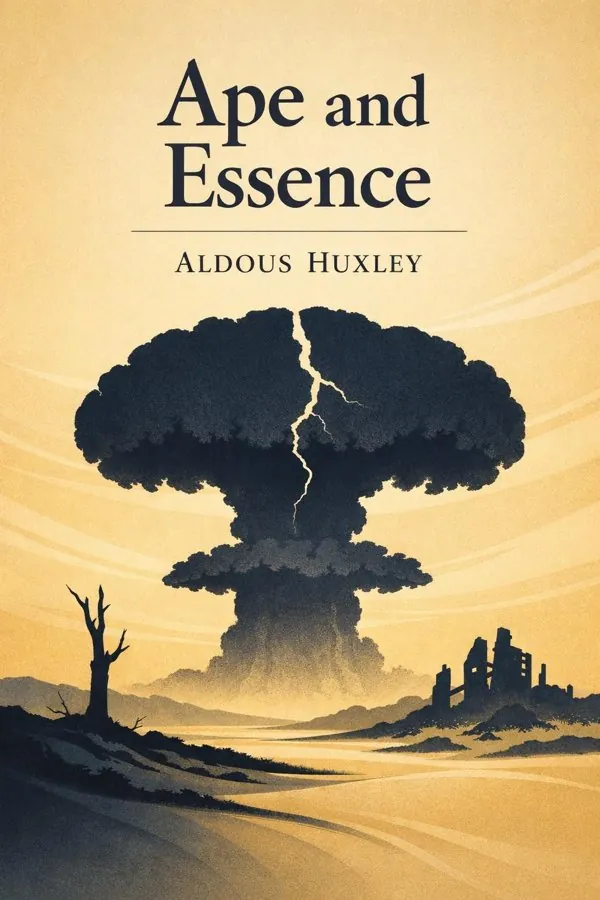
Ape and Essence: Summary & Key Insights
 10 min9 chaptersAudio available
Key Takeaways from Ape and Essence
Sometimes the most revealing truth appears in what a culture throws away.
A civilization can master immense power and still fail the test of being human.
Ruins are never only physical; they are moral evidence.
When a society loses genuine spiritual orientation, it rarely becomes neutral; it usually worships something worse.
In a broken world, the most radical act may be to remain human.
What Is Ape and Essence About?
Ape and Essence by Aldous Huxley is a bestsellers book spanning 7 pages. Ape and Essence is Aldous Huxley’s fierce, unsettling vision of what remains when civilization destroys itself and then tries to call the wreckage “normal.” Set in a world devastated by nuclear war, the novel unfolds through an unusual frame: Hollywood men discover a screenplay that imagines a future in which Los Angeles has become a grotesque wasteland of superstition, ritualized violence, and spiritual collapse. Through this device, Huxley turns a post-apocalyptic story into something sharper than prophecy: a moral diagnosis of modernity. What makes the book matter is not merely its ruined landscapes or shocking scenes, but the question beneath them: if scientific power advances faster than wisdom, what kind of humanity survives? Huxley suggests that without moral discipline, compassion, and reverence for life, progress becomes self-destruction. The novel is both satire and warning, attacking militarism, mass culture, blind obedience, sexual hypocrisy, and the worship of force. Huxley writes with unusual authority because he was not only a novelist but also one of the twentieth century’s keenest social critics. In Ape and Essence, his philosophical concerns become brutal drama, giving us a book that still feels disturbingly current.
This FizzRead summary covers all 9 key chapters of Ape and Essence in approximately 10 minutes, distilling the most important ideas, arguments, and takeaways from Aldous Huxley's work. Also available as an audio summary and Key Quotes Podcast.
Ape and Essence
Ape and Essence is Aldous Huxley’s fierce, unsettling vision of what remains when civilization destroys itself and then tries to call the wreckage “normal.” Set in a world devastated by nuclear war, the novel unfolds through an unusual frame: Hollywood men discover a screenplay that imagines a future in which Los Angeles has become a grotesque wasteland of superstition, ritualized violence, and spiritual collapse. Through this device, Huxley turns a post-apocalyptic story into something sharper than prophecy: a moral diagnosis of modernity.
What makes the book matter is not merely its ruined landscapes or shocking scenes, but the question beneath them: if scientific power advances faster than wisdom, what kind of humanity survives? Huxley suggests that without moral discipline, compassion, and reverence for life, progress becomes self-destruction. The novel is both satire and warning, attacking militarism, mass culture, blind obedience, sexual hypocrisy, and the worship of force.
Huxley writes with unusual authority because he was not only a novelist but also one of the twentieth century’s keenest social critics. In Ape and Essence, his philosophical concerns become brutal drama, giving us a book that still feels disturbingly current.
Who Should Read Ape and Essence?
This book is perfect for anyone interested in bestsellers and looking to gain actionable insights in a short read. Whether you're a student, professional, or lifelong learner, the key ideas from Ape and Essence by Aldous Huxley will help you think differently.
- ✓Readers who enjoy bestsellers and want practical takeaways
- ✓Professionals looking to apply new ideas to their work and life
- ✓Anyone who wants the core insights of Ape and Essence in just 10 minutes
Want the full summary?
Get instant access to this book summary and 100K+ more with Fizz Moment.
Get Free SummaryAvailable on App Store • Free to download
Key Chapters
Sometimes the most revealing truth appears in what a culture throws away. Ape and Essence opens not in the post-apocalyptic wasteland, but in Hollywood, where two literary men encounter a discarded screenplay written by the deceased William Tallis. This beginning is not a decorative trick. Huxley uses the frame narrative to expose the shallowness, commercialism, and self-importance of modern cultural life before he ever shows us the ruined future. The contrast is crucial: apocalypse is not separate from everyday civilization, but latent within it.
By placing the central story inside a found screenplay, Huxley adds irony and distance. Hollywood, the factory of fantasies, becomes the setting in which a terrifyingly plausible truth is ignored. The people handling the manuscript are surrounded by industry routines, petty judgments, and institutional blindness. The implication is sharp: societies often fail to recognize their deepest warnings because they are too busy packaging reality into entertainment.
This idea still applies. Today, serious warnings about climate risk, political extremism, misinformation, and technological misuse are often absorbed into media cycles and then forgotten. We consume catastrophe as content. We debate tone, marketability, and optics while missing the moral emergency beneath them.
Huxley asks us to examine not only what we believe, but the systems through which belief is filtered. Do our institutions encourage wisdom, or do they neutralize it? Do we confront uncomfortable truths, or do we turn them into background noise?
Actionable takeaway: pay attention to the warnings your culture trivializes. What gets dismissed as “too dark,” “too idealistic,” or “too inconvenient” may be exactly what deserves your deepest thought.
A civilization can master immense power and still fail the test of being human. When the screenplay begins, we are transported to the year 2108, long after the Third World War has obliterated the old order. Huxley does not present the future as a glamorous scientific dystopia. Instead, he imagines the aftermath of technological triumph unrestrained by moral intelligence. Cities are shattered, nature is poisoned, and human life continues only in degraded forms.
The horror here is not simply destruction. It is regression. Scientific achievement, rather than leading to enlightenment, has accelerated barbarism. The modern dream of control ends in chaos because the inner life of humanity has not matured alongside its instruments of power. Huxley’s target is not science itself, but scientism: the faith that technical capability alone can save us, justify us, or replace wisdom.
This is one of the book’s most enduring insights. Tools amplify intention. A society that is greedy, fearful, tribal, and spiritually empty will use advanced technology to magnify those traits. Nuclear weapons are the most obvious example in Huxley’s world, but the pattern extends further. Surveillance systems, propaganda machinery, biological engineering, and algorithmic influence all raise the same question: who are we when we wield power?
In everyday life, this means we should stop equating innovation with improvement. A faster system is not automatically a better one. A powerful invention is not necessarily a humane one. Any discussion of progress must include ethics, restraint, and long-term consequences.
Actionable takeaway: whenever you encounter a new technology or policy, ask not only “Can we do this?” but also “What kind of people will this make us, and what values guide its use?”
Ruins are never only physical; they are moral evidence. In Ape and Essence, a New Zealand scientific expedition arrives in devastated California expecting to study the remnants of a destroyed civilization. What they encounter is more disturbing than dead infrastructure. The landscape itself bears witness to a world that converted intelligence into annihilation and left behind not renewal, but corruption and fear.
Huxley uses the expedition as a lens through which readers confront collapse gradually. Outsiders observe the shattered buildings, toxic environment, and strange survivors with a mixture of curiosity, disbelief, and dread. This perspective matters because it prevents the wasteland from becoming merely familiar background. We see it as an outcome, as something made by human decisions. The expedition members represent the remnants of rational inquiry entering a world where reason has lost authority.
The scene also captures a timeless truth about decline: collapse does not always look like clean endings. It often appears as fragments, improvisations, and systems of survival built on trauma. The survivors have adapted, but adaptation is not the same as flourishing. They live amid the remains of a high civilization without inheriting its wisdom.
In modern terms, this key idea challenges the assumption that institutions are stable simply because they have existed for a long time. Environmental degradation, social mistrust, and political violence can hollow out a society long before it fully breaks. By the time outsiders notice the ruins, the moral collapse has usually been underway for years.
Actionable takeaway: treat early signs of institutional decay seriously. When you see rising cynicism, cruelty, or indifference to truth, do not dismiss them as temporary ugliness; they may be the first visible cracks in a deeper collapse.
When a society loses genuine spiritual orientation, it rarely becomes neutral; it usually worships something worse. One of the most shocking elements of Ape and Essence is the religion of the postwar survivors, who revere Belial, a satanic figure embodying destruction, lust, fear, and hatred of life. Their rituals are grotesque, but Huxley’s point is not simply to horrify. He is showing how cultures can turn violence and degradation into sacred order.
Belial represents more than theological evil. He symbolizes the dark drives that emerge when human beings organize themselves around resentment, domination, and despair. In this world, cruelty is normalized, reproduction is controlled through terror, and deformity leads to ruthless persecution. Religion, which might have elevated conscience, has been inverted into a system that sanctifies fear.
The insight reaches far beyond the novel’s setting. Huxley suggests that every society worships something, whether or not it calls that devotion religion. It may worship power, nation, race, profit, pleasure, efficiency, or ideological purity. When ultimate loyalty is given to anything less than truth and compassion, human beings become capable of ritualized inhumanity while believing themselves justified.
You can see this pattern in everyday institutions. A workplace that worships performance at any cost can normalize burnout and ethical compromise. A political movement that worships victory can excuse lies and cruelty. A culture that worships status can hollow out character.
Huxley invites us to ask: what does our society really bow down to? What practices reveal our true faith?
Actionable takeaway: identify the values your daily routines actually serve. If your habits repeatedly reward fear, vanity, or domination, begin replacing them with practices that affirm dignity, honesty, and care.
In a broken world, the most radical act may be to remain human. Dr. Alfred Poole, one of the central figures in the screenplay, is not a conquering hero but an observer, scientist, and moral witness. As he encounters the degraded social order of postwar Los Angeles, he struggles to understand how people continue living within systems of fear and absurdity. His role is essential because he embodies Huxley’s recurring question: can intelligence preserve meaning when civilization has collapsed?
Poole is a man of reason entering a society that has weaponized unreason. Yet Huxley does not present reason alone as sufficient. Poole’s scientific training helps him interpret what he sees, but the deeper challenge is ethical and spiritual. He must decide whether to become detached, complicit, or responsive. His encounters force him to confront suffering not as theory, but as lived degradation.
This makes Poole relevant to contemporary readers. Many people today are well informed, analytically capable, and socially aware, yet still feel powerless in the face of large-scale dysfunction. Information does not automatically create courage. Understanding a problem is different from bearing moral responsibility within it.
Poole’s journey suggests that meaning comes from refusing numbness. Even in absurd conditions, one can choose attention, pity, honesty, and solidarity. These choices may not save the world at once, but they resist the logic of dehumanization.
Practically, this applies whenever you work inside flawed institutions. You may not be able to transform the whole system immediately, but you can refuse small forms of surrender: cynical language, lazy cruelty, passive obedience, and moral evasion.
Actionable takeaway: when facing a corrupt environment, ask not only “What do I think?” but “What kind of person am I becoming here?” Let that answer guide your next decision.
Even in a world organized around brutality, tenderness can survive as a form of resistance. Loola, the young woman Dr. Poole meets and later protects, is more than an individual love interest. She represents damaged yet persistent humanity within a culture devoted to degradation. Through her, Huxley introduces the possibility that innocence, care, and mutual recognition can endure even where institutions have collapsed.
Loola’s importance lies in contrast. Around her stands a society that treats bodies as impure, fertility as dangerous, and women as objects of control. She has been shaped by that world, yet she is not reducible to it. Her vulnerability reveals the cruelty of the surrounding order, while her responsiveness reveals that the human soul is not entirely extinguished. This gives the novel one of its few shafts of emotional warmth.
Huxley is not sentimental here. Tenderness does not magically erase horror. It remains fragile, threatened, and costly. But that fragility is the point. In conditions of fear, even basic decency becomes morally significant. To protect another person, to speak gently, to imagine a life beyond domination—these become acts of rebellion.
For modern readers, Loola’s role underscores the importance of preserving human relationships in dehumanizing environments. Bureaucracies, digital life, ideological conflict, and chronic stress can all make people feel like functions, categories, or enemies. The antidote is not vague optimism, but concrete regard for another person’s humanity.
You do not need an apocalypse to practice this. Listening carefully, refusing contempt, and creating spaces of trust are ways of defending the human against systems that flatten it.
Actionable takeaway: choose one relationship this week in which you will practice intentional tenderness—more patience, fuller attention, or protective care—as a deliberate stand against dehumanization.
Hope in Ape and Essence is never comfortable; it has to be wrestled from terror. As the story moves toward escape and confrontation, Huxley refuses to offer an easy redemption arc. The characters’ attempts to flee the postwar social order reveal both the brutality of the system and the immense difficulty of reclaiming freedom once fear has become normal. Escape is not simply geographic. It is moral, psychological, and spiritual.
This matters because oppressive cultures do not survive by force alone. They endure by teaching people to expect degradation, to mistrust joy, and to fear alternatives. Breaking free therefore requires more than courage in a single moment. It demands the recovery of imagination—the belief that life could be ordered differently. The threat of violence remains real, but the deeper conflict is between a closed world and the possibility of renewal.
Huxley’s treatment of hope is disciplined rather than naive. Renewal is possible, but it is fragile. It depends on memory, conscience, and the willingness to act before destruction becomes destiny. The novel does not promise that goodness will inevitably win. Instead, it suggests that every humane future begins with vulnerable acts of refusal.
This has practical relevance in personal and social life. Leaving a toxic workplace, ending an abusive relationship, resisting a manipulative ideology, or rebuilding trust after institutional failure all follow this pattern. Freedom can feel disorienting because oppression reshapes expectations. People often need not only rescue, but rehumanization.
Actionable takeaway: if you are trying to leave a destructive pattern, do not focus only on escape. Build the habits, relationships, and beliefs that make a healthier life emotionally imaginable and practically sustainable.
The strangest scenes in Ape and Essence are not merely exaggerations; they are mirrors. Huxley uses savage satire to expose tendencies already present in modern civilization: militarism, mass manipulation, sexual anxiety, bureaucratic absurdity, and the surrender of conscience to systems. The post-apocalyptic world is extreme, but its roots are recognizably contemporary. That is why the book still disturbs.
Satire works here by stripping away euphemism. What respectable societies often hide behind polished language—strategic necessity, national interest, efficiency, social hygiene—Huxley reveals in raw form. Ritualized cruelty appears as cruelty. Collective irrationality appears as madness rather than policy. The grotesque future is simply the present without its cosmetic self-deceptions.
This is one reason the novel can feel harsher than more straightforward dystopias. Huxley does not invite readers to think, “How terrible those future people are.” He pushes us toward a more uncomfortable recognition: the seeds of catastrophe are embedded in our assumptions, entertainments, institutions, and habits of thought. The ape and the essence coexist in us now.
For modern readers, satire remains useful because it can puncture normalization. When harmful patterns become familiar, direct criticism often loses force. But irony, inversion, and exaggeration can restore moral visibility. They help us see the absurdity of what we have accepted.
You can apply this insight by examining the official language around harmful practices in your own environment. What gets justified as inevitable? What forms of harm are hidden behind jargon? What social rituals disguise moral emptiness as success?
Actionable takeaway: once this week, take a polished public message—from politics, business, or media—and rewrite it in plain moral language. Notice what becomes visible when euphemism disappears.
A warning matters only if it changes how we see the world we live in now. When Ape and Essence returns to its frame narrative, Huxley closes the circle between imagined future and present-day civilization. The screenplay is no longer just a strange artifact; it becomes an indictment of the society that produced and ignored it. The ending invites readers to compare Hollywood’s polished normality with the wasteland’s grotesque honesty.
This structural return is one of the novel’s most intelligent moves. It reminds us that the apocalyptic vision was never really separate from the modern world. The same tendencies that lead to catastrophe—vanity, distraction, commodification, shallow judgment, and institutional blindness—are already present in ordinary life. The frame therefore transforms the screenplay from fiction into diagnosis.
Huxley’s larger message is that civilization cannot be measured by comfort, technique, or cultural output alone. A truly civilized society must cultivate self-restraint, moral seriousness, reverence for life, and the capacity for spiritual depth. Without those, refinement becomes a mask over barbarism. The final effect is unsettling because it denies readers the comfort of distance.
This idea remains vital today. It is easy to imagine collapse as something dramatic and external. Huxley asks us to see that collapse may begin in habits of trivialization, in the inability to distinguish entertainment from truth, or in the erosion of moral vocabulary. The future is shaped by what the present chooses not to notice.
Actionable takeaway: after finishing any disturbing book, article, or film, ask a final question: “What in my current world does this story illuminate?” Then write down one concrete implication for how you will live differently.
All Chapters in Ape and Essence
About the Author
Aldous Huxley (1894–1963) was an English novelist, essayist, and cultural critic whose work examined the promises and dangers of modern civilization. Born into a prominent intellectual family, he developed a wide-ranging interest in science, politics, religion, psychology, and philosophy, all of which shaped his writing. He is best known for Brave New World, but his body of work extends far beyond that classic, including novels, essays, and social commentary that question materialism, mass culture, authoritarianism, and blind faith in progress. In his later years, Huxley became increasingly interested in mysticism, consciousness, and spiritual experience. His writing remains influential because it combines literary sophistication with urgent moral and philosophical inquiry, making him one of the twentieth century’s most incisive critics of technological modernity.
Get This Summary in Your Preferred Format
Read or listen to the Ape and Essence summary by Aldous Huxley anytime, anywhere. FizzRead offers multiple formats so you can learn on your terms — all free.
Available formats: App · Audio · PDF · EPUB — All included free with FizzRead
Download Ape and Essence PDF and EPUB Summary
Key Quotes from Ape and Essence
“Sometimes the most revealing truth appears in what a culture throws away.”
“A civilization can master immense power and still fail the test of being human.”
“Ruins are never only physical; they are moral evidence.”
“When a society loses genuine spiritual orientation, it rarely becomes neutral; it usually worships something worse.”
“In a broken world, the most radical act may be to remain human.”
Frequently Asked Questions about Ape and Essence
Ape and Essence by Aldous Huxley is a bestsellers book that explores key ideas across 9 chapters. Ape and Essence is Aldous Huxley’s fierce, unsettling vision of what remains when civilization destroys itself and then tries to call the wreckage “normal.” Set in a world devastated by nuclear war, the novel unfolds through an unusual frame: Hollywood men discover a screenplay that imagines a future in which Los Angeles has become a grotesque wasteland of superstition, ritualized violence, and spiritual collapse. Through this device, Huxley turns a post-apocalyptic story into something sharper than prophecy: a moral diagnosis of modernity. What makes the book matter is not merely its ruined landscapes or shocking scenes, but the question beneath them: if scientific power advances faster than wisdom, what kind of humanity survives? Huxley suggests that without moral discipline, compassion, and reverence for life, progress becomes self-destruction. The novel is both satire and warning, attacking militarism, mass culture, blind obedience, sexual hypocrisy, and the worship of force. Huxley writes with unusual authority because he was not only a novelist but also one of the twentieth century’s keenest social critics. In Ape and Essence, his philosophical concerns become brutal drama, giving us a book that still feels disturbingly current.
More by Aldous Huxley
You Might Also Like

The Godfather
Mario Puzo
10 min
The Handmaid's Tale
Margaret Atwood
10 min
The Hunger Games
Suzanne Collins
10 min
The Nightingale
Kristin Hannah
10 min
The Seven Husbands of Evelyn Hugo
Taylor Jenkins Reid
10 min
Backwater Justice
Fern Michaels
10 minBrowse by Category
Ready to read Ape and Essence?
Get the full summary and 100K+ more books with Fizz Moment.