
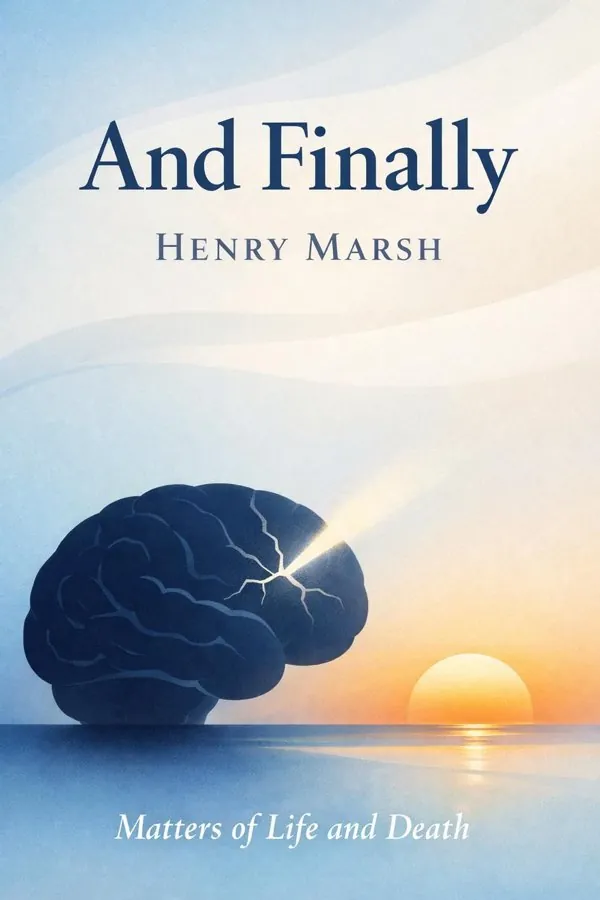
And Finally: Matters of Life and Death: Summary & Key Insights
by Henry Marsh
 10 min8 chaptersAudio available
Key Takeaways from And Finally: Matters of Life and Death
We all know we will die, but most of us live as if that truth belongs to someone else.
Modern medicine can be miraculous, but it is not omnipotent.
Silence often makes dying harder than death itself.
We often treat independence as a permanent feature of adulthood, when in fact it is a temporary condition.
Love is easy to declare in principle and difficult to practice in the routines of care.
What Is And Finally: Matters of Life and Death About?
And Finally: Matters of Life and Death by Henry Marsh is a biographies book. What happens when a surgeon who has spent a lifetime operating on the human brain becomes a patient confronting his own decline? In And Finally: Matters of Life and Death, celebrated British neurosurgeon Henry Marsh turns his attention inward, writing with unusual honesty about aging, illness, mortality, and the limits of medicine. This is not a conventional memoir of professional triumph. Instead, it is a deeply reflective account of what it means to grow old after decades of making life-and-death decisions for others, only to face vulnerability oneself. Marsh explores retirement, physical frailty, the fear of dependency, and the uneasy relationship between medical intervention and human dignity. He also reflects on caregiving, family, and the practical realities of dying well. The book matters because it cuts through comforting clichés and invites readers to think clearly about how they want to live at the end of life. Marsh’s authority comes not only from his long career as one of Britain’s most respected neurosurgeons, but from his willingness to question medicine’s power and confront mortality without sentimentality.
This FizzRead summary covers all 8 key chapters of And Finally: Matters of Life and Death in approximately 10 minutes, distilling the most important ideas, arguments, and takeaways from Henry Marsh's work. Also available as an audio summary and Key Quotes Podcast.
And Finally: Matters of Life and Death
What happens when a surgeon who has spent a lifetime operating on the human brain becomes a patient confronting his own decline? In And Finally: Matters of Life and Death, celebrated British neurosurgeon Henry Marsh turns his attention inward, writing with unusual honesty about aging, illness, mortality, and the limits of medicine. This is not a conventional memoir of professional triumph. Instead, it is a deeply reflective account of what it means to grow old after decades of making life-and-death decisions for others, only to face vulnerability oneself. Marsh explores retirement, physical frailty, the fear of dependency, and the uneasy relationship between medical intervention and human dignity. He also reflects on caregiving, family, and the practical realities of dying well. The book matters because it cuts through comforting clichés and invites readers to think clearly about how they want to live at the end of life. Marsh’s authority comes not only from his long career as one of Britain’s most respected neurosurgeons, but from his willingness to question medicine’s power and confront mortality without sentimentality.
Who Should Read And Finally: Matters of Life and Death?
This book is perfect for anyone interested in biographies and looking to gain actionable insights in a short read. Whether you're a student, professional, or lifelong learner, the key ideas from And Finally: Matters of Life and Death by Henry Marsh will help you think differently.
- ✓Readers who enjoy biographies and want practical takeaways
- ✓Professionals looking to apply new ideas to their work and life
- ✓Anyone who wants the core insights of And Finally: Matters of Life and Death in just 10 minutes
Want the full summary?
Get instant access to this book summary and 100K+ more with Fizz Moment.
Get Free SummaryAvailable on App Store • Free to download
Key Chapters
We all know we will die, but most of us live as if that truth belongs to someone else. One of Henry Marsh’s central insights is that mortality remains abstract until age, illness, or loss makes it immediate. As a neurosurgeon, he spent decades working at the edge of death, telling families terrible news and performing operations where outcomes were uncertain. Yet even with that experience, the reality of his own aging and illness changes everything. The professional observer becomes the vulnerable subject.
This shift matters because it reveals how thin the line is between control and helplessness. In youth or midlife, people often imagine they can plan around death through healthy habits, medical advances, or determination. Marsh shows that while these things matter, they do not abolish human finitude. Bodies weaken. Memory falters. Independence shrinks. The question is not whether this will happen, but how honestly we will face it.
In practical terms, this idea encourages earlier reflection. Instead of postponing conversations about aging, dependency, or death until a crisis arrives, families can discuss preferences in advance. Individuals can think through where they want to live, what treatments they would accept, and what quality of life means to them. Professionals in medicine can also benefit by remembering that clinical distance can hide a failure of empathy.
Marsh’s point is not to cultivate despair, but clarity. Accepting mortality can make life less casual and more intentional. It can sharpen gratitude, deepen relationships, and reduce illusions about endless time.
Actionable takeaway: Set aside time to write down your priorities for later life and share them with someone close to you before circumstances force the conversation.
Modern medicine can be miraculous, but it is not omnipotent. Marsh writes from the rare position of someone who has both wielded medical expertise and witnessed its disappointments from the inside. He understands the temptation to believe that another test, operation, or procedure will solve what is fundamentally unsolvable. Yet he also shows how often treatment extends suffering, creates false hope, or distracts from what patients most need: truthful guidance.
This is especially powerful because Marsh is not anti-medicine. He knows surgery can save lives and transform outcomes. But he has also seen how medical culture sometimes confuses action with wisdom. Doctors may keep intervening because stopping feels like failure. Patients and families may cling to treatment because the alternative sounds like surrender. The result can be prolonged distress rather than meaningful recovery.
The broader lesson is that more treatment is not always better treatment. A good medical decision depends on context: the patient’s age, functional status, prognosis, values, and tolerance for risk. Someone may rationally choose a burdensome intervention for a chance at more time, while someone else may prioritize comfort, lucidity, and dignity. Both choices can be valid if they are informed.
In everyday life, this idea applies whenever people engage with healthcare systems. Ask not only what can be done, but what is likely to happen, what the side effects are, and whether the outcome aligns with your goals. A technically successful intervention may still produce a life the patient would not have wanted.
Actionable takeaway: At your next major medical decision, ask three questions: What is the likely benefit? What is the likely burden? And how does this fit my personal definition of a life worth living?
Silence often makes dying harder than death itself. Marsh argues that one of the tragedies of modern life is how poorly many people talk about the end of life. Families avoid painful topics to protect one another. Doctors soften reality because blunt truth feels cruel. Patients may sense what is happening but remain trapped in polite denial. The result is confusion, isolation, and decisions made too late.
Marsh insists that honesty is not the opposite of compassion; it is often its highest form. When people understand what lies ahead, they can prepare emotionally, practically, and spiritually. They can settle affairs, say what needs to be said, and make choices about where and how they wish to die. Without that honesty, decisions default to systems, emergency protocols, and the anxieties of others.
This does not mean every conversation should be cold or brutally blunt. Timing, tone, and sensitivity matter. But evasiveness can be deeply harmful. For example, a family that never discusses palliative care may end up pursuing exhausting hospital interventions that the patient would have refused. An older person who never names their fear of dependency may miss the chance to arrange support that preserves dignity. A clinician who speaks in vague probabilities instead of plain language may leave relatives clinging to unrealistic expectations.
The practical application is simple but challenging: talk early, revisit often, and speak concretely. Discuss powers of attorney, resuscitation preferences, hospice, pain management, and what outcomes would feel unacceptable. These conversations can be emotionally taxing, but they usually bring relief as well.
Actionable takeaway: Initiate one end-of-life conversation this month with a loved one, focusing on preferences and values rather than abstract fear.
We often treat independence as a permanent feature of adulthood, when in fact it is a temporary condition. Marsh reflects candidly on aging not merely as a biological process but as a gradual erosion of autonomy. Tasks once performed without thought become difficult. The body becomes less reliable. Pride is tested by the need for assistance. This loss is not only physical; it is existential, because autonomy is tied to identity.
What makes this theme powerful is Marsh’s refusal to romanticize old age. He does not pretend that surrendering independence is easy or spiritually uplifting. Instead, he shows how humiliating and frightening dependence can feel, especially for people who have built their lives around competence and self-control. For a surgeon, whose work demands precision and authority, this reversal carries special force.
Yet the insight extends far beyond medicine. Most people do not prepare emotionally or logistically for dependency. They assume they will adapt somehow when the time comes. But real preparation means thinking ahead about housing, mobility, caregiving, finances, and social support. It also means cultivating the humility to receive help. People who can no longer drive, cook, or manage personal care need more than practical assistance; they need respect.
On a personal level, the book invites readers to examine whether their sense of worth depends too heavily on productivity and control. If so, aging can feel like annihilation. Building a broader identity—through relationships, curiosity, kindness, and presence—may make later losses less devastating.
Actionable takeaway: Review one area where future dependency may affect you—such as housing, transport, or daily care—and make a realistic plan before urgency removes your choices.
Love is easy to declare in principle and difficult to practice in the routines of care. Marsh writes movingly about his wife’s illness and the intimate burdens of caregiving, showing that devotion often expresses itself not through grand gestures but through repetition, patience, and endurance. Illness transforms relationships. It disrupts old roles, introduces frustration and exhaustion, and forces couples or families to negotiate new forms of intimacy.
This insight matters because caregiving is often sentimentalized by outsiders and undervalued by institutions. In reality, it can be physically tiring, emotionally draining, and morally complex. The caregiver may feel compassion one moment and resentment the next. The person receiving care may feel gratitude mixed with shame or anger. Marsh acknowledges these tensions without reducing them to failure. They are part of what makes care human.
The broader lesson is that serious illness affects networks, not just individuals. When someone deteriorates, partners, children, friends, and clinicians all become part of the experience. Good care requires honesty about limits. A spouse may not be able to provide round-the-clock support indefinitely. An adult child may need respite. Professional help may become essential not because love is lacking, but because love needs reinforcement.
In practical terms, caregivers benefit from planning, delegation, and permission to ask for help. Communities can support this by treating caregiving as skilled labor worthy of recognition. Even small acts—organizing meals, handling paperwork, offering transport, providing companionship—can significantly reduce strain.
Actionable takeaway: If you are supporting someone ill, identify one task you can delegate this week and one source of emotional support you can actively accept.
When work defines who we are, retirement can feel like disappearance. Marsh confronts the uneasy transition from a celebrated neurosurgical career to life beyond the operating theatre. For years, his profession gave structure, status, urgency, and meaning. Stepping away is not simply a scheduling change; it is a confrontation with ego, usefulness, and self-worth.
This theme resonates widely because many people, not only surgeons, build their identity around competence and recognition. Careers provide narratives: I solve problems, I lead teams, I help people, I matter. Retirement or forced withdrawal due to age or illness can strip away those markers. Without them, some experience relief, but others feel diminished, restless, or invisible.
Marsh’s reflections suggest that the problem is not ambition itself, but over-identification with role. If all value comes from performance, then any decline threatens the self. A healthier approach is to develop dimensions of identity that do not depend solely on professional excellence. These might include family, friendship, ethical commitments, intellectual curiosity, craft, service, or the capacity to appreciate ordinary life.
Practically, this means preparing for transitions before they arrive. Professionals nearing retirement can experiment with new routines, interests, and communities while still working. They can mentor others, shift from achievement to contribution, and become comfortable being less central. For those already retired, the challenge is to remain engaged without chasing former status.
Marsh does not offer simplistic reinvention. He recognizes that loss is real. But he also implies that a life worth living cannot depend forever on being exceptional in one domain.
Actionable takeaway: Write a short list of roles and qualities that define you beyond your job, then invest time this week in one of them.
Dignity at the end of life is often discussed in vague, reverent language, but Marsh gives it practical substance. Dignity is not merely being treated politely or kept comfortable, though both matter. It also involves being told the truth, having one’s preferences respected, and retaining as much agency as possible in situations of decline. People lose dignity when decisions are made around them rather than with them.
This perspective challenges a common medical pattern in which professionals focus on clinical options while neglecting existential priorities. A patient may care less about maximal survival than about staying mentally alert, avoiding institutionalization, or dying at home. If those values are never clearly elicited, care can become technically competent but personally wrong.
Marsh’s reflections point toward the ethical importance of advance planning and shared decision-making. For example, someone with progressive illness may choose to forgo burdensome treatment in favor of symptom control and time with family. Another may choose aggressive treatment despite low odds because their threshold for risk is different. Respecting dignity means honoring informed values, not imposing a universal script.
The idea also applies beyond medicine. Older adults in everyday settings often lose agency through subtle paternalism: people speak over them, make assumptions, or equate frailty with incapacity. Preserving dignity may require slower conversations, clearer information, and a deliberate effort to involve the person directly.
The deeper insight is that dignity is relational. It depends on how honestly and attentively others respond to vulnerability.
Actionable takeaway: Ask an older relative or loved one one direct question about what matters most to them if their health worsens, and record the answer in practical terms.
The proximity of death can strip away illusion and reveal what truly matters. Marsh’s book is not simply about decline; it is also about the sharpened perception that comes when time feels finite. When endless future disappears as a fantasy, small things can become more vivid: companionship, nature, daily routines, moments of lucidity, honest conversation. Mortality does not automatically make life meaningful, but it can make meaning harder to postpone.
This idea stands against a culture that often treats death as an interruption to life rather than a condition of it. Marsh suggests that awareness of mortality can improve how we live now. It can reduce trivial ambitions, expose vanity, and help distinguish urgent from important. A person may realize they have spent too much energy defending status, accumulating possessions, or avoiding difficult truths. Aging and illness force a reckoning with these habits.
The practical application is not to wait for catastrophe before reassessing your life. You can ask now: What relationships require attention? What pleasures are already available? What unnecessary busyness prevents depth? What would I regret if my horizon shortened suddenly? These questions are not morbid; they are organizing.
Marsh’s candor gives this message credibility. He does not promise serenity. Fear, grief, and frustration remain. But he suggests that lucidity is better than denial, even when lucidity hurts. To face death honestly is also to face life honestly.
Actionable takeaway: Choose one meaningful but postponed act—such as repairing a relationship, taking time in nature, or simplifying an obligation—and do it within the next seven days.
All Chapters in And Finally: Matters of Life and Death
About the Author
Henry Marsh is a renowned British neurosurgeon and author known for his candid reflections on medicine, mortality, and the moral complexity of clinical practice. Over the course of a distinguished career, he became one of the United Kingdom’s most respected brain surgeons, recognized not only for technical skill but also for his willingness to speak honestly about uncertainty, failure, and the limits of treatment. Marsh reached a wide readership through his acclaimed books Do No Harm, Admissions, and And Finally: Matters of Life and Death. His writing combines memoir, ethical inquiry, and sharp observation, offering rare insight into both the medical profession and the human experience of illness, aging, and death.
Get This Summary in Your Preferred Format
Read or listen to the And Finally: Matters of Life and Death summary by Henry Marsh anytime, anywhere. FizzRead offers multiple formats so you can learn on your terms — all free.
Available formats: App · Audio · PDF · EPUB — All included free with FizzRead
Download And Finally: Matters of Life and Death PDF and EPUB Summary
Key Quotes from And Finally: Matters of Life and Death
“We all know we will die, but most of us live as if that truth belongs to someone else.”
“Modern medicine can be miraculous, but it is not omnipotent.”
“Silence often makes dying harder than death itself.”
“We often treat independence as a permanent feature of adulthood, when in fact it is a temporary condition.”
“Love is easy to declare in principle and difficult to practice in the routines of care.”
Frequently Asked Questions about And Finally: Matters of Life and Death
And Finally: Matters of Life and Death by Henry Marsh is a biographies book that explores key ideas across 8 chapters. What happens when a surgeon who has spent a lifetime operating on the human brain becomes a patient confronting his own decline? In And Finally: Matters of Life and Death, celebrated British neurosurgeon Henry Marsh turns his attention inward, writing with unusual honesty about aging, illness, mortality, and the limits of medicine. This is not a conventional memoir of professional triumph. Instead, it is a deeply reflective account of what it means to grow old after decades of making life-and-death decisions for others, only to face vulnerability oneself. Marsh explores retirement, physical frailty, the fear of dependency, and the uneasy relationship between medical intervention and human dignity. He also reflects on caregiving, family, and the practical realities of dying well. The book matters because it cuts through comforting clichés and invites readers to think clearly about how they want to live at the end of life. Marsh’s authority comes not only from his long career as one of Britain’s most respected neurosurgeons, but from his willingness to question medicine’s power and confront mortality without sentimentality.
More by Henry Marsh
You Might Also Like

An American Marriage
Tayari Jones
10 min
Benjamin Franklin: An American Life
Walter Isaacson
10 min
I Know Why The Caged Bird Sings
Maya Angelou
10 min
Long Walk to Freedom
Nelson Mandela
10 min
Persepolis
Marjane Satrapi
10 min
Surely You're Joking, Mr. Feynman!
Richard P. Feynman
10 minBrowse by Category
Ready to read And Finally: Matters of Life and Death?
Get the full summary and 100K+ more books with Fizz Moment.