
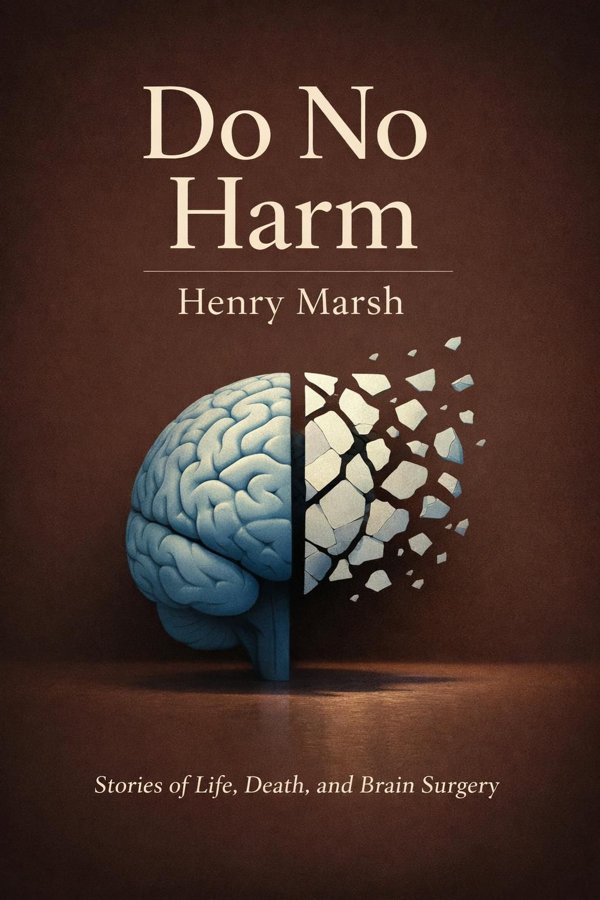
Do No Harm: Summary & Key Insights
by Henry Marsh
 10 min8 chaptersAudio available
Key Takeaways from Do No Harm
The most sobering truth in Do No Harm is that even life-saving treatment can cause devastating harm.
One of Marsh’s most powerful insights is that expertise without humility can become dangerous.
A central moral force in Do No Harm is Marsh’s insistence that medical treatment is never purely technical.
A striking theme in Do No Harm is that medical errors do not end when the operation is over.
Symptoms can be ambiguous, scans can mislead, operations can unfold unpredictably, and recovery can take unexpected turns.
What Is Do No Harm About?
Do No Harm by Henry Marsh is a memoir book. What happens when the margin for error is almost nonexistent, and every decision may alter a human life forever? In Do No Harm, renowned British neurosurgeon Henry Marsh brings readers into the operating theater, the consultation room, and the private moral landscape of a doctor whose work involves the most delicate organ in the body: the brain. This memoir is not a heroic celebration of medicine, but a candid, often unsettling account of uncertainty, failure, responsibility, and the fragile line between healing and harm. Marsh writes with unusual honesty about success and disappointment, about the emotional burden of operating on patients who place absolute trust in him, and about the limits of even the most advanced medical skill. What makes the book matter so deeply is its refusal to hide behind professional detachment. Instead, it reveals medicine as a profoundly human practice shaped by judgment, fallibility, and compassion. As one of Britain’s most respected neurosurgeons, Marsh has the authority of decades of experience, but his true power as a writer lies in his humility. Do No Harm is essential reading for anyone interested in medicine, ethics, mortality, or the difficult responsibilities that come with expertise.
This FizzRead summary covers all 8 key chapters of Do No Harm in approximately 10 minutes, distilling the most important ideas, arguments, and takeaways from Henry Marsh's work. Also available as an audio summary and Key Quotes Podcast.
Do No Harm
What happens when the margin for error is almost nonexistent, and every decision may alter a human life forever? In Do No Harm, renowned British neurosurgeon Henry Marsh brings readers into the operating theater, the consultation room, and the private moral landscape of a doctor whose work involves the most delicate organ in the body: the brain. This memoir is not a heroic celebration of medicine, but a candid, often unsettling account of uncertainty, failure, responsibility, and the fragile line between healing and harm. Marsh writes with unusual honesty about success and disappointment, about the emotional burden of operating on patients who place absolute trust in him, and about the limits of even the most advanced medical skill. What makes the book matter so deeply is its refusal to hide behind professional detachment. Instead, it reveals medicine as a profoundly human practice shaped by judgment, fallibility, and compassion. As one of Britain’s most respected neurosurgeons, Marsh has the authority of decades of experience, but his true power as a writer lies in his humility. Do No Harm is essential reading for anyone interested in medicine, ethics, mortality, or the difficult responsibilities that come with expertise.
Who Should Read Do No Harm?
This book is perfect for anyone interested in memoir and looking to gain actionable insights in a short read. Whether you're a student, professional, or lifelong learner, the key ideas from Do No Harm by Henry Marsh will help you think differently.
- ✓Readers who enjoy memoir and want practical takeaways
- ✓Professionals looking to apply new ideas to their work and life
- ✓Anyone who wants the core insights of Do No Harm in just 10 minutes
Want the full summary?
Get instant access to this book summary and 100K+ more with Fizz Moment.
Get Free SummaryAvailable on App Store • Free to download
Key Chapters
The most sobering truth in Do No Harm is that even life-saving treatment can cause devastating harm. Henry Marsh shows that neurosurgery is never a simple contest between action and inaction. Every intervention carries risk, and every delay does too. A tumor may need removal, but the surgery might leave the patient unable to speak, move, or remember. In this world, there are rarely perfect choices; there are only difficult judgments made with incomplete information.
Marsh’s memoir makes clear that medicine is often imagined as more precise than it really is. Patients may hope for certainty, and doctors may feel pressure to project confidence, but the reality is messier. A surgeon can be highly skilled, well-prepared, and deeply committed, yet still face outcomes no one can fully control. The brain is too complex, and each patient’s anatomy and condition are too variable for guarantees.
This idea matters beyond medicine. Many high-stakes decisions in life and work involve trade-offs rather than clear wins. Leaders, parents, teachers, and professionals often must choose between options that all carry some risk. Marsh’s honesty invites us to stop seeking impossible certainty and instead focus on thoughtful judgment.
A practical application is to improve how we make difficult decisions. Rather than asking, “What is the risk-free option?” ask, “What are the likely benefits, the possible harms, and what matters most if things go wrong?” This framework leads to clearer, more realistic choices.
Actionable takeaway: When facing a major decision, write down the best-case, likely, and worst-case outcomes for each option before acting.
One of Marsh’s most powerful insights is that expertise without humility can become dangerous. Neurosurgery demands confidence, steady hands, and decisive action, yet Marsh repeatedly shows that arrogance is a hidden threat in medicine. A surgeon who believes too strongly in his own ability may ignore uncertainty, overlook warning signs, or underestimate the complexity of a case. In a field where a millimeter can change a life, overconfidence is not simply a personality flaw; it can be catastrophic.
What makes Do No Harm so compelling is Marsh’s willingness to examine his own ego. He does not pretend to be immune to pride, frustration, or the desire to succeed dramatically. Instead, he reveals how these emotions can influence judgment. This self-awareness is one of the book’s great strengths. He suggests that good doctors are not those who never doubt themselves, but those who understand that doubt can be a form of discipline.
The lesson applies to anyone in a position of responsibility. In business, law, education, or management, competence is essential, but the best professionals know the limits of their knowledge. Humility encourages better questions, better listening, and better collaboration. It also makes room for learning after mistakes.
A practical example is the habit of pausing before important decisions to ask, “What might I be missing?” Teams can formalize this by inviting dissent, second opinions, or structured reviews. That extra step may feel inefficient, but it often prevents costly errors.
Actionable takeaway: Build one humility check into major decisions by actively seeking a credible second opinion before moving forward.
A central moral force in Do No Harm is Marsh’s insistence that medical treatment is never purely technical. A brain scan may reveal a lesion, pressure, or hemorrhage, but behind every image is a person with fears, relationships, memories, and hopes. Neurosurgery can easily reduce human beings to anatomy because the work is so specialized and urgent. Marsh resists that reduction, even as he admits how difficult it can be within hospital systems shaped by time pressure and emotional self-protection.
The memoir shows that patients do not experience illness as doctors do. A surgeon may focus on probabilities, procedures, and surgical margins, while the patient is wondering whether they will still recognize their spouse, return to work, or remain themselves after the operation. Marsh’s reflections remind readers that good care depends not only on technical excellence but also on understanding what outcomes matter most to the person being treated.
This insight extends well beyond hospitals. In any professional setting, people can become categories: clients, employees, users, students, or cases. When that happens, empathy weakens and decisions become less humane. Remembering the whole person improves judgment because it reveals what truly matters.
Practically, this means asking better questions. Instead of only asking what can be done, ask what the affected person values, fears, and considers an acceptable outcome. In healthcare, that can guide treatment decisions. In everyday life, it improves communication, leadership, and trust.
Actionable takeaway: In your next difficult conversation, spend at least five minutes understanding the other person’s priorities before offering solutions.
A striking theme in Do No Harm is that medical errors do not end when the operation is over. They live on in memory, conscience, and identity. Marsh writes with unusual candor about mistakes, near misses, and poor outcomes, showing that for surgeons, failure is not just professional embarrassment. It can become a source of guilt, self-doubt, and emotional injury that lasts for years.
This is important because public discussions about medicine often simplify the story. Patients rightly focus on the suffering caused by error, but Marsh adds another dimension: doctors are also shaped, and sometimes haunted, by what goes wrong. That does not excuse negligence. Instead, it reveals how deeply serious responsible practitioners feel about the consequences of their decisions. A surgeon may continue functioning outwardly while carrying private memories of a patient harmed despite his best efforts.
The broader lesson is that high-responsibility work always has an emotional cost. People who make consequential decisions—whether in emergency services, leadership, law, or caregiving—need ways to process failure honestly rather than deny it. Suppressing mistakes may protect pride in the short term, but it blocks learning and increases burnout.
A practical application is to create structured reflection after difficult outcomes. This could involve debriefs, journaling, peer discussion, or supervision. The goal is not self-punishment, but accountability combined with recovery. Reflection turns pain into insight.
Actionable takeaway: After any significant mistake or setback, review what happened using three questions: What was under my control, what was not, and what will I do differently next time?
Many readers come to Do No Harm expecting stories of surgical brilliance, but one of the book’s most revealing lessons is that uncertainty is not an exception in medicine; it is the normal condition. Symptoms can be ambiguous, scans can mislead, operations can unfold unpredictably, and recovery can take unexpected turns. Marsh demonstrates that doctors often act without complete clarity, making the best judgment they can from imperfect evidence.
This matters because modern culture often treats expert knowledge as if it should eliminate doubt. When outcomes are poor, people may assume someone must have failed. Marsh complicates that assumption. Sometimes medicine fails not because of incompetence, but because the human body is complex and reality does not always cooperate with prediction. Accepting this does not mean lowering standards. It means understanding what expertise really looks like: not omniscience, but disciplined decision-making under uncertainty.
This insight is useful in everyday life. We often postpone action while waiting for total confidence, but many important decisions—career moves, relationships, investments, creative projects—must be made before certainty arrives. Marsh’s example encourages us to combine analysis with realism.
A practical strategy is to prepare for uncertainty rather than deny it. Identify key unknowns, set thresholds for action, and define what signals would cause you to reconsider. This makes decisions more resilient when conditions change.
Actionable takeaway: Before making a major decision, list the top three uncertainties and decide in advance how you will respond if each one turns against you.
Do No Harm is not only about individual surgeons; it is also about the institutions in which they work. Marsh reveals how hospitals, staffing shortages, bureaucracy, exhausted teams, and inefficient systems influence patient care. Even the most conscientious doctor operates inside structures that can support or undermine good judgment. This is one of the memoir’s most important ethical points: harm does not arise only from bad individuals, but also from strained systems.
Marsh’s perspective helps readers see that medicine is not a clean meritocracy in which skill alone determines outcomes. Delays in diagnosis, unavailable resources, overworked staff, and administrative pressures can all affect what treatment is possible and how safely it is delivered. The burden on doctors is real, but so is the burden on patients who enter systems that may be doing their best while still falling short.
This broader view applies to other workplaces as well. Organizations often focus on individual performance while ignoring structural causes of failure. Yet repeated mistakes usually point to broken processes, poor communication, or unrealistic demands. Personal responsibility matters, but system design matters too.
A practical example is to audit recurring problems instead of blaming the last person involved. If deadlines are repeatedly missed, ask whether the process, timeline, or handoff structure is flawed. If customer complaints keep rising, look for systemic gaps rather than isolated errors.
Actionable takeaway: When a problem happens more than once, stop asking only “Who made the mistake?” and start asking “What in the system made this likely?”
Marsh makes clear that caring deeply for patients is necessary, but total emotional immersion would make neurosurgery impossible. A surgeon cannot tremble, hesitate, or collapse under the weight of every tragedy. At the same time, too much detachment risks turning patients into objects and suffering into routine. Do No Harm explores this tension with unusual honesty: good doctors must care enough to act ethically, yet remain steady enough to function effectively.
This balance is difficult in every helping profession. Teachers, therapists, managers, social workers, and family caregivers often face the same dilemma. If they distance themselves too much, they become cold and ineffective. If they absorb every emotion around them, they become exhausted and compromised. Marsh does not offer an easy formula, but he shows that maturity lies in managing both compassion and control.
A useful practical lesson is to distinguish empathy from emotional engulfment. Empathy means recognizing another person’s experience and responding with respect. It does not mean carrying their entire pain inside yourself. Healthy boundaries allow sustained care over time.
In practice, this might mean fully listening during difficult encounters, then using routines to reset afterward: notes, brief reflection, a walk, conversation with a colleague, or time away from screens. These habits protect attention and prevent emotional overload.
Actionable takeaway: Choose one boundary practice—such as a five-minute reset after stressful interactions—to help you stay compassionate without becoming depleted.
At its deepest level, Do No Harm is a book about mortality. The brain is the seat of identity, and operating on it forces constant confrontation with the fragility of selfhood and life. Marsh does not sentimentalize death, nor does he treat medicine as all-powerful. Instead, he asks what honesty, dignity, and responsibility look like when not every patient can be cured.
This is where the memoir becomes more than a medical narrative. It becomes a reflection on how human beings cope with finitude. Patients want hope, families want reassurance, and doctors want to help, but hope becomes dangerous when it turns into denial. Marsh argues, implicitly and sometimes directly, that truth matters even when it hurts. Honest conversations about prognosis, risk, and likely outcomes are acts of respect, not cruelty.
The lesson is relevant outside healthcare. People often avoid difficult truths because they fear causing pain, yet avoidance frequently creates worse suffering later. Clear communication about limits, loss, and reality allows better choices and more meaningful preparation.
A practical example is end-of-life planning, but the idea also applies to finances, relationships, and career transitions. Facing reality early gives people agency. It lets them prioritize what matters while time and options remain.
Actionable takeaway: Have one honest conversation you have been postponing—especially if avoiding it prevents practical planning or emotional clarity.
All Chapters in Do No Harm
About the Author
Henry Marsh is a distinguished British neurosurgeon and author known for his candid writing about medicine, ethics, and the human consequences of clinical decision-making. He spent much of his career working as a consultant neurosurgeon in London, earning respect for his expertise in complex brain surgery. Beyond the operating theater, Marsh became widely known for bringing rare honesty to public discussions of medical fallibility, responsibility, and mortality. He also devoted significant effort to supporting neurosurgical care in Ukraine, where he helped train doctors and improve access to treatment. As a writer, Marsh combines technical authority with humility and literary clarity, making difficult medical realities accessible to general readers. Do No Harm established him as one of the most compelling physician memoirists of his generation.
Get This Summary in Your Preferred Format
Read or listen to the Do No Harm summary by Henry Marsh anytime, anywhere. FizzRead offers multiple formats so you can learn on your terms — all free.
Available formats: App · Audio · PDF · EPUB — All included free with FizzRead
Download Do No Harm PDF and EPUB Summary
Key Quotes from Do No Harm
“The most sobering truth in Do No Harm is that even life-saving treatment can cause devastating harm.”
“One of Marsh’s most powerful insights is that expertise without humility can become dangerous.”
“A central moral force in Do No Harm is Marsh’s insistence that medical treatment is never purely technical.”
“A striking theme in Do No Harm is that medical errors do not end when the operation is over.”
“Many readers come to Do No Harm expecting stories of surgical brilliance, but one of the book’s most revealing lessons is that uncertainty is not an exception in medicine; it is the normal condition.”
Frequently Asked Questions about Do No Harm
Do No Harm by Henry Marsh is a memoir book that explores key ideas across 8 chapters. What happens when the margin for error is almost nonexistent, and every decision may alter a human life forever? In Do No Harm, renowned British neurosurgeon Henry Marsh brings readers into the operating theater, the consultation room, and the private moral landscape of a doctor whose work involves the most delicate organ in the body: the brain. This memoir is not a heroic celebration of medicine, but a candid, often unsettling account of uncertainty, failure, responsibility, and the fragile line between healing and harm. Marsh writes with unusual honesty about success and disappointment, about the emotional burden of operating on patients who place absolute trust in him, and about the limits of even the most advanced medical skill. What makes the book matter so deeply is its refusal to hide behind professional detachment. Instead, it reveals medicine as a profoundly human practice shaped by judgment, fallibility, and compassion. As one of Britain’s most respected neurosurgeons, Marsh has the authority of decades of experience, but his true power as a writer lies in his humility. Do No Harm is essential reading for anyone interested in medicine, ethics, mortality, or the difficult responsibilities that come with expertise.
More by Henry Marsh
You Might Also Like






Featured In
Browse by Category
Ready to read Do No Harm?
Get the full summary and 100K+ more books with Fizz Moment.