
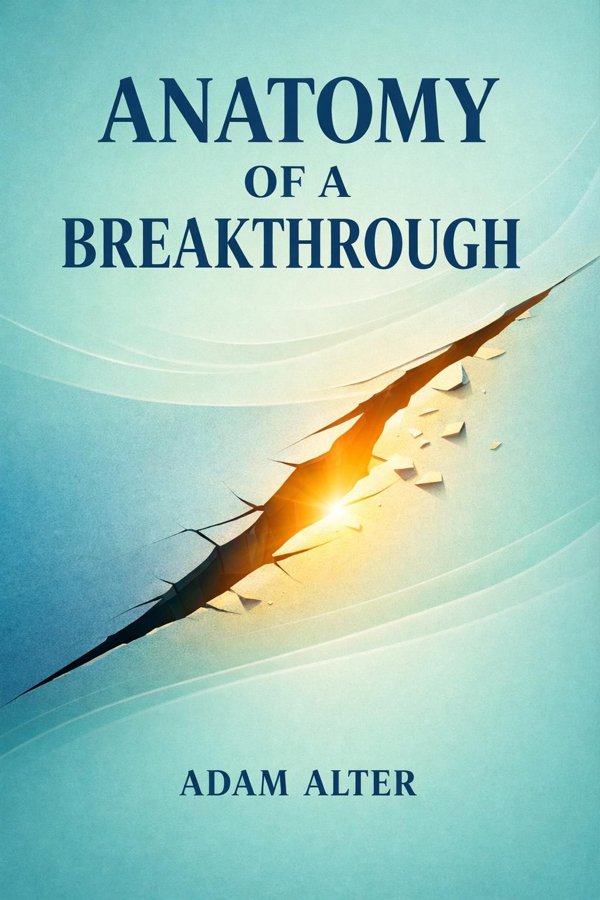
Anatomy of a Breakthrough: How to Get Unstuck When It Matters Most: Summary & Key Insights
by Adam Alter
 10 min9 chaptersAudio available
Key Takeaways from Anatomy of a Breakthrough: How to Get Unstuck When It Matters Most
Feeling stuck is not simply a lack of discipline; it is often a collision between emotion, perception, and behavior.
Progress is rarely a straight line.
We often imagine breakthroughs as products of willpower, but Alter shows that environment is one of the strongest hidden forces behind both stagnation and progress.
When people are stuck, they often wait for a dramatic burst of inspiration.
A common cause of stuckness is the belief that we need certainty before acting.
What Is Anatomy of a Breakthrough: How to Get Unstuck When It Matters Most About?
Anatomy of a Breakthrough: How to Get Unstuck When It Matters Most by Adam Alter is a psychology book spanning 6 pages. Why do smart, capable, motivated people suddenly lose momentum? Why do teams with talent and resources stall just when progress matters most? In Anatomy of a Breakthrough, Adam Alter tackles one of modern life’s most frustrating experiences: getting stuck. Whether the problem shows up as a creative block, a career plateau, a struggling relationship, or an organization that can no longer innovate, Alter argues that stuckness is neither random nor permanent. It follows patterns, emerges from identifiable forces, and can be reversed with the right interventions. Drawing on psychology, neuroscience, behavioral science, and vivid case studies, Alter shows that breakthroughs rarely come from brute force alone. They come from understanding the emotional, cognitive, and environmental traps that keep us frozen, then learning how to redesign our habits, surroundings, and expectations. The book matters because periods of stagnation are inevitable, but remaining stuck is not. Alter, a professor of marketing and psychology at NYU Stern and the bestselling author of Irresistible, brings both research depth and practical clarity to the subject, making this a timely guide for anyone who wants to regain traction when forward motion feels impossible.
This FizzRead summary covers all 9 key chapters of Anatomy of a Breakthrough: How to Get Unstuck When It Matters Most in approximately 10 minutes, distilling the most important ideas, arguments, and takeaways from Adam Alter's work. Also available as an audio summary and Key Quotes Podcast.
Anatomy of a Breakthrough: How to Get Unstuck When It Matters Most
Why do smart, capable, motivated people suddenly lose momentum? Why do teams with talent and resources stall just when progress matters most? In Anatomy of a Breakthrough, Adam Alter tackles one of modern life’s most frustrating experiences: getting stuck. Whether the problem shows up as a creative block, a career plateau, a struggling relationship, or an organization that can no longer innovate, Alter argues that stuckness is neither random nor permanent. It follows patterns, emerges from identifiable forces, and can be reversed with the right interventions.
Drawing on psychology, neuroscience, behavioral science, and vivid case studies, Alter shows that breakthroughs rarely come from brute force alone. They come from understanding the emotional, cognitive, and environmental traps that keep us frozen, then learning how to redesign our habits, surroundings, and expectations. The book matters because periods of stagnation are inevitable, but remaining stuck is not. Alter, a professor of marketing and psychology at NYU Stern and the bestselling author of Irresistible, brings both research depth and practical clarity to the subject, making this a timely guide for anyone who wants to regain traction when forward motion feels impossible.
Who Should Read Anatomy of a Breakthrough: How to Get Unstuck When It Matters Most?
This book is perfect for anyone interested in psychology and looking to gain actionable insights in a short read. Whether you're a student, professional, or lifelong learner, the key ideas from Anatomy of a Breakthrough: How to Get Unstuck When It Matters Most by Adam Alter will help you think differently.
- ✓Readers who enjoy psychology and want practical takeaways
- ✓Professionals looking to apply new ideas to their work and life
- ✓Anyone who wants the core insights of Anatomy of a Breakthrough: How to Get Unstuck When It Matters Most in just 10 minutes
Want the full summary?
Get instant access to this book summary and 100K+ more with Fizz Moment.
Get Free SummaryAvailable on App Store • Free to download
Key Chapters
Feeling stuck is not simply a lack of discipline; it is often a collision between emotion, perception, and behavior. One of Alter’s key insights is that stagnation usually feels personal, but it is often structural and psychological. We interpret stalled progress as evidence that something is wrong with us, when in fact it may reflect uncertainty, overload, fear of failure, perfectionism, or the absence of visible rewards. This matters because the wrong diagnosis leads to the wrong solution. If you think you are lazy, you push harder. If the real issue is anxiety or ambiguity, more pressure may deepen the paralysis.
Alter shows that stuckness tends to thrive when effort no longer produces feedback. Human beings are motivated by signs of movement. When the path ahead is unclear or outcomes are delayed, the brain struggles to sustain energy and belief. A writer who receives no immediate response, a founder facing repeated setbacks, or an employee whose work seems invisible can all begin to disengage, even if they still care deeply.
This also explains why stuckness can feel so confusing. You may still have ambition, intelligence, and desire, yet remain unable to act. The problem is not a complete absence of motivation but a disruption in the systems that convert desire into momentum.
A practical application is to separate the feeling of stuckness into parts: emotional barriers, cognitive confusion, environmental friction, and skill gaps. Instead of asking, “What’s wrong with me?” ask, “What exactly is blocking movement right now?” That shift turns a vague struggle into a solvable problem.
Actionable takeaway: When you feel stuck, diagnose before you push. Write down the emotional, mental, and practical obstacles in front of you, then address the specific block rather than blaming your character.
Progress is rarely a straight line. One of the book’s most useful ideas is that individuals and organizations move through recurring phases of growth, plateau, and renewal. Stagnation often feels like failure because we expect continuous upward motion. But plateaus are normal. They are not always signs that the journey has ended; sometimes they are signals that the current approach has run its course.
Alter emphasizes that many breakthroughs are preceded by long periods when nothing seems to happen. Athletes stop improving with the same training routine. Companies lose their edge after mastering one successful model. Relationships become repetitive when partners fall into fixed scripts. In each case, the plateau is not meaningless. It reveals that the existing system has extracted most of the value it can.
Recognizing this pattern reduces shame and improves strategy. If stuckness is part of a cycle, then the key question is not whether plateaus occur but how you respond to them. Some people react by quitting too early. Others double down on methods that no longer work. More adaptive responses include pausing to reassess, changing the challenge level, introducing variation, or redefining what progress should look like in the current phase.
For example, a professional who has stopped learning in a familiar role may need a lateral move rather than a promotion. A team whose meetings produce no fresh ideas may need a new format, new voices, or a break in routine. A creator whose work feels flat may need to switch medium, audience, or constraints.
Actionable takeaway: Treat plateaus as information, not verdicts. Identify which phase you are in—growth, plateau, or renewal—and make one deliberate change that fits the phase instead of clinging to a strategy built for an earlier stage.
We often imagine breakthroughs as products of willpower, but Alter shows that environment is one of the strongest hidden forces behind both stagnation and progress. Context influences attention, mood, creativity, persistence, and even the kinds of ideas we believe are possible. A stale environment can lock us into stale thinking. A fresh environment can interrupt mental ruts.
This applies to physical spaces, social settings, schedules, and digital environments. An office filled with interruptions can make deep work almost impossible. A home setup associated with stress can reinforce avoidance. A team culture that punishes risk will produce caution rather than innovation. Even online platforms can shape stuckness by fragmenting attention and making meaningful effort harder to sustain.
Alter’s broader point is that the mind does not operate in isolation. If you repeatedly fail to make progress in one context, changing that context may do more than trying to summon more internal resolve. Writers often find momentum in a new room, a library, or a public workspace because the shift weakens old associations. Teams can unlock better thinking by changing meeting structures, removing hierarchy from brainstorming, or stepping away from familiar rooms. People trying to solve personal problems may gain clarity simply by walking, traveling, or changing routines.
The practical lesson is not that every breakthrough requires a dramatic relocation. Often small environmental shifts produce disproportionate results: moving your phone out of sight, scheduling high-focus work earlier, using different spaces for different tasks, or surrounding yourself with people who energize experimentation rather than defend habit.
Actionable takeaway: Audit your environment for friction. Identify one physical, social, or digital element that reinforces your stuck pattern, and redesign it this week to make progress easier and avoidance harder.
When people are stuck, they often wait for a dramatic burst of inspiration. Alter argues that this is usually the wrong approach. Breakthroughs may look sudden from the outside, but they are often built from small wins that restore momentum. The psychology here is powerful: visible progress creates motivation, and motivation then supports further progress. In other words, action does not always follow confidence; confidence often follows action.
This matters especially when the challenge feels overwhelming. A large, undefined goal can trigger avoidance because the first step seems too small to matter or too difficult to begin. Alter suggests that incremental movement changes the emotional temperature of a problem. Instead of trying to finish the proposal, write the opening paragraph. Instead of fixing your entire career, have one exploratory conversation. Instead of redesigning a failing organization, solve one recurring bottleneck that everyone recognizes.
Small wins are not trivial. They generate feedback, reveal what works, and counter the helplessness that comes from standing still. They also shift identity. Someone who says, “I can’t get started,” becomes someone who has already started. That internal change can be decisive.
Examples are everywhere. A person recovering from burnout may regain energy by restoring one stable routine, such as sleep or walking. A business trapped in complexity may find traction by simplifying one customer journey. A student overwhelmed by a thesis may commit to twenty minutes a day and gradually rebuild consistency.
Actionable takeaway: Shrink the next step until it feels almost impossible to resist. Define one concrete action you can complete in under fifteen minutes, do it immediately, and use that completed action to create your next step.
A common cause of stuckness is the belief that we need certainty before acting. Alter challenges this instinct by showing that breakthroughs often emerge from experimentation rather than flawless planning. When people are trapped, they tend to overthink, seeking the ideal path that will eliminate risk. But in uncertain situations, waiting for clarity can become its own trap. Clarity frequently arrives after action, not before it.
Experimentation works because it lowers the stakes. Instead of asking, “What is the perfect solution?” you ask, “What is one test that might teach me something useful?” That shift transforms a paralyzing decision into a learning process. It also reduces the ego threat attached to failure. A failed experiment is not proof of inadequacy; it is data.
This mindset is especially valuable in careers, creative work, and organizational change. Someone considering a new field does not have to resign tomorrow; they can shadow a professional, take a short course, or freelance on the side. A company seeking innovation does not need a full reinvention overnight; it can prototype, gather feedback, and refine. A person trying to improve a relationship can test a new communication ritual before demanding a complete transformation.
Alter also connects experimentation to resilience. People who frame setbacks as information are less likely to become immobilized by them. They maintain movement because every outcome expands understanding.
Actionable takeaway: Replace one high-pressure decision with a low-risk experiment. Ask what you can test in the next seven days that would give you real information, then judge the result by what you learned rather than whether it worked perfectly.
Many people treat frustration, boredom, anxiety, or discouragement as obstacles to overcome through sheer force. Alter takes a more nuanced view: these emotions are often signals. They do not always mean you should stop, but they may be telling you that something in the system needs attention. Ignoring them can prolong stuckness because emotion influences what we notice, what we avoid, and how much uncertainty we can tolerate.
For instance, boredom may indicate that a challenge has become too repetitive or too easy. Anxiety may point to unclear stakes, insufficient preparation, or excessive perfectionism. Frustration may reveal that your effort and reward are out of alignment. Even envy can be informative, hinting at ambitions you have not admitted openly.
This perspective is helpful because it turns emotion into information rather than moral judgment. Instead of saying, “I shouldn’t feel this way,” you can ask, “What is this feeling trying to show me?” A manager who feels dread before every meeting may discover that the meetings are structurally ineffective. A student who keeps procrastinating may realize the assignment is too vague. A creative professional who feels numb may need novelty, rest, or a different audience.
At the same time, Alter does not suggest obeying every feeling. The goal is interpretation, not surrender. Emotions can mislead, but they are still data. The challenge is to decode them carefully and use them to guide better interventions.
Actionable takeaway: The next time a negative emotion appears repeatedly, label it precisely and ask what condition might be producing it. Use the answer to change the structure of the task instead of merely demanding a better mood.
One of the most counterintuitive ideas in the book is that progress sometimes depends on stepping back. In a culture that glorifies relentless effort, pauses can look like weakness. Alter argues that strategic rest is often essential for breakthroughs because overexertion narrows thought, depletes emotional reserves, and makes us more likely to repeat familiar patterns. Exhausted minds seek efficiency, not originality.
Renewal is not passive withdrawal; it is active recalibration. When people are deeply stuck, they often need distance from the problem to recover perspective. Sleep, downtime, walks, conversation, play, and time in different environments allow unconscious processing to continue while conscious strain eases. This is why solutions sometimes appear in the shower, during a run, or after a vacation. The mind can reorganize when it is not being forced along the same tracks.
This principle applies beyond individuals. Teams under nonstop pressure can become rigid and reactive. Organizations that never pause to reflect may confuse activity with advancement. Introducing recovery periods, review cycles, and protected reflection time can improve both judgment and creativity.
Of course, rest can slide into avoidance if it becomes endless postponement. Alter’s point is not to escape the challenge but to create the conditions under which better engagement becomes possible. The best pauses are purposeful: they restore energy, broaden attention, and prepare the next move.
Actionable takeaway: If repeated effort is producing diminishing returns, schedule a deliberate reset. Take a defined break, change your setting, and return with one question: what should be stopped, not just what should be pushed harder?
Getting unstuck is only part of the story. Alter also explores what it takes to sustain momentum once a breakthrough begins. This matters because early progress can create overconfidence, leading people to abandon the habits and structures that made movement possible. The same forces that caused stagnation can return if the underlying system remains unchanged.
Sustainable momentum comes from converting insight into routine. A breakthrough idea, emotional realization, or strategic pivot has limited value unless it becomes embedded in daily behavior. If a writer overcomes a block by drafting in shorter sessions, that pattern needs to be protected. If a company escapes a plateau through experimentation, it must preserve the culture that supports learning rather than reverting to complacency once results improve.
Alter’s broader contribution is to frame breakthroughs not as singular heroic moments but as transitions into a new operating mode. That requires reflection: What exactly helped? Which conditions made progress easier? Which warning signs suggest relapse into old patterns? People who ask these questions are more likely to preserve gains.
Examples include tracking lead indicators rather than waiting for outcomes, keeping accountability structures in place after the crisis passes, and institutionalizing what worked through calendars, checklists, rituals, and team norms. The goal is to make renewed progress less dependent on mood and more dependent on design.
Actionable takeaway: After any meaningful step forward, spend ten minutes identifying the behaviors, conditions, and supports that enabled it. Turn at least one of them into a repeatable rule so the breakthrough becomes a durable pattern rather than a brief exception.
All Chapters in Anatomy of a Breakthrough: How to Get Unstuck When It Matters Most
About the Author
Adam Alter is a professor of marketing and psychology at New York University’s Stern School of Business, where he studies judgment, decision-making, and the subtle forces that shape human behavior. His work bridges academic research and everyday life, helping readers understand how psychology influences habit, motivation, attention, and choice. Alter is widely known for making behavioral science accessible without oversimplifying it. He is also the bestselling author of Irresistible, a book that explored the design of addictive technologies and behaviors. In Anatomy of a Breakthrough, he brings that same research-driven, readable style to the question of why people and organizations get stuck. His expertise makes him a strong guide for readers seeking both insight and practical strategies for regaining momentum.
Get This Summary in Your Preferred Format
Read or listen to the Anatomy of a Breakthrough: How to Get Unstuck When It Matters Most summary by Adam Alter anytime, anywhere. FizzRead offers multiple formats so you can learn on your terms — all free.
Available formats: App · Audio · PDF · EPUB — All included free with FizzRead
Download Anatomy of a Breakthrough: How to Get Unstuck When It Matters Most PDF and EPUB Summary
Key Quotes from Anatomy of a Breakthrough: How to Get Unstuck When It Matters Most
“Feeling stuck is not simply a lack of discipline; it is often a collision between emotion, perception, and behavior.”
“One of the book’s most useful ideas is that individuals and organizations move through recurring phases of growth, plateau, and renewal.”
“We often imagine breakthroughs as products of willpower, but Alter shows that environment is one of the strongest hidden forces behind both stagnation and progress.”
“When people are stuck, they often wait for a dramatic burst of inspiration.”
“A common cause of stuckness is the belief that we need certainty before acting.”
Frequently Asked Questions about Anatomy of a Breakthrough: How to Get Unstuck When It Matters Most
Anatomy of a Breakthrough: How to Get Unstuck When It Matters Most by Adam Alter is a psychology book that explores key ideas across 9 chapters. Why do smart, capable, motivated people suddenly lose momentum? Why do teams with talent and resources stall just when progress matters most? In Anatomy of a Breakthrough, Adam Alter tackles one of modern life’s most frustrating experiences: getting stuck. Whether the problem shows up as a creative block, a career plateau, a struggling relationship, or an organization that can no longer innovate, Alter argues that stuckness is neither random nor permanent. It follows patterns, emerges from identifiable forces, and can be reversed with the right interventions. Drawing on psychology, neuroscience, behavioral science, and vivid case studies, Alter shows that breakthroughs rarely come from brute force alone. They come from understanding the emotional, cognitive, and environmental traps that keep us frozen, then learning how to redesign our habits, surroundings, and expectations. The book matters because periods of stagnation are inevitable, but remaining stuck is not. Alter, a professor of marketing and psychology at NYU Stern and the bestselling author of Irresistible, brings both research depth and practical clarity to the subject, making this a timely guide for anyone who wants to regain traction when forward motion feels impossible.
More by Adam Alter
You Might Also Like
The Body Keeps the Score
Bessel van der Kolk
10 min
Surrounded by Idiots
Thomas Erikson
10 min
Emotional Intelligence
Daniel Goleman
10 min
Attached
Amir Levine
10 min
Why Does He Do That
Lundy Bancroft
10 min
Women Who Run with the Wolves
Clarissa Pinkola Estés
10 minBrowse by Category
Ready to read Anatomy of a Breakthrough: How to Get Unstuck When It Matters Most?
Get the full summary and 100K+ more books with Fizz Moment.