
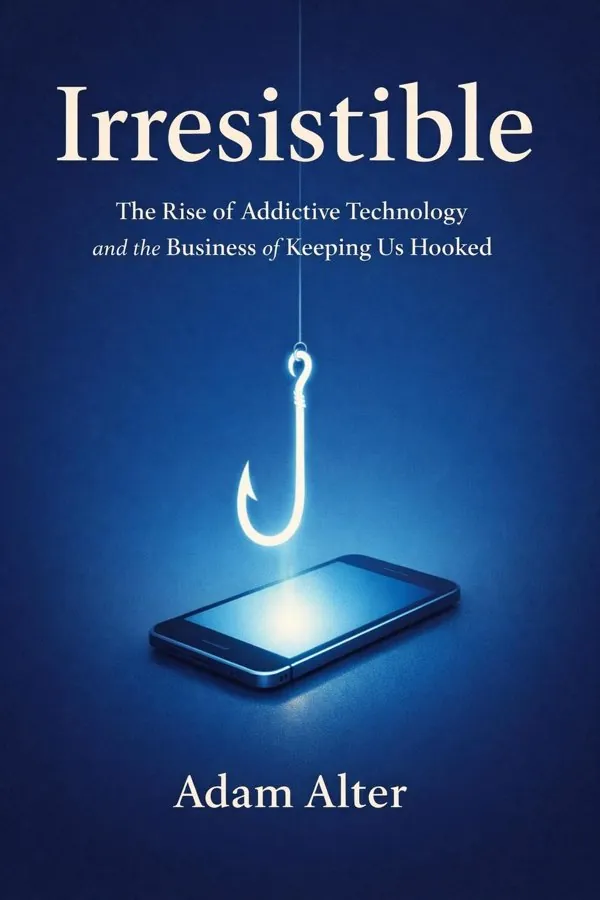
Irresistible: The Rise of Addictive Technology and the Business of Keeping Us Hooked: Summary & Key Insights
by Adam Alter
 10 min12 chaptersAudio available
What Is Irresistible: The Rise of Addictive Technology and the Business of Keeping Us Hooked About?
Irresistible: The Rise of Addictive Technology and the Business of Keeping Us Hooked by Adam Alter is a digital_culture book spanning 12 pages. In this groundbreaking work, Adam Alter explores the psychology behind behavioral addiction and the irresistible pull of modern technology. Drawing on research from psychology, neuroscience, and marketing, Alter reveals how apps, games, and social media are designed to keep us hooked, and offers insights into how we can regain control over our attention and time.
This FizzRead summary covers all 12 key chapters of Irresistible: The Rise of Addictive Technology and the Business of Keeping Us Hooked in approximately 10 minutes, distilling the most important ideas, arguments, and takeaways from Adam Alter's work. Also available as an audio summary and Key Quotes Podcast.
Irresistible: The Rise of Addictive Technology and the Business of Keeping Us Hooked
In this groundbreaking work, Adam Alter explores the psychology behind behavioral addiction and the irresistible pull of modern technology. Drawing on research from psychology, neuroscience, and marketing, Alter reveals how apps, games, and social media are designed to keep us hooked, and offers insights into how we can regain control over our attention and time.
Who Should Read Irresistible: The Rise of Addictive Technology and the Business of Keeping Us Hooked?
This book is perfect for anyone interested in digital_culture and looking to gain actionable insights in a short read. Whether you're a student, professional, or lifelong learner, the key ideas from Irresistible: The Rise of Addictive Technology and the Business of Keeping Us Hooked by Adam Alter will help you think differently.
- ✓Readers who enjoy digital_culture and want practical takeaways
- ✓Professionals looking to apply new ideas to their work and life
- ✓Anyone who wants the core insights of Irresistible: The Rise of Addictive Technology and the Business of Keeping Us Hooked in just 10 minutes
Want the full summary?
Get instant access to this book summary and 100K+ more with Fizz Moment.
Get Free SummaryAvailable on App Store • Free to download
Key Chapters
To understand digital addiction, we must first trace its lineage. Long before smartphones and social media, human beings displayed compulsive tendencies toward games, work, and even rituals. The moment technology began amplifying these behaviors—first with arcade games, later with personal computers—the seeds of modern addiction were sown. The history is less about machines and more about our response to them. Pong and Pac-Man were early experiments in visual stimuli rewarding persistence and skill. Slots and online gambling further refined the notion of intermittent gratification. Each technological advance didn’t invent addiction; it optimized it.
What changed most dramatically in the twenty-first century was accessibility. While previous addictive experiences required a physical venue—a casino, a gaming arcade—smartphones brought the addictive interface into the palm of our hands. Suddenly, engagement was possible every minute of the day. This shift turned occasional indulgence into chronic dependence. The technologies themselves evolved alongside psychology; developers learned, sometimes intuitively, that humans respond best to uncertainty and variable outcomes. It’s not the win that keeps us playing—it’s the potential to win soon.
Looking back, even early media theorists worried about passive consumption. What’s unique now is that the consumption is personalized and interactive, powered by data trails that ensure every temptation is tailored to the individual. The history of addictive behavior is therefore the history of personalization. The more we revealed about ourselves, the better systems became at predicting what we wanted before we even knew it. This historical trajectory shows how our tools adapted to human psychology until, at some point, they began to manipulate it in return.
Every addictive cycle, whether chemical or behavioral, rests on the foundation of reward and reinforcement. The reason digital experiences captivate us is because they engage the brain’s dopaminergic system—the part that signals pleasure but also motivates pursuit. Dopamine isn’t the substance of satisfaction itself; it’s the signal that tells us a reward might be approaching. This is why anticipation, rather than fulfillment, holds such power.
When you check your notifications, you are not chasing the message; you are chasing the possibility of a message. The brain learns to associate the act of checking with a fleeting rush of dopamine. Over time, this pattern forms a habit loop: cue, action, reward. The cue might be boredom, the action is opening your device, and the reward is unpredictable social gratification. This loop strengthens as neural pathways reorganize, making the behavior feel automatic.
Psychological studies show that intermittent reinforcement—where rewards come at unpredictable intervals—is the strongest driver of persistence. Slot machines are the classic example, yet social media operates on the same logic. Likes, shares, and comments appear sporadically, keeping users in a constant state of anticipation. The problem isn’t pleasure itself; it’s the compulsion to seek it endlessly. Behavioral addiction hijacks the reward system designed for survival and repurposes it for engagement. In evolutionary terms, we were built to pursue uncertain rewards because they indicated learning opportunities. In the digital era, that ancient mechanism meets infinite stimuli, and the result is exhaustion masked as connection.
+ 10 more chapters — available in the FizzRead app
All Chapters in Irresistible: The Rise of Addictive Technology and the Business of Keeping Us Hooked
About the Author
Adam Alter is a professor of psychology and marketing at New York University’s Stern School of Business. His research focuses on judgment, decision-making, and social psychology, and he is known for his accessible writing on the intersection of technology and human behavior.
Get This Summary in Your Preferred Format
Read or listen to the Irresistible: The Rise of Addictive Technology and the Business of Keeping Us Hooked summary by Adam Alter anytime, anywhere. FizzRead offers multiple formats so you can learn on your terms — all free.
Available formats: App · Audio · PDF · EPUB — All included free with FizzRead
Download Irresistible: The Rise of Addictive Technology and the Business of Keeping Us Hooked PDF and EPUB Summary
Key Quotes from Irresistible: The Rise of Addictive Technology and the Business of Keeping Us Hooked
“To understand digital addiction, we must first trace its lineage.”
“Every addictive cycle, whether chemical or behavioral, rests on the foundation of reward and reinforcement.”
Frequently Asked Questions about Irresistible: The Rise of Addictive Technology and the Business of Keeping Us Hooked
Irresistible: The Rise of Addictive Technology and the Business of Keeping Us Hooked by Adam Alter is a digital_culture book that explores key ideas across 12 chapters. In this groundbreaking work, Adam Alter explores the psychology behind behavioral addiction and the irresistible pull of modern technology. Drawing on research from psychology, neuroscience, and marketing, Alter reveals how apps, games, and social media are designed to keep us hooked, and offers insights into how we can regain control over our attention and time.
More by Adam Alter

You Might Also Like

An Ugly Truth: Inside Facebook’s Battle for Domination
Sheera Frenkel, Cecilia Kang
10 min
Cyber Citizens
Ian Goodfellow
10 min
Digital Minimalism: Choosing a Focused Life in a Noisy World
Cal Newport
10 min
E‑Books & Beyond
Various Authors
10 min
The Future of Media
Various Authors
10 min
This Is Why We Can't Have Nice Things
Whitney Phillips
10 minBrowse by Category
Ready to read Irresistible: The Rise of Addictive Technology and the Business of Keeping Us Hooked?
Get the full summary and 100K+ more books with Fizz Moment.