
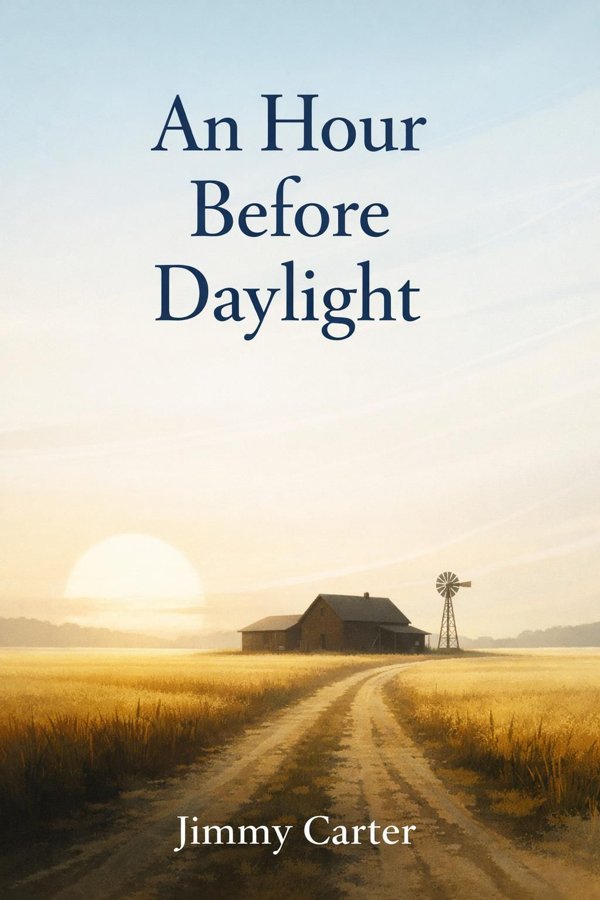
An Hour Before Daylight: Memories of a Rural Boyhood: Summary & Key Insights
by Jimmy Carter
 10 min11 chaptersAudio available
What Is An Hour Before Daylight: Memories of a Rural Boyhood About?
An Hour Before Daylight: Memories of a Rural Boyhood by Jimmy Carter is a biographies book spanning 11 pages. In this memoir, former U.S. President Jimmy Carter reflects on his childhood in rural Georgia during the Great Depression. He recounts life on the family farm, the values of hard work and community, and the racial and social realities of the American South. The book offers an intimate portrait of the people and experiences that shaped his character and worldview.
This FizzRead summary covers all 11 key chapters of An Hour Before Daylight: Memories of a Rural Boyhood in approximately 10 minutes, distilling the most important ideas, arguments, and takeaways from Jimmy Carter's work. Also available as an audio summary and Key Quotes Podcast.
An Hour Before Daylight: Memories of a Rural Boyhood
In this memoir, former U.S. President Jimmy Carter reflects on his childhood in rural Georgia during the Great Depression. He recounts life on the family farm, the values of hard work and community, and the racial and social realities of the American South. The book offers an intimate portrait of the people and experiences that shaped his character and worldview.
Who Should Read An Hour Before Daylight: Memories of a Rural Boyhood?
This book is perfect for anyone interested in biographies and looking to gain actionable insights in a short read. Whether you're a student, professional, or lifelong learner, the key ideas from An Hour Before Daylight: Memories of a Rural Boyhood by Jimmy Carter will help you think differently.
- ✓Readers who enjoy biographies and want practical takeaways
- ✓Professionals looking to apply new ideas to their work and life
- ✓Anyone who wants the core insights of An Hour Before Daylight: Memories of a Rural Boyhood in just 10 minutes
Want the full summary?
Get instant access to this book summary and 100K+ more with Fizz Moment.
Get Free SummaryAvailable on App Store • Free to download
Key Chapters
I was born in 1924 in Plains, Georgia, and raised a few miles outside of town in Archery, a tiny community surrounded by farms and woodlands. My father, Earl Carter, was a strict but fair man, a businessman of remarkable discipline who believed that every child ought to pull his share. From him I learned the virtue of precision and the importance of one’s word. My mother, Lillian Gordy Carter, known to everyone simply as Miss Lillian, was the opposite kind of force—a nurse, a spirited optimist, whose heart extended far beyond the constraints of race or class. Between them, they taught me the balance of conscience and practicality—my father through discipline, my mother through compassion.
Our home was modest, but it pulsed with energy. My siblings—Gloria, Ruth, and Billy—each carried their own spark of rebellion, tenderness, and humor. We lived without electricity, without plumbing, but not without order. My father ran the farm like a tight ship; we were each assigned tasks suited to our size and strength. Looking back, I understand now that my father’s relentless standards weren’t cruelty—they were preparation. He lived by the clock, and so did we, measuring time by sunlight and harvest, by droughts and rain. What we lacked in luxury, we made up for in purpose.
The farm was both our livelihood and our way of life. We grew corn, cotton, and most notably, peanuts. Every chore had its rhythm. Dawn came early; my father would rouse us before the sky turned gray, reminding me that 'an hour before daylight' was when real work began. That phrase would stay with me my entire life, a symbol of quiet persistence before the world is fully awake.
I fed the mules, milked cows, and helped with planting and plowing—each task requiring attention and patience. Farming was an unpredictable partnership with nature; droughts and floods tested our will more than our muscles. But in those fields, I came to understand the dignity of physical labor and the humility it imposed. The success of a harvest depended not on any single person but on collective endurance—ours, our animals’, even the weather’s mercy.
The lessons of those days reached far beyond agriculture. They taught me responsibility before reward, that success often arrives without applause, and that solitude can be deeply instructive. In every solitary furrow, I heard the quiet conversation between a boy and his land—a dialogue that would later inform my politics and my approach to leadership.
+ 9 more chapters — available in the FizzRead app
All Chapters in An Hour Before Daylight: Memories of a Rural Boyhood
About the Author
Jimmy Carter, born in 1924 in Plains, Georgia, served as the 39th President of the United States from 1977 to 1981. After leaving office, he became a global humanitarian and was awarded the Nobel Peace Prize in 2002 for his efforts in advancing peace, democracy, and human rights.
Get This Summary in Your Preferred Format
Read or listen to the An Hour Before Daylight: Memories of a Rural Boyhood summary by Jimmy Carter anytime, anywhere. FizzRead offers multiple formats so you can learn on your terms — all free.
Available formats: App · Audio · PDF · EPUB — All included free with FizzRead
Download An Hour Before Daylight: Memories of a Rural Boyhood PDF and EPUB Summary
Key Quotes from An Hour Before Daylight: Memories of a Rural Boyhood
“I was born in 1924 in Plains, Georgia, and raised a few miles outside of town in Archery, a tiny community surrounded by farms and woodlands.”
“The farm was both our livelihood and our way of life.”
Frequently Asked Questions about An Hour Before Daylight: Memories of a Rural Boyhood
An Hour Before Daylight: Memories of a Rural Boyhood by Jimmy Carter is a biographies book that explores key ideas across 11 chapters. In this memoir, former U.S. President Jimmy Carter reflects on his childhood in rural Georgia during the Great Depression. He recounts life on the family farm, the values of hard work and community, and the racial and social realities of the American South. The book offers an intimate portrait of the people and experiences that shaped his character and worldview.
More by Jimmy Carter

You Might Also Like

An American Marriage
Tayari Jones
10 min
Benjamin Franklin: An American Life
Walter Isaacson
10 min
I Know Why The Caged Bird Sings
Maya Angelou
10 min
Long Walk to Freedom
Nelson Mandela
10 min
Persepolis
Marjane Satrapi
10 min
Surely You're Joking, Mr. Feynman!
Richard P. Feynman
10 minBrowse by Category
Ready to read An Hour Before Daylight: Memories of a Rural Boyhood?
Get the full summary and 100K+ more books with Fizz Moment.