
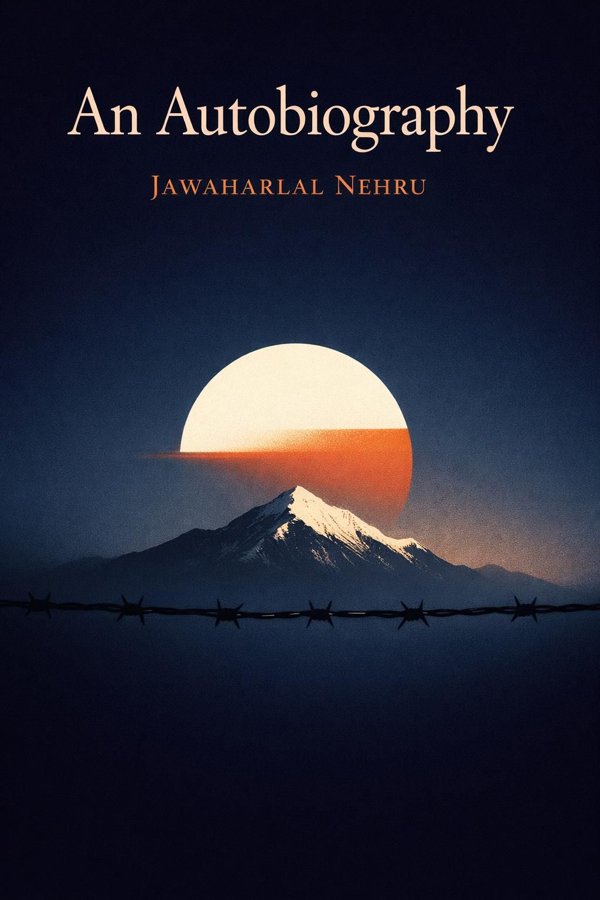
An Autobiography: Summary & Key Insights
 10 min10 chaptersAudio available
What Is An Autobiography About?
An Autobiography by Jawaharlal Nehru is a biographies book spanning 10 pages. Written during his imprisonment in Almora Jail between 1934 and 1935, Jawaharlal Nehru’s *An Autobiography* offers a deeply personal account of his life, political awakening, and philosophical reflections on India’s struggle for independence. The book combines introspection with historical narrative, portraying both his private doubts and his public convictions. It remains a seminal work in modern Indian political literature and a key document of the freedom movement.
This FizzRead summary covers all 10 key chapters of An Autobiography in approximately 10 minutes, distilling the most important ideas, arguments, and takeaways from Jawaharlal Nehru's work. Also available as an audio summary and Key Quotes Podcast.
An Autobiography
Written during his imprisonment in Almora Jail between 1934 and 1935, Jawaharlal Nehru’s *An Autobiography* offers a deeply personal account of his life, political awakening, and philosophical reflections on India’s struggle for independence. The book combines introspection with historical narrative, portraying both his private doubts and his public convictions. It remains a seminal work in modern Indian political literature and a key document of the freedom movement.
Who Should Read An Autobiography?
This book is perfect for anyone interested in biographies and looking to gain actionable insights in a short read. Whether you're a student, professional, or lifelong learner, the key ideas from An Autobiography by Jawaharlal Nehru will help you think differently.
- ✓Readers who enjoy biographies and want practical takeaways
- ✓Professionals looking to apply new ideas to their work and life
- ✓Anyone who wants the core insights of An Autobiography in just 10 minutes
Want the full summary?
Get instant access to this book summary and 100K+ more with Fizz Moment.
Get Free SummaryAvailable on App Store • Free to download
Key Chapters
I was born into comfort and privilege in 1889, in Allahabad, a city that often seemed a curious blend of tradition and colonial modernity. My father, Motilal Nehru, was a formidable figure—a self-made lawyer who had risen to prominence in British India, embodying at once admiration for Western efficiency and pride in our heritage. Our home, Anand Bhavan, was filled with books, conversation, and the vibrant energy of the nationalist movement that would later consume my life.
As a child, I looked upon my father with both awe and distance. He commanded respect and carried the confidence of one who had mastered the language and law of the rulers, yet his heart remained Indian at its core. It was my mother, gentle and deeply religious, who infused in me a different temperament—an inward, emotional sensitivity that later sought balance with intellectual rigor. I grew up surrounded by both Indian and British influences, speaking English fluently yet feeling the absence of true familiarity with India’s countless languages and customs. This dichotomy became the foundation of my lifelong tension: between East and West, reason and sentiment, modernity and tradition.
The India of my childhood was a mosaic of contradictions—wealth beside poverty, pride beside servility. The British Raj seemed omnipresent, shaping even our thoughts. Yet in our household, there was an undercurrent of resistance, a quiet assertion that Indians could excel in the very domains monopolized by the colonial elite. My father’s success proved that; but it also revealed the limits of individual achievement amidst national subjection. It was from this paradox—of privilege in a land oppressed—that the seed of my political consciousness began to sprout.
Leaving India for England was like stepping from one world into another. At Harrow, and later at Trinity College, Cambridge, I immersed myself in the intellectual ferment of early twentieth-century Britain. There I discovered the allure of science, rationalism, and modern political thought. The English landscape, its civility and institutions, fascinated me. Yet deep within, I remained an outsider—a colonial subject among rulers.
I studied natural sciences, captivated by the precision and beauty of scientific reasoning that offered a lens to view the world unclouded by superstition. Cambridge was not merely a place of learning; it was an encounter with the modern mind. I read H.G. Wells, Bertrand Russell, and Marx with equal curiosity, finding in their ideas glimpses of universalism and justice. But even as I absorbed the intellectual vigor of England, I began to sense the emptiness behind its imperial structure. Its civilization seemed self-assured, yet strangely mechanical, driven by the dominance over others.
In London, I trained for the bar at Inner Temple, conforming outwardly to the expectations of a future gentleman-lawyer. But inner rebellion was quietly stirring. I had seen the elegance of British order, yet I could not forget the inequality it represented back home. The contrast sharpened my awareness: science could be used for progress or oppression, reason could serve liberty or empire. When I finally returned to India, I carried both admiration and ambivalence—a belief in modern enlightenment mixed with discomfort at its imperial mask.
+ 8 more chapters — available in the FizzRead app
All Chapters in An Autobiography
About the Author
Jawaharlal Nehru (1889–1964) was an Indian statesman and the first Prime Minister of independent India. A central figure in Indian politics before and after independence, Nehru was a leading member of the Indian National Congress and a close associate of Mahatma Gandhi. His writings and speeches shaped modern India’s secular and democratic ideals.
Get This Summary in Your Preferred Format
Read or listen to the An Autobiography summary by Jawaharlal Nehru anytime, anywhere. FizzRead offers multiple formats so you can learn on your terms — all free.
Available formats: App · Audio · PDF · EPUB — All included free with FizzRead
Download An Autobiography PDF and EPUB Summary
Key Quotes from An Autobiography
“I was born into comfort and privilege in 1889, in Allahabad, a city that often seemed a curious blend of tradition and colonial modernity.”
“Leaving India for England was like stepping from one world into another.”
Frequently Asked Questions about An Autobiography
An Autobiography by Jawaharlal Nehru is a biographies book that explores key ideas across 10 chapters. Written during his imprisonment in Almora Jail between 1934 and 1935, Jawaharlal Nehru’s *An Autobiography* offers a deeply personal account of his life, political awakening, and philosophical reflections on India’s struggle for independence. The book combines introspection with historical narrative, portraying both his private doubts and his public convictions. It remains a seminal work in modern Indian political literature and a key document of the freedom movement.
More by Jawaharlal Nehru
You Might Also Like

An American Marriage
Tayari Jones
10 min
Benjamin Franklin: An American Life
Walter Isaacson
10 min
I Know Why The Caged Bird Sings
Maya Angelou
10 min
Long Walk to Freedom
Nelson Mandela
10 min
Persepolis
Marjane Satrapi
10 min
Surely You're Joking, Mr. Feynman!
Richard P. Feynman
10 minBrowse by Category
Ready to read An Autobiography?
Get the full summary and 100K+ more books with Fizz Moment.