
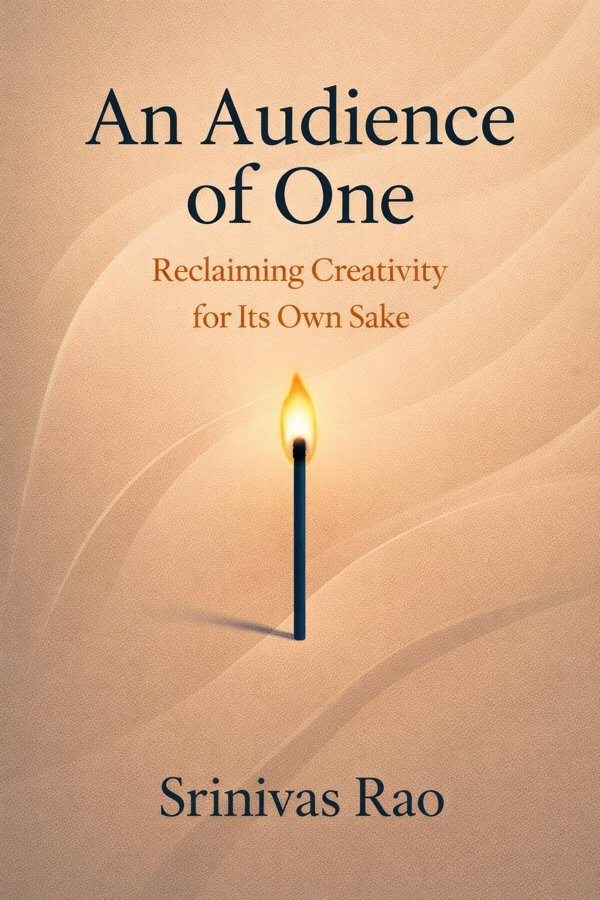
An Audience of One: Reclaiming Creativity for Its Own Sake: Summary & Key Insights
by Srinivas Rao
 10 min10 chaptersAudio available
Key Takeaways from An Audience of One: Reclaiming Creativity for Its Own Sake
One of the most dangerous things that can happen to a creator is to confuse attention with meaning.
Creativity begins to recover the moment it stops trying to impress.
What we call a creative block is often an attention problem in disguise.
The strongest creative work rarely comes from pressure; it comes from inner necessity.
Many people sabotage creativity by demanding certainty too early.
What Is An Audience of One: Reclaiming Creativity for Its Own Sake About?
An Audience of One: Reclaiming Creativity for Its Own Sake by Srinivas Rao is a creativity book spanning 10 pages. In An Audience of One, Srinivas Rao makes a timely and deeply human argument: creativity loses its vitality when it becomes a performance for strangers. In an age shaped by algorithms, personal branding, and constant comparison, many people no longer create because they are curious, moved, or alive to possibility. They create to be seen. Rao challenges that habit at its root. He invites readers to shift from public approval to private honesty, from chasing attention to cultivating meaningful expression. The book explores why external validation so easily hijacks creative work, how fear and distraction erode originality, and what it takes to build a practice grounded in intrinsic motivation. Drawing on psychology, artistic insight, and years of conversation through his work as host of The Unmistakable Creative, Rao writes with both practical clarity and philosophical depth. This matters because the health of our creative lives affects more than art alone; it shapes how we think, solve problems, and experience identity. For anyone who feels creatively blocked, performative, or burned out, this book offers a compelling path back to authentic creation.
This FizzRead summary covers all 10 key chapters of An Audience of One: Reclaiming Creativity for Its Own Sake in approximately 10 minutes, distilling the most important ideas, arguments, and takeaways from Srinivas Rao's work. Also available as an audio summary and Key Quotes Podcast.
An Audience of One: Reclaiming Creativity for Its Own Sake
In An Audience of One, Srinivas Rao makes a timely and deeply human argument: creativity loses its vitality when it becomes a performance for strangers. In an age shaped by algorithms, personal branding, and constant comparison, many people no longer create because they are curious, moved, or alive to possibility. They create to be seen. Rao challenges that habit at its root. He invites readers to shift from public approval to private honesty, from chasing attention to cultivating meaningful expression. The book explores why external validation so easily hijacks creative work, how fear and distraction erode originality, and what it takes to build a practice grounded in intrinsic motivation. Drawing on psychology, artistic insight, and years of conversation through his work as host of The Unmistakable Creative, Rao writes with both practical clarity and philosophical depth. This matters because the health of our creative lives affects more than art alone; it shapes how we think, solve problems, and experience identity. For anyone who feels creatively blocked, performative, or burned out, this book offers a compelling path back to authentic creation.
Who Should Read An Audience of One: Reclaiming Creativity for Its Own Sake?
This book is perfect for anyone interested in creativity and looking to gain actionable insights in a short read. Whether you're a student, professional, or lifelong learner, the key ideas from An Audience of One: Reclaiming Creativity for Its Own Sake by Srinivas Rao will help you think differently.
- ✓Readers who enjoy creativity and want practical takeaways
- ✓Professionals looking to apply new ideas to their work and life
- ✓Anyone who wants the core insights of An Audience of One: Reclaiming Creativity for Its Own Sake in just 10 minutes
Want the full summary?
Get instant access to this book summary and 100K+ more with Fizz Moment.
Get Free SummaryAvailable on App Store • Free to download
Key Chapters
One of the most dangerous things that can happen to a creator is to confuse attention with meaning. Rao argues that modern creative life is often distorted by the pursuit of external validation: likes, followers, praise, sales, applause, and social proof. None of these things are inherently bad, but they become destructive when they start determining what we make and why we make it. Instead of asking, “What feels true, interesting, or alive to me?” creators begin asking, “What will perform?” That subtle shift can quietly drain originality from the work.
The problem is psychological as much as cultural. External rewards create dependency. Once your sense of progress relies on audience response, every project becomes emotionally unstable. Silence feels like failure. Criticism feels like a verdict on your identity. Even success can become a trap, because you feel pressured to repeat what worked before rather than explore what might matter next.
Rao encourages readers to notice where their creative instincts have been outsourced to metrics. A writer may avoid difficult ideas because they do not “fit the brand.” A designer may copy trends because they are more likely to be shared. A musician may release only what seems marketable rather than what feels artistically honest.
The alternative is not indifference to audience, but freedom from dependence on audience. Create from internal conviction first; let reception come second. Actionable takeaway: before starting your next creative project, write down one sentence answering this question: “If no one ever saw this, why would it still be worth making?”
Creativity begins to recover the moment it stops trying to impress. Rao invites readers to remember a more natural relationship with making, one rooted in curiosity, play, and discovery. As children, we draw, build, invent stories, and experiment without asking whether the result is strategic, polished, or impressive. We make things because making itself is pleasurable. That spirit is not childish; it is foundational.
Over time, however, many people internalize judgment. School grades, professional expectations, online visibility, and cultural pressure teach us to evaluate every effort through the lens of success or failure. The result is a loss of spontaneity. We stop exploring and start performing. We become self-conscious instead of creatively absorbed.
Rao’s point is that joy is not a bonus outcome of creativity; it is often the condition that makes creativity possible. When you are genuinely engaged, you notice more, risk more, and think more flexibly. The work becomes less about proving talent and more about following energy. This often leads to better results precisely because it is less forced.
Practical applications can be simple. A writer can freewrite without intending to publish. A photographer can shoot only for fascination rather than portfolio value. A professional can take up sketching, journaling, or music with no ambition beyond enjoyment. These low-stakes acts restore trust in your own impulses.
Actionable takeaway: set aside thirty minutes this week to make something with one rule only: you are not allowed to share, optimize, or judge it. Your goal is not output, but rediscovering what creative enjoyment feels like.
What we call a creative block is often an attention problem in disguise. Rao emphasizes that creativity requires more than talent or inspiration; it requires sustained, undivided attention. In a world of notifications, multitasking, and endless digital stimuli, attention is constantly fragmented. When the mind is scattered, original thought struggles to emerge. Creativity needs space to connect ideas, notice subtle patterns, and stay with uncertainty long enough for something surprising to appear.
Distraction is not just an interruption of time; it is an interruption of depth. You may spend hours “working” while never entering the concentration needed for meaningful creation. Social media is especially corrosive because it rewards reactivity. It trains the mind to seek novelty instead of depth, comparison instead of imagination, and speed instead of reflection.
Rao suggests that reclaiming creativity means reclaiming sovereignty over your attention. This may involve structured periods of deep work, device-free walks, analog tools, or simple rituals that signal to your mind that it is time to focus. The goal is not purity or perfection, but intentionality. Even an hour of protected attention each day can transform the quality of your work.
For example, a writer might draft first thing in the morning before checking messages. A painter might leave the phone outside the studio. A knowledge worker might keep a notebook for ideas instead of toggling among tabs. These small boundaries protect mental continuity.
Actionable takeaway: choose one recurring creative session each week and make it completely distraction-free by turning off notifications, closing all extra tabs, and committing to uninterrupted focus for at least forty-five minutes.
The strongest creative work rarely comes from pressure; it comes from inner necessity. Rao argues that intrinsic motivation, the desire to create because the act itself matters to you, is more sustainable and more generative than extrinsic motivation. When your work is driven mainly by rewards, recognition, or status, your effort becomes conditional. You create as long as the response is favorable. But when your motivation is internal, the process can continue through obscurity, uncertainty, and slow progress.
Intrinsic motivation does not mean every creative session feels magical. It means the work is connected to something deeper than applause. Maybe it helps you understand yourself. Maybe it allows you to investigate questions you care about. Maybe it gives shape to emotions you cannot otherwise express. This kind of motivation creates resilience because it is not controlled by market response.
Rao encourages creators to identify their real reasons for making things. A novelist may be motivated by a fascination with human contradictions. A podcaster may want to explore conversations that mainstream media ignores. An entrepreneur may design products out of genuine obsession with solving a problem. Once you know your internal driver, you can make decisions with more coherence and less anxiety.
A practical way to strengthen intrinsic motivation is to create personal scorecards. Instead of measuring success by views or revenue alone, ask: Did I say what I meant? Did I take a creative risk? Did I learn something? Did I stay honest? Those questions cultivate self-trust.
Actionable takeaway: write a short “creative manifesto” listing three internal reasons you create, and review it whenever you feel pulled toward comparison or approval-seeking.
Many people sabotage creativity by demanding certainty too early. Rao reframes the creative process not as a straight path to a finished product, but as a process of exploration. You do not always begin with clarity. Often, you begin with fragments: a hunch, an image, a question, a sentence, a feeling. Creativity develops through movement, experimentation, and revision, not through immediate mastery.
This matters because perfectionism often disguises itself as seriousness. People wait until they have the right idea, the right plan, or the right level of confidence before they begin. But exploration requires tolerance for mess. The first version may be clumsy. The early idea may be incomplete. The breakthrough often appears only after a period of wandering.
Rao encourages readers to treat creative work like research rather than self-judgment. A sketch is not proof of talent or lack of talent; it is information. A failed draft is not embarrassment; it is data. A side project that goes nowhere may still teach you what fascinates you and what does not. This mindset reduces fear and increases experimentation.
For example, a writer can draft multiple openings before choosing one. A product designer can prototype quickly rather than overthinking. An artist can create a series around one theme without expecting every piece to succeed. Exploration widens the field of possibility.
Actionable takeaway: on your next project, set a target based on exploration rather than outcome, such as generating ten ideas, sketching five versions, or writing badly for twenty minutes before editing anything.
If you wait to feel fearless before you create, you may wait forever. Rao is clear that fear is not evidence that you are unfit for creative work; it is often evidence that the work matters. Resistance shows up as procrastination, self-doubt, perfectionism, overplanning, and endless consumption of other people’s ideas. Its job is to keep you safe from exposure, uncertainty, and possible disappointment.
The mistake many creators make is believing they must eliminate fear before taking action. Rao suggests a more realistic approach: expect fear, understand it, and work anyway. Fear often intensifies when a project feels personal because authentic creation reveals something real about you. That vulnerability can feel risky, especially when you have become accustomed to controlling perception.
Practical strategies help. Reduce the emotional scale of the task by focusing on a small next step. Separate drafting from evaluation so the inner critic does not dominate the early process. Build routines that make starting easier than avoiding. Name your fear explicitly: fear of being ignored, misunderstood, judged, or discovering your limits. Once named, fear becomes less mystical and more manageable.
A painter who is afraid of ruining a canvas can begin with studies. A writer overwhelmed by a book can commit to 300 words. A creator hesitant to publish can first share selectively with a trusted peer. Courage grows through repetition, not revelation.
Actionable takeaway: the next time you avoid a creative task, finish this sentence in writing: “I am resisting this because…” Then choose the smallest possible action that moves the work forward and do it immediately.
Inspiration is unreliable; practice is renewable. Rao argues that one of the healthiest ways to reclaim creativity is to build a sustainable creative rhythm instead of waiting for ideal moods or dramatic breakthroughs. Many people romanticize creativity as a lightning strike, but lasting creative output usually comes from habits, systems, and repeated engagement. The point is not rigid productivity. It is making creativity a stable part of life rather than an occasional emotional event.
A sustainable practice respects both ambition and reality. That means designing routines that you can actually maintain. A daily hour of writing is more powerful than a once-a-month burst driven by guilt. A weekly studio block is better than constantly promising yourself that you will create “when things calm down.” Regularity builds momentum, lowers resistance, and strengthens identity. You stop asking whether you are creative and start living as someone who creates.
Rao also emphasizes the importance of energy management. Creative practice must account for your schedule, environment, and mental bandwidth. Some people work best in the morning. Others need long sessions on weekends. Sustainability requires self-observation, not imitation.
Examples are straightforward: a designer may keep a daily idea log; a musician may practice twenty minutes before dinner; a manager may reserve Sunday afternoons for essay writing. The scale matters less than consistency.
Actionable takeaway: choose one recurring creative appointment for the next two weeks, put it on your calendar, and treat it with the same seriousness you would give a meeting with someone important.
Creativity may feel personal, but it is never fully separate from context. Rao highlights how environment and community either nourish or distort creative work. The spaces we inhabit, the people we spend time with, and the norms we absorb all influence what feels possible. If your environment rewards conformity, urgency, and constant visibility, it becomes harder to hear your own creative instincts. If your community values experimentation, honesty, and depth, creative risk becomes easier.
Environment includes physical conditions as well as psychological ones. A cluttered, noisy, interruption-filled space can make concentration difficult. So can a social environment shaped by cynicism or comparison. By contrast, even simple rituals such as a dedicated desk, a notebook always within reach, or a quiet corner can signal seriousness to the mind.
Community matters because creativity is vulnerable. You need people who support the process, not just celebrate polished outcomes. That may mean peers who give thoughtful feedback, mentors who normalize struggle, or friends who respect your boundaries. The right community does not tell you what to make; it helps you keep making.
Rao’s insight is especially useful for creators whose identities are entangled with online spaces. Not every platform deserves equal access to your attention or self-worth. Curating your informational and social inputs is part of protecting creativity.
Actionable takeaway: make one environmental and one social change this week. Create a more intentional workspace, and identify one person or group that supports honest creative growth rather than comparison-driven performance.
If success is defined entirely by public recognition, most creators will feel perpetually behind. Rao argues that reclaiming creativity requires redefining success in a way that reflects your values rather than inherited cultural standards. Conventional markers such as fame, scale, prestige, or profitability can be meaningful, but they are incomplete. If you achieve them at the cost of autonomy, integrity, or joy, the success may feel strangely hollow.
A more useful definition of success asks different questions. Did the work express what mattered to you? Did it stretch your abilities? Did it deepen your understanding? Did it create the kind of life you want to live? These questions restore the relationship between creativity and self-respect. They also make room for forms of accomplishment that are quieter but deeply satisfying.
This reframing does not mean abandoning ambition. It means choosing ambition consciously. One artist may want mass reach; another may want a small but devoted audience. One writer may care most about publishing widely; another may value the freedom to write experimental work without pressure. Both can be successful if their definition aligns with their priorities.
Without this clarity, creators often chase goals that impress others but do not nourish them. They build careers that look desirable from the outside and feel misaligned on the inside. Personal success metrics create a steadier path.
Actionable takeaway: define success for your creative life in one paragraph without using the words followers, money, fame, or recognition. Keep refining it until it feels both honest and motivating.
Creativity is not only for artists, and it does not require a separate life. Rao’s broader message is that creativity can become a daily way of relating to work, problems, and experience. When people think of creativity as rare, specialized, or reserved for professionals, they often distance themselves from it. But creativity is also how you approach conversations, solve practical challenges, notice beauty, connect ideas, and shape your routines with intention.
Integrating creativity into daily life lowers the stakes and increases access. You do not need a retreat, a grant, or a perfect studio to begin. You can practice creativity in how you journal, cook, teach, organize, write emails, decorate a room, or rethink a process at work. This perspective is liberating because it makes creativity less precious and more alive.
Rao encourages readers to develop creative awareness, not just creative output. Pay attention to what intrigues you. Collect ideas. Follow unusual questions. Make time for boredom, reflection, and observation. These habits turn everyday life into source material. The world becomes less something to consume and more something to interpret.
For professionals, this can mean bringing more imagination into problem-solving. For parents, it may mean making space for playful creation with children. For anyone feeling disconnected, it can begin with a notebook and a few minutes of reflection each day.
Actionable takeaway: start a daily “creative noticing” practice. Each evening, write down three things you observed, wondered about, or found interesting. Over time, this habit trains your mind to live more creatively.
All Chapters in An Audience of One: Reclaiming Creativity for Its Own Sake
About the Author
Srinivas Rao is a writer, speaker, and creative thinker best known as the founder and host of The Unmistakable Creative, a widely respected podcast featuring conversations about art, work, entrepreneurship, and human potential. Over the years, he has interviewed hundreds of creators, innovators, and unconventional thinkers, developing a distinctive perspective on originality, identity, and meaningful work. His writing often explores the tension between social expectations and authentic self-expression, especially in a culture dominated by performance and comparison. Rao brings together insights from psychology, personal development, and lived experience in a way that is both reflective and practical. His work resonates with readers who want to create more honestly, think more independently, and build lives shaped by inner conviction rather than external approval.
Get This Summary in Your Preferred Format
Read or listen to the An Audience of One: Reclaiming Creativity for Its Own Sake summary by Srinivas Rao anytime, anywhere. FizzRead offers multiple formats so you can learn on your terms — all free.
Available formats: App · Audio · PDF · EPUB — All included free with FizzRead
Download An Audience of One: Reclaiming Creativity for Its Own Sake PDF and EPUB Summary
Key Quotes from An Audience of One: Reclaiming Creativity for Its Own Sake
“One of the most dangerous things that can happen to a creator is to confuse attention with meaning.”
“Creativity begins to recover the moment it stops trying to impress.”
“What we call a creative block is often an attention problem in disguise.”
“The strongest creative work rarely comes from pressure; it comes from inner necessity.”
“Many people sabotage creativity by demanding certainty too early.”
Frequently Asked Questions about An Audience of One: Reclaiming Creativity for Its Own Sake
An Audience of One: Reclaiming Creativity for Its Own Sake by Srinivas Rao is a creativity book that explores key ideas across 10 chapters. In An Audience of One, Srinivas Rao makes a timely and deeply human argument: creativity loses its vitality when it becomes a performance for strangers. In an age shaped by algorithms, personal branding, and constant comparison, many people no longer create because they are curious, moved, or alive to possibility. They create to be seen. Rao challenges that habit at its root. He invites readers to shift from public approval to private honesty, from chasing attention to cultivating meaningful expression. The book explores why external validation so easily hijacks creative work, how fear and distraction erode originality, and what it takes to build a practice grounded in intrinsic motivation. Drawing on psychology, artistic insight, and years of conversation through his work as host of The Unmistakable Creative, Rao writes with both practical clarity and philosophical depth. This matters because the health of our creative lives affects more than art alone; it shapes how we think, solve problems, and experience identity. For anyone who feels creatively blocked, performative, or burned out, this book offers a compelling path back to authentic creation.
You Might Also Like
Dimensions Of Creativity
Margaret A. Boden
10 min
How to Fly a Horse: The Secret History of Creation, Invention, and Discovery
Kevin Ashton
10 min
Imagine: How Creativity Works
Jonah Lehrer
10 min
The Accidental Creative: How to Be Brilliant at a Moment's Notice
Todd Henry
10 min
The Origins of Creativity
Edward O. Wilson
10 min
Wired to Create: Unraveling the Mysteries of the Creative Mind
Scott Barry Kaufman, Carolyn Gregoire
10 minFeatured In
Browse by Category
Ready to read An Audience of One: Reclaiming Creativity for Its Own Sake?
Get the full summary and 100K+ more books with Fizz Moment.