
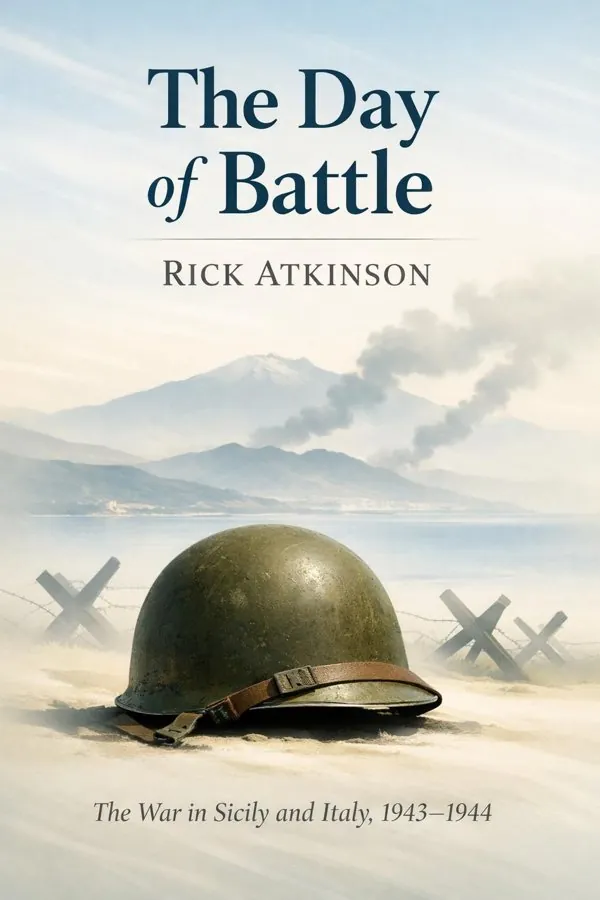
The Day of Battle: The War in Sicily and Italy, 1943–1944: Summary & Key Insights
 10 min10 chaptersAudio available
Key Takeaways from The Day of Battle: The War in Sicily and Italy, 1943–1944
One of the book’s sharpest insights is that major campaigns are often born not from clarity, but from disagreement.
A bold plan can still unravel on contact with reality.
The fall of Mussolini is one of the campaign’s most dramatic turning points, but Atkinson makes clear that regime change rarely produces immediate stability.
Amphibious invasion makes headlines, but sustained advance is where campaigns are won or stalled.
In Italy, the land itself fought back.
What Is The Day of Battle: The War in Sicily and Italy, 1943–1944 About?
The Day of Battle: The War in Sicily and Italy, 1943–1944 by Rick Atkinson is a war_military book spanning 11 pages. Rick Atkinson’s The Day of Battle is the second volume of his celebrated Liberation Trilogy, and it turns one of World War II’s most misunderstood campaigns into a gripping, consequential human drama. Covering the Allied invasions of Sicily and mainland Italy from 1943 to 1944, the book shows how a campaign often dismissed as secondary was in fact central to the defeat of Nazi Germany. What looked, in Churchill’s phrase, like the “soft underbelly” of Europe became a brutal proving ground of mountains, mud, miscalculation, and endurance. Atkinson brings together grand strategy and intimate experience: generals argue over plans, politicians maneuver for advantage, soldiers crawl through shellfire, and civilians endure hunger, bombardment, and occupation. The result is both military history and moral history. It matters because it reveals how wars are really fought—not as clean sequences of victories, but as costly contests shaped by terrain, weather, ego, logistics, and luck. A Pulitzer Prize-winning historian and former journalist, Atkinson writes with rare authority, blending meticulous archival research with vivid storytelling to illuminate a campaign that tested Allied leadership and human resilience at every turn.
This FizzRead summary covers all 10 key chapters of The Day of Battle: The War in Sicily and Italy, 1943–1944 in approximately 10 minutes, distilling the most important ideas, arguments, and takeaways from Rick Atkinson's work. Also available as an audio summary and Key Quotes Podcast.
The Day of Battle: The War in Sicily and Italy, 1943–1944
Rick Atkinson’s The Day of Battle is the second volume of his celebrated Liberation Trilogy, and it turns one of World War II’s most misunderstood campaigns into a gripping, consequential human drama. Covering the Allied invasions of Sicily and mainland Italy from 1943 to 1944, the book shows how a campaign often dismissed as secondary was in fact central to the defeat of Nazi Germany. What looked, in Churchill’s phrase, like the “soft underbelly” of Europe became a brutal proving ground of mountains, mud, miscalculation, and endurance. Atkinson brings together grand strategy and intimate experience: generals argue over plans, politicians maneuver for advantage, soldiers crawl through shellfire, and civilians endure hunger, bombardment, and occupation. The result is both military history and moral history. It matters because it reveals how wars are really fought—not as clean sequences of victories, but as costly contests shaped by terrain, weather, ego, logistics, and luck. A Pulitzer Prize-winning historian and former journalist, Atkinson writes with rare authority, blending meticulous archival research with vivid storytelling to illuminate a campaign that tested Allied leadership and human resilience at every turn.
Who Should Read The Day of Battle: The War in Sicily and Italy, 1943–1944?
This book is perfect for anyone interested in war_military and looking to gain actionable insights in a short read. Whether you're a student, professional, or lifelong learner, the key ideas from The Day of Battle: The War in Sicily and Italy, 1943–1944 by Rick Atkinson will help you think differently.
- ✓Readers who enjoy war_military and want practical takeaways
- ✓Professionals looking to apply new ideas to their work and life
- ✓Anyone who wants the core insights of The Day of Battle: The War in Sicily and Italy, 1943–1944 in just 10 minutes
Want the full summary?
Get instant access to this book summary and 100K+ more with Fizz Moment.
Get Free SummaryAvailable on App Store • Free to download
Key Chapters
One of the book’s sharpest insights is that major campaigns are often born not from clarity, but from disagreement. After the Allied victory in North Africa, the next move was hotly contested. American leaders generally wanted to focus resources on the eventual cross-Channel invasion of France, while Winston Churchill pressed for action in the Mediterranean, arguing that Italy was the most promising place to keep pressure on the Axis. The debate was not simply academic. It involved competing theories of how to win the war fastest, how to manage coalitions, and how to balance political symbolism against military necessity.
Atkinson shows that the Italian campaign emerged from this tension. It was expected to knock Italy out of the war, tie down German divisions, and sustain Allied momentum. Yet strategic compromises created ambiguous goals from the start. Was Italy a decisive front, a diversion, or a stepping stone? Because leaders never fully agreed, commanders in the field often worked under mixed assumptions. This ambiguity shaped planning, priorities, and expectations throughout the campaign.
The lesson reaches far beyond military history. In business, politics, or institutional leadership, teams frequently move forward before every strategic disagreement is resolved. The danger is not disagreement itself, but failing to define what success means. If one group believes a project is exploratory while another treats it as mission-critical, confusion becomes inevitable.
Actionable takeaway: before launching any major initiative, identify the real objective, the acceptable cost, and the criteria for success. If those are unclear at the top, execution below will suffer.
A bold plan can still unravel on contact with reality. Operation Husky, the July 1943 invasion of Sicily, was the largest amphibious assault in history up to that time. It required massive coordination among naval forces, air support, logistics networks, and two Allied armies landing on multiple beaches. On paper, the operation demonstrated the Allies’ growing ability to synchronize modern warfare at scale. In practice, it revealed how even meticulous planning can be disrupted by weather, timing, miscommunication, and human error.
Atkinson details the invasion’s astonishing complexity: airborne drops scattered in wind and darkness, naval gunfire support under pressure, amphibious landings dependent on precise timing, and commanders forced to improvise as conditions changed. Yet despite confusion and losses, the Allies established themselves on the island and ultimately forced Axis withdrawal. The campaign underscored a central truth: planning matters enormously, but adaptability matters just as much.
This idea applies in any field involving coordination under uncertainty. Product launches, emergency responses, and organizational transformations all resemble large operations in miniature. You need structure, sequencing, contingency plans, and role clarity. But once events begin, rigid adherence to the original plan may do more harm than good. Strong leaders monitor the environment, empower subordinates, and revise decisions quickly.
Atkinson also reminds us that competence is cumulative. The Allies learned from North Africa and Sicily, even through mistakes, and those lessons improved future operations. Progress often looks messy from the inside.
Actionable takeaway: build detailed plans, but also design fallback options and decision authority in advance. Success belongs not just to the best plan, but to the best-adjusted plan when conditions change.
The fall of Mussolini is one of the campaign’s most dramatic turning points, but Atkinson makes clear that regime change rarely produces immediate stability. In July 1943, after military failures and growing internal discontent, Benito Mussolini was removed from power. To many Allied observers, this seemed to confirm that Italy was cracking and that the campaign might accelerate the collapse of Axis resistance. Yet the political shock did not instantly end fighting. Instead, it opened a new and dangerous phase filled with uncertainty, deception, and competing loyalties.
Italy’s surrender was secretive, hesitant, and badly coordinated. As the monarchy and new government sought terms, the Germans moved decisively to disarm Italian forces, seize territory, and reinforce control. Rather than producing a clean transition, Mussolini’s fall triggered fragmentation: civil conflict, occupation, reprisals, and confusion among soldiers and civilians alike. Some Italians welcomed liberation; others feared chaos; many simply struggled to survive amid rapidly shifting power.
Atkinson’s treatment of this moment offers a valuable insight into systems under stress. The removal of a leader or the collapse of a visible structure can create the illusion that the deeper problem has been solved. But institutions, networks, and coercive forces often endure beyond the figure at the top. In organizations, replacing one executive may not fix a dysfunctional culture. In politics, a toppled regime may leave a vacuum that intensifies conflict.
The Italian experience teaches that transitions require preparation, communication, and realistic expectations. Victory in one dimension can unleash disorder in another.
Actionable takeaway: when evaluating change, look beyond symbolic milestones. Ask what structures remain, who controls force or resources, and what conditions are needed to turn a breakthrough into durable progress.
Amphibious invasion makes headlines, but sustained advance is where campaigns are won or stalled. After Sicily, the Allies crossed to mainland Italy expecting that the enemy might weaken as political collapse spread through the country. Instead, they encountered a far more stubborn reality. German forces, under skilled commanders, executed delaying actions with discipline and precision, trading space for time while exploiting Italy’s geography to maximum advantage.
Atkinson shows how the crossings to the mainland were tactically impressive but strategically incomplete. The Allies had gained entry, not momentum. Every valley, river line, mountain ridge, and road junction became an opportunity for defense. Supply lines stretched. Coordination between armies proved difficult. Expectations of rapid breakthrough repeatedly collided with terrain and German skill.
This distinction between entry and progress is useful far beyond war. Organizations often celebrate the launch of a project, acquisition of a new market, or appointment of a reform-minded leader, only to discover that implementation is far harder than the initial breakthrough. Getting in the door is not the same as changing the system. Advancement requires follow-through, logistical support, and sustained alignment.
Atkinson’s narrative also captures the emotional consequence of false expectations. Troops and publics were repeatedly led to hope that Rome was near, that the enemy was close to collapse, or that one more push would end the deadlock. Those hopes mattered, because repeated disappointment damages morale.
Actionable takeaway: separate the success of initiation from the demands of execution. After any promising start, immediately assess what support, endurance, and adaptation are needed to turn access into real progress.
In Italy, the land itself fought back. One of Atkinson’s most powerful achievements is showing that mountains, rivers, mud, snow, and rain were not background details but active participants in the campaign. The Italian peninsula narrowed movement, funneled armies into predictable routes, and gave defenders commanding positions above valleys and roads. Winter turned fields into bogs, washed out bridges, grounded aircraft, and exhausted men already carrying heavy loads under fire.
This matters because it destroys the illusion that wars are decided only by courage, numbers, or superior weapons. In Italy, tactical brilliance could be blunted by a swollen river; armored strength could be neutralized by steep ridges; and offensive momentum could disappear in freezing rain. Atkinson repeatedly emphasizes that the Germans understood how to use this terrain, building layered defenses that forced the Allies to pay dearly for each mile.
The broader lesson is that context shapes performance. Whether in war, management, education, or policy, outcomes often depend less on abstract plans than on the environment in which they are executed. A strategy that works in one setting may fail in another because the terrain—literal or institutional—changes what is possible. Smart leaders study constraints before overpromising results.
The campaign also illustrates the cumulative toll of difficult conditions. Fatigue is not just emotional; it is physical, environmental, and logistical. People make worse decisions when they are cold, wet, hungry, and sleep-deprived.
Actionable takeaway: always account for the operating environment. Before judging performance or launching change, identify the structural obstacles—physical, organizational, or cultural—that can turn a good plan into a grinding struggle.
Few episodes in the book better capture the tragedy of attritional warfare than the battles of Monte Cassino. The monastery high above the Liri Valley became the symbol of a campaign in which repeated attacks promised breakthrough but often delivered only devastation. Atkinson reconstructs the sequence with clarity and force: Allied commanders believed the Gustav Line had to be broken to open the road to Rome, yet each assault ran into fierce resistance, poor conditions, and interlocking defensive positions that punished frontal attacks.
The bombing of the abbey remains especially haunting. Intended to eliminate a perceived German advantage, it instead became one of the campaign’s most controversial decisions. The destruction of a historic religious site carried moral and symbolic weight, and the rubble that followed may even have improved defensive conditions. Atkinson does not reduce the episode to easy judgment; he shows how fear, uncertainty, and battlefield logic can produce decisions with lasting historical consequences.
Monte Cassino offers a broader lesson about persistence. Determination is admirable, but repeated effort without adequate reassessment can become wasteful. In organizations, teams sometimes continue investing in failing approaches because so much has already been committed. The campaign warns against confusing endurance with wisdom. Persistence should include learning, not just repetition.
At the same time, Atkinson honors the soldiers who fought there. Their courage was real even when strategy faltered. That distinction matters: brave people can be trapped inside flawed plans.
Actionable takeaway: when a challenge resists repeated attacks, pause to reexamine assumptions, methods, and costs. Persevere, but only with updated understanding rather than automatic repetition.
The landing at Anzio began with the promise of surprise and maneuver. Allied planners hoped to bypass the strongest German defenses, threaten the rear of the Gustav Line, and force a rapid shift in the campaign. Initially, the landing achieved operational surprise. Yet what followed became one of the war’s starkest examples of how hesitation can waste advantage. Instead of driving aggressively inland, Allied forces consolidated the beachhead, giving German commanders time to respond, encircle, and contain them.
Atkinson presents Anzio as a study in command psychology. Fear of overextension, uncertainty about enemy strength, and competing interpretations of risk all shaped the decisions that followed. The result was a bloody stalemate in which troops endured shelling, mud, and constant tension on a constricted perimeter. What might have been a daring turning movement became a costly siege.
The implications are universal. Sometimes leaders earn a rare opening—a market disruption, a favorable negotiation, a political window, a technological breakthrough—but fail to exploit it because they become more focused on preserving the gain than converting it into a larger result. Prudence is necessary, but excessive caution can become its own form of failure.
Atkinson is especially strong at showing that outcomes are rarely determined by one heroic choice alone. Opportunity must align with preparation, intent, speed, and clarity of purpose. Anzio failed not because the idea lacked merit, but because execution did not match ambition.
Actionable takeaway: when a genuine opportunity appears, act with disciplined boldness. Secure your position, but define in advance what decisive exploitation looks like so caution does not quietly become paralysis.
A recurring strength of The Day of Battle is its unsparing portrait of command. Atkinson examines generals and statesmen not as distant icons, but as flawed human beings whose judgments carried enormous consequences. Figures such as Eisenhower, Alexander, Clark, Patton, Montgomery, Kesselring, and Churchill are shown navigating ego, alliance politics, incomplete intelligence, and competing priorities. Some inspired confidence; others courted resentment. Some grasped logistics and coalition realities; others chased prestige or clung to shaky assumptions.
What makes this treatment especially valuable is that Atkinson links high-level decisions directly to the experience of ordinary soldiers and civilians. A commander’s impatience might mean another attack through impossible ground. A rivalry between allies might distort priorities. A politician’s optimism might feed unrealistic timelines. Leadership in war is not abstract—it is translated into marches, casualties, shortages, and grief.
The lesson extends naturally into modern leadership. Authority magnifies consequences. Leaders often imagine their choices in strategic or reputational terms, but the people below experience them concretely: workload, stress, confusion, danger, or trust. Effective leadership therefore requires more than intelligence or force of personality. It demands self-awareness, accountability, and a willingness to align ambition with reality.
Atkinson also reminds readers that coalition leadership is uniquely difficult. Success depends on managing partners who share broad goals but differ in style, interest, and tolerance for risk. That challenge exists in multinational politics, cross-functional organizations, and large partnerships.
Actionable takeaway: evaluate leadership not only by vision or confidence, but by consequences on the ground. Ask whether decisions are realistic, clearly communicated, and humane for those expected to carry them out.
Military history can become too focused on maps and commanders, but Atkinson keeps civilians at the center of the story. As the campaign moved through Sicily and Italy, towns were bombed, homes destroyed, food supplies disrupted, and families trapped between occupying armies, retreating forces, and partisan violence. Liberation was often real, but it rarely arrived cleanly. It came with rubble, hunger, displacement, fear, and moral ambiguity.
Atkinson’s portrayal of Italian civilians deepens the book’s emotional and ethical force. He shows peasants, priests, mayors, mothers, refugees, and reluctant bystanders confronting the collapse of normal life. Some aided the Allies; some cooperated with Germans under duress; many simply tried to endure. This complexity matters because it resists sentimental narratives. Civilians are not passive scenery in war. They are participants, victims, witnesses, and sometimes the terrain over which legitimacy itself is contested.
The wider lesson is that every large conflict or policy struggle has downstream human effects that can be overlooked by decision-makers. Strategic success means little if planners ignore how systems of transport, food, shelter, health, and trust will be affected. The Italian campaign reminds us that humanitarian reality is not separate from military reality; it can influence morale, intelligence, legitimacy, and long-term stability.
For readers in any field, this is a call to widen the frame of analysis. Metrics and milestones matter, but so do lived consequences for the vulnerable.
Actionable takeaway: when assessing any major decision, ask who bears the hidden cost. Build plans that account not only for operational goals, but also for the civilian or human impact that follows in their wake.
The capture of Rome in June 1944 gave the Allies a major symbolic triumph, but Atkinson shows that symbols can conceal unfinished realities. Rome was the first Axis capital to fall, and its liberation carried immense political and psychological significance. Yet the campaign had not delivered the decisive collapse many had hoped for. German forces withdrew in good order, preserving their ability to continue fighting farther north. Within days, the Normandy invasion shifted global attention, and the Italian campaign was again overshadowed.
This ending is central to the book’s argument. The Italian campaign mattered, but not in the simple way early advocates imagined. It did not become the quickest route to ending the war in Europe. Instead, it tied down German divisions, tested Allied leadership, refined operational capabilities, and exposed the harsh realities of coalition warfare. It was both valuable and costly, both necessary and disappointing.
Atkinson’s reflection on Rome offers a mature understanding of achievement. Some victories are real without being complete. Organizations, governments, and individuals often reach meaningful milestones that deserve recognition, yet those milestones should not be mistaken for final success. Declaring closure too early breeds complacency; failing to acknowledge progress breeds cynicism. Wisdom lies in holding both truths at once.
The book closes this phase of the war with a sense of earned complexity. History rarely provides neat endings. Progress is often partial, contingent, and paid for dearly.
Actionable takeaway: celebrate milestones, but distinguish symbolic success from strategic completion. After any major win, ask what remains unresolved and what discipline is required to carry momentum into the next phase.
All Chapters in The Day of Battle: The War in Sicily and Italy, 1943–1944
About the Author
Rick Atkinson is an acclaimed American historian and author best known for his richly researched books on war and military leadership. Before focusing on book writing, he built a distinguished journalism career at The Washington Post, where he served as a reporter, foreign correspondent, and senior editor. His background in reporting helped shape the vivid narrative style and documentary rigor that define his historical work. Atkinson won the Pulitzer Prize for History for An Army at Dawn, the first volume of his Liberation Trilogy, which chronicles the Allied path to victory in Europe during World War II. The Day of Battle is the trilogy’s second volume. He is widely respected for combining archival depth, strategic insight, and powerful storytelling that brings large-scale military campaigns down to the level of individual experience.
Get This Summary in Your Preferred Format
Read or listen to the The Day of Battle: The War in Sicily and Italy, 1943–1944 summary by Rick Atkinson anytime, anywhere. FizzRead offers multiple formats so you can learn on your terms — all free.
Available formats: App · Audio · PDF · EPUB — All included free with FizzRead
Download The Day of Battle: The War in Sicily and Italy, 1943–1944 PDF and EPUB Summary
Key Quotes from The Day of Battle: The War in Sicily and Italy, 1943–1944
“One of the book’s sharpest insights is that major campaigns are often born not from clarity, but from disagreement.”
“A bold plan can still unravel on contact with reality.”
“The fall of Mussolini is one of the campaign’s most dramatic turning points, but Atkinson makes clear that regime change rarely produces immediate stability.”
“Amphibious invasion makes headlines, but sustained advance is where campaigns are won or stalled.”
“One of Atkinson’s most powerful achievements is showing that mountains, rivers, mud, snow, and rain were not background details but active participants in the campaign.”
Frequently Asked Questions about The Day of Battle: The War in Sicily and Italy, 1943–1944
The Day of Battle: The War in Sicily and Italy, 1943–1944 by Rick Atkinson is a war_military book that explores key ideas across 10 chapters. Rick Atkinson’s The Day of Battle is the second volume of his celebrated Liberation Trilogy, and it turns one of World War II’s most misunderstood campaigns into a gripping, consequential human drama. Covering the Allied invasions of Sicily and mainland Italy from 1943 to 1944, the book shows how a campaign often dismissed as secondary was in fact central to the defeat of Nazi Germany. What looked, in Churchill’s phrase, like the “soft underbelly” of Europe became a brutal proving ground of mountains, mud, miscalculation, and endurance. Atkinson brings together grand strategy and intimate experience: generals argue over plans, politicians maneuver for advantage, soldiers crawl through shellfire, and civilians endure hunger, bombardment, and occupation. The result is both military history and moral history. It matters because it reveals how wars are really fought—not as clean sequences of victories, but as costly contests shaped by terrain, weather, ego, logistics, and luck. A Pulitzer Prize-winning historian and former journalist, Atkinson writes with rare authority, blending meticulous archival research with vivid storytelling to illuminate a campaign that tested Allied leadership and human resilience at every turn.
More by Rick Atkinson
You Might Also Like
Patriot
Andrew Britton
10 min
War
John Hersey
10 min
An Army at Dawn: The War in North Africa, 1942–1943
Rick Atkinson
10 min
Brave New War: The Next Stage of Terrorism and the End of Globalization
John Robb
10 min
Catch-22
Joseph Heller
10 min
Command and Control: Nuclear Weapons, the Damascus Accident, and the Illusion of Safety
Eric Schlosser
10 minBrowse by Category
Ready to read The Day of Battle: The War in Sicily and Italy, 1943–1944?
Get the full summary and 100K+ more books with Fizz Moment.