
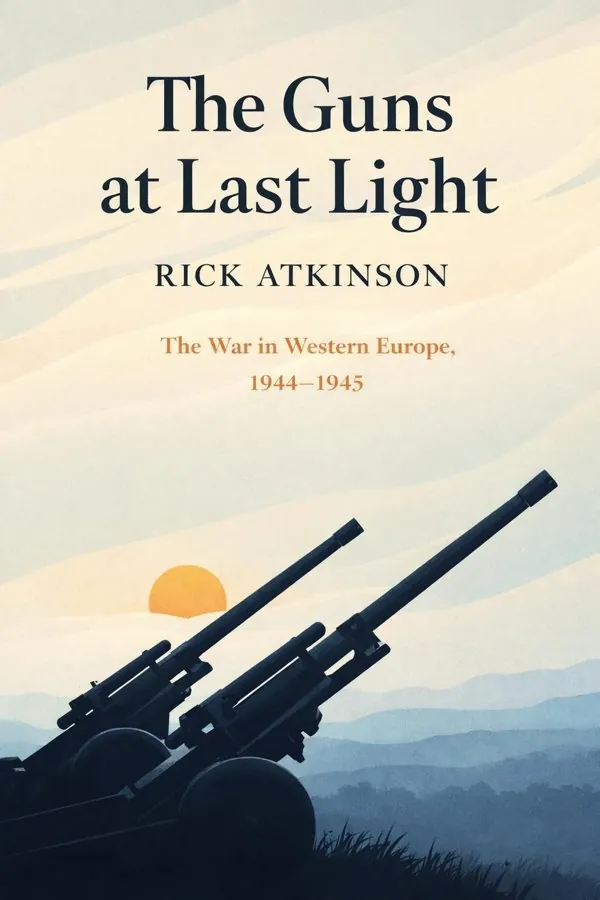
The Guns at Last Light: The War in Western Europe, 1944–1945: Summary & Key Insights
 10 min9 chaptersAudio available
Key Takeaways from The Guns at Last Light: The War in Western Europe, 1944–1945
Great victories often look inevitable in hindsight, but before they happen they are usually tangled in doubt, argument, and fear.
History remembers June 6, 1944 as a triumph, but Atkinson insists that triumph began in terror.
Liberation is rarely as simple as the word suggests.
Momentum can be as dangerous as stagnation when leaders begin to believe speed alone guarantees success.
Wars are often remembered through battlefield courage, but Atkinson repeatedly demonstrates that logistics determines whether courage can matter.
What Is The Guns at Last Light: The War in Western Europe, 1944–1945 About?
The Guns at Last Light: The War in Western Europe, 1944–1945 by Rick Atkinson is a war_military book spanning 6 pages. Rick Atkinson’s The Guns at Last Light is the gripping final volume of the Liberation Trilogy, tracing the climactic last year of World War II in Western Europe from the planning of D-Day to the collapse of Nazi Germany. More than a battlefield chronicle, it is a study of how victory is actually won: through logistics as much as bravery, through coalition politics as much as combat, and through leaders and ordinary soldiers struggling under extreme pressure. Atkinson moves from war rooms to foxholes, from the beaches of Normandy to the frozen forests of the Ardennes, showing how every advance came at a terrible human cost. What makes this book especially powerful is its refusal to romanticize triumph. The liberation of Europe emerges as a story filled with blunders, exhaustion, moral ambiguity, and the growing realization of Nazi atrocity. Atkinson writes with the narrative force of a great journalist and the rigor of a serious historian, drawing on extensive archival research, letters, diaries, and official records. The result is an authoritative, deeply human account of how the Western Allies prevailed—and what that victory demanded.
This FizzRead summary covers all 9 key chapters of The Guns at Last Light: The War in Western Europe, 1944–1945 in approximately 10 minutes, distilling the most important ideas, arguments, and takeaways from Rick Atkinson's work. Also available as an audio summary and Key Quotes Podcast.
The Guns at Last Light: The War in Western Europe, 1944–1945
Rick Atkinson’s The Guns at Last Light is the gripping final volume of the Liberation Trilogy, tracing the climactic last year of World War II in Western Europe from the planning of D-Day to the collapse of Nazi Germany. More than a battlefield chronicle, it is a study of how victory is actually won: through logistics as much as bravery, through coalition politics as much as combat, and through leaders and ordinary soldiers struggling under extreme pressure. Atkinson moves from war rooms to foxholes, from the beaches of Normandy to the frozen forests of the Ardennes, showing how every advance came at a terrible human cost.
What makes this book especially powerful is its refusal to romanticize triumph. The liberation of Europe emerges as a story filled with blunders, exhaustion, moral ambiguity, and the growing realization of Nazi atrocity. Atkinson writes with the narrative force of a great journalist and the rigor of a serious historian, drawing on extensive archival research, letters, diaries, and official records. The result is an authoritative, deeply human account of how the Western Allies prevailed—and what that victory demanded.
Who Should Read The Guns at Last Light: The War in Western Europe, 1944–1945?
This book is perfect for anyone interested in war_military and looking to gain actionable insights in a short read. Whether you're a student, professional, or lifelong learner, the key ideas from The Guns at Last Light: The War in Western Europe, 1944–1945 by Rick Atkinson will help you think differently.
- ✓Readers who enjoy war_military and want practical takeaways
- ✓Professionals looking to apply new ideas to their work and life
- ✓Anyone who wants the core insights of The Guns at Last Light: The War in Western Europe, 1944–1945 in just 10 minutes
Want the full summary?
Get instant access to this book summary and 100K+ more with Fizz Moment.
Get Free SummaryAvailable on App Store • Free to download
Key Chapters
Great victories often look inevitable in hindsight, but before they happen they are usually tangled in doubt, argument, and fear. That is the essential truth behind Operation Overlord, the Allied invasion of Normandy. Atkinson shows that D-Day was not simply a bold military strike; it was the product of years of planning, deception, industrial buildup, and fraught coalition management among the Americans, British, Canadians, and Free French. Success depended not only on courage at the beaches but also on landing craft production, weather forecasting, intelligence work, and the ability of senior commanders to balance urgency with caution.
The book reveals how difficult it is to coordinate a massive operation when even allies disagree on strategy. Eisenhower had to hold together forceful personalities such as Montgomery, Bradley, and Churchill while keeping the larger mission intact. A failed invasion would not just have cost lives; it could have prolonged the war and altered the political shape of Europe. Atkinson emphasizes that the invasion’s architecture mattered because it transformed military ambition into practical capability.
This idea extends beyond war. Any major undertaking—launching a company, managing a public project, or leading institutional change—depends on invisible preparation more than dramatic execution. Teams often celebrate the “big day,” but overlook the systems, redundancies, and contingency plans that make it possible.
The lesson is clear: when stakes are high, treat preparation as part of the victory itself. Build patiently, align people around a shared objective, and never confuse boldness with improvisation.
History remembers June 6, 1944 as a triumph, but Atkinson insists that triumph began in terror. The landings on Utah, Omaha, Gold, Juno, and Sword were not cinematic set pieces to those who endured them; they were chaotic zones of drowning men, shattered formations, missed objectives, and small acts of survival. Nowhere was this more apparent than Omaha Beach, where confusion, strong German defenses, and brutal incoming fire threatened catastrophe. The scale of the undertaking was epic, yet the outcome turned on intensely local decisions made by officers, engineers, medics, and infantrymen under fire.
Atkinson’s account breaks the myth of smooth execution. Amphibious tanks sank, units landed off target, radios failed, and command structures frayed. Still, momentum slowly shifted because soldiers adapted. Junior leaders improvised. Naval gunfire was redirected. Small groups found paths off the beaches. The invasion succeeded not because the plan unfolded perfectly, but because enough people continued acting purposefully when the plan collapsed.
This is one of the book’s most practical insights: resilience is often more decisive than precision. In business, politics, or personal crisis, plans rarely survive first contact with reality. What matters is the capacity to regroup without losing the objective.
Normandy also reminds us that strategic success can conceal profound human suffering. To study victory responsibly is to remember its cost, not just its outcome.
Actionable takeaway: prepare rigorously, but expect disorder. Build teams that can think independently, adapt under pressure, and keep moving even when circumstances destroy the script.
Liberation is rarely as simple as the word suggests. Atkinson presents the freeing of Paris and other occupied territories not merely as a moment of jubilation, but as a collision between military necessity, political symbolism, and the emotional exhaustion of a continent. The liberation of Paris in August 1944 became a defining image of Allied success, yet behind the celebration lay hard choices: whether to divert resources, how to balance French national pride with Allied command priorities, and how to maintain momentum against a still-dangerous German army.
Atkinson captures both the ecstasy and the illusion of liberation. Crowds cheered in the streets, collaborators were punished, and a city reclaimed its dignity. Yet the war was far from over. Supplies remained strained, German resistance continued, and millions across Europe still lived amid ruin, hunger, displacement, and fear. The book reminds readers that symbolic victories can inspire morale, but symbolism alone does not end a conflict.
The broader application is striking. Organizations and societies often mistake visible milestones for finished work: a product launch, an election win, a public announcement, a new leadership team. These moments matter, but they can create dangerous complacency if the deeper structural challenges remain unresolved.
Atkinson’s treatment of Paris also shows the importance of narrative in leadership. Leaders must understand when symbolism strengthens legitimacy and when it distracts from practical demands.
Actionable takeaway: celebrate real milestones, but do not confuse emotional high points with mission completion. After any breakthrough, ask what unfinished work still threatens the larger goal.
Momentum can be as dangerous as stagnation when leaders begin to believe speed alone guarantees success. After the breakout from Normandy, the Allied armies surged across France and into Belgium with astonishing rapidity. German forces reeled, Paris was liberated, and the possibility of ending the war in 1944 seemed suddenly plausible. Yet Atkinson shows how this exhilarating advance generated new vulnerabilities. Supply lines stretched thin, ports remained inadequate, fuel shortages multiplied, and commanders increasingly argued over priorities.
This phase of the war reveals one of Atkinson’s central insights: success creates its own distortions. Montgomery’s ambitious Operation Market Garden, intended to leap across the Netherlands and outflank German defenses, embodied both daring and wishful thinking. The plan depended on optimistic assumptions, tight timing, and underestimation of German capacity to recover. Its failure exposed the costs of strategic overreach and the danger of believing an enemy is beaten before he is broken.
The lesson resonates far beyond military history. In growth periods, companies overexpand, leaders chase prestige projects, and institutions mistake favorable momentum for durable stability. When resources are finite, the question is not simply what can be attempted, but what can be sustained.
Atkinson also highlights the tension between broad-front and narrow-thrust strategies, showing how personality, ego, and politics shape operational decisions. Rational planning is rarely free from human ambition.
Actionable takeaway: when progress accelerates, become more disciplined, not less. Reassess assumptions, protect logistics, and distinguish between bold opportunities and seductive overreach.
Wars are often remembered through battlefield courage, but Atkinson repeatedly demonstrates that logistics determines whether courage can matter. Ammunition, fuel, winter clothing, replacement troops, bridging equipment, truck transport, medical evacuation, and port access all shaped the Allied campaign as decisively as tactical skill. The advance after Normandy did not slow because the Allies lacked bravery; it slowed because armies outran their supply systems. Even overwhelming industrial power had to be translated into usable support at the front.
This is one of the book’s most valuable contributions. Atkinson makes logistics vivid rather than abstract. A fuel shortage becomes a strategic brake. A damaged road network alters tempo. Poor weather changes delivery schedules. An understaffed replacement system affects combat effectiveness and morale. Seen this way, war is not only a clash of armies but a test of organizational endurance.
In practical terms, this insight applies to every large endeavor. Vision without infrastructure fails. Talented employees cannot perform without tools. A creative strategy falters if operations cannot support it. Leaders who focus only on front-facing performance while neglecting systems eventually collide with reality.
Atkinson also shows that logistical competence is moral as well as technical. Supplying troops properly, evacuating the wounded, and planning for harsh conditions reflect a leader’s seriousness about human lives.
Actionable takeaway: whenever assessing a plan, ask not just whether it is inspiring, but whether the support system behind it is robust. Sustainable performance depends on the unglamorous architecture beneath visible success.
Nothing tests a coalition more than discovering that apparent victory has arrived too early. In December 1944, as many Allied leaders believed Germany was nearing collapse, Hitler launched the Ardennes offensive—the Battle of the Bulge—in a last, desperate attempt to split Allied forces and seize the initiative. Atkinson portrays the battle not simply as a German gamble, but as a devastating reminder that even a weakened enemy can retain deadly capacity. Surprise, weather, intelligence failures, and complacency all contributed to the initial shock.
The freezing conditions compounded everything. Men fought in snow, fog, and severe cold with inadequate rest and often limited visibility. The human body itself became a battlefield through frostbite, exhaustion, and hunger. Yet Atkinson also shows how resilience emerged from the crisis. Bastogne became a symbol of stubborn defense. Command structures regained coherence. Air power returned when the weather cleared. What looked like strategic rupture became, through endurance and coordination, a turning point toward final German defeat.
This episode offers a broader lesson about setbacks. Progress does not move in a straight line, and confidence can become a liability when it blinds leaders to residual risk. In business or public life, crises often erupt not only because threats exist, but because success has lowered vigilance.
Atkinson’s account teaches that recovery depends on composure, clear command, and the refusal to let initial confusion define the outcome.
Actionable takeaway: build plans that assume reversals are possible. In moments of sudden setback, stabilize first, restore communication, and turn resilience into a disciplined counterresponse.
Winning together can be harder than fighting the enemy. One of Atkinson’s deepest themes is that the Western Allied campaign succeeded not because disagreements were absent, but because the coalition endured despite them. Eisenhower had to manage clashing national interests, military doctrines, egos, and political expectations among American, British, Canadian, and French leaders. Montgomery was brilliant and exasperating. Patton was dynamic and volatile. Bradley was steady but sometimes overmatched by events. Churchill pressed strategic preferences shaped by imperial and political concerns. De Gaulle demanded French dignity and sovereignty.
Atkinson never reduces these men to caricatures. Instead, he shows leadership as a condition of constant friction. Strategic disputes over resource allocation, timing, and operational direction were not side dramas; they were part of the campaign itself. Coalition warfare required persuasion, patience, compromise, and occasionally the ability to absorb insult without losing focus.
This matters far beyond military history because most meaningful achievements today are coalition efforts: cross-functional teams, international partnerships, public-private collaborations, and political alliances. Technical competence is not enough. Leaders must hold together people who do not fully trust one another, who interpret success differently, and who carry different incentives.
Atkinson’s portrait of Eisenhower is especially revealing. His genius was not flamboyant battlefield command, but the steadier art of alliance maintenance. He understood that fractured unity could squander military superiority.
Actionable takeaway: if you lead a coalition, treat relationship management as core strategy. Clarify shared goals, absorb tension without panic, and remember that unity under strain is itself a decisive achievement.
The military defeat of Nazi Germany was also the beginning of a moral awakening for many Allied soldiers. As the Western armies crossed the Rhine and penetrated deeper into Germany in 1945, Atkinson’s narrative shifts from operational culmination to ethical confrontation. Towns fell, resistance weakened, and the regime visibly disintegrated. Yet with each mile eastward, liberators encountered evidence of crimes on a scale many had not fully imagined. Camps, slave labor sites, and emaciated survivors forced a reckoning with what the war had truly been about.
Atkinson handles this transition with great power. The end of combat did not produce uncomplicated triumph. It exposed atrocity, vengeance, displacement, and the collapse of civic order. Soldiers who had spent months focused on tactical objectives now had to absorb the reality that they were not only defeating an army but uncovering a system of industrialized barbarism. Victory became inseparable from witness.
This idea expands the meaning of liberation. Military success matters, but the deeper purpose of force is revealed in what it halts, protects, or exposes. In modern terms, performance without ethics is empty. Any institution can become obsessed with metrics, targets, or winning while forgetting the human consequences beneath the scoreboard.
Atkinson also reminds readers that endings are morally demanding. They require documentation, accountability, restraint, and care for survivors, not just celebration.
Actionable takeaway: judge success by more than whether a goal was reached. Ask what human reality your effort changed, what truths it revealed, and what responsibility follows from seeing them.
The end of war does not erase the cost of getting there. One of Atkinson’s most enduring messages is that Allied victory in Western Europe, though necessary and just, came at an immense price measured in graves, shattered bodies, devastated cities, and lives permanently marked by trauma. The final year of the war is often narrated as an unstoppable march toward Berlin, but Atkinson insists on restoring uncertainty, suffering, and sacrifice to the story. This is not a tale of clean inevitability. It is a record of what democratic societies had to spend to defeat a monstrous regime.
That insistence matters because memory tends to simplify. Nations prefer legends of competence, courage, and righteousness uncontaminated by blunder or ambiguity. Atkinson complicates that comforting version. He shows misjudgments, vanity, friendly-fire tragedies, failed operations, and the grinding attrition borne largely by ordinary soldiers. In doing so, he makes remembrance more honest.
This has practical importance in any field where organizations inherit past success. When people remember only the triumph and not the cost, they become careless with hard-won advantages. Historical seriousness fosters humility. It teaches that institutions survive through sacrifice, and that gains can be squandered when later generations consume the legacy without understanding its price.
The final lesson is civic as much as personal: gratitude is not sentimentality. It is disciplined remembrance tied to responsibility.
Actionable takeaway: when reflecting on success—whether national, institutional, or personal—study the cost as closely as the outcome. Honest memory produces humility, seriousness, and wiser stewardship.
All Chapters in The Guns at Last Light: The War in Western Europe, 1944–1945
About the Author
Rick Atkinson is an American author, historian, and former journalist celebrated for his narrative works on military history. He spent many years at The Washington Post, where he served as a reporter and senior editor, contributing to Pulitzer Prize-winning coverage. Atkinson later became widely known for writing deeply researched histories that combine archival rigor with vivid storytelling and close attention to individual lives. He is best known for the Liberation Trilogy, his three-volume account of the Allied campaign in Europe during World War II, culminating in The Guns at Last Light. His work is praised for making large, complex wars understandable while preserving their moral gravity, strategic complexity, and human cost.
Get This Summary in Your Preferred Format
Read or listen to the The Guns at Last Light: The War in Western Europe, 1944–1945 summary by Rick Atkinson anytime, anywhere. FizzRead offers multiple formats so you can learn on your terms — all free.
Available formats: App · Audio · PDF · EPUB — All included free with FizzRead
Download The Guns at Last Light: The War in Western Europe, 1944–1945 PDF and EPUB Summary
Key Quotes from The Guns at Last Light: The War in Western Europe, 1944–1945
“Great victories often look inevitable in hindsight, but before they happen they are usually tangled in doubt, argument, and fear.”
“History remembers June 6, 1944 as a triumph, but Atkinson insists that triumph began in terror.”
“Liberation is rarely as simple as the word suggests.”
“Momentum can be as dangerous as stagnation when leaders begin to believe speed alone guarantees success.”
“Wars are often remembered through battlefield courage, but Atkinson repeatedly demonstrates that logistics determines whether courage can matter.”
Frequently Asked Questions about The Guns at Last Light: The War in Western Europe, 1944–1945
The Guns at Last Light: The War in Western Europe, 1944–1945 by Rick Atkinson is a war_military book that explores key ideas across 9 chapters. Rick Atkinson’s The Guns at Last Light is the gripping final volume of the Liberation Trilogy, tracing the climactic last year of World War II in Western Europe from the planning of D-Day to the collapse of Nazi Germany. More than a battlefield chronicle, it is a study of how victory is actually won: through logistics as much as bravery, through coalition politics as much as combat, and through leaders and ordinary soldiers struggling under extreme pressure. Atkinson moves from war rooms to foxholes, from the beaches of Normandy to the frozen forests of the Ardennes, showing how every advance came at a terrible human cost. What makes this book especially powerful is its refusal to romanticize triumph. The liberation of Europe emerges as a story filled with blunders, exhaustion, moral ambiguity, and the growing realization of Nazi atrocity. Atkinson writes with the narrative force of a great journalist and the rigor of a serious historian, drawing on extensive archival research, letters, diaries, and official records. The result is an authoritative, deeply human account of how the Western Allies prevailed—and what that victory demanded.
More by Rick Atkinson
You Might Also Like
Patriot
Andrew Britton
10 min
War
John Hersey
10 min
An Army at Dawn: The War in North Africa, 1942–1943
Rick Atkinson
10 min
Brave New War: The Next Stage of Terrorism and the End of Globalization
John Robb
10 min
Catch-22
Joseph Heller
10 min
Command and Control: Nuclear Weapons, the Damascus Accident, and the Illusion of Safety
Eric Schlosser
10 minBrowse by Category
Ready to read The Guns at Last Light: The War in Western Europe, 1944–1945?
Get the full summary and 100K+ more books with Fizz Moment.