
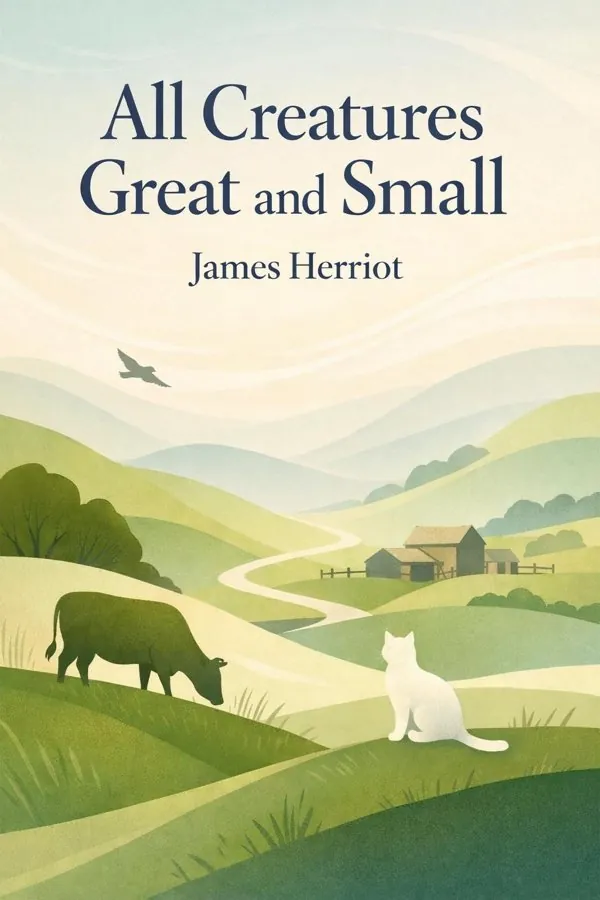
All Creatures Great and Small: Summary & Key Insights
 10 min8 chaptersAudio available
Key Takeaways from All Creatures Great and Small
A new landscape can unsettle us precisely because it asks us to become someone larger than we were before.
Competence is usually built in moments that feel most like failure.
Some of the most important teachers in our lives are the ones who confuse, frustrate, and amuse us in equal measure.
The way people treat animals often reveals truths they never state openly.
Belonging does not arrive all at once; it accumulates through repeated acts of commitment.
What Is All Creatures Great and Small About?
All Creatures Great and Small by James Herriot is a biographies book spanning 5 pages. What begins as the story of a young veterinarian taking his first job in the Yorkshire Dales becomes something far richer: a portrait of work, character, community, and the quiet dignity of everyday life. In All Creatures Great and Small, James Herriot recounts his early years as a country vet, moving from the certainty of classroom training into a world where every animal, every farm, and every farmer presents a different challenge. The book is full of comic mishaps, nerve-racking calls, stubborn livestock, and unforgettable people, but beneath its warmth lies a deeper wisdom about resilience, humility, and compassion. Herriot writes with unusual authority because he lived these experiences. Born James Alfred Wight, he spent decades practicing veterinary medicine in rural Yorkshire, and his stories draw directly from the realities of that profession. Yet his gift was not only clinical knowledge; it was his ability to see both animals and humans with tenderness, honesty, and humor. That is why this memoir still matters. It reminds us that real expertise is never just technical. It is also patience, observation, kindness, and the willingness to keep learning from life.
This FizzRead summary covers all 8 key chapters of All Creatures Great and Small in approximately 10 minutes, distilling the most important ideas, arguments, and takeaways from James Herriot's work. Also available as an audio summary and Key Quotes Podcast.
All Creatures Great and Small
What begins as the story of a young veterinarian taking his first job in the Yorkshire Dales becomes something far richer: a portrait of work, character, community, and the quiet dignity of everyday life. In All Creatures Great and Small, James Herriot recounts his early years as a country vet, moving from the certainty of classroom training into a world where every animal, every farm, and every farmer presents a different challenge. The book is full of comic mishaps, nerve-racking calls, stubborn livestock, and unforgettable people, but beneath its warmth lies a deeper wisdom about resilience, humility, and compassion.
Herriot writes with unusual authority because he lived these experiences. Born James Alfred Wight, he spent decades practicing veterinary medicine in rural Yorkshire, and his stories draw directly from the realities of that profession. Yet his gift was not only clinical knowledge; it was his ability to see both animals and humans with tenderness, honesty, and humor. That is why this memoir still matters. It reminds us that real expertise is never just technical. It is also patience, observation, kindness, and the willingness to keep learning from life.
Who Should Read All Creatures Great and Small?
This book is perfect for anyone interested in biographies and looking to gain actionable insights in a short read. Whether you're a student, professional, or lifelong learner, the key ideas from All Creatures Great and Small by James Herriot will help you think differently.
- ✓Readers who enjoy biographies and want practical takeaways
- ✓Professionals looking to apply new ideas to their work and life
- ✓Anyone who wants the core insights of All Creatures Great and Small in just 10 minutes
Want the full summary?
Get instant access to this book summary and 100K+ more with Fizz Moment.
Get Free SummaryAvailable on App Store • Free to download
Key Chapters
A new landscape can unsettle us precisely because it asks us to become someone larger than we were before. When James Herriot first arrives in the Yorkshire Dales, he is not stepping into a simple job but into an entire way of life. Fresh from veterinary school, he carries knowledge, ambition, and anxiety, yet the countryside quickly teaches him that professional competence is only one part of real practice. The Dales are rugged, beautiful, and demanding. The farms are spread across windswept hills, the weather is unpredictable, and the people are practical, guarded, and deeply rooted in the rhythms of land and livestock.
Herriot’s first encounters with local farmers are often awkward and revealing. Many of them say little, but they watch everything. They do not care much for polished credentials unless those credentials prove useful in a muddy barn at dawn. Through these interactions, Herriot learns that entering a community requires humility. He must earn trust not through speeches but through steady work, respect, and presence. The animals, too, are part of this education. Their illnesses are not abstract cases; they are tied to livelihoods, family survival, and emotional bonds.
The practical lesson is universal. Any time we enter a new environment, whether a workplace, a town, or a social circle, we are tempted to rely on what we already know. Herriot shows that adaptation matters just as much. Observe first. Listen carefully. Notice local customs, values, and priorities before assuming you understand the place.
Actionable takeaway: when entering a new role or community, spend your first days learning its unwritten rules and showing respect before trying to prove yourself.
Competence is usually built in moments that feel most like failure. Herriot’s early veterinary calls are full of uncertainty, embarrassment, and improvisation. The textbooks have taught him anatomy, diagnosis, and treatment, but the reality of rural practice is messier than any classroom. He is called to tend to calves, horses, sheep, and cows in conditions that are physically uncomfortable and emotionally tense. Farmers expect results. Animals cannot explain their symptoms. And every decision carries consequences.
These episodes reveal one of the book’s central truths: professional growth happens when theory collides with experience. Herriot discovers that knowing the correct procedure in principle is not the same as carrying it out while a skeptical farmer watches, a distressed animal struggles, and the weather turns against you. He makes mistakes, hesitates, and occasionally feels foolish. Yet these are the very moments that sharpen his instincts. Over time, he learns how to combine knowledge with calm, observation, and practical judgment.
The stories also highlight the emotional side of work. Herriot is not a detached technician. He feels the pressure of wanting to help and the sting of not always getting things right. That honesty is one reason his memoir feels so human. It reassures readers that early struggle does not mean we are unsuited to the work; it often means we are beginning to learn it for real.
In everyday life, this lesson applies far beyond veterinary medicine. Starting a new career, learning to lead, or taking on unfamiliar responsibilities will often feel clumsy at first. Growth is rarely graceful.
Actionable takeaway: treat early mistakes as field training, not personal verdicts, and review each difficult experience for one practical lesson you can use next time.
Some of the most important teachers in our lives are the ones who confuse, frustrate, and amuse us in equal measure. For Herriot, that role is played brilliantly by Siegfried Farnon, his mercurial employer, and Tristan Farnon, Siegfried’s charming and irresponsible younger brother. Together they create one of the memoir’s richest dynamics, turning the veterinary practice into both a workplace and a theater of personality.
Siegfried is brilliant, demanding, impulsive, and often contradictory. He can be generous one moment and exasperating the next. Working under him forces Herriot to become more adaptable, because he never knows whether he will receive stern criticism, practical guidance, or sudden warmth. Tristan, by contrast, brings levity, disorder, and wit. He is less disciplined, more carefree, and often the source of comic relief, yet he also reveals the emotional life beneath the practice’s daily routines.
These relationships matter because they show that mentorship is rarely neat. Herriot does not learn in a tidy institutional setting. He learns through tension, affection, irritation, and observation. He sees excellence mixed with flaws. He understands that people can be deeply capable while also deeply imperfect. This prepares him for the reality of adult work: organizations and families are held together not by perfection but by loyalty, forgiveness, and shared purpose.
For readers, the Farnon household offers a practical reminder about team life. Every workplace contains different temperaments. Some colleagues push standards higher. Others keep morale alive. Both types matter, and learning how to work with varied personalities is itself a professional skill.
Actionable takeaway: identify what each difficult or eccentric colleague can teach you, and focus on learning from their strengths instead of reacting only to their flaws.
The way people treat animals often reveals truths they never state openly. One of Herriot’s great gifts is his ability to use veterinary encounters not just to describe illness and treatment, but to illuminate human character. Every farm visit becomes a small moral portrait. Through a sick dog, a prized horse, or a struggling cow, we see pride, tenderness, thrift, fear, loneliness, and devotion.
In the Yorkshire Dales, animals are never merely decorative. They are working partners, sources of income, family attachments, and, often, emotional companions. Herriot meets owners who are stoic on the surface but quietly heartbroken over a suffering animal. He also encounters those whose practicality can seem harsh until one understands the economic pressure behind it. This complexity is one reason the book feels so true. Herriot refuses sentimentality, but he never abandons compassion.
His stories remind us that care is rarely abstract. It appears in ordinary acts: showing up in bad weather, checking on an animal after hours, speaking gently to a worried owner, or trying one more treatment because giving up feels wrong. The veterinary profession becomes a bridge between species, but also between different kinds of people. Herriot must understand the animal’s condition and the owner’s values at the same time.
In modern life, this insight applies to all forms of service and care. Behind every practical problem is a person’s pride, fear, or hope. Whether we work in medicine, education, customer service, or management, empathy improves judgment.
Actionable takeaway: when responding to a problem, ask not only “What is wrong?” but also “What does this situation mean to the person involved?”
Belonging does not arrive all at once; it accumulates through repeated acts of commitment. Over the course of All Creatures Great and Small, Herriot evolves from an uncertain outsider into someone rooted in place, work, and affection. His growing confidence as a veterinarian is only part of the story. Equally important is the way he slowly comes to feel that the Dales are not just where he works, but where he belongs.
This process is tied to competence, but also to relationships. As Herriot becomes more trusted by farmers and more integrated into the rhythms of rural life, he stops measuring himself only by whether he performs perfectly. He begins to understand that being useful, dependable, and kind matters as much as being impressive. His personal life deepens this transformation, especially through the emergence of love and companionship. Emotional attachment gives structure to his experience and turns a difficult posting into a meaningful life.
What makes this theme powerful is that Herriot never presents belonging as effortless. It is earned through persistence. There are awkward beginnings, lonely stretches, professional doubts, and social uncertainty. Yet by continuing to show up, he creates a home for himself. That is a reassuring message for anyone in transition. We often imagine that confidence must come first and belonging second. Herriot’s life suggests the reverse may also be true: by committing ourselves to a place, a craft, and other people, confidence gradually grows.
This idea resonates with readers navigating new careers, relocations, or relationships. Stability often emerges from participation, not certainty.
Actionable takeaway: if you feel like an outsider, choose one place, one craft, and one relationship to invest in consistently; belonging often follows sustained involvement.
Laughter is not a denial of hardship; it is one of the ways people endure it. Herriot’s memoir is beloved partly because it is so funny. Animals misbehave, social encounters go sideways, and human vanity is exposed in wonderfully gentle ways. Yet the humor is never cheap. It serves a deeper function: it makes a demanding profession emotionally livable.
Country veterinary work is full of discomfort and stress. Herriot is called out at inconvenient hours, faces physically unpleasant conditions, and carries the burden of decisions that affect both animals and livelihoods. Without humor, such work could become crushing. The comic episodes involving the Farnons, eccentric clients, and unexpected disasters remind readers that absurdity accompanies seriousness in almost every line of work. A badly timed kick, a stubborn cow, or a pompous pet owner can transform tension into perspective.
Herriot’s humor also reflects generosity. He laughs at others, but also at himself. This matters. Self-aware humor builds trust because it signals that one does not need to appear flawless. It lowers defenses and makes room for connection. In the book, many of the funniest moments also reveal warmth. We laugh not because the people are ridiculous in a cruel sense, but because they are recognizably human.
Practically speaking, this is a powerful lesson for modern readers. Teams under pressure often become brittle. Families under strain can become humorless. A well-timed, kindhearted laugh can restore proportion and keep people close.
Actionable takeaway: in stressful situations, look for a way to name the absurdity without dismissing the seriousness; shared humor can reduce tension and strengthen resilience.
Nature is beautiful, but it is never sentimental. One of the quiet achievements of All Creatures Great and Small is its honest portrayal of rural life. Herriot captures the scenic charm of the Yorkshire Dales, but he never lets readers forget that farming is hard, uncertain work. Animals fall ill. Weather destroys plans. Money is limited. Survival depends on labor, timing, and practical wisdom built over generations.
This realism gives the memoir much of its depth. Herriot arrives as an educated professional, but he soon learns that the farmers possess a kind of knowledge no institution can fully teach. They understand seasons, breeding, feeding, temperament, and risk in ways shaped by lived necessity. Some seem rough or conservative, yet beneath that exterior is often a disciplined awareness of how fragile a farm economy can be.
The book therefore becomes a meditation on respecting reality. Good intentions are not enough. Care must be tied to conditions on the ground. Herriot cannot treat every case as if cost were irrelevant, and farmers cannot indulge every emotional impulse if a business is to survive. The tension between compassion and practicality runs throughout the memoir, making it far richer than a simple collection of charming animal stories.
For contemporary readers, this theme offers an antidote to abstraction. Many decisions today are made at a distance from physical consequences. Herriot’s world reminds us that real life is constrained by time, resources, weather, fatigue, and material limits.
Actionable takeaway: before making judgments or plans, identify the real-world constraints involved; wisdom begins when ideals are tested against actual conditions.
A meaningful vocation is often less about dramatic heroics than about dependable presence. Herriot’s work as a country vet is defined by constant movement: long drives, late-night calls, emergency visits, follow-ups, and routine care. The memoir makes clear that service is not glamorous most of the time. It is repetitive, inconvenient, and physically tiring. Yet this very repetition is what builds trust and meaning.
Farmers come to rely on Herriot not because he delivers perfection in every moment, but because he keeps showing up. He answers calls, enters difficult situations, and gives his best effort even when conditions are poor. Over time, that consistency transforms his role. He is no longer just a hired expert. He becomes part of the social fabric of the community, someone people expect to see in moments of urgency.
This idea has broad application. In many professions, people overvalue brilliance and undervalue reliability. But families, communities, and institutions are sustained by those who return again and again with care. Herriot’s memoir honors that unglamorous form of excellence. It suggests that character is built not through isolated achievements but through habits of duty.
This is especially relevant in an age of distraction and constant novelty. Many people want work that feels meaningful, but meaning often emerges through repetition rather than excitement. Showing up consistently allows relationships, trust, and skill to compound.
Actionable takeaway: choose one area of responsibility and become noticeably dependable in it; reliability, practiced over time, is one of the strongest forms of service.
All Chapters in All Creatures Great and Small
About the Author
James Herriot was the pen name of James Alfred Wight (1916–1995), a British veterinary surgeon whose writing introduced millions of readers to the world of rural Yorkshire. Born in Sunderland and raised in Glasgow, he studied at the Glasgow Veterinary College before beginning practice in the Yorkshire Dales, where he worked for many years as a country vet. Drawing on those experiences, he wrote a series of semi-autobiographical books that blended humor, compassion, and vivid observation. All Creatures Great and Small became an international success and helped establish Herriot as one of the most beloved memoirists of the twentieth century. His work remains admired for its warmth, gentle wit, and respectful portrayal of both animals and the people who care for them.
Get This Summary in Your Preferred Format
Read or listen to the All Creatures Great and Small summary by James Herriot anytime, anywhere. FizzRead offers multiple formats so you can learn on your terms — all free.
Available formats: App · Audio · PDF · EPUB — All included free with FizzRead
Download All Creatures Great and Small PDF and EPUB Summary
Key Quotes from All Creatures Great and Small
“A new landscape can unsettle us precisely because it asks us to become someone larger than we were before.”
“Competence is usually built in moments that feel most like failure.”
“Some of the most important teachers in our lives are the ones who confuse, frustrate, and amuse us in equal measure.”
“The way people treat animals often reveals truths they never state openly.”
“Belonging does not arrive all at once; it accumulates through repeated acts of commitment.”
Frequently Asked Questions about All Creatures Great and Small
All Creatures Great and Small by James Herriot is a biographies book that explores key ideas across 8 chapters. What begins as the story of a young veterinarian taking his first job in the Yorkshire Dales becomes something far richer: a portrait of work, character, community, and the quiet dignity of everyday life. In All Creatures Great and Small, James Herriot recounts his early years as a country vet, moving from the certainty of classroom training into a world where every animal, every farm, and every farmer presents a different challenge. The book is full of comic mishaps, nerve-racking calls, stubborn livestock, and unforgettable people, but beneath its warmth lies a deeper wisdom about resilience, humility, and compassion. Herriot writes with unusual authority because he lived these experiences. Born James Alfred Wight, he spent decades practicing veterinary medicine in rural Yorkshire, and his stories draw directly from the realities of that profession. Yet his gift was not only clinical knowledge; it was his ability to see both animals and humans with tenderness, honesty, and humor. That is why this memoir still matters. It reminds us that real expertise is never just technical. It is also patience, observation, kindness, and the willingness to keep learning from life.
More by James Herriot
You Might Also Like

An American Marriage
Tayari Jones
10 min
Benjamin Franklin: An American Life
Walter Isaacson
10 min
I Know Why The Caged Bird Sings
Maya Angelou
10 min
Long Walk to Freedom
Nelson Mandela
10 min
Persepolis
Marjane Satrapi
10 min
Surely You're Joking, Mr. Feynman!
Richard P. Feynman
10 minBrowse by Category
Ready to read All Creatures Great and Small?
Get the full summary and 100K+ more books with Fizz Moment.