
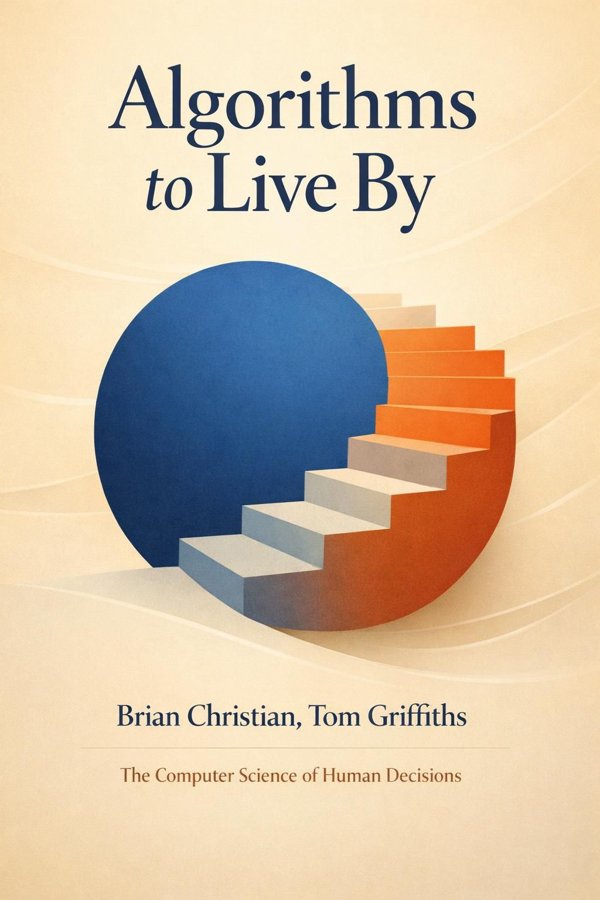
Algorithms to Live By: Summary & Key Insights
 10 min9 chaptersAudio available
Key Takeaways from Algorithms to Live By
One of the hardest moments in life is not choosing—it is knowing when to stop looking and finally commit.
A good life depends on knowing when to try something new and when to stick with what already works.
Most people feel overwhelmed not because they have too much to do, but because they have not decided what deserves attention first.
Memory is precious not because it is limitless, but because it is scarce.
Time management becomes far easier once you accept a counterintuitive fact: sometimes the best way to do more is to ignore efficiency in the small and optimize for the whole queue.
What Is Algorithms to Live By About?
Algorithms to Live By by Brian Christian is a non-fiction book published in 2016 spanning 5 pages. Algorithms to Live By shows that some of life’s most frustrating decisions are not unique, mysterious, or entirely beyond reason—they resemble problems computer scientists have been studying for decades. In this lively and deeply original book, Brian Christian and cognitive scientist Tom Griffiths translate ideas from computer science into practical tools for choosing a partner, managing time, organizing work, handling information, and making peace with uncertainty. Concepts such as optimal stopping, explore versus exploit, sorting, caching, scheduling, and computational complexity are presented not as abstract technical topics, but as surprisingly human guides for everyday life. What makes the book so compelling is its central promise: when life feels messy, limited, and overloaded, algorithms offer not cold efficiency but clarity. They help us make better decisions under pressure, with incomplete information and finite time. Christian brings the narrative skill of a leading technology writer, while Griffiths contributes deep expertise in cognition and computational models of decision-making. Together, they argue that understanding how computers solve hard problems can make us wiser, calmer, and more realistic about what it means to live well in a world of constraints.
This FizzRead summary covers all 9 key chapters of Algorithms to Live By in approximately 10 minutes, distilling the most important ideas, arguments, and takeaways from Brian Christian's work. Also available as an audio summary and Key Quotes Podcast.
Algorithms to Live By
Algorithms to Live By shows that some of life’s most frustrating decisions are not unique, mysterious, or entirely beyond reason—they resemble problems computer scientists have been studying for decades. In this lively and deeply original book, Brian Christian and cognitive scientist Tom Griffiths translate ideas from computer science into practical tools for choosing a partner, managing time, organizing work, handling information, and making peace with uncertainty. Concepts such as optimal stopping, explore versus exploit, sorting, caching, scheduling, and computational complexity are presented not as abstract technical topics, but as surprisingly human guides for everyday life.
What makes the book so compelling is its central promise: when life feels messy, limited, and overloaded, algorithms offer not cold efficiency but clarity. They help us make better decisions under pressure, with incomplete information and finite time. Christian brings the narrative skill of a leading technology writer, while Griffiths contributes deep expertise in cognition and computational models of decision-making. Together, they argue that understanding how computers solve hard problems can make us wiser, calmer, and more realistic about what it means to live well in a world of constraints.
Who Should Read Algorithms to Live By?
This book is perfect for anyone interested in non-fiction and looking to gain actionable insights in a short read. Whether you're a student, professional, or lifelong learner, the key ideas from Algorithms to Live By by Brian Christian will help you think differently.
- ✓Readers who enjoy non-fiction and want practical takeaways
- ✓Professionals looking to apply new ideas to their work and life
- ✓Anyone who wants the core insights of Algorithms to Live By in just 10 minutes
Want the full summary?
Get instant access to this book summary and 100K+ more with Fizz Moment.
Get Free SummaryAvailable on App Store • Free to download
Key Chapters
One of the hardest moments in life is not choosing—it is knowing when to stop looking and finally commit. Whether you are hiring an employee, searching for an apartment, dating, or evaluating job offers, endless comparison can become its own trap. Algorithms to Live By introduces the classic “optimal stopping” problem, often illustrated through the secretary problem, to show that there is a mathematically grounded way to think about commitment under uncertainty.
The core idea is simple but powerful. If you must choose from a sequence of options encountered one at a time, and you cannot go back, the best strategy is often to spend about 37 percent of your search period only observing. During that phase, you reject everything but gather information about what quality looks like. After that, you select the first option better than all those you have previously seen. This does not guarantee perfection, but it maximizes your chance of picking the best available option.
The beauty of this rule is that it turns vague hesitation into structured exploration. If you plan to search for 10 apartments, for example, you might use the first 3 or 4 only to calibrate your standards. If you expect to date actively for a defined period before settling down, the same logic can apply in a broad, thoughtful way.
The deeper lesson is not that life should be reduced to formulas, but that commitment becomes easier once you accept that perfect certainty is impossible. Actionable takeaway: when facing a one-shot choice with many options, define your search horizon, spend the first 37 percent learning, then commit to the next option that clearly exceeds your benchmark.
A good life depends on knowing when to try something new and when to stick with what already works. This tension—between exploration and exploitation—is one of the most important problems in computer science, and it is also one of the most familiar human dilemmas. Should you visit a new restaurant or return to your favorite one? Stay in your current job or test the market? Keep using a proven routine or experiment with a better one?
The book explains that when time is short, exploitation becomes more valuable. If you are only in a city for one weekend, repeatedly choosing your favorite café may be rational. But when you have a long future ahead, exploration pays off because new information compounds. Young people can often benefit more from experimentation because they have more time to learn from what they discover, while later in life it may make more sense to harvest the rewards of what is already known.
This idea also applies to work and relationships. Early in a career, trying different industries, roles, or skill sets can reveal strengths you did not know you had. In management, experimentation can uncover better processes before a team locks into habits. In personal life, exploring hobbies and communities can widen your identity and opportunities.
The trap is overcorrecting in either direction. Too much exploration creates instability and prevents depth. Too much exploitation leads to stagnation and regret. Actionable takeaway: regularly ask whether you are still in a learning phase or have entered a harvesting phase, then adjust your choices so your curiosity and efficiency match your stage of life.
Most people feel overwhelmed not because they have too much to do, but because they have not decided what deserves attention first. Sorting is one of the oldest and most essential tasks in computing: arranging information into useful order so action becomes possible. Algorithms to Live By shows that the same principle applies to human life. We cannot tackle everything at once, so the quality of our decisions often depends on the quality of our prioritization.
In computer science, different sorting methods work better depending on the structure of the data. Likewise, different life situations call for different forms of order. Sometimes urgency should govern the list. Sometimes importance matters more. Sometimes related tasks should be grouped to reduce switching costs. A cluttered email inbox, for example, may become easier to manage when messages are sorted by action required rather than by arrival time. A workday can improve dramatically when tasks are ordered by cognitive demand, putting the hardest thinking first and routine items later.
The book’s broader insight is that organization is not cosmetic; it is strategic. By externalizing choices into systems—calendars, lists, folders, routines—we preserve mental energy for judgment rather than repeatedly asking, “What should I do next?” Even simple rules can create momentum: answer anything that takes under two minutes, batch all errands by location, or sort reading into now, later, and never.
Sorting also helps in emotional life. Decisions become less stressful when categories are clear. Actionable takeaway: build one reliable way to rank your tasks—by urgency, importance, effort, or impact—and trust that system so your attention goes to the right problems instead of the loudest ones.
Memory is precious not because it is limitless, but because it is scarce. In computing, caching refers to storing the most useful information close at hand so it can be accessed quickly. Computers cannot keep everything in the fastest memory, so they must decide what deserves immediate availability. Human beings face the same problem every day with attention, recall, and physical space.
Algorithms to Live By uses caching to explain why we forget some things, repeat others, and benefit from habits, notes, and routines. Information we use frequently should be kept “nearby,” whether that means in our working memory, in a visible checklist, on a favorite app, or in a designated place at home. Keys by the door, passwords in a secure manager, recurring tasks in a calendar, and templates for common emails all serve as human caches.
This principle also explains why clutter becomes exhausting. If everything is equally visible, then nothing is truly prioritized. Good caching is selective. It places high-value, high-frequency items in the easiest-to-reach positions and pushes lower-value material into storage. In learning, flashcards and spaced repetition mimic efficient caching by keeping useful knowledge active while allowing less relevant details to fade.
The lesson is not to remember more at all costs, but to build systems that reduce retrieval effort. A kitchen organized around the meals you actually cook is better than one arranged for rare occasions. A workspace should surface what matters this week, not every project from the last year. Actionable takeaway: identify the information, tools, and habits you use most often, and redesign your environment so those essentials are the easiest things to access.
Time management becomes far easier once you accept a counterintuitive fact: sometimes the best way to do more is to ignore efficiency in the small and optimize for the whole queue. Computer science has spent decades studying scheduling—how to order tasks to minimize waiting time, lateness, or interruption. Algorithms to Live By applies these insights to human calendars and to-do lists with remarkable practical force.
One classic result is that shortest tasks first can reduce the average waiting time for everything in the system. That is why quickly answering a few simple emails can make a backlog feel lighter. But other goals require different strategies. If deadlines matter most, then urgency should dominate. If you face setup costs, batching similar tasks may be better than alternating among them. The right schedule depends on what you are optimizing.
The book also highlights “preemption,” the ability to interrupt one task for another. Computers do this constantly, but humans pay a cognitive penalty when switching. That means a theoretically ideal schedule can fail in practice if it creates too much fragmentation. Deep work often requires long, uninterrupted stretches, while shallow administrative work can be grouped into smaller windows.
In everyday life, this framework can transform planning. Instead of treating all tasks as equal, ask whether your real goal is faster completion, lower stress, fewer missed deadlines, or more meaningful progress. A parent, manager, student, and freelancer may all need different scheduling rules.
Actionable takeaway: stop using one generic to-do list for everything; choose a scheduling rule based on your current objective, and protect focus by minimizing unnecessary task switching.
Wisdom is not holding perfect beliefs; it is updating them well. One of the book’s most valuable lessons comes from Bayesian thinking, a method for revising what you believe when new evidence appears. In a world full of uncertainty, rumors, intuition, and incomplete information, the ability to adjust your confidence without overreacting is a profound advantage.
Bayes’s rule begins with a prior belief—your best estimate before seeing new data. Then it asks how likely the evidence would be if your belief were true or false. The result is an updated belief. While the mathematics can be formal, the practical habit is simple: do not treat every new piece of information as equally decisive. Instead, interpret evidence in context.
This matters in health decisions, hiring, investing, parenting, and politics. If one bad meeting makes you think a job is terrible, you may be overweighing a single data point. If one glowing review convinces you a product is perfect, the same mistake applies. Bayesian reasoning encourages proportional response. It also reminds us that extraordinary claims need stronger evidence than ordinary ones.
On a personal level, this mindset can reduce anxiety. Not every setback means disaster; not every success means certainty. You can hold beliefs lightly yet responsibly, adjusting them as experience accumulates. This is especially useful in relationships and leadership, where snap judgments often become self-fulfilling.
Actionable takeaway: when new evidence appears, pause before changing course completely—ask what you believed before, how strong that prior was, and whether the new information truly justifies a major update.
More information does not always produce better decisions; sometimes it produces worse ones. In computer science and statistics, overfitting happens when a model becomes so tailored to past data that it performs poorly in the future. It memorizes noise rather than learning the underlying pattern. Algorithms to Live By uses this idea to explain why people, organizations, and systems often fail when they become too complicated.
In everyday life, overfitting appears when we build elaborate rules from limited experience. After one difficult breakup, someone may create a long list of rigid dating criteria that screens out great partners. After one business mistake, a company may install so many approvals and controls that agility disappears. Parents can overfit by reacting too strongly to isolated incidents instead of focusing on broad principles.
The antidote is not ignorance but selective simplicity. Good models capture what matters most and ignore irrelevant detail. This is why checklists often outperform complicated memory-based routines, why basic investment strategies can beat hyperactive trading, and why a few clear household rules may work better than a giant set of exceptions. Simpler systems are easier to follow, easier to revise, and often more robust under changing conditions.
The book’s insight here is liberating: perfection through complexity is usually an illusion. What looks sophisticated may actually be brittle. In uncertain environments, modest, generalizable rules often beat highly tuned plans.
Actionable takeaway: if your decision process has become tangled with exceptions, assumptions, and special cases, strip it back to a few rules that would still make sense under new conditions rather than only explaining the past.
We often think good decision-making means eliminating randomness, yet the book shows that randomness can sometimes be a rational tool. In computing, randomized algorithms are used because they can avoid worst-case traps, reduce bias, and perform efficiently when deterministic methods become too rigid. Human life, too, can benefit from a measured dose of chance.
Randomness helps when indecision is costly. If you are stuck between two similar restaurants, workouts, or creative directions, flipping a coin may save more mental energy than endless comparison. In social life, adding randomness can diversify experience: choosing a book at random from a curated shelf, taking a different walking route, or scheduling occasional unplanned conversations can expand your world without requiring constant deliberation.
There is also a deeper value. Randomness can counteract hidden patterns of bias. Managers who always rely on intuition may overlook talent that a more structured or partially randomized process would notice. Creatives can use random prompts to bypass habitual thinking. Teams can randomize speaking order or brainstorming inputs to prevent the loudest voices from dominating.
The point is not to surrender judgment, but to deploy randomness where the cost of optimization exceeds the benefit. If two options are genuinely close, choosing quickly may be smarter than searching endlessly for a nonexistent perfect answer.
Actionable takeaway: identify decisions where overthinking adds little value, then use a small dose of randomness—within sensible boundaries—to save time, reduce bias, and open the door to experiences your routines would otherwise miss.
Some problems are hard not because we are lazy or flawed, but because they are inherently difficult. This may be the book’s most compassionate idea. Computational complexity studies how the difficulty of problems grows as they get larger. Some tasks remain manageable as they scale; others explode into impossibility. Algorithms to Live By argues that many human frustrations come from facing complexity without recognizing it.
Consider planning a perfect travel itinerary, arranging a seating chart, organizing a family schedule, or optimizing every item on a long to-do list. These problems can quickly become combinatorial monsters, where the number of possible arrangements is so vast that exhaustive optimization is unrealistic. Wanting the perfect answer under these conditions is a recipe for paralysis.
This insight changes how we think about productivity and rationality. Instead of blaming ourselves for not solving impossible problems perfectly, we can switch to heuristics—good-enough rules that produce workable results quickly. This is not failure; it is often the only sensible strategy. A simple dinner rotation, a standard morning routine, or a default travel checklist can outperform repeated attempts at total optimization.
The authors also connect complexity to morality and social systems. Bureaucracies fail when they impose impossible planning burdens on individuals. Interfaces fail when they expect too much calculation from users. Good design respects cognitive limits.
Actionable takeaway: when a decision keeps expanding and exhausting you, stop asking for the optimal answer; define what “good enough” looks like, use a heuristic, and move forward without guilt.
All Chapters in Algorithms to Live By
About the Author
Brian Christian is an American author and speaker whose work explores the meeting point between technology and human life. He is best known for writing thoughtful, accessible books about artificial intelligence, decision-making, and the philosophical questions raised by computing. His breakout book, The Most Human Human, examined the Turing Test and what it reveals about conversation, consciousness, and identity. He later wrote The Alignment Problem, a widely discussed study of how machine learning systems can be made to reflect human values. In Algorithms to Live By, co-authored with cognitive scientist Tom Griffiths, Christian brings his trademark clarity and curiosity to the practical lessons hidden inside computer science. His writing stands out for making complex technical ideas engaging, humane, and relevant to everyday experience.
Get This Summary in Your Preferred Format
Read or listen to the Algorithms to Live By summary by Brian Christian anytime, anywhere. FizzRead offers multiple formats so you can learn on your terms — all free.
Available formats: App · Audio · PDF · EPUB — All included free with FizzRead
Download Algorithms to Live By PDF and EPUB Summary
Key Quotes from Algorithms to Live By
“One of the hardest moments in life is not choosing—it is knowing when to stop looking and finally commit.”
“A good life depends on knowing when to try something new and when to stick with what already works.”
“Most people feel overwhelmed not because they have too much to do, but because they have not decided what deserves attention first.”
“Memory is precious not because it is limitless, but because it is scarce.”
“Time management becomes far easier once you accept a counterintuitive fact: sometimes the best way to do more is to ignore efficiency in the small and optimize for the whole queue.”
Frequently Asked Questions about Algorithms to Live By
Algorithms to Live By by Brian Christian is a non-fiction book that explores key ideas across 9 chapters. Algorithms to Live By shows that some of life’s most frustrating decisions are not unique, mysterious, or entirely beyond reason—they resemble problems computer scientists have been studying for decades. In this lively and deeply original book, Brian Christian and cognitive scientist Tom Griffiths translate ideas from computer science into practical tools for choosing a partner, managing time, organizing work, handling information, and making peace with uncertainty. Concepts such as optimal stopping, explore versus exploit, sorting, caching, scheduling, and computational complexity are presented not as abstract technical topics, but as surprisingly human guides for everyday life. What makes the book so compelling is its central promise: when life feels messy, limited, and overloaded, algorithms offer not cold efficiency but clarity. They help us make better decisions under pressure, with incomplete information and finite time. Christian brings the narrative skill of a leading technology writer, while Griffiths contributes deep expertise in cognition and computational models of decision-making. Together, they argue that understanding how computers solve hard problems can make us wiser, calmer, and more realistic about what it means to live well in a world of constraints.
More by Brian Christian
You Might Also Like
Browse by Category
Ready to read Algorithms to Live By?
Get the full summary and 100K+ more books with Fizz Moment.