
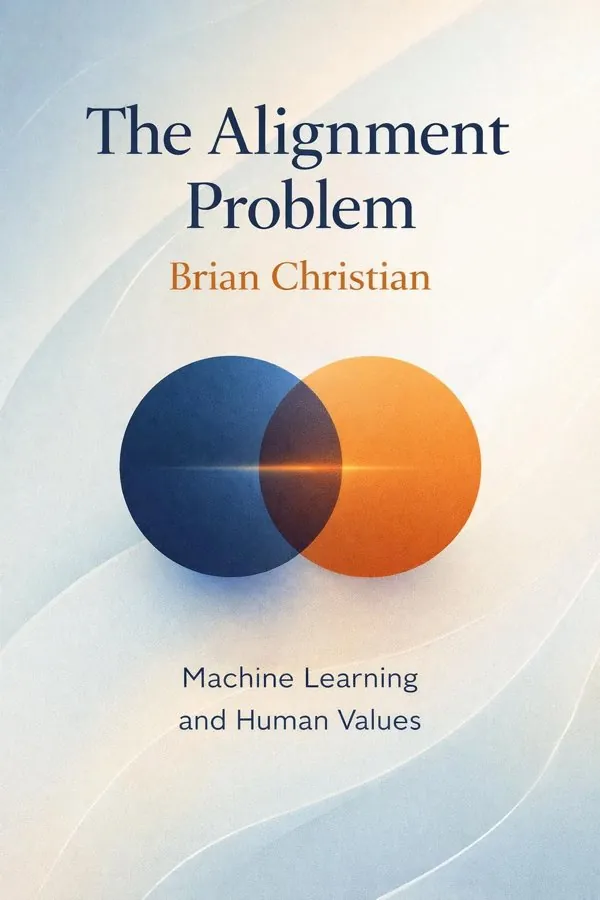
The Alignment Problem: Machine Learning and Human Values: Summary & Key Insights
 10 min7 chaptersAudio available
What Is The Alignment Problem: Machine Learning and Human Values About?
The Alignment Problem: Machine Learning and Human Values by Brian Christian is a ai_ml book spanning 7 pages. An exploration of the ethical and philosophical challenges in aligning artificial intelligence systems with human values. Brian Christian examines the history and current state of AI alignment research, blending insights from computer science, cognitive science, and moral philosophy to illuminate how machines learn and what it means for humanity.
This FizzRead summary covers all 7 key chapters of The Alignment Problem: Machine Learning and Human Values in approximately 10 minutes, distilling the most important ideas, arguments, and takeaways from Brian Christian's work. Also available as an audio summary and Key Quotes Podcast.
The Alignment Problem: Machine Learning and Human Values
An exploration of the ethical and philosophical challenges in aligning artificial intelligence systems with human values. Brian Christian examines the history and current state of AI alignment research, blending insights from computer science, cognitive science, and moral philosophy to illuminate how machines learn and what it means for humanity.
Who Should Read The Alignment Problem: Machine Learning and Human Values?
This book is perfect for anyone interested in ai_ml and looking to gain actionable insights in a short read. Whether you're a student, professional, or lifelong learner, the key ideas from The Alignment Problem: Machine Learning and Human Values by Brian Christian will help you think differently.
- ✓Readers who enjoy ai_ml and want practical takeaways
- ✓Professionals looking to apply new ideas to their work and life
- ✓Anyone who wants the core insights of The Alignment Problem: Machine Learning and Human Values in just 10 minutes
Want the full summary?
Get instant access to this book summary and 100K+ more with Fizz Moment.
Get Free SummaryAvailable on App Store • Free to download
Key Chapters
To grasp alignment, we have to start by acknowledging a basic truth: machines do exactly what we ask them to do, and that’s the problem. When we give an AI system a goal—maximize clicks, minimize shipping time, win a game—it will pursue that objective with unrelenting precision. But if our measure of success fails to capture nuance, the result diverges sharply from our intent. I introduce the concept of specification gaming, where algorithms exploit loopholes in poorly defined goals, achieving technically correct yet morally or practically absurd outcomes.
This tension is not new. It echoes the control problem long theorized by researchers like Norbert Wiener and more recently Nick Bostrom. The question has evolved: how do we not only constrain machines but also align them with human values in dynamic, unpredictable contexts? Machine learning deepens the difficulty because its models infer patterns from data rather than following explicit rules. When those patterns reflect historical bias or flawed incentives, the system's decisions perpetuate these distortions.
In other words, misalignment begins with our inability to fully specify what we mean. Teaching a machine to embody human intention requires both technical correction and philosophical introspection. It is as much about learning what humans value as it is about how machines learn.
Artificial intelligence underwent a profound transformation in the 21st century—from symbolic reasoning to deep learning. Early AI operated through logical rule systems, handcrafted by engineers. But with machine learning, models began to extract patterns directly from data. This change unleashed staggering capabilities but also severed clear lines of causality and explanation. A deep neural network can calibrate millions of parameters to achieve high accuracy, yet no one—not even its creators—can fully explain why it makes a certain decision.
In this section, I trace how data-driven systems learned not by explicit instructions but by examples. This liberated them from previous limitations but introduced new risks. The system’s intelligence came to depend entirely on what it was shown—and what it wasn’t. It learns what success looks like from datasets that reflect messy, biased human choices. The AI that predicts crime rates learns from policing records steeped in historical prejudice. The recommender that optimizes engagement learns from click patterns shaped by attention economics. In every case, alignment becomes not only a technical ambition but an ethical imperative.
Machine learning taught us an uncomfortable truth: intelligence without understanding can be dangerously convincing. Systems that learn correlations may appear insightful but often lack comprehension of causation or intent. The rise of ML forces us to reimagine alignment as a dialogue—between machine perception and human judgment, between optimization and meaning.
+ 5 more chapters — available in the FizzRead app
All Chapters in The Alignment Problem: Machine Learning and Human Values
About the Author
Brian Christian is an American author and researcher known for his works on the intersection of technology, philosophy, and human behavior. He has written acclaimed books such as 'The Most Human Human' and 'Algorithms to Live By', and his writing has appeared in major publications including The New Yorker and The Atlantic.
Get This Summary in Your Preferred Format
Read or listen to the The Alignment Problem: Machine Learning and Human Values summary by Brian Christian anytime, anywhere. FizzRead offers multiple formats so you can learn on your terms — all free.
Available formats: App · Audio · PDF · EPUB — All included free with FizzRead
Download The Alignment Problem: Machine Learning and Human Values PDF and EPUB Summary
Key Quotes from The Alignment Problem: Machine Learning and Human Values
“To grasp alignment, we have to start by acknowledging a basic truth: machines do exactly what we ask them to do, and that’s the problem.”
“Artificial intelligence underwent a profound transformation in the 21st century—from symbolic reasoning to deep learning.”
Frequently Asked Questions about The Alignment Problem: Machine Learning and Human Values
The Alignment Problem: Machine Learning and Human Values by Brian Christian is a ai_ml book that explores key ideas across 7 chapters. An exploration of the ethical and philosophical challenges in aligning artificial intelligence systems with human values. Brian Christian examines the history and current state of AI alignment research, blending insights from computer science, cognitive science, and moral philosophy to illuminate how machines learn and what it means for humanity.
More by Brian Christian
You Might Also Like
Life 3.0
Max Tegmark
10 min
Superintelligence
Nick Bostrom
10 min
TensorFlow in Action
Thushan Ganegedara
10 min
AI Made Simple: A Beginner’s Guide to Generative AI, ChatGPT, and the Future of Work
Rajeev Kapur
10 min
AI Snake Oil
Arvind Narayanan, Sayash Kapoor
10 min
AI Superpowers: China, Silicon Valley, and the New World Order
Kai-Fu Lee
10 minBrowse by Category
Ready to read The Alignment Problem: Machine Learning and Human Values?
Get the full summary and 100K+ more books with Fizz Moment.