
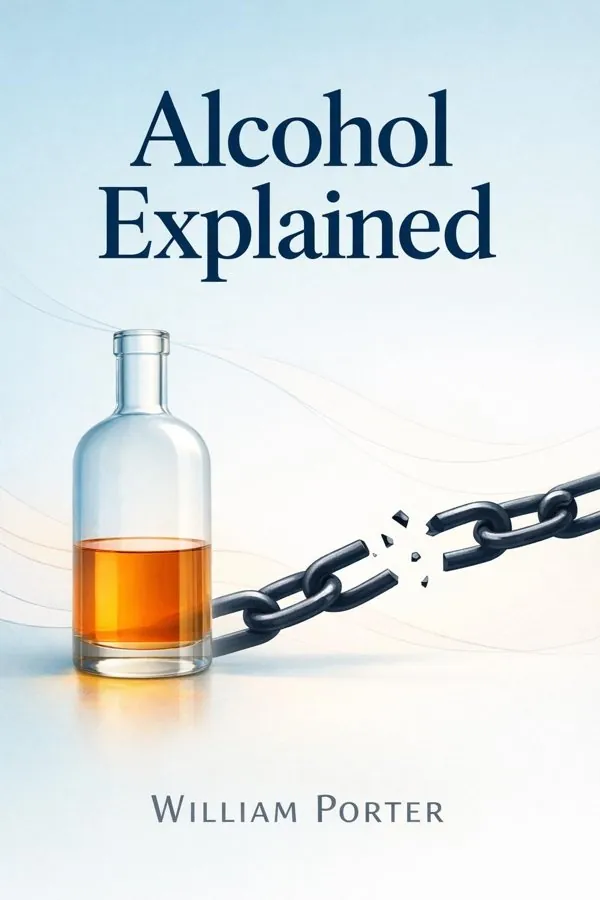
Alcohol Explained: Summary & Key Insights
 10 min9 chaptersAudio available
Key Takeaways from Alcohol Explained
The most important shift in this book begins with a simple but unsettling insight: alcohol is not a special emotional solution, a social enhancer, or a reward in liquid form.
What feels like relief is often the beginning of a hidden stress response.
One reason alcohol is so persuasive is that it changes not only how we feel, but how we interpret what we feel.
Addiction rarely begins with dramatic collapse.
A powerful insight in Alcohol Explained is that many people drink not to feel good, but to stop feeling bad.
What Is Alcohol Explained About?
Alcohol Explained by William Porter is a mental_health book spanning 5 pages. Alcohol Explained is a direct, illuminating look at one of the most normalized drugs in modern life. In this book, William Porter strips away the romance, ritual, and confusion surrounding alcohol and examines what it actually does to the body, brain, and emotions. Rather than treating drinking as a moral failure or a mysterious weakness, he explains it as a chemical process that creates predictable physical and psychological effects. That shift matters, because many people continue drinking not because alcohol truly helps them, but because they misunderstand what it is doing. Porter writes with unusual authority because his perspective combines careful research with lived experience. He understands both the science of ethanol and the inner logic of habitual drinking: the cravings, the self-justifications, the cycles of anxiety and relief. His great strength is clarity. He translates complex ideas about tolerance, dependence, withdrawal, sleep disruption, and social conditioning into language that feels practical and immediately relevant. For anyone who has ever wondered why alcohol can feel comforting one moment and destructive the next, Alcohol Explained offers a rational framework that can change how you think—and potentially how you live.
This FizzRead summary covers all 9 key chapters of Alcohol Explained in approximately 10 minutes, distilling the most important ideas, arguments, and takeaways from William Porter's work. Also available as an audio summary and Key Quotes Podcast.
Alcohol Explained
Alcohol Explained is a direct, illuminating look at one of the most normalized drugs in modern life. In this book, William Porter strips away the romance, ritual, and confusion surrounding alcohol and examines what it actually does to the body, brain, and emotions. Rather than treating drinking as a moral failure or a mysterious weakness, he explains it as a chemical process that creates predictable physical and psychological effects. That shift matters, because many people continue drinking not because alcohol truly helps them, but because they misunderstand what it is doing.
Porter writes with unusual authority because his perspective combines careful research with lived experience. He understands both the science of ethanol and the inner logic of habitual drinking: the cravings, the self-justifications, the cycles of anxiety and relief. His great strength is clarity. He translates complex ideas about tolerance, dependence, withdrawal, sleep disruption, and social conditioning into language that feels practical and immediately relevant. For anyone who has ever wondered why alcohol can feel comforting one moment and destructive the next, Alcohol Explained offers a rational framework that can change how you think—and potentially how you live.
Who Should Read Alcohol Explained?
This book is perfect for anyone interested in mental_health and looking to gain actionable insights in a short read. Whether you're a student, professional, or lifelong learner, the key ideas from Alcohol Explained by William Porter will help you think differently.
- ✓Readers who enjoy mental_health and want practical takeaways
- ✓Professionals looking to apply new ideas to their work and life
- ✓Anyone who wants the core insights of Alcohol Explained in just 10 minutes
Want the full summary?
Get instant access to this book summary and 100K+ more with Fizz Moment.
Get Free SummaryAvailable on App Store • Free to download
Key Chapters
The most important shift in this book begins with a simple but unsettling insight: alcohol is not a special emotional solution, a social enhancer, or a reward in liquid form. It is ethanol, a drug with specific chemical effects. Much of alcohol’s power comes from the stories we attach to it, but Porter argues that once we see alcohol clearly, many of its mysteries disappear.
Alcohol enters the bloodstream quickly and travels throughout the body, including the brain. Unlike food, it offers no real nourishment. The body treats it as a toxin and prioritizes breaking it down over other metabolic tasks. That is why drinking affects coordination, judgment, mood, sleep, digestion, and energy. What people often call “relaxation” is frequently the early sedative effect of a depressant acting on the nervous system.
This matters because many drinkers think they are consuming a sophisticated lifestyle product when they are actually managing the effects of a drug. A glass of wine at dinner, a beer after work, or a cocktail at a celebration may look different socially, but chemically they all deliver ethanol. The labels, traditions, and settings can disguise that basic fact.
A practical application of this idea is to stop evaluating alcohol by branding or context and start evaluating it by effect. Ask: How do I sleep after drinking? How anxious do I feel the next day? How often does one drink become several? When you assess alcohol as a drug instead of a cultural symbol, your observations become more honest.
Actionable takeaway: For one week, describe every drink in plain language as “ethanol” rather than wine, beer, or spirits, and notice how that changes your perception of its role in your life.
What feels like relief is often the beginning of a hidden stress response. Porter explains that alcohol initially depresses the central nervous system, which can create a short-lived sense of calm or emotional distance. But the body does not passively accept that sedation. It fights back to restore balance, releasing stimulating chemicals and activating countermeasures that push the system in the opposite direction.
This rebound effect helps explain why drinking often ends in restlessness, irritability, early waking, or next-day anxiety. The person may believe alcohol helped them relax, when in fact it triggered a cycle: sedation first, overstimulation later. This is one of the book’s key revelations. Alcohol does not remove stress in a lasting way; it frequently creates more of it after a brief delay.
Consider the common example of someone who drinks after work to “unwind.” The first drink may soften tension, but by late evening they may need another to maintain the feeling. During the night, sleep becomes lighter and less restorative. The next morning brings dehydration, poor concentration, and unease. By the afternoon, they feel stressed again and interpret that discomfort as a reason to drink, not realizing alcohol helped produce it.
Understanding this pattern can be liberating. It reframes cravings and “bad nerves” not as personal weakness, but as predictable consequences of alcohol’s action and the body’s reaction. Once this is understood, the appeal of drinking for relaxation begins to weaken.
Actionable takeaway: The next time you feel a drink would calm you, wait 20 minutes and write down your current stress level, then compare it with how you feel the next morning if you choose to drink.
One reason alcohol is so persuasive is that it changes not only how we feel, but how we interpret what we feel. Porter shows that alcohol can create a deceptive mental environment in which ordinary emotional shifts seem meaningful and alcohol itself appears to be the answer. In reality, the substance often reduces clarity, narrows perspective, and interferes with honest self-assessment.
Drinking can temporarily mute self-consciousness, lower inhibitions, and produce a sensation of ease. That can feel like confidence, social fluency, or emotional freedom. But Porter argues that this benefit is largely illusory. The person is not becoming more capable; they are becoming less aware of risk, nuance, and consequence. Conversations may feel deeper than they are. Laughter may feel more genuine than it is. Decisions may feel wise while being impulsive.
This distortion also influences memory. People may remember only the high points of drinking and forget the dullness, repetition, embarrassment, arguments, overeating, poor sleep, or low mood that followed. The mind edits the experience in alcohol’s favor. That selective recall strengthens the habit.
A practical example is the social drinker who believes they are more likable after a few drinks. Yet if they examine outcomes closely, they may notice interrupted sleep, repeated stories, emotional oversharing, or next-day regret. The pleasant feeling was real in the moment, but the interpretation of enhanced performance was often false.
Actionable takeaway: After any drinking occasion, record three things you enjoyed and three costs you experienced; this balanced review helps counter alcohol’s tendency to rewrite the memory in its own favor.
Addiction rarely begins with dramatic collapse. More often, it develops through adaptation. Porter explains that tolerance is the process by which the body and brain become less responsive to alcohol’s initial effects, pushing the drinker to consume more to achieve the same perceived benefit. What starts as occasional use can become routine not because alcohol keeps delivering pleasure, but because the user keeps chasing an effect that is fading.
As tolerance rises, drinking can look outwardly controlled while becoming inwardly necessary. A person who once felt buzzed after one or two drinks may later need four or five just to feel “normal” or properly relaxed. That shift is dangerous because it disguises dependence as experience. People may even take pride in “handling their drink,” unaware that this ability often reflects a body that has become accustomed to repeated chemical disruption.
Tolerance also deepens the cycle of rebound discomfort. Because the body is increasingly prepared to resist alcohol’s sedative effects, the stimulating counter-response can become stronger. This means more drinking, less satisfaction, and worse aftereffects. At this stage, many people conclude they need alcohol because life feels flat or tense without it, when actually alcohol has been training their system to feel that way.
In everyday life, this can appear as drinking earlier in the evening, pouring larger servings, choosing stronger drinks, or feeling disappointed when “just one” seems pointless. These are not random habits; they are signs of adaptation.
Actionable takeaway: Compare your current drinking pattern with your pattern from one or two years ago, focusing on quantity, frequency, and reasons for drinking; any steady increase deserves serious attention.
A powerful insight in Alcohol Explained is that many people drink not to feel good, but to stop feeling bad. Dependence grows when alcohol repeatedly creates discomfort that only more alcohol seems to relieve. Porter describes withdrawal not only as an extreme condition seen in severe alcoholism, but as a spectrum of symptoms that can affect regular drinkers: irritability, shakiness, poor sleep, anxiety, low mood, racing thoughts, and an agitated sense that something is missing.
These symptoms are easy to misread. A person may believe they are naturally anxious, socially awkward, or unable to unwind without a drink. Yet the very thing they rely on may be intensifying those states. The evening drink soothes the beginning of withdrawal from previous drinking, which creates the illusion that alcohol is medicine. In this way, alcohol can present itself as the cure for the distress it helped generate.
Think of the weekend drinker who feels edgy on Friday and interprets that as proof they need alcohol to relax. Or the nightly drinker who wakes at 3 a.m., cannot settle, and looks forward to the next evening’s wine. These are not random personal flaws; they are signs of a conditioned cycle.
Seeing withdrawal clearly changes the story from “I need alcohol because life is hard” to “Alcohol has trained my body and mind to demand relief.” That understanding can reduce shame and increase motivation, because it identifies a mechanism rather than a character defect.
Actionable takeaway: If you suspect your stress may be alcohol-related, track your mood, sleep, and cravings across several alcohol-free days to see whether symptoms improve once the cycle is interrupted.
Many people treat alcohol as a sleep aid, but Porter argues that this is one of the most costly myths surrounding drinking. Alcohol can make you fall asleep faster because of its sedating effect, yet sedation is not the same as healthy sleep. The body’s processing of alcohol later in the night disrupts natural sleep architecture, reduces restorative rest, and often causes early waking or fragmented sleep.
This matters because poor sleep affects nearly everything: patience, concentration, emotional regulation, appetite, productivity, and resilience. A person may not connect their fatigue or low mood to drinking if they believe they “slept all night.” But if that sleep was chemically distorted, they may wake feeling unrefreshed despite spending enough hours in bed.
A common example is the person who drinks a few glasses of wine in the evening and falls asleep easily, only to wake at 3 or 4 a.m. with a racing mind, thirst, or a vague sense of panic. They may blame stress or aging, not recognizing alcohol’s role. Others notice they need caffeine to function, are more short-tempered, or struggle to exercise or focus after drinking nights.
Porter’s point is practical: when alcohol is removed, sleep often improves significantly after an adjustment period. Better sleep then improves mood and self-control, making it easier to continue cutting back or quitting. This creates an upward spiral that works against dependence.
Actionable takeaway: Test alcohol’s impact by comparing one week of drinking evenings with one week of alcohol-free evenings, and note differences in sleep quality, waking time, energy, and mood.
One of the book’s sharpest observations is that alcohol benefits from social protection. Long before people take their first drink, they absorb messages that alcohol means fun, adulthood, romance, reward, sophistication, rebellion, or belonging. Porter argues that these cultural associations are so strong that they shape the experience itself. People often do not evaluate alcohol independently; they inherit beliefs about what it is supposed to do.
Advertising, films, family rituals, business events, holidays, and peer groups all reinforce the idea that drinking is normal and often necessary. If someone feels awkward at a party, alcohol gets credit for easing tension. If they feel connected over dinner, alcohol gets included in the memory. Rarely do people ask whether the conversation, music, food, or companionship mattered more than the drink.
This conditioning can make abstaining feel like deprivation even when drinking causes harm. It can also create shame for people who question alcohol’s role. They may fear being dull, antisocial, or difficult. Porter exposes how irrational that is: no one believes they must smoke cigarettes to celebrate, yet many people feel compelled to drink to participate fully.
A practical application is to separate events from alcohol in your mind. Weddings are about love, not champagne. Relaxing evenings are about rest, not wine. Friendship is about connection, not pints. When this distinction becomes clear, alcohol loses much of its borrowed glamour.
Actionable takeaway: List five situations where you assume alcohol is essential, then write down what the real benefit of each situation is and how you could access that benefit without drinking.
People frequently approach alcohol problems as if they were battles of discipline: drink less, try harder, make stricter rules, feel guilty when you fail. Porter challenges this model. He suggests that willpower is fragile when it fights against misunderstanding. If you still believe alcohol relaxes you, improves your social life, rewards your effort, and helps you cope, then abstaining feels like constant sacrifice. Knowledge changes the emotional equation.
This does not mean self-control is irrelevant. It means sustainable change is easier when the desire itself is weakened. Once a person sees that alcohol increases anxiety, disrupts sleep, fuels cravings, and gains much of its appeal from social conditioning, saying no can begin to feel less like deprivation and more like self-protection.
This idea has practical value for anyone trapped in cycles of resolution and relapse. A person may decide every Sunday to drink less, then by Thursday feel deprived and resentful. The problem is not always lack of character. It may be that part of them still views alcohol as a treasured benefit. Porter’s method aims to remove that illusion through understanding.
For example, instead of repeating “I can’t drink,” a person might reframe the issue as “I don’t want the anxiety, poor sleep, and false relief alcohol brings.” This is a more stable position because it aligns choice with insight.
Actionable takeaway: Replace rules based on restriction with statements based on understanding, and write a short personal list of what alcohol actually costs you versus what you once believed it provided.
The final lesson of Alcohol Explained is quietly hopeful: change becomes possible when confusion ends. Porter does not ask readers to adopt a dramatic identity or surrender to moral judgment. Instead, he invites them to observe cause and effect carefully. If alcohol is understood plainly, the compulsion around it often begins to loosen.
This approach is powerful because it restores agency. Rather than seeing drinking as a mysterious fate, readers learn to notice patterns: the craving after stress, the rebound anxiety after a night out, the romanticized memory of drinking, the hidden role of poor sleep, the escalation of tolerance, and the relief that follows alcohol-free periods. These observations build confidence because they make behavior intelligible.
Recovery, in this framework, is not only about stopping alcohol. It is about regaining mental clarity and emotional stability. Many people discover that ordinary life becomes easier without constant chemical disturbance. Mornings improve. Anxiety decreases. Self-respect returns. Social situations become more genuine. The absence of alcohol is not an empty space but a clearing in which better habits can grow.
In practice, this means approaching change with curiosity rather than self-contempt. Instead of asking, “Why am I like this?” ask, “What happens when I drink, and what happens when I don’t?” That shift encourages learning, not punishment.
Actionable takeaway: Commit to a defined alcohol-free experiment, observe your sleep, mood, stress, and energy without judgment, and let evidence—not fear or social pressure—guide your next decision.
All Chapters in Alcohol Explained
About the Author
William Porter is a British author known for his clear, practical writing on alcohol, addiction, and recovery. He has built a strong following by explaining drinking not as a moral issue, but as a chemical and psychological process that can be understood. Drawing on both personal experience and extensive independent study, Porter writes in a way that is accessible to general readers while still grounded in real mechanisms of dependence, withdrawal, and habit formation. His best-known work, Alcohol Explained, has helped many readers rethink long-held assumptions about alcohol and question the myths that keep drinking attractive. Porter’s broader body of work continues this mission, offering thoughtful guidance to people who want greater freedom, clarity, and control in their lives.
Get This Summary in Your Preferred Format
Read or listen to the Alcohol Explained summary by William Porter anytime, anywhere. FizzRead offers multiple formats so you can learn on your terms — all free.
Available formats: App · Audio · PDF · EPUB — All included free with FizzRead
Download Alcohol Explained PDF and EPUB Summary
Key Quotes from Alcohol Explained
“The most important shift in this book begins with a simple but unsettling insight: alcohol is not a special emotional solution, a social enhancer, or a reward in liquid form.”
“What feels like relief is often the beginning of a hidden stress response.”
“One reason alcohol is so persuasive is that it changes not only how we feel, but how we interpret what we feel.”
“Addiction rarely begins with dramatic collapse.”
“A powerful insight in Alcohol Explained is that many people drink not to feel good, but to stop feeling bad.”
Frequently Asked Questions about Alcohol Explained
Alcohol Explained by William Porter is a mental_health book that explores key ideas across 9 chapters. Alcohol Explained is a direct, illuminating look at one of the most normalized drugs in modern life. In this book, William Porter strips away the romance, ritual, and confusion surrounding alcohol and examines what it actually does to the body, brain, and emotions. Rather than treating drinking as a moral failure or a mysterious weakness, he explains it as a chemical process that creates predictable physical and psychological effects. That shift matters, because many people continue drinking not because alcohol truly helps them, but because they misunderstand what it is doing. Porter writes with unusual authority because his perspective combines careful research with lived experience. He understands both the science of ethanol and the inner logic of habitual drinking: the cravings, the self-justifications, the cycles of anxiety and relief. His great strength is clarity. He translates complex ideas about tolerance, dependence, withdrawal, sleep disruption, and social conditioning into language that feels practical and immediately relevant. For anyone who has ever wondered why alcohol can feel comforting one moment and destructive the next, Alcohol Explained offers a rational framework that can change how you think—and potentially how you live.
You Might Also Like
Big Feelings: How to Be Okay When Things Are Not Okay
Liz Fosslien, Mollie West Duffy
10 min
Creative Arts Therapies Handbook: Art, Music and Dance Therapy Practices for Wellbeing
Susan I. Buchalter
10 min
Emotional First Aid: Healing Rejection, Guilt, Failure, and Other Everyday Hurts
Guy Winch
10 min
Lost Connections: Why You're Depressed and How to Find Hope
Johann Hari
10 min
No Time to Panic: How to Stop Worrying and Embrace Life
Matt Gutman
10 min
Overcoming Mobbing: A Recovery Guide for Workplace Aggression and Bullying
Maureen Duffy, Len Sperry
10 minFeatured In
Browse by Category
Ready to read Alcohol Explained?
Get the full summary and 100K+ more books with Fizz Moment.