
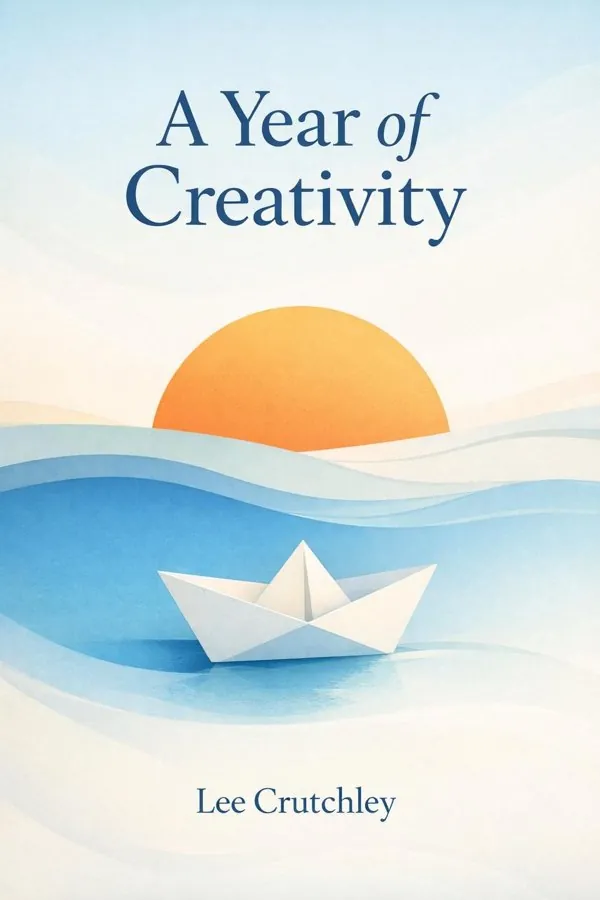
A Year of Creativity: Summary & Key Insights
 10 min5 chaptersAudio available
What Is A Year of Creativity About?
A Year of Creativity by Lee Crutchley is a creativity book spanning 5 pages. A Year of Creativity is a guided journal designed to help readers explore their imagination and develop creative habits throughout the year. Each page offers prompts, exercises, and reflections that encourage artistic expression, mindfulness, and self-discovery.
This FizzRead summary covers all 5 key chapters of A Year of Creativity in approximately 10 minutes, distilling the most important ideas, arguments, and takeaways from Lee Crutchley's work. Also available as an audio summary and Key Quotes Podcast.
A Year of Creativity
A Year of Creativity is a guided journal designed to help readers explore their imagination and develop creative habits throughout the year. Each page offers prompts, exercises, and reflections that encourage artistic expression, mindfulness, and self-discovery.
Who Should Read A Year of Creativity?
This book is perfect for anyone interested in creativity and looking to gain actionable insights in a short read. Whether you're a student, professional, or lifelong learner, the key ideas from A Year of Creativity by Lee Crutchley will help you think differently.
- ✓Readers who enjoy creativity and want practical takeaways
- ✓Professionals looking to apply new ideas to their work and life
- ✓Anyone who wants the core insights of A Year of Creativity in just 10 minutes
Want the full summary?
Get instant access to this book summary and 100K+ more with Fizz Moment.
Get Free SummaryAvailable on App Store • Free to download
Key Chapters
Creativity thrives not in bursts of brilliance but in the rhythm of small, consistent acts. One of the core truths I share in this book is that discipline in creativity rarely looks glamorous. It’s the decision to draw for five minutes when you feel tired, to jot down a thought even when you think it’s silly. These micro-moments shape a habit stronger than any single achievement.
If you think about musicians practicing scales or writers filling notebooks with drafts, each repetition is a form of devotion. In this guided year, I encourage you to treat your creative time with similar reverence—not as an obligation but as a daily breath. The book’s structure itself mirrors that rhythm: one page, one prompt, one day at a time.
Over time, these small actions accumulate into a kind of muscle memory. You’ll notice that creativity stops being something you wait for and becomes something you embody. On days when motivation is low, the act of simply doing—a sketch, a color, a sentence—becomes its own reward. Your creative habit then shifts from effort to ease.
In psychology, this is the mechanism of habit formation: cue, action, reward. I wanted readers to feel this natural progression without overthinking it. Each exercise in this book serves as both a cue and a reward. You begin with curiosity, perform an action, and feel the satisfaction of completion. That emotional feedback is what sustains the practice across the year.
Ultimately, these daily engagements are small ceremonies. By honoring them, you redefine what productivity means—not by output, but by continuity. Over 365 days, those small actions create an invisible foundation for a lifetime of creative resilience.
There’s an unspoken truth about creativity: it needs space—not only physical space but mental space. Before diving into the daily work, I invite you to consider what you want creativity to mean for you. Is it a means of expression? A way to process emotions? A playful escape from logic? Setting intentions gives shape to your journey. Without them, your efforts feel scattered; with them, your creative energy has direction.
Throughout the book, I ask you to create a personal ritual around your practice. Maybe it’s lighting a candle, sitting by a window, or simply turning your phone off for ten minutes. This ritual transforms ordinary time into creative time. It signals your brain that it’s safe to explore without judgment.
We also talk about mental space—the mindset that allows ideas to flourish. In my own experiences as an illustrator and writer, I’ve found that creativity emerges most freely when the mind isn’t crowded with expectation. That’s why many of the early prompts are simple and open-ended: draw what you feel, write what you see, imagine what could be. They’re scaffolds for openness.
Setting intentions helps you notice your patterns, too. You’ll begin to see what types of tasks energize you and which ones drain you. This awareness becomes the groundwork for maintaining creativity even beyond the book. When you understand your rhythms, you can align them with your intentions rather than fighting against them.
Think of this as cultivating a garden. You prepare the soil with patience, set boundaries around what you’ll nurture, and allow yourself to enjoy the process rather than rush towards harvest. Creativity blooms best when it’s planted with care, not with pressure.
+ 3 more chapters — available in the FizzRead app
All Chapters in A Year of Creativity
About the Author
Lee Crutchley is a British illustrator and author known for his creative self-help books that combine art and psychology. His works often focus on mental health, creativity, and personal growth.
Get This Summary in Your Preferred Format
Read or listen to the A Year of Creativity summary by Lee Crutchley anytime, anywhere. FizzRead offers multiple formats so you can learn on your terms — all free.
Available formats: App · Audio · PDF · EPUB — All included free with FizzRead
Download A Year of Creativity PDF and EPUB Summary
Key Quotes from A Year of Creativity
“Creativity thrives not in bursts of brilliance but in the rhythm of small, consistent acts.”
“There’s an unspoken truth about creativity: it needs space—not only physical space but mental space.”
Frequently Asked Questions about A Year of Creativity
A Year of Creativity by Lee Crutchley is a creativity book that explores key ideas across 5 chapters. A Year of Creativity is a guided journal designed to help readers explore their imagination and develop creative habits throughout the year. Each page offers prompts, exercises, and reflections that encourage artistic expression, mindfulness, and self-discovery.
You Might Also Like
Dimensions Of Creativity
Margaret A. Boden
10 min
How to Fly a Horse: The Secret History of Creation, Invention, and Discovery
Kevin Ashton
10 min
Imagine: How Creativity Works
Jonah Lehrer
10 min
The Accidental Creative: How to Be Brilliant at a Moment's Notice
Todd Henry
10 min
The Origins of Creativity
Edward O. Wilson
10 min
Wired to Create: Unraveling the Mysteries of the Creative Mind
Scott Barry Kaufman, Carolyn Gregoire
10 minFeatured In
Browse by Category
Ready to read A Year of Creativity?
Get the full summary and 100K+ more books with Fizz Moment.