
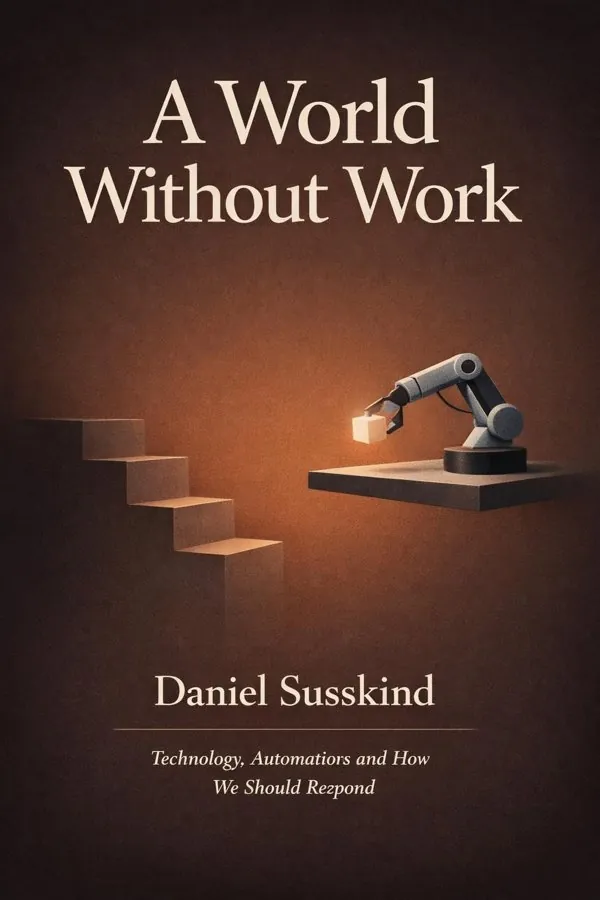
A World Without Work: Technology, Automation, and How We Should Respond: Summary & Key Insights
 10 min8 chaptersAudio available
What Is A World Without Work: Technology, Automation, and How We Should Respond About?
A World Without Work: Technology, Automation, and How We Should Respond by Daniel Susskind is a economics book spanning 8 pages. In this book, Daniel Susskind explores how automation and artificial intelligence are transforming the nature of work and employment. He examines the economic and social consequences of a future where machines increasingly perform tasks once done by humans, and proposes ways societies can adapt to ensure prosperity and purpose in a world with less traditional work.
This FizzRead summary covers all 8 key chapters of A World Without Work: Technology, Automation, and How We Should Respond in approximately 10 minutes, distilling the most important ideas, arguments, and takeaways from Daniel Susskind's work. Also available as an audio summary and Key Quotes Podcast.
A World Without Work: Technology, Automation, and How We Should Respond
In this book, Daniel Susskind explores how automation and artificial intelligence are transforming the nature of work and employment. He examines the economic and social consequences of a future where machines increasingly perform tasks once done by humans, and proposes ways societies can adapt to ensure prosperity and purpose in a world with less traditional work.
Who Should Read A World Without Work: Technology, Automation, and How We Should Respond?
This book is perfect for anyone interested in economics and looking to gain actionable insights in a short read. Whether you're a student, professional, or lifelong learner, the key ideas from A World Without Work: Technology, Automation, and How We Should Respond by Daniel Susskind will help you think differently.
- ✓Readers who enjoy economics and want practical takeaways
- ✓Professionals looking to apply new ideas to their work and life
- ✓Anyone who wants the core insights of A World Without Work: Technology, Automation, and How We Should Respond in just 10 minutes
Want the full summary?
Get instant access to this book summary and 100K+ more with Fizz Moment.
Get Free SummaryAvailable on App Store • Free to download
Key Chapters
To understand the extraordinary transformation taking place today, we must first step back into history. The fear that machines will replace human labor is not new—it has echoed through centuries of technological progress. From the Luddites who smashed textile machines in nineteenth-century Britain to the automation debates of the 1960s, each generation has worried that innovation would destroy jobs and livelihoods. Yet history also reveals that technological revolutions tend to create new kinds of work just as they eliminate old ones.
During the agricultural revolution, machines reduced the need for farm labor, yet new manufacturing work absorbed displaced workers. The industrial revolution mechanized production, but simultaneously gave birth to management, engineering, and service professions. Even the computer revolution, which automated entire industries, spurred demand for programmers, digital designers, and information specialists. At each stage, work did not simply vanish—it evolved.
But here lies the subtle truth: the pattern of displacement and reemployment depended on machines being relatively dumb. They replaced physical effort but not mental capability. Humans remained at the cognitive center of production. What makes today’s transformation so revolutionary is that machines are, for the first time, encroaching on cognitive territory. Artificial intelligence means that technology no longer merely helps us work—it increasingly does the work for us. The historical analogy, therefore, gives comfort but limited reassurance. This time, the dynamic might not repeat so neatly.
As I explore these past episodes, my purpose is not nostalgia but clarity. It teaches us how to distinguish normal cycles of disruption from deeper structural shifts. The automation we face today isn’t simply faster—it’s different. By understanding how history prepared us for this moment, we can better grasp why the coming changes challenge our assumptions about work itself.
The key distinction between earlier technologies and today’s automation lies in what computers can actually do. For centuries, machines automated tasks we could precisely describe. A loom followed a pattern; a factory robot obeyed instructions. But such machines could not handle ambiguity—they did not learn, adapt, or generalize. Modern AI and machine learning, however, can. These systems process mountains of data, detect patterns, and improve on their own.
In the past, we built machines by telling them exactly what to do. Now we build systems that figure things out by themselves. This change transforms the nature of knowledge and skill. It erodes the boundary between tasks that are routine and those that require judgment. Radiologists, lawyers, accountants, and teachers—all professions that hinge on expertise—are witnessing their cognitive functions being replicated or enhanced by algorithms.
This progress forces us to rethink what “intelligence” really means. When machines perform cognitive tasks, their success isn’t proof of consciousness—it’s evidence that many human capabilities are computationally describable. That realization dislodges one of our deepest economic assumptions: the idea that intellectual skills form a permanent refuge for human workers. AI shows that even those bastions are vulnerable.
From my perspective as an economist, the most revealing aspect of this progress is not technical but institutional. We design work around scarcity—around the limits of what people can do. But as technology expands capability beyond human reach, it changes the economics of production entirely. The marginal cost of replicating a machine’s output is near zero, and that makes traditional labor competition untenable.
Understanding this shift is essential. It is not merely a question of faster computers; it’s a fundamental reconfiguration of economic logic. When machines can learn, our traditional tools for predicting work and wages begin to fail. The challenge of this century is to build new frameworks that describe a world where human effort is no longer the defining input.
+ 6 more chapters — available in the FizzRead app
All Chapters in A World Without Work: Technology, Automation, and How We Should Respond
About the Author
Daniel Susskind is a British economist and academic. He is a Fellow in Economics at Balliol College, Oxford University, and has worked for the British government. His research focuses on technology, work, and inequality.
Get This Summary in Your Preferred Format
Read or listen to the A World Without Work: Technology, Automation, and How We Should Respond summary by Daniel Susskind anytime, anywhere. FizzRead offers multiple formats so you can learn on your terms — all free.
Available formats: App · Audio · PDF · EPUB — All included free with FizzRead
Download A World Without Work: Technology, Automation, and How We Should Respond PDF and EPUB Summary
Key Quotes from A World Without Work: Technology, Automation, and How We Should Respond
“To understand the extraordinary transformation taking place today, we must first step back into history.”
“The key distinction between earlier technologies and today’s automation lies in what computers can actually do.”
Frequently Asked Questions about A World Without Work: Technology, Automation, and How We Should Respond
A World Without Work: Technology, Automation, and How We Should Respond by Daniel Susskind is a economics book that explores key ideas across 8 chapters. In this book, Daniel Susskind explores how automation and artificial intelligence are transforming the nature of work and employment. He examines the economic and social consequences of a future where machines increasingly perform tasks once done by humans, and proposes ways societies can adapt to ensure prosperity and purpose in a world with less traditional work.
More by Daniel Susskind
You Might Also Like

Business Adventures
John Brooks
10 min
Nudge
Richard H. Thaler, Cass R. Sunstein
10 min
The Hitchhiker"s Guide to the Galaxy
Douglas Adams
10 minThe Muqaddimah
Ibn Khaldun
10 minThe Outsiders
William N. Thorndike
10 min
A Little History of Economics
Niall Kishtainy
10 minFeatured In
Browse by Category
Ready to read A World Without Work: Technology, Automation, and How We Should Respond?
Get the full summary and 100K+ more books with Fizz Moment.