
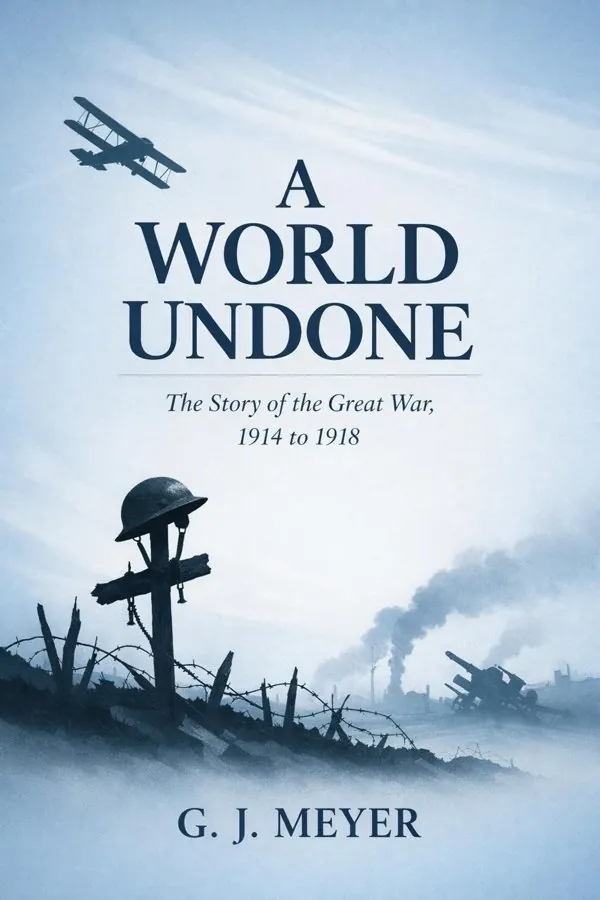
A World Undone: The Story of the Great War, 1914 to 1918: Summary & Key Insights
by G. J. Meyer
 10 min12 chaptersAudio available
What Is A World Undone: The Story of the Great War, 1914 to 1918 About?
A World Undone: The Story of the Great War, 1914 to 1918 by G. J. Meyer is a world_history book spanning 12 pages. A comprehensive narrative history of World War I, this book explores the political, military, and human dimensions of the conflict from its origins in 1914 to its conclusion in 1918. Meyer weaves together detailed accounts of battles, leaders, and ordinary soldiers, providing a vivid and accessible overview of the Great War’s causes, course, and consequences.
This FizzRead summary covers all 12 key chapters of A World Undone: The Story of the Great War, 1914 to 1918 in approximately 10 minutes, distilling the most important ideas, arguments, and takeaways from G. J. Meyer's work. Also available as an audio summary and Key Quotes Podcast.
A World Undone: The Story of the Great War, 1914 to 1918
A comprehensive narrative history of World War I, this book explores the political, military, and human dimensions of the conflict from its origins in 1914 to its conclusion in 1918. Meyer weaves together detailed accounts of battles, leaders, and ordinary soldiers, providing a vivid and accessible overview of the Great War’s causes, course, and consequences.
Who Should Read A World Undone: The Story of the Great War, 1914 to 1918?
This book is perfect for anyone interested in world_history and looking to gain actionable insights in a short read. Whether you're a student, professional, or lifelong learner, the key ideas from A World Undone: The Story of the Great War, 1914 to 1918 by G. J. Meyer will help you think differently.
- ✓Readers who enjoy world_history and want practical takeaways
- ✓Professionals looking to apply new ideas to their work and life
- ✓Anyone who wants the core insights of A World Undone: The Story of the Great War, 1914 to 1918 in just 10 minutes
Want the full summary?
Get instant access to this book summary and 100K+ more with Fizz Moment.
Get Free SummaryAvailable on App Store • Free to download
Key Chapters
Before Europe descended into chaos, it seemed to rest upon a sturdy foundation—the balance of power that great statesmen had maintained since the Congress of Vienna. Monarchies ruled with centuries of continuity, aristocrats directed economies, and industrial progress promised endless prosperity. But beneath this elegant façade lay a structure strained by rival ambitions and mutual fears.
In my telling, prewar Europe is less a garden of peace than a greenhouse of tension. Britain stood as the global naval power, jealously guarding its empire. Germany, newly unified and restless, sought its place in the sun, building fleets and industries to match. France, still haunted by defeat in 1870, dreamed of recovery. The Austro-Hungarian Empire teetered on the edges of ethnic division, while Russia—vast, backward, and volatile—loomed uncertainly in the east.
These nations were bound together by treaties and alliances meant to preserve peace but which, in practice, guaranteed that any spark could set the whole continent aflame. The Triple Alliance of Germany, Austria-Hungary, and Italy faced the Triple Entente of France, Britain, and Russia. Beneath these diplomatic arrangements pulsed nationalism, militarism, and insecurity. Armies were vast, and war plans were precise to the minute; peace, ironically, depended on the assumption that war was inevitable.
The old order, then, was not a fortress but a tinderbox. It is vital to remember that those who guided Europe in 1914 did not imagine annihilation—they believed themselves stewards of civilization. Yet as I show, their decisions were shaped not by clear vision, but by fear of losing status and control. The peace of Europe had become a game played by exhausted men managing a machine too complex for anyone to master.
Everything changed on June 28, 1914. In the city of Sarajevo, a young Bosnian Serb named Gavrilo Princip fired two shots into the car carrying Archduke Franz Ferdinand and his wife, Sophie. The bullets killed both, and in that instant, the intricate architecture of European diplomacy began to crumble.
I present the event not merely as the spark but as a tragedy born of layers of misunderstanding. Franz Ferdinand was heir to the Austro-Hungarian throne, an empire already struggling to hold its diverse peoples together. Ironically, he was one of the few leaders who desired reform—a greater federation to placate South Slavs within the empire. But to Serbian nationalists, he symbolized oppression. To his own government, his death was a provocation demanding vengeance.
Sarajevo might have remained a local affair, yet the reaction in Vienna transformed it. Austria’s leaders, desperate to uphold imperial prestige, saw in the assassination an opportunity to crush Serbia once and for all. But to do so, they needed Germany’s backing—and Germany, bound by alliance and eager to assert power, gave what became the fateful ‘blank check.’
The story of Sarajevo is the story of how emotion replaced logic, how honor and fear collided to ignite catastrophe. In the streets of that Balkan city, with its mingled Ottoman, Slavic, and Austro-Hungarian influences, one can feel the instability of an empire and the raw passion of a nationalist age. The shots fired there reverberated far beyond the Balkans; they shook the entire world.
+ 10 more chapters — available in the FizzRead app
All Chapters in A World Undone: The Story of the Great War, 1914 to 1918
About the Author
G. J. Meyer is an American journalist and author known for his works on European and world history, including 'A World Undone' and 'A World Remade'. He has written extensively on historical subjects with a focus on clarity and narrative depth.
Get This Summary in Your Preferred Format
Read or listen to the A World Undone: The Story of the Great War, 1914 to 1918 summary by G. J. Meyer anytime, anywhere. FizzRead offers multiple formats so you can learn on your terms — all free.
Available formats: App · Audio · PDF · EPUB — All included free with FizzRead
Download A World Undone: The Story of the Great War, 1914 to 1918 PDF and EPUB Summary
Key Quotes from A World Undone: The Story of the Great War, 1914 to 1918
“Before Europe descended into chaos, it seemed to rest upon a sturdy foundation—the balance of power that great statesmen had maintained since the Congress of Vienna.”
“In the city of Sarajevo, a young Bosnian Serb named Gavrilo Princip fired two shots into the car carrying Archduke Franz Ferdinand and his wife, Sophie.”
Frequently Asked Questions about A World Undone: The Story of the Great War, 1914 to 1918
A World Undone: The Story of the Great War, 1914 to 1918 by G. J. Meyer is a world_history book that explores key ideas across 12 chapters. A comprehensive narrative history of World War I, this book explores the political, military, and human dimensions of the conflict from its origins in 1914 to its conclusion in 1918. Meyer weaves together detailed accounts of battles, leaders, and ordinary soldiers, providing a vivid and accessible overview of the Great War’s causes, course, and consequences.
You Might Also Like
The Age of Capital
Eric Hobsbawm
10 min
The Gulag Archipelago
Aleksandr Solzhenitsyn
10 min
Jerusalem: The Biography
Simon Sebag Montefiore
10 min
The Anglo-Saxons
James Campbell
10 min
The Boer War
Thomas Pakenham
10 min
The Industrial Revolutionaries: The Making of the Modern World 1776–1914
Gavin Weightman
10 minFeatured In
Browse by Category
Ready to read A World Undone: The Story of the Great War, 1914 to 1918?
Get the full summary and 100K+ more books with Fizz Moment.