
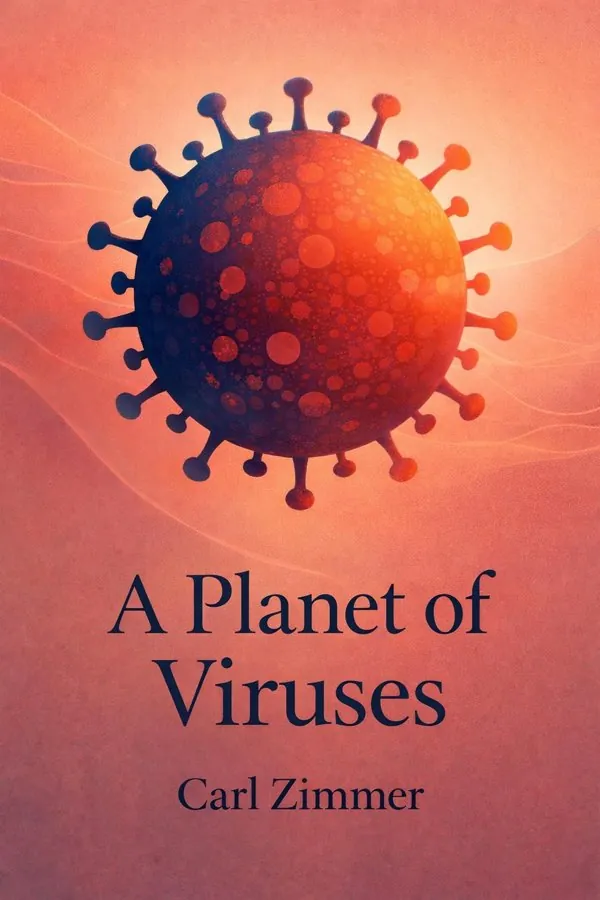
A Planet of Viruses: Summary & Key Insights
by Carl Zimmer
 10 min9 chaptersAudio available
Key Takeaways from A Planet of Viruses
A virus may be too small to see, but its story may be as old as life itself.
The most familiar viruses are often the easiest to underestimate.
If the common cold teaches persistence, influenza teaches speed.
Some of the most important viruses do not infect humans at all.
You do not need to be sick to be affected by viruses.
What Is A Planet of Viruses About?
A Planet of Viruses by Carl Zimmer is a life_science book spanning 11 pages. Viruses are usually introduced to us as enemies: the cause of colds, flus, epidemics, and fear. In A Planet of Viruses, Carl Zimmer asks us to look again. He shows that viruses are not just agents of disease but one of the most powerful and pervasive forces shaping life on Earth. They influence evolution, regulate ecosystems, alter genomes, and challenge the boundary between the living and the nonliving. What seems at first like a book about microscopic threats becomes a much bigger story about biology itself. Zimmer’s gift is to make complex science vivid and approachable. Drawing on his deep experience as a science journalist and author, he combines historical episodes, cutting-edge virology, and memorable examples—from the common cold and influenza to HIV, marine viruses, and giant viruses—to reveal a hidden world operating all around us. The book matters because it expands our understanding of health, ecology, and human identity. It reminds us that to understand pandemics, evolution, or even our own DNA, we must understand viruses. This is a concise but eye-opening exploration of one of nature’s most influential creations.
This FizzRead summary covers all 9 key chapters of A Planet of Viruses in approximately 10 minutes, distilling the most important ideas, arguments, and takeaways from Carl Zimmer's work. Also available as an audio summary and Key Quotes Podcast.
A Planet of Viruses
Viruses are usually introduced to us as enemies: the cause of colds, flus, epidemics, and fear. In A Planet of Viruses, Carl Zimmer asks us to look again. He shows that viruses are not just agents of disease but one of the most powerful and pervasive forces shaping life on Earth. They influence evolution, regulate ecosystems, alter genomes, and challenge the boundary between the living and the nonliving. What seems at first like a book about microscopic threats becomes a much bigger story about biology itself.
Zimmer’s gift is to make complex science vivid and approachable. Drawing on his deep experience as a science journalist and author, he combines historical episodes, cutting-edge virology, and memorable examples—from the common cold and influenza to HIV, marine viruses, and giant viruses—to reveal a hidden world operating all around us. The book matters because it expands our understanding of health, ecology, and human identity. It reminds us that to understand pandemics, evolution, or even our own DNA, we must understand viruses. This is a concise but eye-opening exploration of one of nature’s most influential creations.
Who Should Read A Planet of Viruses?
This book is perfect for anyone interested in life_science and looking to gain actionable insights in a short read. Whether you're a student, professional, or lifelong learner, the key ideas from A Planet of Viruses by Carl Zimmer will help you think differently.
- ✓Readers who enjoy life_science and want practical takeaways
- ✓Professionals looking to apply new ideas to their work and life
- ✓Anyone who wants the core insights of A Planet of Viruses in just 10 minutes
Want the full summary?
Get instant access to this book summary and 100K+ more with Fizz Moment.
Get Free SummaryAvailable on App Store • Free to download
Key Chapters
A virus may be too small to see, but its story may be as old as life itself. One of Zimmer’s most striking ideas is that viruses are not recent accidents of biology. They may have emerged near the dawn of life, evolving alongside cells for billions of years. Because viruses leave no conventional fossils, scientists reconstruct their past through molecular evidence: shared genes, strange replication strategies, and genetic fragments embedded in the DNA of modern organisms.
This matters because viruses force us to rethink what evolution looks like. Instead of life unfolding as a simple tree with neatly separated branches, Zimmer shows it as a tangled web of exchange, adaptation, and opportunism. Viruses move genes between species, create evolutionary pressure, and constantly reshape the organisms they infect. They are not outside the story of life; they are one of its engines.
The question of whether viruses are truly “alive” becomes less important than the role they play. They cannot reproduce on their own, yet they evolve rapidly, adapt brilliantly, and exert immense influence. In that sense, they occupy an unsettling but important biological middle ground.
A practical implication is scientific humility. When we study disease, biodiversity, or genetics, we cannot treat viruses as side characters. They are part of the main plot. Whether you are reading about pandemics, evolution, or gene editing, it helps to remember that viral mechanisms often reveal fundamental truths about biology.
Actionable takeaway: Stop thinking of viruses only as pathogens; start seeing them as ancient evolutionary actors that help explain how life became what it is today.
If the common cold teaches persistence, influenza teaches speed. Zimmer presents the flu as one of the clearest examples of evolution unfolding before our eyes. Influenza viruses change constantly through mutation and, in some cases, through genetic reassortment, where different viral strains swap segments inside a host. That is why flu season returns every year with new variations, and why vaccines must be continually updated.
The flu is especially important because it links everyday illness with global risk. Seasonal influenza infects millions, but the same family of viruses can also generate pandemics when novel strains emerge to which humans have little immunity. Birds, pigs, and humans can all play roles in this process, making influenza not just a medical issue but an ecological one. Human health is entangled with animal health and environmental contact.
Zimmer’s treatment of influenza also reveals how science works under uncertainty. Researchers track strains across the globe, trying to predict which versions will dominate in the coming season. Vaccination campaigns are based on probabilities, surveillance, and rapid response. This is not perfect control but informed adaptation.
The practical lesson is that public health depends on preparation before crisis. Flu vaccination may seem routine, but it is part of a large global system designed to reduce suffering and slow the impact of an ever-changing virus. The same principles apply to future outbreaks: monitoring, data sharing, and early intervention are essential.
Actionable takeaway: Take annual flu prevention seriously—vaccination, awareness of outbreaks, and staying informed are simple ways to cooperate with a system built to outpace viral evolution.
Some of the most important viruses do not infect humans at all. Bacteriophages, or phages, infect bacteria, and they may be the most abundant biological entities on Earth. Zimmer uses them to broaden the reader’s perspective: viruses are not merely enemies of humans but major regulators of the microbial world. By invading and destroying bacteria, phages help control bacterial populations in oceans, soils, and bodies.
This makes phages scientifically and medically fascinating. Long before antibiotics, researchers explored phage therapy as a way to treat bacterial infections. Interest declined in parts of the world after antibiotics became dominant, but rising antibiotic resistance has renewed attention. In some cases, phages may offer a targeted way to kill dangerous bacteria while leaving beneficial microbes relatively untouched.
Phages also helped launch molecular biology. Research on these viruses revealed core principles about genes, DNA replication, and the logic of inheritance. In other words, studying viruses has repeatedly deepened our understanding of life at large.
The practical applications are increasingly relevant. As hospitals face drug-resistant infections, phage therapy is being revisited as a complement or alternative to antibiotics. Agriculture, food safety, and biotechnology also benefit from phage-based tools. The idea is simple but powerful: sometimes the best way to fight one microbe is with another.
For readers, this chapter reframes the word “virus.” A virus can destroy a host, but it can also become part of a therapeutic strategy or a scientific breakthrough. Context matters.
Actionable takeaway: When thinking about microbes, remember that not all viruses threaten us directly—some may become essential tools in medicine and biotechnology.
You do not need to be sick to be affected by viruses. Zimmer shows that viruses quietly govern entire ecosystems, especially through plant and marine infections. Plant viruses can stunt crops, distort leaves, and devastate agricultural systems, affecting food supply and economic stability. Their impact reaches far beyond botany into trade, hunger, and environmental management.
Marine viruses expand the story even further. The oceans are saturated with them. They infect microbes such as bacteria and plankton, killing immense numbers every day and thereby influencing nutrient cycles, population balance, and even the chemistry of the atmosphere. In a very real sense, viruses help regulate planetary systems. They are tiny agents with enormous ecological consequences.
This view changes the scale of virology. A virus is not just a clinical concern inside a hospital or human body. It can determine whether algal blooms spread, whether microbial communities thrive, and how energy and carbon move through food webs. That means viruses are part of climate science, agriculture, and conservation biology—not just infectious disease.
A practical example is crop management. Understanding how plant viruses spread through insects, seeds, or soil can help farmers reduce losses through quarantine, resistant varieties, and monitoring. In marine science, viral ecology helps researchers model ocean health and understand the resilience of ecosystems under stress.
The big lesson is interconnectedness. Human life depends on biological systems that viruses are constantly shaping, often invisibly.
Actionable takeaway: Expand your definition of viral impact—supporting food security, environmental science, and ecosystem monitoring is also part of understanding and managing the viral world.
One of the book’s most astonishing insights is that viruses are not only around us—they are within us. Zimmer explains how ancient viral infections left genetic material in the DNA of our ancestors. Over time, some of these viral sequences became permanent residents in the genome, passed from one generation to the next. These are endogenous viruses, molecular fossils hidden inside us.
This discovery transforms how we think about identity and evolution. The human genome is not a pristine, self-contained blueprint. It is a historical record of encounters, invasions, and incorporations. Some viral genes appear to have been repurposed by evolution for beneficial functions. A famous example is the role certain viral-derived genes may play in the development of the placenta, a structure essential for mammalian reproduction.
That means viruses have not only caused disease; they may also have helped enable major evolutionary innovations. The relationship between host and virus is not always destructive. Sometimes it becomes collaborative, at least over deep time.
The practical implication is conceptual but powerful. Genetics is more dynamic than most people assume. Our DNA contains traces of conflict, adaptation, and borrowed biological solutions. This perspective encourages curiosity about gene regulation, evolutionary medicine, and the surprising origins of traits we take for granted.
For medicine, endogenous viral elements can also matter in cancer research, immunology, and developmental biology. What was once dismissed as genomic junk may hold clues to health and disease.
Actionable takeaway: View the human genome as an archive of past viral encounters—understanding those inherited traces can change how you think about evolution, medicine, and even what counts as “human.”
Some discoveries are important not because they solve a mystery, but because they make the mystery deeper. Giant viruses do exactly that. Zimmer describes viruses so large and genetically complex that they blur categories scientists once thought were clear. These viruses can rival small bacteria in size and contain many more genes than expected for something traditionally viewed as simple and inert.
Their existence forces a reevaluation of basic biological assumptions. If viruses were supposed to be stripped-down genetic parasites, what do we make of viruses with unexpectedly rich genomes? Giant viruses challenge the tidy distinction between cellular life and viral particles. They do not erase the differences, but they expose how much our definitions depend on historical habits rather than absolute boundaries.
This matters because science advances by confronting anomalies. Giant viruses remind us that nature often resists our labels. They also suggest that viral diversity is far greater than we once imagined. What we have already discovered may represent only a fraction of the virosphere.
In practical terms, this idea encourages openness in research and education. Students, clinicians, and general readers benefit from understanding that biology is not fixed into simple categories. The natural world includes edge cases, hybrids, and surprises that can lead to major breakthroughs.
Zimmer’s larger point is that viruses are not a minor exception to life’s rules. They are part of the reason those rules must be continually revised.
Actionable takeaway: Hold biological definitions lightly—when nature produces exceptions like giant viruses, curiosity matters more than clinging to old categories.
The final revelation of A Planet of Viruses is that viruses do more than shape cells and ecosystems—they shape human thought. Zimmer shows how viruses have influenced public fear, scientific discovery, medical innovation, and cultural imagination. They appear in news headlines, political debates, films, and metaphors. We use viral language to describe online content, social contagion, and sudden spread because viruses have become one of the central images through which modern society understands connection and risk.
At the same time, virology has transformed science. Research on viruses helped uncover major principles of genetics, immunity, and molecular biology. Today, viruses are used as tools in gene therapy, vaccine development, and laboratory research. Something once seen only as a menace can also become an instrument of healing and knowledge.
Zimmer’s broader argument is that living on a planet of viruses requires intellectual maturity. Fear alone is not enough. We need a richer framework—one that includes danger, yes, but also ecology, evolution, utility, and coexistence. Viruses will continue to emerge, surprise, and challenge us, but they will also continue to teach us.
For readers, the practical application is clear: scientific literacy about viruses is now part of civic literacy. Understanding how viruses spread, evolve, and interact with society helps people evaluate health advice, policy decisions, and media narratives more intelligently.
Actionable takeaway: Build a nuanced view of viruses—learn enough virology to move beyond panic and participate thoughtfully in conversations about health, science, and society.
All Chapters in A Planet of Viruses
About the Author
Carl Zimmer is an American science writer, journalist, and author renowned for translating complex biological ideas into clear, compelling prose. His work often focuses on evolution, genetics, heredity, parasites, microbes, and the future of medicine. He has written for major publications, including The New York Times, where he has helped bring cutting-edge science to a broad public audience. Zimmer is known for combining rigorous reporting with vivid storytelling, making him one of the most respected voices in popular science writing. Across his books and articles, he consistently explores how hidden biological processes shape everyday life. In A Planet of Viruses, that talent is especially evident as he turns virology into an accessible, fascinating story about life, evolution, and our place in a world saturated with unseen organisms.
Get This Summary in Your Preferred Format
Read or listen to the A Planet of Viruses summary by Carl Zimmer anytime, anywhere. FizzRead offers multiple formats so you can learn on your terms — all free.
Available formats: App · Audio · PDF · EPUB — All included free with FizzRead
Download A Planet of Viruses PDF and EPUB Summary
Key Quotes from A Planet of Viruses
“A virus may be too small to see, but its story may be as old as life itself.”
“The most familiar viruses are often the easiest to underestimate.”
“If the common cold teaches persistence, influenza teaches speed.”
“Some of the most important viruses do not infect humans at all.”
“You do not need to be sick to be affected by viruses.”
Frequently Asked Questions about A Planet of Viruses
A Planet of Viruses by Carl Zimmer is a life_science book that explores key ideas across 9 chapters. Viruses are usually introduced to us as enemies: the cause of colds, flus, epidemics, and fear. In A Planet of Viruses, Carl Zimmer asks us to look again. He shows that viruses are not just agents of disease but one of the most powerful and pervasive forces shaping life on Earth. They influence evolution, regulate ecosystems, alter genomes, and challenge the boundary between the living and the nonliving. What seems at first like a book about microscopic threats becomes a much bigger story about biology itself. Zimmer’s gift is to make complex science vivid and approachable. Drawing on his deep experience as a science journalist and author, he combines historical episodes, cutting-edge virology, and memorable examples—from the common cold and influenza to HIV, marine viruses, and giant viruses—to reveal a hidden world operating all around us. The book matters because it expands our understanding of health, ecology, and human identity. It reminds us that to understand pandemics, evolution, or even our own DNA, we must understand viruses. This is a concise but eye-opening exploration of one of nature’s most influential creations.
More by Carl Zimmer

Parasite Rex: Inside the Bizarre World of Nature's Most Dangerous Creatures
Carl Zimmer
10 min
Soul Made Flesh: The Discovery of the Brain—and How It Changed the World
Carl Zimmer
10 min
She Has Her Mother’s Laugh: The Powers, Perversions, and Potential of Heredity
Carl Zimmer
10 min
The Tangled Bank: An Introduction to Evolution
Carl Zimmer
10 minYou Might Also Like

The Selfish Gene
Richard Dawkins
10 min
Awakenings
Oliver Sacks
10 minParasite Rex: Inside the Bizarre World of Nature's Most Dangerous Creatures
Carl Zimmer
10 min
The Atlas of Life on Earth
Various
10 min
The Book of Humans: The Story of How We Became Us
Adam Rutherford
10 min
The Horse
Wendy Williams
10 minFeatured In
Browse by Category
Ready to read A Planet of Viruses?
Get the full summary and 100K+ more books with Fizz Moment.