
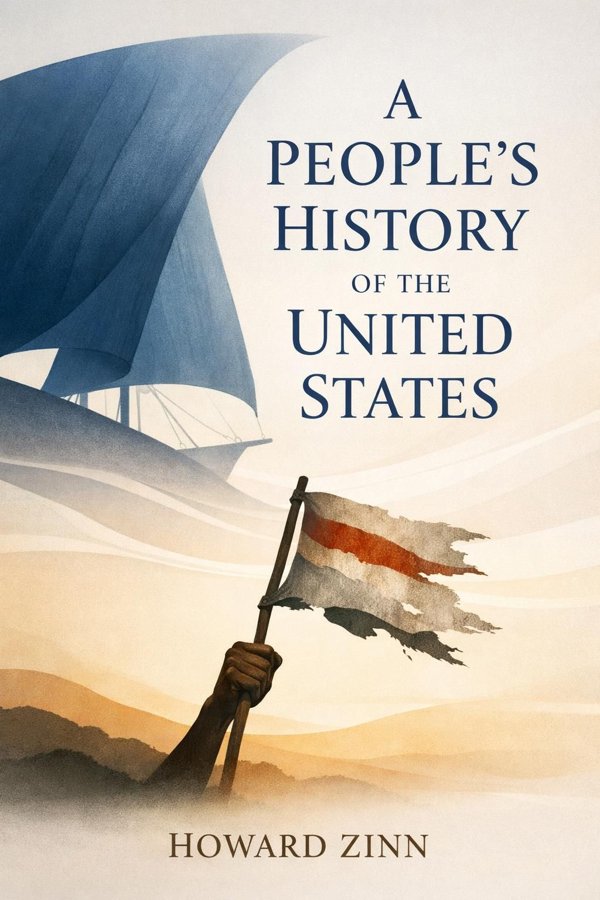
A People's History of the United States: Summary & Key Insights
by Howard Zinn
 10 min6 chaptersAudio available
What Is A People's History of the United States About?
A People's History of the United States by Howard Zinn is a world_history book spanning 6 pages. A groundbreaking work of historical scholarship, Howard Zinn’s *A People’s History of the United States* presents American history from the perspective of ordinary people rather than political and economic elites. Covering events from the arrival of Columbus to the late 20th century, Zinn highlights the struggles of workers, women, enslaved people, and minorities, challenging traditional narratives and emphasizing social justice and resistance.
This FizzRead summary covers all 6 key chapters of A People's History of the United States in approximately 10 minutes, distilling the most important ideas, arguments, and takeaways from Howard Zinn's work. Also available as an audio summary and Key Quotes Podcast.
A People's History of the United States
A groundbreaking work of historical scholarship, Howard Zinn’s *A People’s History of the United States* presents American history from the perspective of ordinary people rather than political and economic elites. Covering events from the arrival of Columbus to the late 20th century, Zinn highlights the struggles of workers, women, enslaved people, and minorities, challenging traditional narratives and emphasizing social justice and resistance.
Who Should Read A People's History of the United States?
This book is perfect for anyone interested in world_history and looking to gain actionable insights in a short read. Whether you're a student, professional, or lifelong learner, the key ideas from A People's History of the United States by Howard Zinn will help you think differently.
- ✓Readers who enjoy world_history and want practical takeaways
- ✓Professionals looking to apply new ideas to their work and life
- ✓Anyone who wants the core insights of A People's History of the United States in just 10 minutes
Want the full summary?
Get instant access to this book summary and 100K+ more with Fizz Moment.
Get Free SummaryAvailable on App Store • Free to download
Key Chapters
In opening this history, I began with Christopher Columbus because his arrival marks the symbolic doorway through which European domination entered the Americas. Yet the traditional celebration of his courage obscures the vast suffering his expeditions unleashed. Through the diaries of Columbus and the testimony of his contemporaries, it is clear that the encounter between Europeans and the Arawak was not one of mutual discovery but of violent conquest.
I wanted readers to see that what is often described as 'progress'—the pursuit of gold, conversion, and empire—came at the expense of millions of indigenous lives. Columbus’s own words reveal not a spirit of exploration but a strategy of exploitation. His men captured natives, forced them into servitude, and began a cycle of genocide that unfolded across the continent. As Spain extracted wealth from these lands, it justified brutality as necessary for civilization. Thus began a legacy of rationalized oppression: the idea that domination could be excused in the name of advancement.
I call this human progress with irony, because progress measured by conquest reduces humanity to commodity. Indigenous societies had rich cultures, languages, and systems of governance long before Europeans set foot on their shores. By recounting their destruction, I mean to challenge the moral language that so often cloaks imperialism. The tragedy of the Arawaks is not a prelude to glory; it is a mirror for all the violence later justified by the rhetoric of destiny.
Through this lens, the founding of America becomes less a story of heroism and more a story of theft. When we see how quickly idealistic words—God, civilization, progress—were twisted to serve greed, we discern the origins of patterns that persist: economic ambition masking itself as moral crusade. This chapter serves as a warning that history’s progress often advances not by enlightenment but by plunder, and only through facing that truth can we reclaim a sense of collective justice.
The establishment of slavery in colonial America did not arise inevitably from difference in skin color—it was constructed, rationalized, and enforced to serve economic power. This chapter was written to uncover those early decisions, those choices by elites that transformed temporary servitude into permanent racial bondage. When English settlers first arrived, they faced labor shortages in their new colonies. They imported both white indentured servants and African laborers. At first, distinctions were blurred; Africans could own property, intermarry, and even earn freedom. But as plantation economies expanded, elites realized that racial division could forestall class unity among the working poor.
By deliberately drawing the color line, colonial leaders created hierarchy based on race. Laws were passed to strip Africans of rights, transforming them from human beings into property. The construction of racism served a political purpose—it made poor whites feel privileged compared to enslaved blacks, ensuring loyalty to the ruling class. This manipulation of identity prevented solidarity. What might have been a unified revolt of workers became a stratified society where fear and prejudice maintained control.
I wrote this not simply to expose cruelty but to show design. Racism in America was not born from ignorance alone—it was engineered for profit. And that engineering left deep scars that persist. Understanding this origin challenges the myth that racism is a natural human instinct; it is instead a political weapon, honed across centuries to divide those who might otherwise resist exploitation together.
By tracing documents, laws, and rebellions—like Bacon’s Rebellion, when black and white laborers briefly joined forces—I show how fear of such unity led elites to double down on racial division. Seeing the colonial color line’s deliberate crafting offers insight not only into the past but the present, reminding us that systems of inequality are maintained by keeping people apart rather than bringing them together.
+ 4 more chapters — available in the FizzRead app
All Chapters in A People's History of the United States
About the Author
Howard Zinn (1922–2010) was an American historian, playwright, and social activist. He taught at Spelman College and Boston University and was known for his commitment to civil rights and anti-war movements. His works, especially *A People’s History of the United States*, have influenced generations of readers to view history through the lens of marginalized voices.
Get This Summary in Your Preferred Format
Read or listen to the A People's History of the United States summary by Howard Zinn anytime, anywhere. FizzRead offers multiple formats so you can learn on your terms — all free.
Available formats: App · Audio · PDF · EPUB — All included free with FizzRead
Download A People's History of the United States PDF and EPUB Summary
Key Quotes from A People's History of the United States
“In opening this history, I began with Christopher Columbus because his arrival marks the symbolic doorway through which European domination entered the Americas.”
“The establishment of slavery in colonial America did not arise inevitably from difference in skin color—it was constructed, rationalized, and enforced to serve economic power.”
Frequently Asked Questions about A People's History of the United States
A People's History of the United States by Howard Zinn is a world_history book that explores key ideas across 6 chapters. A groundbreaking work of historical scholarship, Howard Zinn’s *A People’s History of the United States* presents American history from the perspective of ordinary people rather than political and economic elites. Covering events from the arrival of Columbus to the late 20th century, Zinn highlights the struggles of workers, women, enslaved people, and minorities, challenging traditional narratives and emphasizing social justice and resistance.
You Might Also Like
The Age of Capital
Eric Hobsbawm
10 min
The Gulag Archipelago
Aleksandr Solzhenitsyn
10 min
Jerusalem: The Biography
Simon Sebag Montefiore
10 min
The Anglo-Saxons
James Campbell
10 min
The Boer War
Thomas Pakenham
10 min
The Industrial Revolutionaries: The Making of the Modern World 1776–1914
Gavin Weightman
10 minFeatured In
Browse by Category
Ready to read A People's History of the United States?
Get the full summary and 100K+ more books with Fizz Moment.